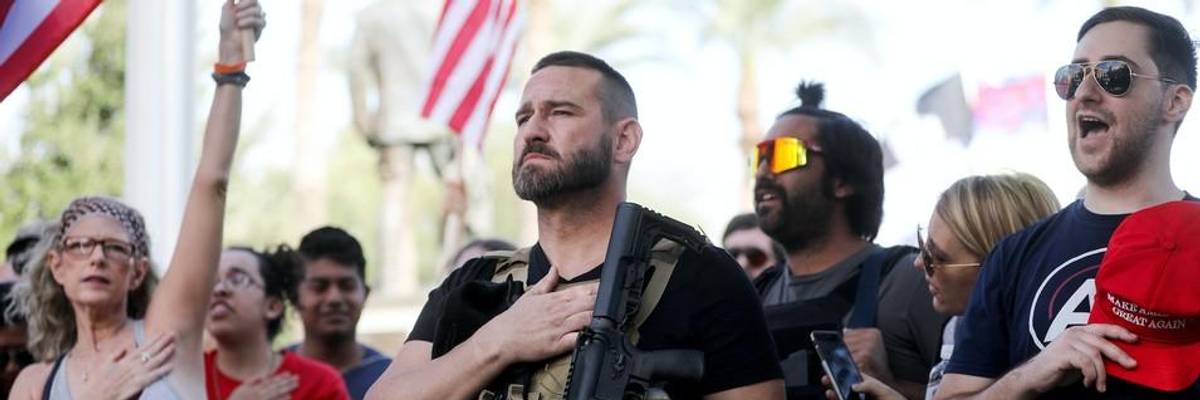
Supporters of President Trump listen to the National Anthem at a "Stop the Steal" rally in Phoenix, Arizona on November 7, 2020. (Photo: Mario Tama/Getty Images)
A Notable Death in 2020: American Democracy
America has two political parties. When one no longer believes in counting the votes, it’s not a democracy.
True story: I used to be a crazy Civil War buff when I was 5 years old. In the year when most normal kids were getting Beatles records or the latest loud offering from Mattel, I asked Santa for my blue Union soldier uniform. I even made my dad get off the Pennsylvania Turnpike and take me to see Gettysburg on our annual pilgrimage to my Midwestern grandparents. Little did I know back in 1964 that I'd get a chance in my lifetime to write about America's second War Between the States.
I don't know what else to call it when 18 U.S. states -- that's seven more than the 11 that seceded in 1861 and formed the Confederacy -- go all the way to the Supreme Court to have my votes and about 7 million others here in Pennsylvania, and those of three other states, thrown out for absurd reasons. It can only be read as, we don't like who won.
Something has clearly gone off the rails when at least 18 people with enough smarts to get elected attorney general of an American state sign onto a lawsuit that managed to be frivolous yet also argued to end democracy as we've known it these last 233 years or so. Or when nearly two-thirds of the Republican members of the U.S. House trip over each other to sign on. Or when dozens of state lawmakers in Harrisburg or other capitals fall into line trying to invalidate the results in their own state.
"This party has to stand up for democracy first, for our Constitution first and not political considerations,," a Michigan congressman, Rep. Paul Mitchell, who voted for Trump last month, said on Monday. "It's not about a candidate. It's not simply for raw political power and that's what I feel is going on, and I've had enough." Mitchell's words came in a letter announcing that he's leaving the Republican Party to serve as an independent, but what's stunning is not that he did this -- but how few other GOPers feel the same.
And so 2020 continues to be the ultimate glass-half-empty-half-full Rorschach test when it comes to how one views the health of American democracy. The half-full crowd can certainly point to the record number of citizens who voted, despite both a pandemic and ridiculous voter suppression laws in some states, and a bevy of Republican-appointed judges and state and local GOP election officials who held firm that these votes must be counted.
Sometimes it might seem silly to call it "a war" because in a modern media culture it plays out in such weird ways: a patronizing Wall Street Journal op-ed questioning whether to call Jill Biden a doctor, or a moral panic when Cleveland's baseball team is no longer called the Indians. But behind those online kerfuffles, America's conservatives feel a duty to defend a system of authority -- with foundational elements of patriarchy and white supremacy -- they see as under assault from a more diverse nation and growing demands to share power.
We are at a crossroads
This country and this world are at a monumental crossroads. In a few short weeks, US voters will have an opportunity to beat back the forces of fascism and confront the billionaires who are rigging the economy, our media system, and our democracy, making it increasingly impossible for ordinary people to get by. We’re not just talking about the election. We’re talking about what must be done once these fascist elements are vanquished from power. We need a bolder set of solutions than what either major party has so far been willing to offer and a working-class movement ready to fight like hell for it. Trump didn't emerge from nowhere. The conditions that fueled MAGA authoritarianism were created by decades of radical neoliberal economic policies and a corrupt political system dominated by corporate interests. They slashed taxes on the super-rich, promising that the benefits would trickle down. They said giveaways to the corporate titans would make life more affordable for the rest of us. It was all bullshit. And when a bitter, betrayed populace searches for someone to blame, right-wing demagogues have little trouble finding scapegoats. People know when they're being lied to, but you won't hear any of this from the corporate media. Only independent journalism—powered and funded by people who believe in building a better world—can deliver truly trustworthy daily news. Our Fall Campaign is underway, and we need your help. To power our newsroom through the rest of the year, we need to raise $125,000 by midnight on October 31. So if you share our vision, please contribute whatever you can to sustain our work. |
True story: I used to be a crazy Civil War buff when I was 5 years old. In the year when most normal kids were getting Beatles records or the latest loud offering from Mattel, I asked Santa for my blue Union soldier uniform. I even made my dad get off the Pennsylvania Turnpike and take me to see Gettysburg on our annual pilgrimage to my Midwestern grandparents. Little did I know back in 1964 that I'd get a chance in my lifetime to write about America's second War Between the States.
I don't know what else to call it when 18 U.S. states -- that's seven more than the 11 that seceded in 1861 and formed the Confederacy -- go all the way to the Supreme Court to have my votes and about 7 million others here in Pennsylvania, and those of three other states, thrown out for absurd reasons. It can only be read as, we don't like who won.
Something has clearly gone off the rails when at least 18 people with enough smarts to get elected attorney general of an American state sign onto a lawsuit that managed to be frivolous yet also argued to end democracy as we've known it these last 233 years or so. Or when nearly two-thirds of the Republican members of the U.S. House trip over each other to sign on. Or when dozens of state lawmakers in Harrisburg or other capitals fall into line trying to invalidate the results in their own state.
"This party has to stand up for democracy first, for our Constitution first and not political considerations,," a Michigan congressman, Rep. Paul Mitchell, who voted for Trump last month, said on Monday. "It's not about a candidate. It's not simply for raw political power and that's what I feel is going on, and I've had enough." Mitchell's words came in a letter announcing that he's leaving the Republican Party to serve as an independent, but what's stunning is not that he did this -- but how few other GOPers feel the same.
And so 2020 continues to be the ultimate glass-half-empty-half-full Rorschach test when it comes to how one views the health of American democracy. The half-full crowd can certainly point to the record number of citizens who voted, despite both a pandemic and ridiculous voter suppression laws in some states, and a bevy of Republican-appointed judges and state and local GOP election officials who held firm that these votes must be counted.
Sometimes it might seem silly to call it "a war" because in a modern media culture it plays out in such weird ways: a patronizing Wall Street Journal op-ed questioning whether to call Jill Biden a doctor, or a moral panic when Cleveland's baseball team is no longer called the Indians. But behind those online kerfuffles, America's conservatives feel a duty to defend a system of authority -- with foundational elements of patriarchy and white supremacy -- they see as under assault from a more diverse nation and growing demands to share power.
True story: I used to be a crazy Civil War buff when I was 5 years old. In the year when most normal kids were getting Beatles records or the latest loud offering from Mattel, I asked Santa for my blue Union soldier uniform. I even made my dad get off the Pennsylvania Turnpike and take me to see Gettysburg on our annual pilgrimage to my Midwestern grandparents. Little did I know back in 1964 that I'd get a chance in my lifetime to write about America's second War Between the States.
I don't know what else to call it when 18 U.S. states -- that's seven more than the 11 that seceded in 1861 and formed the Confederacy -- go all the way to the Supreme Court to have my votes and about 7 million others here in Pennsylvania, and those of three other states, thrown out for absurd reasons. It can only be read as, we don't like who won.
Something has clearly gone off the rails when at least 18 people with enough smarts to get elected attorney general of an American state sign onto a lawsuit that managed to be frivolous yet also argued to end democracy as we've known it these last 233 years or so. Or when nearly two-thirds of the Republican members of the U.S. House trip over each other to sign on. Or when dozens of state lawmakers in Harrisburg or other capitals fall into line trying to invalidate the results in their own state.
"This party has to stand up for democracy first, for our Constitution first and not political considerations,," a Michigan congressman, Rep. Paul Mitchell, who voted for Trump last month, said on Monday. "It's not about a candidate. It's not simply for raw political power and that's what I feel is going on, and I've had enough." Mitchell's words came in a letter announcing that he's leaving the Republican Party to serve as an independent, but what's stunning is not that he did this -- but how few other GOPers feel the same.
And so 2020 continues to be the ultimate glass-half-empty-half-full Rorschach test when it comes to how one views the health of American democracy. The half-full crowd can certainly point to the record number of citizens who voted, despite both a pandemic and ridiculous voter suppression laws in some states, and a bevy of Republican-appointed judges and state and local GOP election officials who held firm that these votes must be counted.
Sometimes it might seem silly to call it "a war" because in a modern media culture it plays out in such weird ways: a patronizing Wall Street Journal op-ed questioning whether to call Jill Biden a doctor, or a moral panic when Cleveland's baseball team is no longer called the Indians. But behind those online kerfuffles, America's conservatives feel a duty to defend a system of authority -- with foundational elements of patriarchy and white supremacy -- they see as under assault from a more diverse nation and growing demands to share power.