SUBSCRIBE TO OUR FREE NEWSLETTER
Daily news & progressive opinion—funded by the people, not the corporations—delivered straight to your inbox.
5
#000000
#FFFFFF
To donate by check, phone, or other method, see our More Ways to Give page.
Daily news & progressive opinion—funded by the people, not the corporations—delivered straight to your inbox.
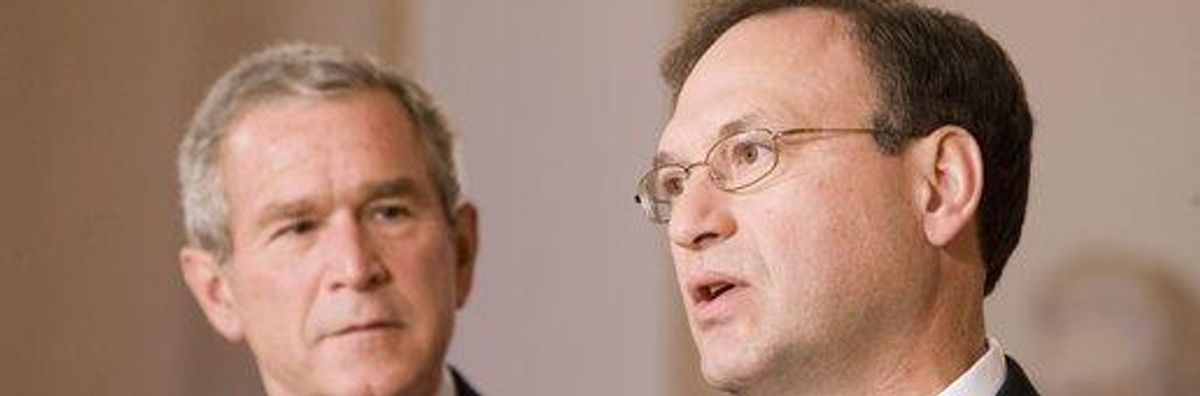
Justice Samuel Alito with President George W. Bush. (Photo via Creative Commons)
I've changed my vote.
No, not that vote.
I've changed my vote for the most reactionary and dangerous member of the U.S. Supreme Court. The distinction no longer belongs to Clarence Thomas. Nor should it be reserved for any of the three conservatives appointed by President Donald Trump--Neil Gorsuch, Brett Kavanaugh, or Amy Coney Barrett.
More than any other member of the high tribunal, he has opted to abuse that power for nakedly partisan ends, making him little more than a political firebrand draped in a black robe.
The honor belongs to Samuel Alito. He's earned it.
A long-time member of the ultraconservative Federalist Society, Alito has been a featured speaker at several of the group's functions, voicing support for rightwing causes and regressive social values.
Nicknamed in progressive legal circles as "Strip-Search Sammy" for a dissenting opinion he wrote in 2004 as a Circuit Court of Appeals judge in Washington, D.C., in which he approved of the body search of an innocent ten-year-old girl, Alito was nominated to the Supreme Court by George W. Bush in 2005.
Alito's selection was widely opposed by civil rights and civil liberties organizations, including the American Civil Liberties Union, which warned of his "troubling decisions on race, religion, and reproductive rights while sitting on the federal appeals court." In its long and storied history, the ACLU has opposed only three other high-court nominees--William Rehnquist, Robert Bork, and Kavanaugh.
Despite these warnings, the Senate confirmed Alito's appointment in January 2006. Since then, Alito has been everything the ACLU feared, endearing himself to the radical right by writing a series of contentious and controversial majority opinions, including:
Ledbetter v. Goodyear Tire & Rubber Co., 2007, dismissing a pay discrimination lawsuit brought by equality activist Lilly Ledbetter because it was not filed within 180 days. (The decision was effectively overturned by the Lilly Ledbetter Fair Pay Act, which was signed into law by President Barack Obama in 2009, following prodding by Justice Ruth Bader Ginsburg.)
McDonald v. City of Chicago, 2010, extending individual gun rights under the Second Amendment to the states.
Clapper v. Amnesty International USA, 2013, holding that American human rights activists had no standing to challenge government surveillance of their communications with persons located abroad.
Burwell v. Hobby Lobby Stores, 2014, exempting "closely held" corporations with religious objections from Obamacare's provisions requiring employers to provide workers with health care insurance coverage of contraceptives.
Glossip v. Gross, 2015, ruling that the Eighth Amendment's ban on cruel and unusual punishment does not prohibit states from using a sedative in lethal injection protocols that causes severe pain.
Husted v. A. Philip Randolph Institute, 2018, upholding Ohio's vast 2016 purge of voting rolls.
Janus v. American Federation of State, County, and Municipal Employees, 2018, invoking the First Amendment to prohibit public-sector unions from collecting fees from non-union members to support collective bargaining activities.
Mitchell v. Wisconsin, 2019, upholding a warrantless blood alcohol sobriety test administered to an unconscious driver.
Hernandez v. Mesa, 2019, declaring that the family of a Mexican teenager shot and killed by a Border Patrol agent while standing in a culvert on the U.S. side of the border could not sue for damages in a U.S. court.
Alito's arch-conservatism has also found its way into his dissenting opinions on the Supreme Court. In 2013, for example, he crafted a breathtakingly homophobic dissent in United States v. Windsor, which struck down key provisions of the federal Defense of Marriage Act. And this past July, he and Thomas displayed their fealty to President Trump, penning separate dissents in Trump v. Vance, the landmark 7-2 ruling that held the Constitution does not categorically block state criminal subpoenas issued to a sitting President.
As awful as his official court opinions have been, it is Alito's behavior off the bench that has set him apart from his fellow jurists. In January 2010, shortly after the court issued its Citizens United decision (in which he, of course, concurred), he was infamously caught on national television sneering during Obama's State of the Union address, mouthing the words "not true" as the President decried the ruling and the effect it would--and did--have on future elections.
A long-time member of the ultraconservative Federalist Society, Alito has been a featured speaker at several of the group's functions, voicing support for rightwing causes and regressive social values. Although it is not unusual for Supreme Court Justices to participate in bar association meetings or academic conferences, Alito discarded all pretense of judicial impartiality in his most recent Federalist Society appearance in a Zoom webinar speech, delivered on November 12, keynoting the society's prestigious annual national lawyers convention.
Sounding like a Fox News host spouting the familiar and incendiary talking points of conservative victimhood, Alito called the Second Amendment "the ultimate second-tier Constitutional right."
In a similar fashion, Alito blasted federal regulatory agencies for churning out "huge volumes of regulations" that, he insisted, shifted policymaking from elected legislators to "an elite group of appointed experts." And he went even further into the nether reaches on the subject of same-sex marriage, charging that "you can't say that marriage is the union between one man and one woman. Until very recently, that's what the vast majority of Americans thought. Now it's considered bigotry."
But it was on the subject of COVID-19 that Alito reached his apogee. He said the recent restrictions imposed in some states on the size of religious gatherings "has resulted in previously unimaginable restrictions on individual liberty." There was nary a nod to slavery, the internment of Japanese Americans, or segregation.
If Alito were still sitting on a lower court, his unhinged commentary could be grounds for disqualification. Supreme Court Justices, however, are not subject to the Code of Conduct for United States Judges. They are beyond the reach of sanctions for conflicts of interest or bias. In a very real sense, they are above the law they are tasked with interpreting and upholding. That is what makes them "supreme."
Alito understands the awesome power that his lifetime appointment has given him. More than any other member of the high tribunal, he has opted to abuse that power for nakedly partisan ends, making him little more than a political firebrand draped in a black robe.
Dear Common Dreams reader, It’s been nearly 30 years since I co-founded Common Dreams with my late wife, Lina Newhouser. We had the radical notion that journalism should serve the public good, not corporate profits. It was clear to us from the outset what it would take to build such a project. No paid advertisements. No corporate sponsors. No millionaire publisher telling us what to think or do. Many people said we wouldn't last a year, but we proved those doubters wrong. Together with a tremendous team of journalists and dedicated staff, we built an independent media outlet free from the constraints of profits and corporate control. Our mission has always been simple: To inform. To inspire. To ignite change for the common good. Building Common Dreams was not easy. Our survival was never guaranteed. When you take on the most powerful forces—Wall Street greed, fossil fuel industry destruction, Big Tech lobbyists, and uber-rich oligarchs who have spent billions upon billions rigging the economy and democracy in their favor—the only bulwark you have is supporters who believe in your work. But here’s the urgent message from me today. It's never been this bad out there. And it's never been this hard to keep us going. At the very moment Common Dreams is most needed, the threats we face are intensifying. We need your support now more than ever. We don't accept corporate advertising and never will. We don't have a paywall because we don't think people should be blocked from critical news based on their ability to pay. Everything we do is funded by the donations of readers like you. When everyone does the little they can afford, we are strong. But if that support retreats or dries up, so do we. Will you donate now to make sure Common Dreams not only survives but thrives? —Craig Brown, Co-founder |
I've changed my vote.
No, not that vote.
I've changed my vote for the most reactionary and dangerous member of the U.S. Supreme Court. The distinction no longer belongs to Clarence Thomas. Nor should it be reserved for any of the three conservatives appointed by President Donald Trump--Neil Gorsuch, Brett Kavanaugh, or Amy Coney Barrett.
More than any other member of the high tribunal, he has opted to abuse that power for nakedly partisan ends, making him little more than a political firebrand draped in a black robe.
The honor belongs to Samuel Alito. He's earned it.
A long-time member of the ultraconservative Federalist Society, Alito has been a featured speaker at several of the group's functions, voicing support for rightwing causes and regressive social values.
Nicknamed in progressive legal circles as "Strip-Search Sammy" for a dissenting opinion he wrote in 2004 as a Circuit Court of Appeals judge in Washington, D.C., in which he approved of the body search of an innocent ten-year-old girl, Alito was nominated to the Supreme Court by George W. Bush in 2005.
Alito's selection was widely opposed by civil rights and civil liberties organizations, including the American Civil Liberties Union, which warned of his "troubling decisions on race, religion, and reproductive rights while sitting on the federal appeals court." In its long and storied history, the ACLU has opposed only three other high-court nominees--William Rehnquist, Robert Bork, and Kavanaugh.
Despite these warnings, the Senate confirmed Alito's appointment in January 2006. Since then, Alito has been everything the ACLU feared, endearing himself to the radical right by writing a series of contentious and controversial majority opinions, including:
Ledbetter v. Goodyear Tire & Rubber Co., 2007, dismissing a pay discrimination lawsuit brought by equality activist Lilly Ledbetter because it was not filed within 180 days. (The decision was effectively overturned by the Lilly Ledbetter Fair Pay Act, which was signed into law by President Barack Obama in 2009, following prodding by Justice Ruth Bader Ginsburg.)
McDonald v. City of Chicago, 2010, extending individual gun rights under the Second Amendment to the states.
Clapper v. Amnesty International USA, 2013, holding that American human rights activists had no standing to challenge government surveillance of their communications with persons located abroad.
Burwell v. Hobby Lobby Stores, 2014, exempting "closely held" corporations with religious objections from Obamacare's provisions requiring employers to provide workers with health care insurance coverage of contraceptives.
Glossip v. Gross, 2015, ruling that the Eighth Amendment's ban on cruel and unusual punishment does not prohibit states from using a sedative in lethal injection protocols that causes severe pain.
Husted v. A. Philip Randolph Institute, 2018, upholding Ohio's vast 2016 purge of voting rolls.
Janus v. American Federation of State, County, and Municipal Employees, 2018, invoking the First Amendment to prohibit public-sector unions from collecting fees from non-union members to support collective bargaining activities.
Mitchell v. Wisconsin, 2019, upholding a warrantless blood alcohol sobriety test administered to an unconscious driver.
Hernandez v. Mesa, 2019, declaring that the family of a Mexican teenager shot and killed by a Border Patrol agent while standing in a culvert on the U.S. side of the border could not sue for damages in a U.S. court.
Alito's arch-conservatism has also found its way into his dissenting opinions on the Supreme Court. In 2013, for example, he crafted a breathtakingly homophobic dissent in United States v. Windsor, which struck down key provisions of the federal Defense of Marriage Act. And this past July, he and Thomas displayed their fealty to President Trump, penning separate dissents in Trump v. Vance, the landmark 7-2 ruling that held the Constitution does not categorically block state criminal subpoenas issued to a sitting President.
As awful as his official court opinions have been, it is Alito's behavior off the bench that has set him apart from his fellow jurists. In January 2010, shortly after the court issued its Citizens United decision (in which he, of course, concurred), he was infamously caught on national television sneering during Obama's State of the Union address, mouthing the words "not true" as the President decried the ruling and the effect it would--and did--have on future elections.
A long-time member of the ultraconservative Federalist Society, Alito has been a featured speaker at several of the group's functions, voicing support for rightwing causes and regressive social values. Although it is not unusual for Supreme Court Justices to participate in bar association meetings or academic conferences, Alito discarded all pretense of judicial impartiality in his most recent Federalist Society appearance in a Zoom webinar speech, delivered on November 12, keynoting the society's prestigious annual national lawyers convention.
Sounding like a Fox News host spouting the familiar and incendiary talking points of conservative victimhood, Alito called the Second Amendment "the ultimate second-tier Constitutional right."
In a similar fashion, Alito blasted federal regulatory agencies for churning out "huge volumes of regulations" that, he insisted, shifted policymaking from elected legislators to "an elite group of appointed experts." And he went even further into the nether reaches on the subject of same-sex marriage, charging that "you can't say that marriage is the union between one man and one woman. Until very recently, that's what the vast majority of Americans thought. Now it's considered bigotry."
But it was on the subject of COVID-19 that Alito reached his apogee. He said the recent restrictions imposed in some states on the size of religious gatherings "has resulted in previously unimaginable restrictions on individual liberty." There was nary a nod to slavery, the internment of Japanese Americans, or segregation.
If Alito were still sitting on a lower court, his unhinged commentary could be grounds for disqualification. Supreme Court Justices, however, are not subject to the Code of Conduct for United States Judges. They are beyond the reach of sanctions for conflicts of interest or bias. In a very real sense, they are above the law they are tasked with interpreting and upholding. That is what makes them "supreme."
Alito understands the awesome power that his lifetime appointment has given him. More than any other member of the high tribunal, he has opted to abuse that power for nakedly partisan ends, making him little more than a political firebrand draped in a black robe.
I've changed my vote.
No, not that vote.
I've changed my vote for the most reactionary and dangerous member of the U.S. Supreme Court. The distinction no longer belongs to Clarence Thomas. Nor should it be reserved for any of the three conservatives appointed by President Donald Trump--Neil Gorsuch, Brett Kavanaugh, or Amy Coney Barrett.
More than any other member of the high tribunal, he has opted to abuse that power for nakedly partisan ends, making him little more than a political firebrand draped in a black robe.
The honor belongs to Samuel Alito. He's earned it.
A long-time member of the ultraconservative Federalist Society, Alito has been a featured speaker at several of the group's functions, voicing support for rightwing causes and regressive social values.
Nicknamed in progressive legal circles as "Strip-Search Sammy" for a dissenting opinion he wrote in 2004 as a Circuit Court of Appeals judge in Washington, D.C., in which he approved of the body search of an innocent ten-year-old girl, Alito was nominated to the Supreme Court by George W. Bush in 2005.
Alito's selection was widely opposed by civil rights and civil liberties organizations, including the American Civil Liberties Union, which warned of his "troubling decisions on race, religion, and reproductive rights while sitting on the federal appeals court." In its long and storied history, the ACLU has opposed only three other high-court nominees--William Rehnquist, Robert Bork, and Kavanaugh.
Despite these warnings, the Senate confirmed Alito's appointment in January 2006. Since then, Alito has been everything the ACLU feared, endearing himself to the radical right by writing a series of contentious and controversial majority opinions, including:
Ledbetter v. Goodyear Tire & Rubber Co., 2007, dismissing a pay discrimination lawsuit brought by equality activist Lilly Ledbetter because it was not filed within 180 days. (The decision was effectively overturned by the Lilly Ledbetter Fair Pay Act, which was signed into law by President Barack Obama in 2009, following prodding by Justice Ruth Bader Ginsburg.)
McDonald v. City of Chicago, 2010, extending individual gun rights under the Second Amendment to the states.
Clapper v. Amnesty International USA, 2013, holding that American human rights activists had no standing to challenge government surveillance of their communications with persons located abroad.
Burwell v. Hobby Lobby Stores, 2014, exempting "closely held" corporations with religious objections from Obamacare's provisions requiring employers to provide workers with health care insurance coverage of contraceptives.
Glossip v. Gross, 2015, ruling that the Eighth Amendment's ban on cruel and unusual punishment does not prohibit states from using a sedative in lethal injection protocols that causes severe pain.
Husted v. A. Philip Randolph Institute, 2018, upholding Ohio's vast 2016 purge of voting rolls.
Janus v. American Federation of State, County, and Municipal Employees, 2018, invoking the First Amendment to prohibit public-sector unions from collecting fees from non-union members to support collective bargaining activities.
Mitchell v. Wisconsin, 2019, upholding a warrantless blood alcohol sobriety test administered to an unconscious driver.
Hernandez v. Mesa, 2019, declaring that the family of a Mexican teenager shot and killed by a Border Patrol agent while standing in a culvert on the U.S. side of the border could not sue for damages in a U.S. court.
Alito's arch-conservatism has also found its way into his dissenting opinions on the Supreme Court. In 2013, for example, he crafted a breathtakingly homophobic dissent in United States v. Windsor, which struck down key provisions of the federal Defense of Marriage Act. And this past July, he and Thomas displayed their fealty to President Trump, penning separate dissents in Trump v. Vance, the landmark 7-2 ruling that held the Constitution does not categorically block state criminal subpoenas issued to a sitting President.
As awful as his official court opinions have been, it is Alito's behavior off the bench that has set him apart from his fellow jurists. In January 2010, shortly after the court issued its Citizens United decision (in which he, of course, concurred), he was infamously caught on national television sneering during Obama's State of the Union address, mouthing the words "not true" as the President decried the ruling and the effect it would--and did--have on future elections.
A long-time member of the ultraconservative Federalist Society, Alito has been a featured speaker at several of the group's functions, voicing support for rightwing causes and regressive social values. Although it is not unusual for Supreme Court Justices to participate in bar association meetings or academic conferences, Alito discarded all pretense of judicial impartiality in his most recent Federalist Society appearance in a Zoom webinar speech, delivered on November 12, keynoting the society's prestigious annual national lawyers convention.
Sounding like a Fox News host spouting the familiar and incendiary talking points of conservative victimhood, Alito called the Second Amendment "the ultimate second-tier Constitutional right."
In a similar fashion, Alito blasted federal regulatory agencies for churning out "huge volumes of regulations" that, he insisted, shifted policymaking from elected legislators to "an elite group of appointed experts." And he went even further into the nether reaches on the subject of same-sex marriage, charging that "you can't say that marriage is the union between one man and one woman. Until very recently, that's what the vast majority of Americans thought. Now it's considered bigotry."
But it was on the subject of COVID-19 that Alito reached his apogee. He said the recent restrictions imposed in some states on the size of religious gatherings "has resulted in previously unimaginable restrictions on individual liberty." There was nary a nod to slavery, the internment of Japanese Americans, or segregation.
If Alito were still sitting on a lower court, his unhinged commentary could be grounds for disqualification. Supreme Court Justices, however, are not subject to the Code of Conduct for United States Judges. They are beyond the reach of sanctions for conflicts of interest or bias. In a very real sense, they are above the law they are tasked with interpreting and upholding. That is what makes them "supreme."
Alito understands the awesome power that his lifetime appointment has given him. More than any other member of the high tribunal, he has opted to abuse that power for nakedly partisan ends, making him little more than a political firebrand draped in a black robe.