SUBSCRIBE TO OUR FREE NEWSLETTER
Daily news & progressive opinion—funded by the people, not the corporations—delivered straight to your inbox.
5
#000000
#FFFFFF
To donate by check, phone, or other method, see our More Ways to Give page.
Daily news & progressive opinion—funded by the people, not the corporations—delivered straight to your inbox.
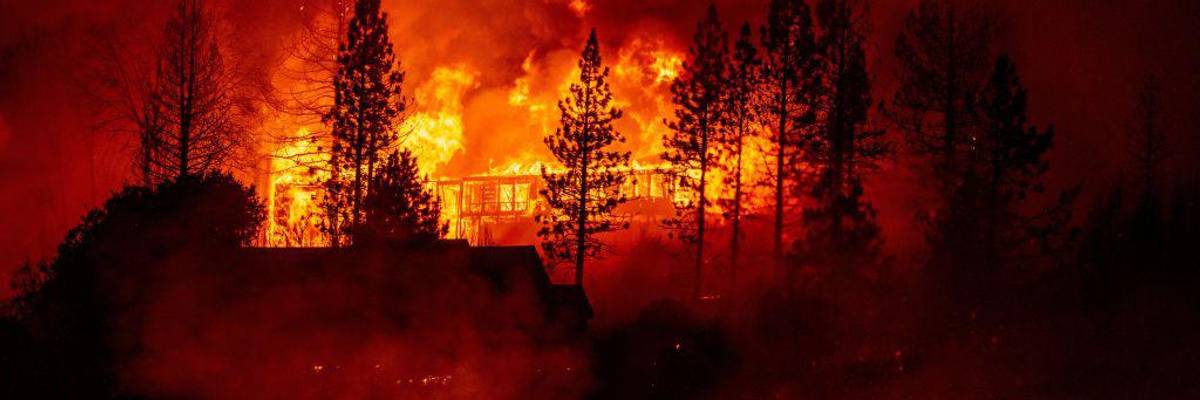
A home is engulfed in flames during the "Creek Fire" in the Tollhouse area of unincorporated Fresno County, California early on September 8, 2020. (Photo: Josh Edelson/AFP via Getty Images)
The signs are ominous as yet another climate record is broken. California is once again burning. From near the southern Mexico border, to San Diego and the forests of the Sierra Nevada, over two million acres of the Golden state were on fire yesterday.
As the state sweltered in record temperatures, the temperature peaked at 121 degrees over the weekend, with firefighters tackling dozens of blazes and the situation still extremely volatile.
Communities across the state are facing power blackouts and internet problems. Last night, Pacific Gas & Electric cut off electricity to parts of the North Bay area as the winds picked up. As I write, an estimated 120,000 PG&E customers are currently without power.
These are the effects of climate change. The amount of land already on fire is another grim record, and the fact it comes now, when late September and October are traditionally peak fire season, raises real cause for concern. The previous record was set decades ago in 1987 at 1.96 million acres.
"The amount of land already on fire is another grim record, and the fact it comes now, when late September and October are traditionally peak fire season, raises real cause for concern."
Yesterday, the California Department of Forestry and Fire Protection spokesperson, Lynne Tolmachoff said, "It's a little unnerving because September and October are historically our worst months for fires. It's usually hot, and the fuels really dry out. And we see more of our wind events."
The authorities are already stretched. Yesterday, the U.S. Forest Service issued a press release warning that "most of California remains under the threat of unprecedented and dangerous fire conditions with a combination of extreme heat, significant wind events, dry conditions, and firefighting resources that are stretched to the limit."
One of the largest fires is the Creek Fire, in the Sierra National Forest, which has burned over 100 square miles of forest, with some 850 firefighters trying to tackle the blaze.
As the LA Times reports, "the Creek fire burning in the Sierra Nevada is the worst, trapping hikers, killing at least one person and destroying a large swath of the town of Big Creek."
One local resident, Debra Rios, told the Guardian, "I hope like heck the fire doesn't reach my little ranch...It's not looking good right now. It's an awfully big fire."
Another resident of the remote hamlet of Big Creek, told the paper, "about half the private homes in town burned down. Words cannot even begin to describe the devastation of this community."
"We lost our home," Nettie Carroll, 40, another local resident, who had lived there for sixteen years, told the New York Times. "It looks like everything is completely gone."
They are not alone. States of emergency have now been issued in five Californian counties, according to the BBC, which include Fresno County, Madera, Mariposa, San Bernardino and San Diego.
And the bad news is that it could get much worse in the coming days, reports the LA Times. According to the paper, "California's record-breaking fire season could get much worse in the coming days as powerful winds heighten the danger of more blazes while firefighters continue to struggle with destructive conflagrations across the state."
The paper continued "Intense Diablo winds are forecast for parts of Northern California this week...Forecasters said 25-35mph winds were expected, with gusts topping 45mph."
And California is not the only state burning. There are also fires burning in Oregon and Washington State, where some 300,000 acres of land have burnt.
On Twitter, people pointed out that this is climate change in action. Bill McKibben, the founder of 350.org tweeted:
Climate Nexus added:
Just hours ago, a joint op-ed written by Vanessa Warheit and Laura Neish, respectively the Executive Director of 350 Bay Area and former Executive Director of Fossil Free California, highlights the financial institutions fueling these wildfires, as some of the largest banks have continued to finance fossil fuel extraction in California and across the globe--investing in over USD $700 billion to the fossil fuel industry since the adaptation of the Paris Climate Agreement.
This country and this world are at a monumental crossroads. US voters have an opportunity to beat back the forces of fascism and confront the billionaires who are rigging the economy, our media system, and our democracy, making it increasingly impossible for ordinary people to get by. We’re not just talking about the election. We’re talking about what must be done once these fascist elements are vanquished from power. We need a bolder set of solutions than what either major party has so far been willing to offer and a working-class movement ready to fight like hell for it. Trump didn't emerge from nowhere. The conditions that fueled MAGA authoritarianism were created by decades of radical neoliberal economic policies and a corrupt political system dominated by corporate interests. They slashed taxes on the super-rich, promising that the benefits would trickle down. They said giveaways to the corporate titans would make life more affordable for the rest of us. It was all bullshit. And when a bitter, betrayed populace searches for someone to blame, right-wing demagogues have little trouble finding scapegoats. People know when they're being lied to, but you won't hear any of this from the corporate media. Only independent journalism—powered and funded by people who believe in building a better world—can deliver truly trustworthy daily news. If you share our vision, please contribute whatever you can to sustain our work. |
The signs are ominous as yet another climate record is broken. California is once again burning. From near the southern Mexico border, to San Diego and the forests of the Sierra Nevada, over two million acres of the Golden state were on fire yesterday.
As the state sweltered in record temperatures, the temperature peaked at 121 degrees over the weekend, with firefighters tackling dozens of blazes and the situation still extremely volatile.
Communities across the state are facing power blackouts and internet problems. Last night, Pacific Gas & Electric cut off electricity to parts of the North Bay area as the winds picked up. As I write, an estimated 120,000 PG&E customers are currently without power.
These are the effects of climate change. The amount of land already on fire is another grim record, and the fact it comes now, when late September and October are traditionally peak fire season, raises real cause for concern. The previous record was set decades ago in 1987 at 1.96 million acres.
"The amount of land already on fire is another grim record, and the fact it comes now, when late September and October are traditionally peak fire season, raises real cause for concern."
Yesterday, the California Department of Forestry and Fire Protection spokesperson, Lynne Tolmachoff said, "It's a little unnerving because September and October are historically our worst months for fires. It's usually hot, and the fuels really dry out. And we see more of our wind events."
The authorities are already stretched. Yesterday, the U.S. Forest Service issued a press release warning that "most of California remains under the threat of unprecedented and dangerous fire conditions with a combination of extreme heat, significant wind events, dry conditions, and firefighting resources that are stretched to the limit."
One of the largest fires is the Creek Fire, in the Sierra National Forest, which has burned over 100 square miles of forest, with some 850 firefighters trying to tackle the blaze.
As the LA Times reports, "the Creek fire burning in the Sierra Nevada is the worst, trapping hikers, killing at least one person and destroying a large swath of the town of Big Creek."
One local resident, Debra Rios, told the Guardian, "I hope like heck the fire doesn't reach my little ranch...It's not looking good right now. It's an awfully big fire."
Another resident of the remote hamlet of Big Creek, told the paper, "about half the private homes in town burned down. Words cannot even begin to describe the devastation of this community."
"We lost our home," Nettie Carroll, 40, another local resident, who had lived there for sixteen years, told the New York Times. "It looks like everything is completely gone."
They are not alone. States of emergency have now been issued in five Californian counties, according to the BBC, which include Fresno County, Madera, Mariposa, San Bernardino and San Diego.
And the bad news is that it could get much worse in the coming days, reports the LA Times. According to the paper, "California's record-breaking fire season could get much worse in the coming days as powerful winds heighten the danger of more blazes while firefighters continue to struggle with destructive conflagrations across the state."
The paper continued "Intense Diablo winds are forecast for parts of Northern California this week...Forecasters said 25-35mph winds were expected, with gusts topping 45mph."
And California is not the only state burning. There are also fires burning in Oregon and Washington State, where some 300,000 acres of land have burnt.
On Twitter, people pointed out that this is climate change in action. Bill McKibben, the founder of 350.org tweeted:
Climate Nexus added:
Just hours ago, a joint op-ed written by Vanessa Warheit and Laura Neish, respectively the Executive Director of 350 Bay Area and former Executive Director of Fossil Free California, highlights the financial institutions fueling these wildfires, as some of the largest banks have continued to finance fossil fuel extraction in California and across the globe--investing in over USD $700 billion to the fossil fuel industry since the adaptation of the Paris Climate Agreement.