
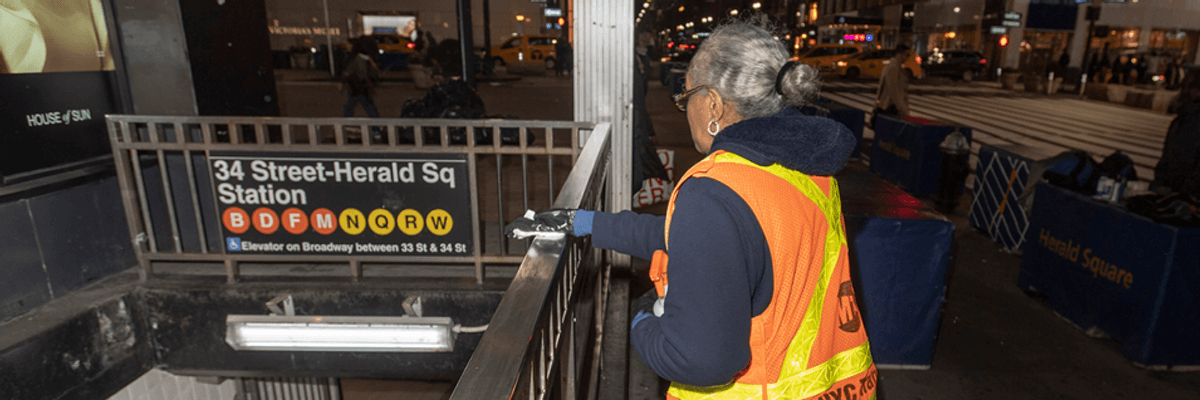
In New York City, MetroCard and ticket vending machines, and handrails, will be disinfected daily during the coronavirus pandemic. (Photo: Patrick Cashin / MTA New York City Transit/Wikimedia Commons)
Decriminalize Fare Evasion
You don't go to jail for missing a highway toll. It shouldn't be any different on transit.
Almost nobody expects jail time for failure to pay a parking ticket or highway toll, right?
This criminalization of fare evasion has caused an unnecessary and terrorizing police presence on public transit.
But in most U.S. cities, public transit riders can be charged with a misdemeanor for failure to pay the full fare. The punishment for "fare evasion" is on par with that of property theft, driving under the influence, or assault.
But jumping a turnstile isn't criminal, and it shouldn't be treated like it is.
This criminalization of fare evasion has caused an unnecessary and terrorizing police presence on public transit. A black 17-year-old who jumped a turnstile in New York was beaten by police and later died from the injuries. In Minneapolis, a 23-year-old's arrest for evading a $1.75 fare led to his deportation.
Akshai Singh, an organizer at Clevelanders for Public Transit in Ohio, said that "if you ask riders or operators if transit police make them feel safer, they laugh."
Police have no business being on public transportation. Two of the key drivers of fare evasion are inconvenient or broken fare collection systems and poverty--neither of which can be addressed by police.
Many public transportation riders don't have the cash to pay for a ride to work or school. They evade out of necessity.
Over a fifth of transit riders have an annual income under $15,000. And a 2014 study found that 1 in 3 of New York's working poor were unable to afford public transit.
Since fare evaders overwhelmingly don't have the cash to afford a $2 fare, they certainly can't pay a citation worth hundreds of dollars. And failure to pay a citation means jail time. In Minnesota, less than 3% of fare evaders are able to pay their fines.
When enforcing these harsh punishments, police directly target riders who are poor, Black, or both.
In New York, the frequency of enforcement in high-poverty neighborhoods is more than twice that in other neighborhoods, and Black riders are 30 times more likely to be arrested for evasion than white riders. In Washington, D.C., 91% of citations for fare evasion between 2016 and 2019 were issued to Black riders.
In other words, the criminalization of fare evasion means more Black people face police brutality and the criminal justice system for harmless infractions.
The criminalization of fare evasion means more Black people face police brutality and the criminal justice system for harmless infractions.
And it's not just the riders that this criminalization threatens--it's also the operators and bus drivers who are forced to report alleged evaders to the cops. A significant chunk of violence toward drivers and operators occurs at the ticket box, so eliminating the threat of a misdemeanor would reduce escalation and therefore protect drivers and operators.
With increasing calls for defunding police, decriminalizing fare evasion is a no-brainer.
There is no evidence that lighter penalties for evasion lead to revenue loss for transit areas, but there is overwhelming evidence that criminal penalties for fare evasion make transit risky for riders and operators.
San Francisco, D.C., Seattle, and Portland have recently decriminalized fare evasion. Every city should follow.
And that's just the first step. Eliminating the fare entirely would promote mobility as a human right. It even makes economic sense in cities like New York, which is currently spending $249 million on new cops to save $200 million on fare evasion.
At worst, punishment for fare evasion should be treated like failure to pay a parking ticket or highway toll. Anything more is criminalizing poverty and endangering riders and operators.
An Urgent Message From Our Co-Founder
Dear Common Dreams reader, It’s been nearly 30 years since I co-founded Common Dreams with my late wife, Lina Newhouser. We had the radical notion that journalism should serve the public good, not corporate profits. It was clear to us from the outset what it would take to build such a project. No paid advertisements. No corporate sponsors. No millionaire publisher telling us what to think or do. Many people said we wouldn't last a year, but we proved those doubters wrong. Together with a tremendous team of journalists and dedicated staff, we built an independent media outlet free from the constraints of profits and corporate control. Our mission has always been simple: To inform. To inspire. To ignite change for the common good. Building Common Dreams was not easy. Our survival was never guaranteed. When you take on the most powerful forces—Wall Street greed, fossil fuel industry destruction, Big Tech lobbyists, and uber-rich oligarchs who have spent billions upon billions rigging the economy and democracy in their favor—the only bulwark you have is supporters who believe in your work. But here’s the urgent message from me today. It's never been this bad out there. And it's never been this hard to keep us going. At the very moment Common Dreams is most needed, the threats we face are intensifying. We need your support now more than ever. We don't accept corporate advertising and never will. We don't have a paywall because we don't think people should be blocked from critical news based on their ability to pay. Everything we do is funded by the donations of readers like you. When everyone does the little they can afford, we are strong. But if that support retreats or dries up, so do we. Will you donate now to make sure Common Dreams not only survives but thrives? —Craig Brown, Co-founder |
Almost nobody expects jail time for failure to pay a parking ticket or highway toll, right?
This criminalization of fare evasion has caused an unnecessary and terrorizing police presence on public transit.
But in most U.S. cities, public transit riders can be charged with a misdemeanor for failure to pay the full fare. The punishment for "fare evasion" is on par with that of property theft, driving under the influence, or assault.
But jumping a turnstile isn't criminal, and it shouldn't be treated like it is.
This criminalization of fare evasion has caused an unnecessary and terrorizing police presence on public transit. A black 17-year-old who jumped a turnstile in New York was beaten by police and later died from the injuries. In Minneapolis, a 23-year-old's arrest for evading a $1.75 fare led to his deportation.
Akshai Singh, an organizer at Clevelanders for Public Transit in Ohio, said that "if you ask riders or operators if transit police make them feel safer, they laugh."
Police have no business being on public transportation. Two of the key drivers of fare evasion are inconvenient or broken fare collection systems and poverty--neither of which can be addressed by police.
Many public transportation riders don't have the cash to pay for a ride to work or school. They evade out of necessity.
Over a fifth of transit riders have an annual income under $15,000. And a 2014 study found that 1 in 3 of New York's working poor were unable to afford public transit.
Since fare evaders overwhelmingly don't have the cash to afford a $2 fare, they certainly can't pay a citation worth hundreds of dollars. And failure to pay a citation means jail time. In Minnesota, less than 3% of fare evaders are able to pay their fines.
When enforcing these harsh punishments, police directly target riders who are poor, Black, or both.
In New York, the frequency of enforcement in high-poverty neighborhoods is more than twice that in other neighborhoods, and Black riders are 30 times more likely to be arrested for evasion than white riders. In Washington, D.C., 91% of citations for fare evasion between 2016 and 2019 were issued to Black riders.
In other words, the criminalization of fare evasion means more Black people face police brutality and the criminal justice system for harmless infractions.
The criminalization of fare evasion means more Black people face police brutality and the criminal justice system for harmless infractions.
And it's not just the riders that this criminalization threatens--it's also the operators and bus drivers who are forced to report alleged evaders to the cops. A significant chunk of violence toward drivers and operators occurs at the ticket box, so eliminating the threat of a misdemeanor would reduce escalation and therefore protect drivers and operators.
With increasing calls for defunding police, decriminalizing fare evasion is a no-brainer.
There is no evidence that lighter penalties for evasion lead to revenue loss for transit areas, but there is overwhelming evidence that criminal penalties for fare evasion make transit risky for riders and operators.
San Francisco, D.C., Seattle, and Portland have recently decriminalized fare evasion. Every city should follow.
And that's just the first step. Eliminating the fare entirely would promote mobility as a human right. It even makes economic sense in cities like New York, which is currently spending $249 million on new cops to save $200 million on fare evasion.
At worst, punishment for fare evasion should be treated like failure to pay a parking ticket or highway toll. Anything more is criminalizing poverty and endangering riders and operators.
Almost nobody expects jail time for failure to pay a parking ticket or highway toll, right?
This criminalization of fare evasion has caused an unnecessary and terrorizing police presence on public transit.
But in most U.S. cities, public transit riders can be charged with a misdemeanor for failure to pay the full fare. The punishment for "fare evasion" is on par with that of property theft, driving under the influence, or assault.
But jumping a turnstile isn't criminal, and it shouldn't be treated like it is.
This criminalization of fare evasion has caused an unnecessary and terrorizing police presence on public transit. A black 17-year-old who jumped a turnstile in New York was beaten by police and later died from the injuries. In Minneapolis, a 23-year-old's arrest for evading a $1.75 fare led to his deportation.
Akshai Singh, an organizer at Clevelanders for Public Transit in Ohio, said that "if you ask riders or operators if transit police make them feel safer, they laugh."
Police have no business being on public transportation. Two of the key drivers of fare evasion are inconvenient or broken fare collection systems and poverty--neither of which can be addressed by police.
Many public transportation riders don't have the cash to pay for a ride to work or school. They evade out of necessity.
Over a fifth of transit riders have an annual income under $15,000. And a 2014 study found that 1 in 3 of New York's working poor were unable to afford public transit.
Since fare evaders overwhelmingly don't have the cash to afford a $2 fare, they certainly can't pay a citation worth hundreds of dollars. And failure to pay a citation means jail time. In Minnesota, less than 3% of fare evaders are able to pay their fines.
When enforcing these harsh punishments, police directly target riders who are poor, Black, or both.
In New York, the frequency of enforcement in high-poverty neighborhoods is more than twice that in other neighborhoods, and Black riders are 30 times more likely to be arrested for evasion than white riders. In Washington, D.C., 91% of citations for fare evasion between 2016 and 2019 were issued to Black riders.
In other words, the criminalization of fare evasion means more Black people face police brutality and the criminal justice system for harmless infractions.
The criminalization of fare evasion means more Black people face police brutality and the criminal justice system for harmless infractions.
And it's not just the riders that this criminalization threatens--it's also the operators and bus drivers who are forced to report alleged evaders to the cops. A significant chunk of violence toward drivers and operators occurs at the ticket box, so eliminating the threat of a misdemeanor would reduce escalation and therefore protect drivers and operators.
With increasing calls for defunding police, decriminalizing fare evasion is a no-brainer.
There is no evidence that lighter penalties for evasion lead to revenue loss for transit areas, but there is overwhelming evidence that criminal penalties for fare evasion make transit risky for riders and operators.
San Francisco, D.C., Seattle, and Portland have recently decriminalized fare evasion. Every city should follow.
And that's just the first step. Eliminating the fare entirely would promote mobility as a human right. It even makes economic sense in cities like New York, which is currently spending $249 million on new cops to save $200 million on fare evasion.
At worst, punishment for fare evasion should be treated like failure to pay a parking ticket or highway toll. Anything more is criminalizing poverty and endangering riders and operators.