SUBSCRIBE TO OUR FREE NEWSLETTER
Daily news & progressive opinion—funded by the people, not the corporations—delivered straight to your inbox.
5
#000000
#FFFFFF
To donate by check, phone, or other method, see our More Ways to Give page.
Daily news & progressive opinion—funded by the people, not the corporations—delivered straight to your inbox.
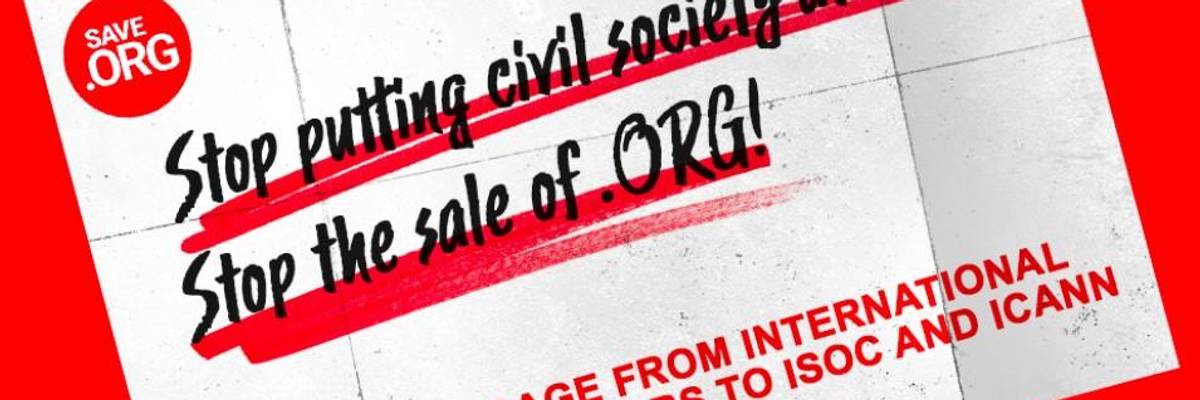
We're glad ICANN listened to the many voices in the nonprofit world urging it not to support the sale of Public Interest Registry, which runs .ORG, to private equity firm Ethos Capital. (Photo: Andrew Stroehlein/Human Rights Watch/Twitter)
In a stunning victory for nonprofits and NGOs around the world working in the public interest, ICANN today roundly rejected Ethos Capital's plan to transform the .ORG domain registry into a heavily indebted for-profit entity. This is an important victory that recognizes the registry's long legacy as a mission-based, non-for-profit entity protecting the interests of thousands of organizations and the people they serve.
We're glad ICANN listened to the many voices in the nonprofit world urging it not to support the sale of Public Interest Registry, which runs .ORG, to private equity firm Ethos Capital. The proposed buyout was an attempt by domain name industry insiders to profit off of thousands of nonprofits and NGOs around the world. Saying the sale would fundamentally change PIR into an "entity bound to serve the interests of its corporate stakeholders" with "no meaningful plan to protect or serve the .ORG community," ICANN made clear that it saw the proposal for what it was, regardless of Ethos' claims that nonprofits would continue to have a say in their future. "ICANN entrusted to PIR the responsibility to serve the public interest in its operation of the .ORG registry," they wrote, "and now ICANN is being asked to transfer that trust to a new entity without a public interest mandate."
The sale threatened to bring censorship and increased operating costs to the nonprofit world. As EFF warned, a private equity-owned registry would have a financial incentive to suspend domain names--causing websites to go dark--at the request of powerful corporate interests and governments.
"ICANN entrusted to PIR the responsibility to serve the public interest in its operation of the .ORG registry, and now ICANN is being asked to transfer that trust to a new entity without a public interest mandate."
In a blog post about its decision, ICANN also pointed out how the deal risked the registry's financial stability. They noted that the $1.1 billion proposed sale would change PIR "from a viable not-for-profit entity to a for-profit entity with a US$360 million debt obligation." The debt was not for the benefit of PIR or the .ORG community, but for the financial interests of Ethos and its investors. And Ethos failed to convince ICANN that it would not drain PIR of its financial resources, putting the stability and security of the .ORG registry at risk.
ICANN was not convinced by the token "stewardship council" that Ethos proposed in an attempt to add an appearance of accountability. Echoing EFF's own letter, they noted that "the membership of the Stewardship Council is subject to the approval of PIR's board of directors and, as a result, could become captured by or beholden to the for-profit interests of PIR's owners and therefore are unlikely to be truly independent of Ethos Capital or PIR's board."
Many organizations worked hard to persuade ICANN to reject the sale. We were joined by the National Council of Nonprofits, NTEN, Access Now, The Girl Scouts of America, Consumer Reports, the YMCA, Demand Progress, OpenMedia, Fight for the Future, Wikimedia, Oxfam, Greenpeace, Consumer Reports, FarmAid, NPR, the American Red Cross, and dozens of other household names. Nonprofit professionals and technologists even gathered in Los Angeles in January to tell ICANN their concerns in person. The coalition defending the .ORG domain was as diverse as .ORG registrants themselves, encompassing all areas of public interest: aid organizations, corporate watchdogs, museums, clubs, theater companies, religious organizations, and much, much more. Petitions to reject the sale received over 64,000 signatures, and nearly 900 organizations signed on. Joining them in their concerns were Members of Congress, UN Special Rapporteurs, and state charity regulators.
A late development that affected ICANN's decision was the letter from California's Attorney General, Xavier Becerra. Citing EFF and other members of the coalition, Becerra's letter urged ICANN to reject the sale. Although ICANN received many last-minute appeals from some parts of its policymaking community urging the organization to ignore Becerra's letter, ICANN acknowledged that as it is a California nonprofit, it could not afford to ignore its state regulator.
Because PIR is incorporated in Pennsylvania, that state's courts must approve its conversion into a for-profit company. Pennsylvania's attorney general is investigating the sale, and may also weigh in. In its rationale, ICANN states that it will allow PIR and Ethos to submit a new application if they are able to get the approval of this other body with authority over the deal. But all of the reasons behind ICANN's rejection of the sale will confront Ethos in Pennsylvania, as well.
This decision by ICANN is a hard-fought victory for nonprofit Internet users. But the .ORG registry still needs a faithful steward, because the Internet Society has made clear it no longer wants that responsibility. ICANN should hold an open consultation, as they did in 2002, to select a new operator of the .ORG domain that will give nonprofits a real voice in its governance, and a real guarantee against censorship and financial exploitation.
Dear Common Dreams reader, It’s been nearly 30 years since I co-founded Common Dreams with my late wife, Lina Newhouser. We had the radical notion that journalism should serve the public good, not corporate profits. It was clear to us from the outset what it would take to build such a project. No paid advertisements. No corporate sponsors. No millionaire publisher telling us what to think or do. Many people said we wouldn't last a year, but we proved those doubters wrong. Together with a tremendous team of journalists and dedicated staff, we built an independent media outlet free from the constraints of profits and corporate control. Our mission has always been simple: To inform. To inspire. To ignite change for the common good. Building Common Dreams was not easy. Our survival was never guaranteed. When you take on the most powerful forces—Wall Street greed, fossil fuel industry destruction, Big Tech lobbyists, and uber-rich oligarchs who have spent billions upon billions rigging the economy and democracy in their favor—the only bulwark you have is supporters who believe in your work. But here’s the urgent message from me today. It's never been this bad out there. And it's never been this hard to keep us going. At the very moment Common Dreams is most needed, the threats we face are intensifying. We need your support now more than ever. We don't accept corporate advertising and never will. We don't have a paywall because we don't think people should be blocked from critical news based on their ability to pay. Everything we do is funded by the donations of readers like you. When everyone does the little they can afford, we are strong. But if that support retreats or dries up, so do we. Will you donate now to make sure Common Dreams not only survives but thrives? —Craig Brown, Co-founder |
In a stunning victory for nonprofits and NGOs around the world working in the public interest, ICANN today roundly rejected Ethos Capital's plan to transform the .ORG domain registry into a heavily indebted for-profit entity. This is an important victory that recognizes the registry's long legacy as a mission-based, non-for-profit entity protecting the interests of thousands of organizations and the people they serve.
We're glad ICANN listened to the many voices in the nonprofit world urging it not to support the sale of Public Interest Registry, which runs .ORG, to private equity firm Ethos Capital. The proposed buyout was an attempt by domain name industry insiders to profit off of thousands of nonprofits and NGOs around the world. Saying the sale would fundamentally change PIR into an "entity bound to serve the interests of its corporate stakeholders" with "no meaningful plan to protect or serve the .ORG community," ICANN made clear that it saw the proposal for what it was, regardless of Ethos' claims that nonprofits would continue to have a say in their future. "ICANN entrusted to PIR the responsibility to serve the public interest in its operation of the .ORG registry," they wrote, "and now ICANN is being asked to transfer that trust to a new entity without a public interest mandate."
The sale threatened to bring censorship and increased operating costs to the nonprofit world. As EFF warned, a private equity-owned registry would have a financial incentive to suspend domain names--causing websites to go dark--at the request of powerful corporate interests and governments.
"ICANN entrusted to PIR the responsibility to serve the public interest in its operation of the .ORG registry, and now ICANN is being asked to transfer that trust to a new entity without a public interest mandate."
In a blog post about its decision, ICANN also pointed out how the deal risked the registry's financial stability. They noted that the $1.1 billion proposed sale would change PIR "from a viable not-for-profit entity to a for-profit entity with a US$360 million debt obligation." The debt was not for the benefit of PIR or the .ORG community, but for the financial interests of Ethos and its investors. And Ethos failed to convince ICANN that it would not drain PIR of its financial resources, putting the stability and security of the .ORG registry at risk.
ICANN was not convinced by the token "stewardship council" that Ethos proposed in an attempt to add an appearance of accountability. Echoing EFF's own letter, they noted that "the membership of the Stewardship Council is subject to the approval of PIR's board of directors and, as a result, could become captured by or beholden to the for-profit interests of PIR's owners and therefore are unlikely to be truly independent of Ethos Capital or PIR's board."
Many organizations worked hard to persuade ICANN to reject the sale. We were joined by the National Council of Nonprofits, NTEN, Access Now, The Girl Scouts of America, Consumer Reports, the YMCA, Demand Progress, OpenMedia, Fight for the Future, Wikimedia, Oxfam, Greenpeace, Consumer Reports, FarmAid, NPR, the American Red Cross, and dozens of other household names. Nonprofit professionals and technologists even gathered in Los Angeles in January to tell ICANN their concerns in person. The coalition defending the .ORG domain was as diverse as .ORG registrants themselves, encompassing all areas of public interest: aid organizations, corporate watchdogs, museums, clubs, theater companies, religious organizations, and much, much more. Petitions to reject the sale received over 64,000 signatures, and nearly 900 organizations signed on. Joining them in their concerns were Members of Congress, UN Special Rapporteurs, and state charity regulators.
A late development that affected ICANN's decision was the letter from California's Attorney General, Xavier Becerra. Citing EFF and other members of the coalition, Becerra's letter urged ICANN to reject the sale. Although ICANN received many last-minute appeals from some parts of its policymaking community urging the organization to ignore Becerra's letter, ICANN acknowledged that as it is a California nonprofit, it could not afford to ignore its state regulator.
Because PIR is incorporated in Pennsylvania, that state's courts must approve its conversion into a for-profit company. Pennsylvania's attorney general is investigating the sale, and may also weigh in. In its rationale, ICANN states that it will allow PIR and Ethos to submit a new application if they are able to get the approval of this other body with authority over the deal. But all of the reasons behind ICANN's rejection of the sale will confront Ethos in Pennsylvania, as well.
This decision by ICANN is a hard-fought victory for nonprofit Internet users. But the .ORG registry still needs a faithful steward, because the Internet Society has made clear it no longer wants that responsibility. ICANN should hold an open consultation, as they did in 2002, to select a new operator of the .ORG domain that will give nonprofits a real voice in its governance, and a real guarantee against censorship and financial exploitation.
In a stunning victory for nonprofits and NGOs around the world working in the public interest, ICANN today roundly rejected Ethos Capital's plan to transform the .ORG domain registry into a heavily indebted for-profit entity. This is an important victory that recognizes the registry's long legacy as a mission-based, non-for-profit entity protecting the interests of thousands of organizations and the people they serve.
We're glad ICANN listened to the many voices in the nonprofit world urging it not to support the sale of Public Interest Registry, which runs .ORG, to private equity firm Ethos Capital. The proposed buyout was an attempt by domain name industry insiders to profit off of thousands of nonprofits and NGOs around the world. Saying the sale would fundamentally change PIR into an "entity bound to serve the interests of its corporate stakeholders" with "no meaningful plan to protect or serve the .ORG community," ICANN made clear that it saw the proposal for what it was, regardless of Ethos' claims that nonprofits would continue to have a say in their future. "ICANN entrusted to PIR the responsibility to serve the public interest in its operation of the .ORG registry," they wrote, "and now ICANN is being asked to transfer that trust to a new entity without a public interest mandate."
The sale threatened to bring censorship and increased operating costs to the nonprofit world. As EFF warned, a private equity-owned registry would have a financial incentive to suspend domain names--causing websites to go dark--at the request of powerful corporate interests and governments.
"ICANN entrusted to PIR the responsibility to serve the public interest in its operation of the .ORG registry, and now ICANN is being asked to transfer that trust to a new entity without a public interest mandate."
In a blog post about its decision, ICANN also pointed out how the deal risked the registry's financial stability. They noted that the $1.1 billion proposed sale would change PIR "from a viable not-for-profit entity to a for-profit entity with a US$360 million debt obligation." The debt was not for the benefit of PIR or the .ORG community, but for the financial interests of Ethos and its investors. And Ethos failed to convince ICANN that it would not drain PIR of its financial resources, putting the stability and security of the .ORG registry at risk.
ICANN was not convinced by the token "stewardship council" that Ethos proposed in an attempt to add an appearance of accountability. Echoing EFF's own letter, they noted that "the membership of the Stewardship Council is subject to the approval of PIR's board of directors and, as a result, could become captured by or beholden to the for-profit interests of PIR's owners and therefore are unlikely to be truly independent of Ethos Capital or PIR's board."
Many organizations worked hard to persuade ICANN to reject the sale. We were joined by the National Council of Nonprofits, NTEN, Access Now, The Girl Scouts of America, Consumer Reports, the YMCA, Demand Progress, OpenMedia, Fight for the Future, Wikimedia, Oxfam, Greenpeace, Consumer Reports, FarmAid, NPR, the American Red Cross, and dozens of other household names. Nonprofit professionals and technologists even gathered in Los Angeles in January to tell ICANN their concerns in person. The coalition defending the .ORG domain was as diverse as .ORG registrants themselves, encompassing all areas of public interest: aid organizations, corporate watchdogs, museums, clubs, theater companies, religious organizations, and much, much more. Petitions to reject the sale received over 64,000 signatures, and nearly 900 organizations signed on. Joining them in their concerns were Members of Congress, UN Special Rapporteurs, and state charity regulators.
A late development that affected ICANN's decision was the letter from California's Attorney General, Xavier Becerra. Citing EFF and other members of the coalition, Becerra's letter urged ICANN to reject the sale. Although ICANN received many last-minute appeals from some parts of its policymaking community urging the organization to ignore Becerra's letter, ICANN acknowledged that as it is a California nonprofit, it could not afford to ignore its state regulator.
Because PIR is incorporated in Pennsylvania, that state's courts must approve its conversion into a for-profit company. Pennsylvania's attorney general is investigating the sale, and may also weigh in. In its rationale, ICANN states that it will allow PIR and Ethos to submit a new application if they are able to get the approval of this other body with authority over the deal. But all of the reasons behind ICANN's rejection of the sale will confront Ethos in Pennsylvania, as well.
This decision by ICANN is a hard-fought victory for nonprofit Internet users. But the .ORG registry still needs a faithful steward, because the Internet Society has made clear it no longer wants that responsibility. ICANN should hold an open consultation, as they did in 2002, to select a new operator of the .ORG domain that will give nonprofits a real voice in its governance, and a real guarantee against censorship and financial exploitation.