SUBSCRIBE TO OUR FREE NEWSLETTER
Daily news & progressive opinion—funded by the people, not the corporations—delivered straight to your inbox.
5
#000000
#FFFFFF
To donate by check, phone, or other method, see our More Ways to Give page.
Daily news & progressive opinion—funded by the people, not the corporations—delivered straight to your inbox.
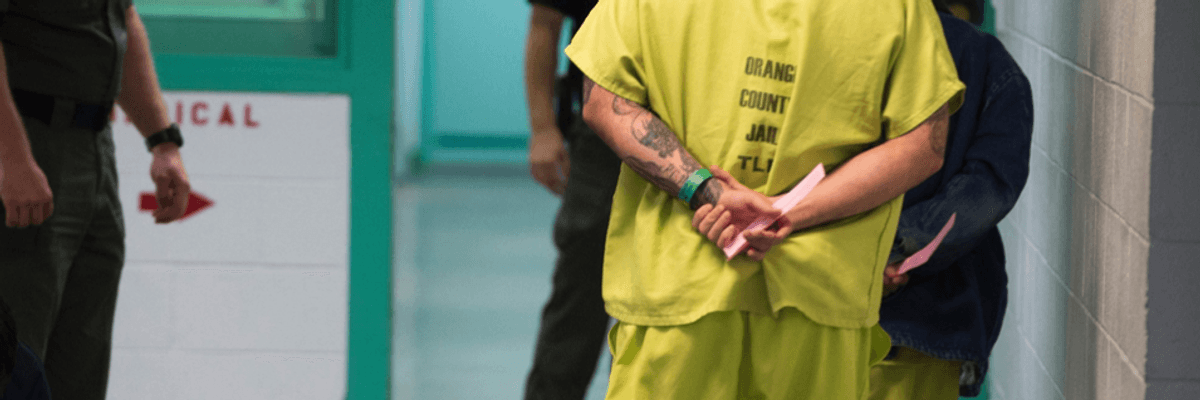
Prisons and jails are virtual petri dishes for the virus. Social distancing is impossible. Soap and water are often not available. (Photo: Robyn Beck / AFP - Getty Images)
This week, the New York Times featured the story of how the coronavirus savaged the Federal Correctional Complex in Oakdale, Louisiana. On March 28, Patrick Jones, 49, serving a 27-year sentence for possession of crack cocaine with the intent to distribute, became the first federal inmate to die of the virus.
Barely three weeks later, seven inmates had died, at least 100 inmates and staff members had been infected, with more than 20 hospitalized -- and an entire community terrorized. The prisoners died, unreported, unknown, their bodies essentially owned by the federal government that imprisoned them.
According to corrections officers there, the warden was slow to act, saying that "we live in the South and it's warm here. We won't have any problems," a haunting illustration of the dangers of loose rhetoric and tall tales from the president, amplified on social media.
The horrors of the Andover, New Jersey nursing home -- with at least 70 residents dead and dozens more testing positive -- has dramatized the vulnerability of the elderly in nursing homes, where over 7,000 have died. Our grossly overpopulated prisons and jails are quickly becoming the next centers to be ravaged by the disease.
Cook County Jail, the largest in the country, is already one of the nation's largest sources of infections, with more confirmed cases than the USS Theodore Roosevelt or the New Rochelle, New York cluster. Four inmates are dead and 215 have tested positive, as have 191 correctional officers and 34 other sheriff's office employees. One employee just died.
We know the most about Cook County because Sheriff Tom Dart has been the most open. Many are suffering and dying of COVID-19 because sheriff's offices around the country have not been very open and are not testing. The jail is overwhelmed. The sheriff and jail workers need more hands on deck. For every shift change, the virus is recycled in the community.
Many inmates are poor, often with health problems--asthma, diabetes, heart conditions, stress -- that make them more vulnerable to the virus.
A state prison in Ohio is now the largest reported source of coronavirus infection in the United States. I called President Trump and urged him to make testing, tracing and social distancing a priority for those in jails, nursing homes and prisons. The workers, inmates and communities where the workers live all need help.
In Ohio, 2,300 prisoners in three prisons have tested positive. In prisons and jails across the country, inmates locked up for nonviolent crimes or while awaiting trial, and older, vulnerable inmates near the end of their term, among others, sit in terror, fearful that they face a death sentence.
Prisons and jails are virtual petri dishes for the virus. Social distancing is impossible. Soap and water are often not available.
Correctional officers have no choice but to mix with inmates. Many inmates are poor, often with health problems--asthma, diabetes, heart conditions, stress -- that make them more vulnerable to the virus.
Prisons and jails have begun--although far too slowly--to react. Cook County Jail has reduced its population from 10,000 to 4,200, partly because of bail reform, some from courts sentencing fewer nonviolent offenders to prison, some from early release. Soap and disinfectants have been made available. Those with symptoms are isolated from the general population. Visitors and volunteers are not allowed, often at great psychic cost to inmates.
Facilities are cleaned more frequently. In some prisons, inmates have been locked in their cells for 22 hours a day to limit human interactions.
But -- as is true for the general population -- testing is often not available. Too few are tested too seldom. That puts not only prisoners but corrections officers and their families, and the people they interact with at risk.
Not surprisingly, prison uprisings have begun, as terrorized inmates demand protection and more information. Corrections officers have joined in lawsuits to get adequate protective equipment, information, and testing. Too often, it is too little and too late.
There is no defense. Clearly, at the federal and state level, prison officials should speed the release of nonviolent offenders, of the elderly and the vulnerable. Universal testing is an imperative. Prisoners need more access to soap and water. And both prisoners and corrections officials need protective gear -- from masks to gloves -- and, most of all, information on how to protect themselves.
Donald Trump informed me that he had made his son-in-law, Jared Kushner, the point person on prison reform. The time for aggressive action is long past. Prisons should be made a priority for supplies, for tests, and for early release of as many inmates as possible, particularly the elderly and the vulnerable.
If the pandemic continues to spread through prisons, the toll in lives will soar.
As the pandemic exposes once more, it is a moral outrage that the U.S. locks up more people than any other country, including China. Prisoners are disproportionately poor and people of color, too often victims of institutionalized racism that still puts African American young men at greater risk of being stopped by police, charged, and jailed if convicted.
Even without the virus, that is a disgrace. Now the virus is turning incarceration into a potential death sentence.
Dear Common Dreams reader, It’s been nearly 30 years since I co-founded Common Dreams with my late wife, Lina Newhouser. We had the radical notion that journalism should serve the public good, not corporate profits. It was clear to us from the outset what it would take to build such a project. No paid advertisements. No corporate sponsors. No millionaire publisher telling us what to think or do. Many people said we wouldn't last a year, but we proved those doubters wrong. Together with a tremendous team of journalists and dedicated staff, we built an independent media outlet free from the constraints of profits and corporate control. Our mission has always been simple: To inform. To inspire. To ignite change for the common good. Building Common Dreams was not easy. Our survival was never guaranteed. When you take on the most powerful forces—Wall Street greed, fossil fuel industry destruction, Big Tech lobbyists, and uber-rich oligarchs who have spent billions upon billions rigging the economy and democracy in their favor—the only bulwark you have is supporters who believe in your work. But here’s the urgent message from me today. It's never been this bad out there. And it's never been this hard to keep us going. At the very moment Common Dreams is most needed, the threats we face are intensifying. We need your support now more than ever. We don't accept corporate advertising and never will. We don't have a paywall because we don't think people should be blocked from critical news based on their ability to pay. Everything we do is funded by the donations of readers like you. When everyone does the little they can afford, we are strong. But if that support retreats or dries up, so do we. Will you donate now to make sure Common Dreams not only survives but thrives? —Craig Brown, Co-founder |
This week, the New York Times featured the story of how the coronavirus savaged the Federal Correctional Complex in Oakdale, Louisiana. On March 28, Patrick Jones, 49, serving a 27-year sentence for possession of crack cocaine with the intent to distribute, became the first federal inmate to die of the virus.
Barely three weeks later, seven inmates had died, at least 100 inmates and staff members had been infected, with more than 20 hospitalized -- and an entire community terrorized. The prisoners died, unreported, unknown, their bodies essentially owned by the federal government that imprisoned them.
According to corrections officers there, the warden was slow to act, saying that "we live in the South and it's warm here. We won't have any problems," a haunting illustration of the dangers of loose rhetoric and tall tales from the president, amplified on social media.
The horrors of the Andover, New Jersey nursing home -- with at least 70 residents dead and dozens more testing positive -- has dramatized the vulnerability of the elderly in nursing homes, where over 7,000 have died. Our grossly overpopulated prisons and jails are quickly becoming the next centers to be ravaged by the disease.
Cook County Jail, the largest in the country, is already one of the nation's largest sources of infections, with more confirmed cases than the USS Theodore Roosevelt or the New Rochelle, New York cluster. Four inmates are dead and 215 have tested positive, as have 191 correctional officers and 34 other sheriff's office employees. One employee just died.
We know the most about Cook County because Sheriff Tom Dart has been the most open. Many are suffering and dying of COVID-19 because sheriff's offices around the country have not been very open and are not testing. The jail is overwhelmed. The sheriff and jail workers need more hands on deck. For every shift change, the virus is recycled in the community.
Many inmates are poor, often with health problems--asthma, diabetes, heart conditions, stress -- that make them more vulnerable to the virus.
A state prison in Ohio is now the largest reported source of coronavirus infection in the United States. I called President Trump and urged him to make testing, tracing and social distancing a priority for those in jails, nursing homes and prisons. The workers, inmates and communities where the workers live all need help.
In Ohio, 2,300 prisoners in three prisons have tested positive. In prisons and jails across the country, inmates locked up for nonviolent crimes or while awaiting trial, and older, vulnerable inmates near the end of their term, among others, sit in terror, fearful that they face a death sentence.
Prisons and jails are virtual petri dishes for the virus. Social distancing is impossible. Soap and water are often not available.
Correctional officers have no choice but to mix with inmates. Many inmates are poor, often with health problems--asthma, diabetes, heart conditions, stress -- that make them more vulnerable to the virus.
Prisons and jails have begun--although far too slowly--to react. Cook County Jail has reduced its population from 10,000 to 4,200, partly because of bail reform, some from courts sentencing fewer nonviolent offenders to prison, some from early release. Soap and disinfectants have been made available. Those with symptoms are isolated from the general population. Visitors and volunteers are not allowed, often at great psychic cost to inmates.
Facilities are cleaned more frequently. In some prisons, inmates have been locked in their cells for 22 hours a day to limit human interactions.
But -- as is true for the general population -- testing is often not available. Too few are tested too seldom. That puts not only prisoners but corrections officers and their families, and the people they interact with at risk.
Not surprisingly, prison uprisings have begun, as terrorized inmates demand protection and more information. Corrections officers have joined in lawsuits to get adequate protective equipment, information, and testing. Too often, it is too little and too late.
There is no defense. Clearly, at the federal and state level, prison officials should speed the release of nonviolent offenders, of the elderly and the vulnerable. Universal testing is an imperative. Prisoners need more access to soap and water. And both prisoners and corrections officials need protective gear -- from masks to gloves -- and, most of all, information on how to protect themselves.
Donald Trump informed me that he had made his son-in-law, Jared Kushner, the point person on prison reform. The time for aggressive action is long past. Prisons should be made a priority for supplies, for tests, and for early release of as many inmates as possible, particularly the elderly and the vulnerable.
If the pandemic continues to spread through prisons, the toll in lives will soar.
As the pandemic exposes once more, it is a moral outrage that the U.S. locks up more people than any other country, including China. Prisoners are disproportionately poor and people of color, too often victims of institutionalized racism that still puts African American young men at greater risk of being stopped by police, charged, and jailed if convicted.
Even without the virus, that is a disgrace. Now the virus is turning incarceration into a potential death sentence.
This week, the New York Times featured the story of how the coronavirus savaged the Federal Correctional Complex in Oakdale, Louisiana. On March 28, Patrick Jones, 49, serving a 27-year sentence for possession of crack cocaine with the intent to distribute, became the first federal inmate to die of the virus.
Barely three weeks later, seven inmates had died, at least 100 inmates and staff members had been infected, with more than 20 hospitalized -- and an entire community terrorized. The prisoners died, unreported, unknown, their bodies essentially owned by the federal government that imprisoned them.
According to corrections officers there, the warden was slow to act, saying that "we live in the South and it's warm here. We won't have any problems," a haunting illustration of the dangers of loose rhetoric and tall tales from the president, amplified on social media.
The horrors of the Andover, New Jersey nursing home -- with at least 70 residents dead and dozens more testing positive -- has dramatized the vulnerability of the elderly in nursing homes, where over 7,000 have died. Our grossly overpopulated prisons and jails are quickly becoming the next centers to be ravaged by the disease.
Cook County Jail, the largest in the country, is already one of the nation's largest sources of infections, with more confirmed cases than the USS Theodore Roosevelt or the New Rochelle, New York cluster. Four inmates are dead and 215 have tested positive, as have 191 correctional officers and 34 other sheriff's office employees. One employee just died.
We know the most about Cook County because Sheriff Tom Dart has been the most open. Many are suffering and dying of COVID-19 because sheriff's offices around the country have not been very open and are not testing. The jail is overwhelmed. The sheriff and jail workers need more hands on deck. For every shift change, the virus is recycled in the community.
Many inmates are poor, often with health problems--asthma, diabetes, heart conditions, stress -- that make them more vulnerable to the virus.
A state prison in Ohio is now the largest reported source of coronavirus infection in the United States. I called President Trump and urged him to make testing, tracing and social distancing a priority for those in jails, nursing homes and prisons. The workers, inmates and communities where the workers live all need help.
In Ohio, 2,300 prisoners in three prisons have tested positive. In prisons and jails across the country, inmates locked up for nonviolent crimes or while awaiting trial, and older, vulnerable inmates near the end of their term, among others, sit in terror, fearful that they face a death sentence.
Prisons and jails are virtual petri dishes for the virus. Social distancing is impossible. Soap and water are often not available.
Correctional officers have no choice but to mix with inmates. Many inmates are poor, often with health problems--asthma, diabetes, heart conditions, stress -- that make them more vulnerable to the virus.
Prisons and jails have begun--although far too slowly--to react. Cook County Jail has reduced its population from 10,000 to 4,200, partly because of bail reform, some from courts sentencing fewer nonviolent offenders to prison, some from early release. Soap and disinfectants have been made available. Those with symptoms are isolated from the general population. Visitors and volunteers are not allowed, often at great psychic cost to inmates.
Facilities are cleaned more frequently. In some prisons, inmates have been locked in their cells for 22 hours a day to limit human interactions.
But -- as is true for the general population -- testing is often not available. Too few are tested too seldom. That puts not only prisoners but corrections officers and their families, and the people they interact with at risk.
Not surprisingly, prison uprisings have begun, as terrorized inmates demand protection and more information. Corrections officers have joined in lawsuits to get adequate protective equipment, information, and testing. Too often, it is too little and too late.
There is no defense. Clearly, at the federal and state level, prison officials should speed the release of nonviolent offenders, of the elderly and the vulnerable. Universal testing is an imperative. Prisoners need more access to soap and water. And both prisoners and corrections officials need protective gear -- from masks to gloves -- and, most of all, information on how to protect themselves.
Donald Trump informed me that he had made his son-in-law, Jared Kushner, the point person on prison reform. The time for aggressive action is long past. Prisons should be made a priority for supplies, for tests, and for early release of as many inmates as possible, particularly the elderly and the vulnerable.
If the pandemic continues to spread through prisons, the toll in lives will soar.
As the pandemic exposes once more, it is a moral outrage that the U.S. locks up more people than any other country, including China. Prisoners are disproportionately poor and people of color, too often victims of institutionalized racism that still puts African American young men at greater risk of being stopped by police, charged, and jailed if convicted.
Even without the virus, that is a disgrace. Now the virus is turning incarceration into a potential death sentence.