

SUBSCRIBE TO OUR FREE NEWSLETTER
Daily news & progressive opinion—funded by the people, not the corporations—delivered straight to your inbox.
5
#000000
#FFFFFF
To donate by check, phone, or other method, see our More Ways to Give page.
Daily news & progressive opinion—funded by the people, not the corporations—delivered straight to your inbox.
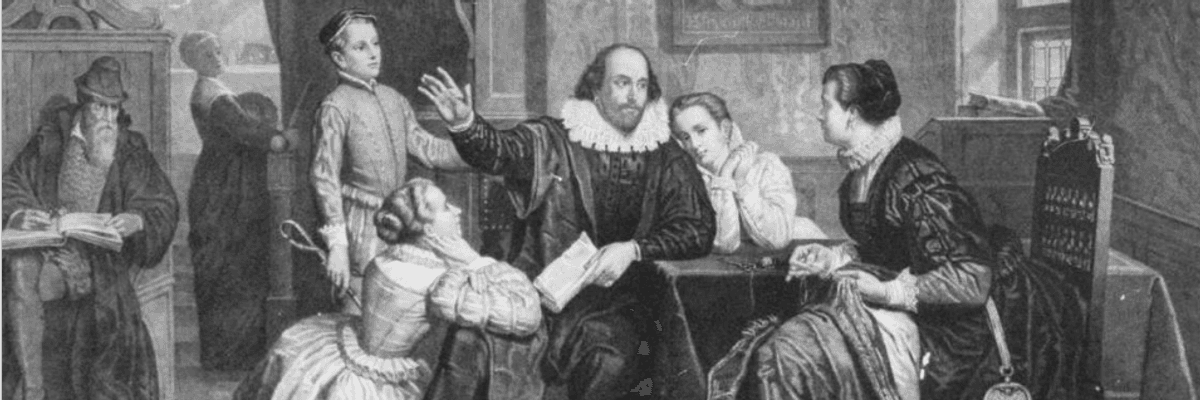
A 19th-century engraving imagining William Shakespeare's family life. (Credit: Wikimedia Commons)
In July 1564, William Shakespeare was three months old when the plague hit his parent's Henley Street neighborhood in Stratford-on-Avon. Mary Arden and John Shakespeare locked their doors and sealed their windows to try and keep the disease at bay, and whether through good fortune, basic hygiene, or snug window frames and door jambs, the future Bard of Avon and his family were spared.
Some 40 years later, at the height of his creative powers, Shakespeare was in London, living in a small room on Silver Street, near St. Giles Church. According to Shakespeare scholar James Shapiro and others, Shakespeare had another "near death" experience with the plague, one that produced unexpectedly "tragic" consequences: the Sonnets and two great tragedies may owe their existence to Elizabethan public health policies.
"In the dark times
Will there also be singing?
Yes, there will also be singing."
--Bertolt Brecht
The Queen's Master of the Revels had closed the theatres as a means of preventing the spread of an outbreak of plague. Shakespeare's Globe theatre could hold as many 2500 people, who attended not only matinee stage plays, but morning bouts of bull and bear baiting. The Globe, Curtain, Swan, Fortune, Rose and other theatres could accommodate as much as 2 percent of the entire population of London in a day. Not only were the close (and unsanitary) quarters of the theater a health issue, but transmissions through contact with ferry boatmen, coachmen, the cooks, servants and hostesses in pubs and inns, not to mention in the "stews" or brothels that the theatre district of Southwark was noted for, were highly likely and impossible to stop.
With the London theater closed, Shakespeare and his company, so some speculate, toured the countryside and even, possibly, Germany. Others think this was the period in which Shakespeare worked on many of his Sonnets (which were printed in 1609). In any event, during the period of 1605 to 1606, Shakespeare wrote two of his greatest tragedies: Antony & Cleopatra and King Lear.
Shakespeare's company, The King's Men, were also able to take over the indoor Blackfriars theater because the plague had decimated the boy companies that had played there. The fact that Shakespeare returned to post-plague London to write more intimate indoor plays (as opposed to those for the open air Globe) gave us his late "Romances": Pericles, The Winter's Tale, and The Tempest among them.
So... Broadway is dark. Local theaters are closed. Productions, readings, concerts (including some of my own) are cancelled, which will, undoubtably, not only bring significant hardship to theaters and individual artists, performers, and technicians, but also to the taxi, Lyft and Uber drivers, parking attendants, restaurant owners and their staffs, baby-sitters, bartenders and many more.
Still... My point is that there will be a silver lining, even if we cannot see it at this moment. Creative people will not only survive, they will create. As Bertolt Brecht wrote in one of his poems:
In the dark times
Will there also be singing?
Yes, there will also be singing.
About the dark times.
Dear Common Dreams reader, It’s been nearly 30 years since I co-founded Common Dreams with my late wife, Lina Newhouser. We had the radical notion that journalism should serve the public good, not corporate profits. It was clear to us from the outset what it would take to build such a project. No paid advertisements. No corporate sponsors. No millionaire publisher telling us what to think or do. Many people said we wouldn't last a year, but we proved those doubters wrong. Together with a tremendous team of journalists and dedicated staff, we built an independent media outlet free from the constraints of profits and corporate control. Our mission has always been simple: To inform. To inspire. To ignite change for the common good. Building Common Dreams was not easy. Our survival was never guaranteed. When you take on the most powerful forces—Wall Street greed, fossil fuel industry destruction, Big Tech lobbyists, and uber-rich oligarchs who have spent billions upon billions rigging the economy and democracy in their favor—the only bulwark you have is supporters who believe in your work. But here’s the urgent message from me today. It's never been this bad out there. And it's never been this hard to keep us going. At the very moment Common Dreams is most needed, the threats we face are intensifying. We need your support now more than ever. We don't accept corporate advertising and never will. We don't have a paywall because we don't think people should be blocked from critical news based on their ability to pay. Everything we do is funded by the donations of readers like you. When everyone does the little they can afford, we are strong. But if that support retreats or dries up, so do we. Will you donate now to make sure Common Dreams not only survives but thrives? —Craig Brown, Co-founder |
In July 1564, William Shakespeare was three months old when the plague hit his parent's Henley Street neighborhood in Stratford-on-Avon. Mary Arden and John Shakespeare locked their doors and sealed their windows to try and keep the disease at bay, and whether through good fortune, basic hygiene, or snug window frames and door jambs, the future Bard of Avon and his family were spared.
Some 40 years later, at the height of his creative powers, Shakespeare was in London, living in a small room on Silver Street, near St. Giles Church. According to Shakespeare scholar James Shapiro and others, Shakespeare had another "near death" experience with the plague, one that produced unexpectedly "tragic" consequences: the Sonnets and two great tragedies may owe their existence to Elizabethan public health policies.
"In the dark times
Will there also be singing?
Yes, there will also be singing."
--Bertolt Brecht
The Queen's Master of the Revels had closed the theatres as a means of preventing the spread of an outbreak of plague. Shakespeare's Globe theatre could hold as many 2500 people, who attended not only matinee stage plays, but morning bouts of bull and bear baiting. The Globe, Curtain, Swan, Fortune, Rose and other theatres could accommodate as much as 2 percent of the entire population of London in a day. Not only were the close (and unsanitary) quarters of the theater a health issue, but transmissions through contact with ferry boatmen, coachmen, the cooks, servants and hostesses in pubs and inns, not to mention in the "stews" or brothels that the theatre district of Southwark was noted for, were highly likely and impossible to stop.
With the London theater closed, Shakespeare and his company, so some speculate, toured the countryside and even, possibly, Germany. Others think this was the period in which Shakespeare worked on many of his Sonnets (which were printed in 1609). In any event, during the period of 1605 to 1606, Shakespeare wrote two of his greatest tragedies: Antony & Cleopatra and King Lear.
Shakespeare's company, The King's Men, were also able to take over the indoor Blackfriars theater because the plague had decimated the boy companies that had played there. The fact that Shakespeare returned to post-plague London to write more intimate indoor plays (as opposed to those for the open air Globe) gave us his late "Romances": Pericles, The Winter's Tale, and The Tempest among them.
So... Broadway is dark. Local theaters are closed. Productions, readings, concerts (including some of my own) are cancelled, which will, undoubtably, not only bring significant hardship to theaters and individual artists, performers, and technicians, but also to the taxi, Lyft and Uber drivers, parking attendants, restaurant owners and their staffs, baby-sitters, bartenders and many more.
Still... My point is that there will be a silver lining, even if we cannot see it at this moment. Creative people will not only survive, they will create. As Bertolt Brecht wrote in one of his poems:
In the dark times
Will there also be singing?
Yes, there will also be singing.
About the dark times.
In July 1564, William Shakespeare was three months old when the plague hit his parent's Henley Street neighborhood in Stratford-on-Avon. Mary Arden and John Shakespeare locked their doors and sealed their windows to try and keep the disease at bay, and whether through good fortune, basic hygiene, or snug window frames and door jambs, the future Bard of Avon and his family were spared.
Some 40 years later, at the height of his creative powers, Shakespeare was in London, living in a small room on Silver Street, near St. Giles Church. According to Shakespeare scholar James Shapiro and others, Shakespeare had another "near death" experience with the plague, one that produced unexpectedly "tragic" consequences: the Sonnets and two great tragedies may owe their existence to Elizabethan public health policies.
"In the dark times
Will there also be singing?
Yes, there will also be singing."
--Bertolt Brecht
The Queen's Master of the Revels had closed the theatres as a means of preventing the spread of an outbreak of plague. Shakespeare's Globe theatre could hold as many 2500 people, who attended not only matinee stage plays, but morning bouts of bull and bear baiting. The Globe, Curtain, Swan, Fortune, Rose and other theatres could accommodate as much as 2 percent of the entire population of London in a day. Not only were the close (and unsanitary) quarters of the theater a health issue, but transmissions through contact with ferry boatmen, coachmen, the cooks, servants and hostesses in pubs and inns, not to mention in the "stews" or brothels that the theatre district of Southwark was noted for, were highly likely and impossible to stop.
With the London theater closed, Shakespeare and his company, so some speculate, toured the countryside and even, possibly, Germany. Others think this was the period in which Shakespeare worked on many of his Sonnets (which were printed in 1609). In any event, during the period of 1605 to 1606, Shakespeare wrote two of his greatest tragedies: Antony & Cleopatra and King Lear.
Shakespeare's company, The King's Men, were also able to take over the indoor Blackfriars theater because the plague had decimated the boy companies that had played there. The fact that Shakespeare returned to post-plague London to write more intimate indoor plays (as opposed to those for the open air Globe) gave us his late "Romances": Pericles, The Winter's Tale, and The Tempest among them.
So... Broadway is dark. Local theaters are closed. Productions, readings, concerts (including some of my own) are cancelled, which will, undoubtably, not only bring significant hardship to theaters and individual artists, performers, and technicians, but also to the taxi, Lyft and Uber drivers, parking attendants, restaurant owners and their staffs, baby-sitters, bartenders and many more.
Still... My point is that there will be a silver lining, even if we cannot see it at this moment. Creative people will not only survive, they will create. As Bertolt Brecht wrote in one of his poems:
In the dark times
Will there also be singing?
Yes, there will also be singing.
About the dark times.

