SUBSCRIBE TO OUR FREE NEWSLETTER
Daily news & progressive opinion—funded by the people, not the corporations—delivered straight to your inbox.
5
#000000
#FFFFFF
To donate by check, phone, or other method, see our More Ways to Give page.
Daily news & progressive opinion—funded by the people, not the corporations—delivered straight to your inbox.
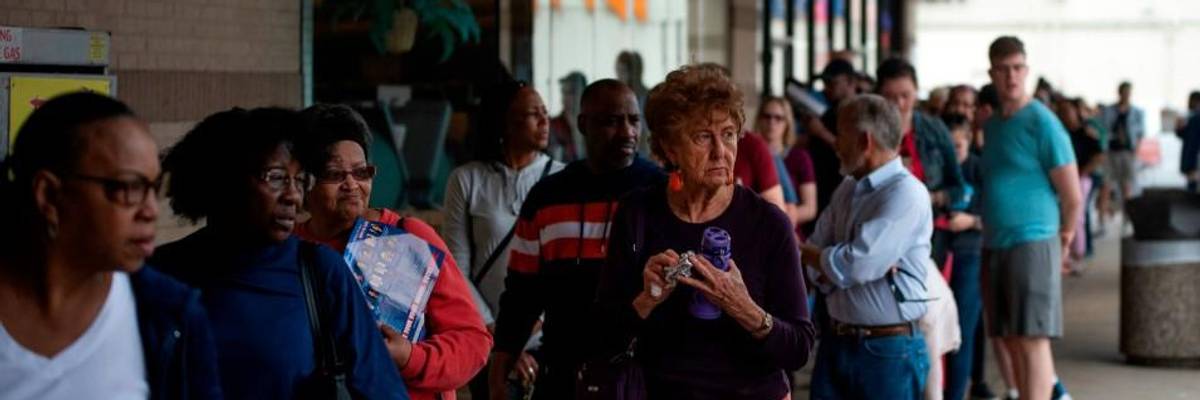
Voters wait in line to cast their ballots during the Democratic presidential primary in Houston, Texas on Super Tuesday, March 3, 2020. (Photo: Mark Felix/AFP via Getty Images)
Six hours is a good, long time. You could do a lot of things in six hours.
You could drive from San Francisco to L.A.
You could finish an audiobook.
You could clean out a garage, paint a room, watch three movies.
Or you could vote.
It took a man named Hervis Rogers that long to do so in Tuesday's Democratic primary. He did not leave his polling place in Houston until 1:30 Wednesday morning--the last person to cast his ballot. "I wanted to get my vote in to voice my opinion," he told KTRK, a local TV news station. "I wasn't going to let anything stop me, so I waited it out."
And if you're wondering why Rogers had to go through that ordeal just to vote, the answer is simple: He is a black man in America. More to the point, he's a black man in a Southern state with a sordid history of disenfranchising voters of color.
From 1965 until 2013, such voters were protected from this kind of thing by the Voting Rights Act. Then the Supreme Court struck down a key provision of the act, which required states and localities with histories of voting discrimination to get federal approval before changing election laws. The court acted under the novel--which is to say, asinine--reasoning that the provision was no longer needed because racism is over.
Or as Chief Justice John Roberts, writing for the majority, put it: "Our country has changed" since 1965. He seemed insensate to the fact that the change he noted had come about because of the act he was gutting. Indeed, the ink was barely dry on his opinion when Southern states and others began to show what they thought of all this "change."
In Georgia, they purged tens of thousands of voters, disproportionately people of color, from the rolls for offenses as trivial as a misplaced hyphen in a name. In North Carolina, they enacted a photo ID law designed with what a federal court called "almost surgical precision" to suppress the black vote. And in Texas, according to a report from the Leadership Conference Education Fund, they've closed 750 polling places since 2013--more than any other state--so that now voters like Rogers must pass an endurance test simply to exercise a constitutional right.
Yes, local officials claim the delay was actually due to higher than expected turnout, voting machine breakdowns and a new polling system. Believe that if you wish. The view from this pew is more cynical. As Rogers told KTRK, the long wait felt like it was "set up for me to walk away."
Isn't it telling, in this era of white grievance ascendant, that the right wing keeps caterwauling about a fictional epidemic with people of color committing voter fraud, even as people of color are seeing voting rights stolen from them in real time? The right projects its sins upon the rest of us--democracy as funhouse mirror where victimizers reflect as victims.
One hopes that when November comes people of color--and good people of all skin tones--summon the perseverance of Hervis Rogers and bring about a blue wave to protect the voting rights of those who are now being systematically disenfranchised. One hopes they resolve to double check their registration and polling locations ahead of time, to charge their devices, wear comfortable clothing, bring snacks, water, lawn chairs, umbrellas, a good book, whatever the wait requires.
The bottom line: There are more of us than there are of them. So there is no excuse to let the forces of intolerance get away with this act of Grand Theft Freedom.
Six hours is time enough to steal a democracy. But it's time enough to save one, too.
Dear Common Dreams reader, It’s been nearly 30 years since I co-founded Common Dreams with my late wife, Lina Newhouser. We had the radical notion that journalism should serve the public good, not corporate profits. It was clear to us from the outset what it would take to build such a project. No paid advertisements. No corporate sponsors. No millionaire publisher telling us what to think or do. Many people said we wouldn't last a year, but we proved those doubters wrong. Together with a tremendous team of journalists and dedicated staff, we built an independent media outlet free from the constraints of profits and corporate control. Our mission has always been simple: To inform. To inspire. To ignite change for the common good. Building Common Dreams was not easy. Our survival was never guaranteed. When you take on the most powerful forces—Wall Street greed, fossil fuel industry destruction, Big Tech lobbyists, and uber-rich oligarchs who have spent billions upon billions rigging the economy and democracy in their favor—the only bulwark you have is supporters who believe in your work. But here’s the urgent message from me today. It's never been this bad out there. And it's never been this hard to keep us going. At the very moment Common Dreams is most needed, the threats we face are intensifying. We need your support now more than ever. We don't accept corporate advertising and never will. We don't have a paywall because we don't think people should be blocked from critical news based on their ability to pay. Everything we do is funded by the donations of readers like you. When everyone does the little they can afford, we are strong. But if that support retreats or dries up, so do we. Will you donate now to make sure Common Dreams not only survives but thrives? —Craig Brown, Co-founder |
Six hours is a good, long time. You could do a lot of things in six hours.
You could drive from San Francisco to L.A.
You could finish an audiobook.
You could clean out a garage, paint a room, watch three movies.
Or you could vote.
It took a man named Hervis Rogers that long to do so in Tuesday's Democratic primary. He did not leave his polling place in Houston until 1:30 Wednesday morning--the last person to cast his ballot. "I wanted to get my vote in to voice my opinion," he told KTRK, a local TV news station. "I wasn't going to let anything stop me, so I waited it out."
And if you're wondering why Rogers had to go through that ordeal just to vote, the answer is simple: He is a black man in America. More to the point, he's a black man in a Southern state with a sordid history of disenfranchising voters of color.
From 1965 until 2013, such voters were protected from this kind of thing by the Voting Rights Act. Then the Supreme Court struck down a key provision of the act, which required states and localities with histories of voting discrimination to get federal approval before changing election laws. The court acted under the novel--which is to say, asinine--reasoning that the provision was no longer needed because racism is over.
Or as Chief Justice John Roberts, writing for the majority, put it: "Our country has changed" since 1965. He seemed insensate to the fact that the change he noted had come about because of the act he was gutting. Indeed, the ink was barely dry on his opinion when Southern states and others began to show what they thought of all this "change."
In Georgia, they purged tens of thousands of voters, disproportionately people of color, from the rolls for offenses as trivial as a misplaced hyphen in a name. In North Carolina, they enacted a photo ID law designed with what a federal court called "almost surgical precision" to suppress the black vote. And in Texas, according to a report from the Leadership Conference Education Fund, they've closed 750 polling places since 2013--more than any other state--so that now voters like Rogers must pass an endurance test simply to exercise a constitutional right.
Yes, local officials claim the delay was actually due to higher than expected turnout, voting machine breakdowns and a new polling system. Believe that if you wish. The view from this pew is more cynical. As Rogers told KTRK, the long wait felt like it was "set up for me to walk away."
Isn't it telling, in this era of white grievance ascendant, that the right wing keeps caterwauling about a fictional epidemic with people of color committing voter fraud, even as people of color are seeing voting rights stolen from them in real time? The right projects its sins upon the rest of us--democracy as funhouse mirror where victimizers reflect as victims.
One hopes that when November comes people of color--and good people of all skin tones--summon the perseverance of Hervis Rogers and bring about a blue wave to protect the voting rights of those who are now being systematically disenfranchised. One hopes they resolve to double check their registration and polling locations ahead of time, to charge their devices, wear comfortable clothing, bring snacks, water, lawn chairs, umbrellas, a good book, whatever the wait requires.
The bottom line: There are more of us than there are of them. So there is no excuse to let the forces of intolerance get away with this act of Grand Theft Freedom.
Six hours is time enough to steal a democracy. But it's time enough to save one, too.
Six hours is a good, long time. You could do a lot of things in six hours.
You could drive from San Francisco to L.A.
You could finish an audiobook.
You could clean out a garage, paint a room, watch three movies.
Or you could vote.
It took a man named Hervis Rogers that long to do so in Tuesday's Democratic primary. He did not leave his polling place in Houston until 1:30 Wednesday morning--the last person to cast his ballot. "I wanted to get my vote in to voice my opinion," he told KTRK, a local TV news station. "I wasn't going to let anything stop me, so I waited it out."
And if you're wondering why Rogers had to go through that ordeal just to vote, the answer is simple: He is a black man in America. More to the point, he's a black man in a Southern state with a sordid history of disenfranchising voters of color.
From 1965 until 2013, such voters were protected from this kind of thing by the Voting Rights Act. Then the Supreme Court struck down a key provision of the act, which required states and localities with histories of voting discrimination to get federal approval before changing election laws. The court acted under the novel--which is to say, asinine--reasoning that the provision was no longer needed because racism is over.
Or as Chief Justice John Roberts, writing for the majority, put it: "Our country has changed" since 1965. He seemed insensate to the fact that the change he noted had come about because of the act he was gutting. Indeed, the ink was barely dry on his opinion when Southern states and others began to show what they thought of all this "change."
In Georgia, they purged tens of thousands of voters, disproportionately people of color, from the rolls for offenses as trivial as a misplaced hyphen in a name. In North Carolina, they enacted a photo ID law designed with what a federal court called "almost surgical precision" to suppress the black vote. And in Texas, according to a report from the Leadership Conference Education Fund, they've closed 750 polling places since 2013--more than any other state--so that now voters like Rogers must pass an endurance test simply to exercise a constitutional right.
Yes, local officials claim the delay was actually due to higher than expected turnout, voting machine breakdowns and a new polling system. Believe that if you wish. The view from this pew is more cynical. As Rogers told KTRK, the long wait felt like it was "set up for me to walk away."
Isn't it telling, in this era of white grievance ascendant, that the right wing keeps caterwauling about a fictional epidemic with people of color committing voter fraud, even as people of color are seeing voting rights stolen from them in real time? The right projects its sins upon the rest of us--democracy as funhouse mirror where victimizers reflect as victims.
One hopes that when November comes people of color--and good people of all skin tones--summon the perseverance of Hervis Rogers and bring about a blue wave to protect the voting rights of those who are now being systematically disenfranchised. One hopes they resolve to double check their registration and polling locations ahead of time, to charge their devices, wear comfortable clothing, bring snacks, water, lawn chairs, umbrellas, a good book, whatever the wait requires.
The bottom line: There are more of us than there are of them. So there is no excuse to let the forces of intolerance get away with this act of Grand Theft Freedom.
Six hours is time enough to steal a democracy. But it's time enough to save one, too.