SUBSCRIBE TO OUR FREE NEWSLETTER
Daily news & progressive opinion—funded by the people, not the corporations—delivered straight to your inbox.
5
#000000
#FFFFFF
To donate by check, phone, or other method, see our More Ways to Give page.
Daily news & progressive opinion—funded by the people, not the corporations—delivered straight to your inbox.
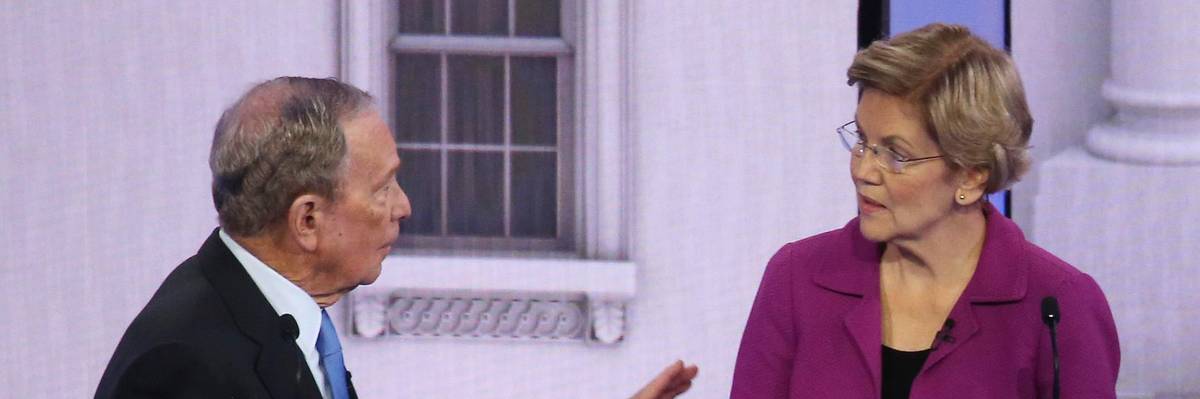
Democratic presidential candidates former New York City Mayor Mike Bloomberg and Sen. Elizabeth Warren (D-MA) speak during the Democratic presidential primary debate at Paris Las Vegas on February 19, 2020 in Las Vegas, Nevada. (Photo: Mario Tama/Getty Images)
As I watched the Nevada Democratic debate last week, like millions of other Americans, I noticed the smug look on Michael Bloomberg's face when Sen. Elizabeth Warren and others challenged him about his treatment of women, stop-and-frisk and other racist policies that he has championed. Eleven years ago, I personally had that exact same look directed at me.
On Feb. 3, 2009, as New York City was reeling from a financial crisis fueled by Wall Street greed, I helped organize a peaceful protest of then-Mayor Bloomberg. More than 100 low-income New Yorkers, most of whom were people of color, entered the ballroom at the Grand Hyatt hotel in midtown Manhattan and surprised Bloomberg in the middle of his keynote address at the "Future of NYC" conference. Other participants attending the $249-per-plate luncheon included the CEOs of some of New York's largest corporations, such as Jamie Dimon, CEO and chairman of J.P. Morgan Chase. This group of New York's political and business elite had charged themselves with developing "recommendations on how to strengthen the city's economy."
The protest was organized by the Right to the City, an alliance of some of the largest grassroots organizations in New York, representing low-income, people of color, homeless and LGBTQ youth, fighting against gentrification and displacement. Our goal was to deliver a letter to the mayor, requesting he meet with a delegation from our network to hear about our ideas for fixing the city's economy. The group had been requesting a meeting with the mayor for months, to no avail.
We peacefully walked through the front door of the Grand Hyatt and entered the conference just as Bloomberg was beginning his speech. We chanted, "Show me what democracy looks like! This is what democracy looks like!" in response to the mayor's continued dismissal of the voices of low-income people of color who lived and worked in New York City.
We came to tell Bloomberg that we were fed up with his racist and undemocratic policies, such as stop-and-frisk, crumbling conditions in public housing, high rates of evictions and homelessness as rows of luxury condos sat vacant. We were also furious that he was circumventing the will of the people by seeking a third term, despite a public referendum in which New Yorkers voted for term limits.
In response to our chant, Bloomberg said, "I think actually they were right! In most other countries, they throw them in the slammer. This is a democracy." Ironically, as we were voluntarily leaving the hotel, eight of our members were arrested, myself included, and forced to spend the night in jail. (The charges were ultimately dropped, but only after months of having to go back and forth to court.)
I'll never forget the look on Bloomberg's face that day in 2009 when he noticed that we had marched into the room (luckily, his face was blown up on large screens around the room). He was shocked and disgusted that anyone would interrupt or challenge him.
Bloomberg says he's sorry for some of the racist policies of his mayoralty--policies that everyday New Yorkers are still reeling from. But from the look he gave Warren--the very same look he gave me and 100 other protestors in the Hyatt Ballroom--it's clear that he hasn't changed a bit. Any apology is pure political expediency.
We cannot allow another billionaire to buy his way into office. We cannot afford to have another leader that thinks he is above critique and dissent. We need a leader who will listen deeply to the voices of those on the ground and work with them to develop solutions that address our country's legacy of greed, racism and sexism.
This is still what democracy looks like.
Dear Common Dreams reader, It’s been nearly 30 years since I co-founded Common Dreams with my late wife, Lina Newhouser. We had the radical notion that journalism should serve the public good, not corporate profits. It was clear to us from the outset what it would take to build such a project. No paid advertisements. No corporate sponsors. No millionaire publisher telling us what to think or do. Many people said we wouldn't last a year, but we proved those doubters wrong. Together with a tremendous team of journalists and dedicated staff, we built an independent media outlet free from the constraints of profits and corporate control. Our mission has always been simple: To inform. To inspire. To ignite change for the common good. Building Common Dreams was not easy. Our survival was never guaranteed. When you take on the most powerful forces—Wall Street greed, fossil fuel industry destruction, Big Tech lobbyists, and uber-rich oligarchs who have spent billions upon billions rigging the economy and democracy in their favor—the only bulwark you have is supporters who believe in your work. But here’s the urgent message from me today. It's never been this bad out there. And it's never been this hard to keep us going. At the very moment Common Dreams is most needed, the threats we face are intensifying. We need your support now more than ever. We don't accept corporate advertising and never will. We don't have a paywall because we don't think people should be blocked from critical news based on their ability to pay. Everything we do is funded by the donations of readers like you. When everyone does the little they can afford, we are strong. But if that support retreats or dries up, so do we. Will you donate now to make sure Common Dreams not only survives but thrives? —Craig Brown, Co-founder |
As I watched the Nevada Democratic debate last week, like millions of other Americans, I noticed the smug look on Michael Bloomberg's face when Sen. Elizabeth Warren and others challenged him about his treatment of women, stop-and-frisk and other racist policies that he has championed. Eleven years ago, I personally had that exact same look directed at me.
On Feb. 3, 2009, as New York City was reeling from a financial crisis fueled by Wall Street greed, I helped organize a peaceful protest of then-Mayor Bloomberg. More than 100 low-income New Yorkers, most of whom were people of color, entered the ballroom at the Grand Hyatt hotel in midtown Manhattan and surprised Bloomberg in the middle of his keynote address at the "Future of NYC" conference. Other participants attending the $249-per-plate luncheon included the CEOs of some of New York's largest corporations, such as Jamie Dimon, CEO and chairman of J.P. Morgan Chase. This group of New York's political and business elite had charged themselves with developing "recommendations on how to strengthen the city's economy."
The protest was organized by the Right to the City, an alliance of some of the largest grassroots organizations in New York, representing low-income, people of color, homeless and LGBTQ youth, fighting against gentrification and displacement. Our goal was to deliver a letter to the mayor, requesting he meet with a delegation from our network to hear about our ideas for fixing the city's economy. The group had been requesting a meeting with the mayor for months, to no avail.
We peacefully walked through the front door of the Grand Hyatt and entered the conference just as Bloomberg was beginning his speech. We chanted, "Show me what democracy looks like! This is what democracy looks like!" in response to the mayor's continued dismissal of the voices of low-income people of color who lived and worked in New York City.
We came to tell Bloomberg that we were fed up with his racist and undemocratic policies, such as stop-and-frisk, crumbling conditions in public housing, high rates of evictions and homelessness as rows of luxury condos sat vacant. We were also furious that he was circumventing the will of the people by seeking a third term, despite a public referendum in which New Yorkers voted for term limits.
In response to our chant, Bloomberg said, "I think actually they were right! In most other countries, they throw them in the slammer. This is a democracy." Ironically, as we were voluntarily leaving the hotel, eight of our members were arrested, myself included, and forced to spend the night in jail. (The charges were ultimately dropped, but only after months of having to go back and forth to court.)
I'll never forget the look on Bloomberg's face that day in 2009 when he noticed that we had marched into the room (luckily, his face was blown up on large screens around the room). He was shocked and disgusted that anyone would interrupt or challenge him.
Bloomberg says he's sorry for some of the racist policies of his mayoralty--policies that everyday New Yorkers are still reeling from. But from the look he gave Warren--the very same look he gave me and 100 other protestors in the Hyatt Ballroom--it's clear that he hasn't changed a bit. Any apology is pure political expediency.
We cannot allow another billionaire to buy his way into office. We cannot afford to have another leader that thinks he is above critique and dissent. We need a leader who will listen deeply to the voices of those on the ground and work with them to develop solutions that address our country's legacy of greed, racism and sexism.
This is still what democracy looks like.
As I watched the Nevada Democratic debate last week, like millions of other Americans, I noticed the smug look on Michael Bloomberg's face when Sen. Elizabeth Warren and others challenged him about his treatment of women, stop-and-frisk and other racist policies that he has championed. Eleven years ago, I personally had that exact same look directed at me.
On Feb. 3, 2009, as New York City was reeling from a financial crisis fueled by Wall Street greed, I helped organize a peaceful protest of then-Mayor Bloomberg. More than 100 low-income New Yorkers, most of whom were people of color, entered the ballroom at the Grand Hyatt hotel in midtown Manhattan and surprised Bloomberg in the middle of his keynote address at the "Future of NYC" conference. Other participants attending the $249-per-plate luncheon included the CEOs of some of New York's largest corporations, such as Jamie Dimon, CEO and chairman of J.P. Morgan Chase. This group of New York's political and business elite had charged themselves with developing "recommendations on how to strengthen the city's economy."
The protest was organized by the Right to the City, an alliance of some of the largest grassroots organizations in New York, representing low-income, people of color, homeless and LGBTQ youth, fighting against gentrification and displacement. Our goal was to deliver a letter to the mayor, requesting he meet with a delegation from our network to hear about our ideas for fixing the city's economy. The group had been requesting a meeting with the mayor for months, to no avail.
We peacefully walked through the front door of the Grand Hyatt and entered the conference just as Bloomberg was beginning his speech. We chanted, "Show me what democracy looks like! This is what democracy looks like!" in response to the mayor's continued dismissal of the voices of low-income people of color who lived and worked in New York City.
We came to tell Bloomberg that we were fed up with his racist and undemocratic policies, such as stop-and-frisk, crumbling conditions in public housing, high rates of evictions and homelessness as rows of luxury condos sat vacant. We were also furious that he was circumventing the will of the people by seeking a third term, despite a public referendum in which New Yorkers voted for term limits.
In response to our chant, Bloomberg said, "I think actually they were right! In most other countries, they throw them in the slammer. This is a democracy." Ironically, as we were voluntarily leaving the hotel, eight of our members were arrested, myself included, and forced to spend the night in jail. (The charges were ultimately dropped, but only after months of having to go back and forth to court.)
I'll never forget the look on Bloomberg's face that day in 2009 when he noticed that we had marched into the room (luckily, his face was blown up on large screens around the room). He was shocked and disgusted that anyone would interrupt or challenge him.
Bloomberg says he's sorry for some of the racist policies of his mayoralty--policies that everyday New Yorkers are still reeling from. But from the look he gave Warren--the very same look he gave me and 100 other protestors in the Hyatt Ballroom--it's clear that he hasn't changed a bit. Any apology is pure political expediency.
We cannot allow another billionaire to buy his way into office. We cannot afford to have another leader that thinks he is above critique and dissent. We need a leader who will listen deeply to the voices of those on the ground and work with them to develop solutions that address our country's legacy of greed, racism and sexism.
This is still what democracy looks like.