SUBSCRIBE TO OUR FREE NEWSLETTER
Daily news & progressive opinion—funded by the people, not the corporations—delivered straight to your inbox.
5
#000000
#FFFFFF
To donate by check, phone, or other method, see our More Ways to Give page.
Coming out of the second round of Democratic debates, a curious storyline crystallized in the media: The candidates are attacking Obama, and that's a sure-fire way to hand the election to Trump. It's the latest flavor of "the Democrats are moving too far left" (FAIR.org, 7/2/19)--this time echoing both Trump himself and the right-wing Democratic candidates, including former Obama Vice President Joe Biden.
During the first debate, Rep. John Delaney pitched the story, claiming, "Most of the folks running for president want to build economic walls to free trade and beat up on President Obama." Biden's team was also quick to hype the story after his own appearance in the second debate. The Washington Post's Steven Stromberg (7/31/19) quoted one of his advisers immediately after the debate: "Many people on this stage spent more time attacking Obama than they did Trump. I think Democratic primary voters will make a judgment about this."
The next day, Trump (Politico, 8/1/19) picked up the Biden spin, declaring:
The Democrats spent more time attacking Barack Obama than they did attacking me, practically. This morning, that's all the fake news was talking about.
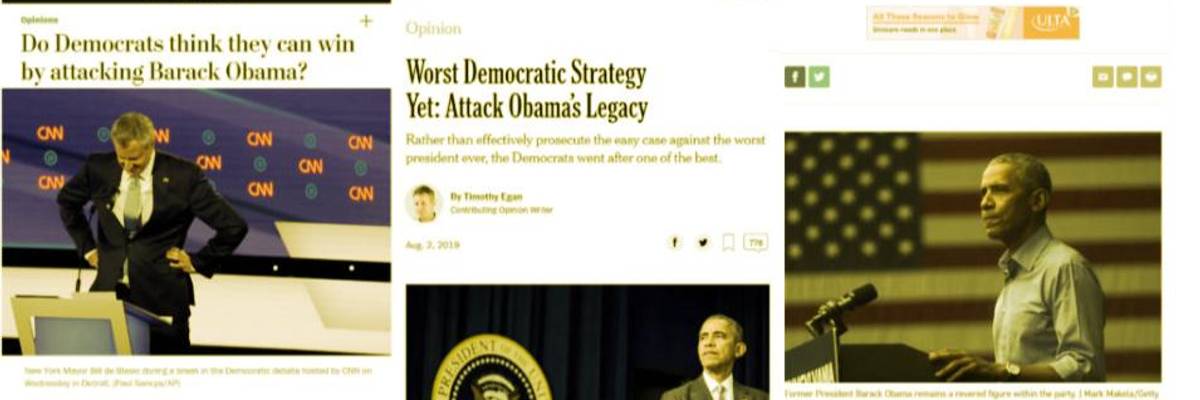
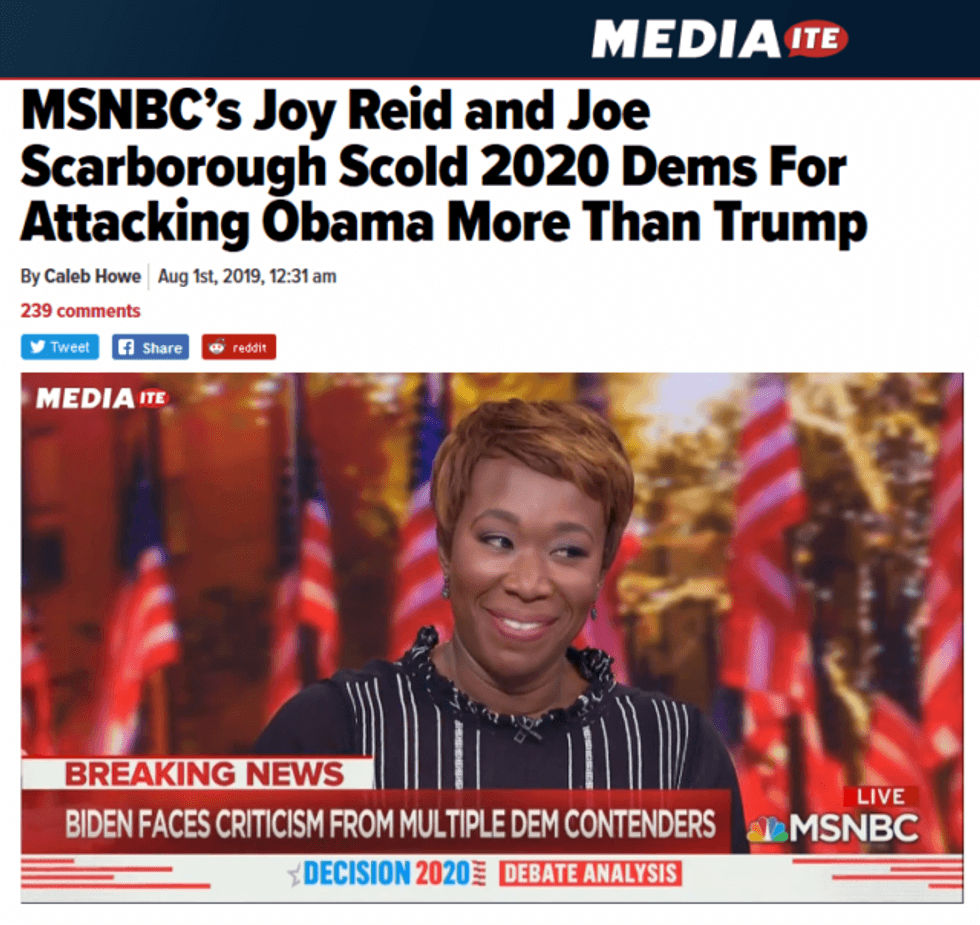
Indeed, it was hard to read coverage of the debates without tripping over pieces like, "Do Democrats Think They Can Win by Attacking Barack Obama?" (Washington Post, 7/31/19), "Worst Democratic Strategy Yet: Attack Obama's Legacy" (New York Times, 8/2/19) or "'Stay Away From Barack': Dems Seethe Over Criticism of Obama" (Politico, 8/1/19). (Note that the "Dems" who are seething in these stories are almost exclusively Biden strategists, former Obama administration officials or strategists, and other party centrists).
It's a curious storyline, if you actually watched the debates. For the record, Trump was mentioned 199 times across the two nights; Obama (or "Obamacare") was mentioned 32 times (including eight name-drops by Biden). And the non-Biden Obama mentions were largely framed as praise--as when Julian Castro argued (7/31/19) that most of the job growth Trump takes credit for was "due to President Obama. Thank you, Barack Obama. Thank you, Barack Obama"--or as a prop for the candidates' plans, as when Kamala Harris said that the "architect of the Obama Affordable Care Act" supported Harris's healthcare plan.
On healthcare, while there were plenty of attacks on left-wing positions from CNN moderators, who peppered candidates with industry-friendly questions about "raising taxes on the middle class" to pay for Medicare for All, and "forcing" people to give up their private insurance, on neither night did candidates attack the ACA or Obama on healthcare. In fact, only a few candidates (besides Biden) mentioned the ACA; none of the mentions could be construed as direct attacks on it, with the possible exception of Beto O'Rourke's claim (7/30/19) that his "Medicare for America" plan is a "better path" than either Medicare for All or "improv[ing] the Affordable Care Act at the margins."
Immigration was probably the most-cited "Obama attack" issue--but it was CNN's Don Lemon who teed up the attack, asking Biden:
In the first two years of the Obama administration, nearly 800,000 immigrants were deported, far more than during President Trump's first two years. Would the higher deportation rates resume if you were president?
Many candidates talked about wanting decriminalization, and reducing deportations, but, again, none aimed their attacks at Obama--unless you take criticism of the healthcare system as criticism of Obama, as the Post seemed to when it cited Warren's criticism that "we have tried the solution of Medicare, Medicaid and private insurance. And what have the private insurance companies done? They've sucked billions of dollars out of our health care system."
Some did aim directly at Biden, including Castro and New York Mayor Bill de Blasio. The Post pointed to Castro, who was Obama's Housing secretary, quipping about the deportation policy of the administration in which he and Biden both served: "It looks like one of us has learned the lessons of the past, and one of us hasn't." The Times piece, by Timothy Egan, didn't even bother citing evidence, instead just asserting that Obama was "now a target for cannibalistic candidates from the left."
And both the Post and Politico cited Cory Booker criticizing Biden, after Biden attempted to distance himself from Obama's deportation policy (answering Lemon's question about whether he would resume Obama's policy with an unequivocal "absolutely not"): "You invoke President Obama more than anybody in this campaign," said Booker. "You can't do it when it's convenient and dodge it when it's not."
Tellingly, no one cited Biden's distancing from Obama policy--in this case, or when he said he would not re-enter the TPP under the same terms Obama did--as criticism of Obama.
Obama was and continues to be highly popular with the public (and especially Democrats), so it's no surprise that Biden is largely pinning his campaign on his connection to the former president, and trying to discredit opponents whose plans might differ from any of Obama's policies. By going along with Biden's efforts to construe any attacks on himself, his record or proposals as attacks on Obama, media are helping to construct a trope that seeks to trap anyone to the left of Obama--and to the left of the media's comfort zone--by effectively putting most criticism of Biden off limits.
Coming out of the second round of Democratic debates, a curious storyline crystallized in the media: The candidates are attacking Obama, and that's a sure-fire way to hand the election to Trump. It's the latest flavor of "the Democrats are moving too far left" (FAIR.org, 7/2/19)--this time echoing both Trump himself and the right-wing Democratic candidates, including former Obama Vice President Joe Biden.
During the first debate, Rep. John Delaney pitched the story, claiming, "Most of the folks running for president want to build economic walls to free trade and beat up on President Obama." Biden's team was also quick to hype the story after his own appearance in the second debate. The Washington Post's Steven Stromberg (7/31/19) quoted one of his advisers immediately after the debate: "Many people on this stage spent more time attacking Obama than they did Trump. I think Democratic primary voters will make a judgment about this."
The next day, Trump (Politico, 8/1/19) picked up the Biden spin, declaring:
The Democrats spent more time attacking Barack Obama than they did attacking me, practically. This morning, that's all the fake news was talking about.
Indeed, it was hard to read coverage of the debates without tripping over pieces like, "Do Democrats Think They Can Win by Attacking Barack Obama?" (Washington Post, 7/31/19), "Worst Democratic Strategy Yet: Attack Obama's Legacy" (New York Times, 8/2/19) or "'Stay Away From Barack': Dems Seethe Over Criticism of Obama" (Politico, 8/1/19). (Note that the "Dems" who are seething in these stories are almost exclusively Biden strategists, former Obama administration officials or strategists, and other party centrists).
It's a curious storyline, if you actually watched the debates. For the record, Trump was mentioned 199 times across the two nights; Obama (or "Obamacare") was mentioned 32 times (including eight name-drops by Biden). And the non-Biden Obama mentions were largely framed as praise--as when Julian Castro argued (7/31/19) that most of the job growth Trump takes credit for was "due to President Obama. Thank you, Barack Obama. Thank you, Barack Obama"--or as a prop for the candidates' plans, as when Kamala Harris said that the "architect of the Obama Affordable Care Act" supported Harris's healthcare plan.
On healthcare, while there were plenty of attacks on left-wing positions from CNN moderators, who peppered candidates with industry-friendly questions about "raising taxes on the middle class" to pay for Medicare for All, and "forcing" people to give up their private insurance, on neither night did candidates attack the ACA or Obama on healthcare. In fact, only a few candidates (besides Biden) mentioned the ACA; none of the mentions could be construed as direct attacks on it, with the possible exception of Beto O'Rourke's claim (7/30/19) that his "Medicare for America" plan is a "better path" than either Medicare for All or "improv[ing] the Affordable Care Act at the margins."
Immigration was probably the most-cited "Obama attack" issue--but it was CNN's Don Lemon who teed up the attack, asking Biden:
In the first two years of the Obama administration, nearly 800,000 immigrants were deported, far more than during President Trump's first two years. Would the higher deportation rates resume if you were president?
Many candidates talked about wanting decriminalization, and reducing deportations, but, again, none aimed their attacks at Obama--unless you take criticism of the healthcare system as criticism of Obama, as the Post seemed to when it cited Warren's criticism that "we have tried the solution of Medicare, Medicaid and private insurance. And what have the private insurance companies done? They've sucked billions of dollars out of our health care system."
Some did aim directly at Biden, including Castro and New York Mayor Bill de Blasio. The Post pointed to Castro, who was Obama's Housing secretary, quipping about the deportation policy of the administration in which he and Biden both served: "It looks like one of us has learned the lessons of the past, and one of us hasn't." The Times piece, by Timothy Egan, didn't even bother citing evidence, instead just asserting that Obama was "now a target for cannibalistic candidates from the left."
And both the Post and Politico cited Cory Booker criticizing Biden, after Biden attempted to distance himself from Obama's deportation policy (answering Lemon's question about whether he would resume Obama's policy with an unequivocal "absolutely not"): "You invoke President Obama more than anybody in this campaign," said Booker. "You can't do it when it's convenient and dodge it when it's not."
Tellingly, no one cited Biden's distancing from Obama policy--in this case, or when he said he would not re-enter the TPP under the same terms Obama did--as criticism of Obama.
Obama was and continues to be highly popular with the public (and especially Democrats), so it's no surprise that Biden is largely pinning his campaign on his connection to the former president, and trying to discredit opponents whose plans might differ from any of Obama's policies. By going along with Biden's efforts to construe any attacks on himself, his record or proposals as attacks on Obama, media are helping to construct a trope that seeks to trap anyone to the left of Obama--and to the left of the media's comfort zone--by effectively putting most criticism of Biden off limits.
Coming out of the second round of Democratic debates, a curious storyline crystallized in the media: The candidates are attacking Obama, and that's a sure-fire way to hand the election to Trump. It's the latest flavor of "the Democrats are moving too far left" (FAIR.org, 7/2/19)--this time echoing both Trump himself and the right-wing Democratic candidates, including former Obama Vice President Joe Biden.
During the first debate, Rep. John Delaney pitched the story, claiming, "Most of the folks running for president want to build economic walls to free trade and beat up on President Obama." Biden's team was also quick to hype the story after his own appearance in the second debate. The Washington Post's Steven Stromberg (7/31/19) quoted one of his advisers immediately after the debate: "Many people on this stage spent more time attacking Obama than they did Trump. I think Democratic primary voters will make a judgment about this."
The next day, Trump (Politico, 8/1/19) picked up the Biden spin, declaring:
The Democrats spent more time attacking Barack Obama than they did attacking me, practically. This morning, that's all the fake news was talking about.
Indeed, it was hard to read coverage of the debates without tripping over pieces like, "Do Democrats Think They Can Win by Attacking Barack Obama?" (Washington Post, 7/31/19), "Worst Democratic Strategy Yet: Attack Obama's Legacy" (New York Times, 8/2/19) or "'Stay Away From Barack': Dems Seethe Over Criticism of Obama" (Politico, 8/1/19). (Note that the "Dems" who are seething in these stories are almost exclusively Biden strategists, former Obama administration officials or strategists, and other party centrists).
It's a curious storyline, if you actually watched the debates. For the record, Trump was mentioned 199 times across the two nights; Obama (or "Obamacare") was mentioned 32 times (including eight name-drops by Biden). And the non-Biden Obama mentions were largely framed as praise--as when Julian Castro argued (7/31/19) that most of the job growth Trump takes credit for was "due to President Obama. Thank you, Barack Obama. Thank you, Barack Obama"--or as a prop for the candidates' plans, as when Kamala Harris said that the "architect of the Obama Affordable Care Act" supported Harris's healthcare plan.
On healthcare, while there were plenty of attacks on left-wing positions from CNN moderators, who peppered candidates with industry-friendly questions about "raising taxes on the middle class" to pay for Medicare for All, and "forcing" people to give up their private insurance, on neither night did candidates attack the ACA or Obama on healthcare. In fact, only a few candidates (besides Biden) mentioned the ACA; none of the mentions could be construed as direct attacks on it, with the possible exception of Beto O'Rourke's claim (7/30/19) that his "Medicare for America" plan is a "better path" than either Medicare for All or "improv[ing] the Affordable Care Act at the margins."
Immigration was probably the most-cited "Obama attack" issue--but it was CNN's Don Lemon who teed up the attack, asking Biden:
In the first two years of the Obama administration, nearly 800,000 immigrants were deported, far more than during President Trump's first two years. Would the higher deportation rates resume if you were president?
Many candidates talked about wanting decriminalization, and reducing deportations, but, again, none aimed their attacks at Obama--unless you take criticism of the healthcare system as criticism of Obama, as the Post seemed to when it cited Warren's criticism that "we have tried the solution of Medicare, Medicaid and private insurance. And what have the private insurance companies done? They've sucked billions of dollars out of our health care system."
Some did aim directly at Biden, including Castro and New York Mayor Bill de Blasio. The Post pointed to Castro, who was Obama's Housing secretary, quipping about the deportation policy of the administration in which he and Biden both served: "It looks like one of us has learned the lessons of the past, and one of us hasn't." The Times piece, by Timothy Egan, didn't even bother citing evidence, instead just asserting that Obama was "now a target for cannibalistic candidates from the left."
And both the Post and Politico cited Cory Booker criticizing Biden, after Biden attempted to distance himself from Obama's deportation policy (answering Lemon's question about whether he would resume Obama's policy with an unequivocal "absolutely not"): "You invoke President Obama more than anybody in this campaign," said Booker. "You can't do it when it's convenient and dodge it when it's not."
Tellingly, no one cited Biden's distancing from Obama policy--in this case, or when he said he would not re-enter the TPP under the same terms Obama did--as criticism of Obama.
Obama was and continues to be highly popular with the public (and especially Democrats), so it's no surprise that Biden is largely pinning his campaign on his connection to the former president, and trying to discredit opponents whose plans might differ from any of Obama's policies. By going along with Biden's efforts to construe any attacks on himself, his record or proposals as attacks on Obama, media are helping to construct a trope that seeks to trap anyone to the left of Obama--and to the left of the media's comfort zone--by effectively putting most criticism of Biden off limits.