

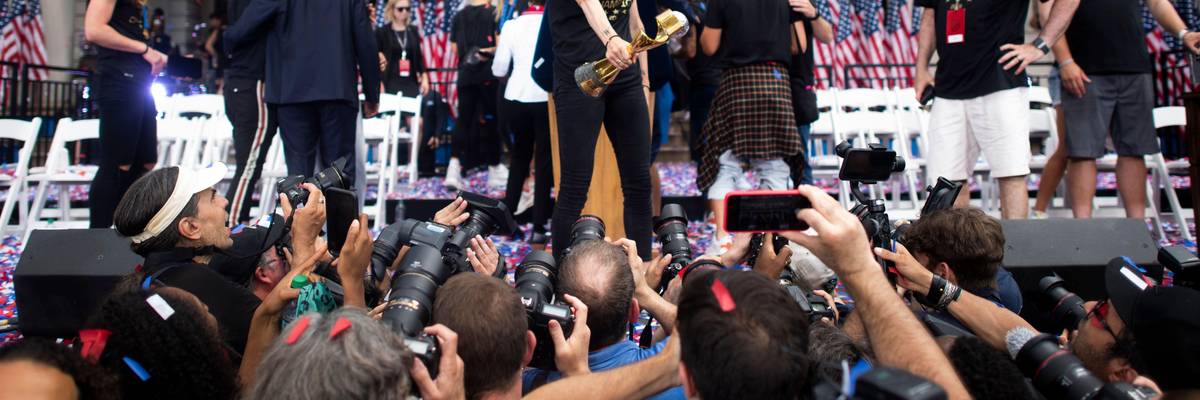
"We have pink hair and purple hair; we have tattoos and dreadlocks. We got white girls and black girls and everything in between. Straight girls and gay girls." (Photo: JOHANNES EISELE/AFP/Getty Images)
U.S. Women's Soccer Players Gain a Global Platform for Their Battles
The U.S. women’s soccer players now have a global platform to highlight the struggle for women’s pay equality and justice
Champagne corks were popping in lower Manhattan on Wednesday -- not only for the victorious United States Women's National Soccer Team as they were feted with a ticker tape parade up New York City's "Canyon of Heroes" on Broadway, passing Wall Street, where the S&P 500 stock index crested 3000 for the first time in history. The 23 women of the soccer team had just returned from winning the World Cup in France. Back in the United States, they will continue another, more difficult battle, for pay and working conditions equal to those of their male counterparts in the U.S. Soccer Federation. A sign held during the parade by team member Crystal Dunn, an African American player from Rockville Centre on Long Island, read, "Parades are cool -- Equal Pay is cooler." The crowd echoed the sentiment. As Carlos Cordeiro, the head of the U.S. Soccer Federation, spoke at the rally that followed the parade, the crowd chanted, "Equal pay! Equal pay!" It was the same chorus that reverberated throughout the Lyon stadium when the women became world champions last Sunday.
The success of Wall Street, juxtaposed with the pay inequality imposed on these remarkable women, recalled the statement made by one of New York City's most famous mayors, Fiorella La Guardia, in 1946: "Ticker tape ain't spaghetti." La Guardia had just taken the reins of the United Nations Relief and Rehabilitation Administration, providing aid to refugees and others struggling to survive in the immediate aftermath of World War II. Paper ticker tape was ubiquitous in those pre-digital days as the means by which real-time stock prices were distributed. Hence, vast quantities of used ticker tape in New York's financial district was repurposed as confetti to rain on returning soldiers, astronauts and victorious athletic teams since the first ticker tape parade in 1886, celebrating the new Statue of Liberty. La Guardia's point was simple: While the postwar economy may have been booming and those invested in the stock market were doing great, it didn't translate into food security for war refugees. Likewise, today, a parade celebrating women athletes is an honor, but it doesn't make up for a lifetime of unequal pay.
The women's team filed a lawsuit last March, accusing the U.S. Soccer Federation of "paying them less than members of the MNT [men's national team] for substantially equal work and by denying them at least equal playing, training, and travel conditions; equal promotion of their games; equal support and development for their games." The U.S. women's team has won four World Cup titles, four Olympic gold medals, has won many other tournaments and is ranked by FIFA as the No. 1 team in its Women's World Rankings. Compare that with the dismal record of the U.S. Men's National Team, which didn't even qualify for the most recent World Cup. Despite their lackluster performance, the men earn far more, on average, than the women.
This disparity is common throughout the U.S. economy. Testifying before Congress last February in support of the Paycheck Fairness Act (H.R. 7): Equal Pay for Equal Work, Fatima Goss Graves, president and CEO of the National Women's Law Center, laid out the disturbing details: "Women working full time, year-round, typically are paid only 80 cents for every dollar paid to men working full time, year-round. The wage gap is even worse when looking specifically at women of color: For every dollar paid to white, non-Hispanic men, black women are paid only 61 cents, Native women 58 cents and Latinas 53 cents." She added, "Women, and especially women of color, face overt discrimination and unconscious biases in the workplace which impact pay."
The U.S. women's soccer players now have a global platform to highlight the struggle for women's pay equality and justice. As co-captain Megan Rapinoe said Wednesday: "Yes we play sports. Yes we play soccer. Yes we're female athletes, but we're so much more than that." Rapinoe, the World Cup's top scorer and best player, is an outspoken advocate for LGBTQ rights, and in 2016 became one of the first major white athletes to take a knee during the national anthem. Throughout the World Cup, she refused to place her hand over her heart or to sing the words of "The Star-Spangled Banner."
"We have pink hair and purple hair; we have tattoos and dreadlocks. We got white girls and black girls and everything in between. Straight girls and gay girls," Rapinoe said at the City Hall rally Wednesday, where the mayor presented the team with the keys to the city. Issuing a call to action to the crowd, Rapinoe went on, "We have to love more, hate less. ... It's our responsibility to make this world a better place."
An Urgent Message From Our Co-Founder
Dear Common Dreams reader, It’s been nearly 30 years since I co-founded Common Dreams with my late wife, Lina Newhouser. We had the radical notion that journalism should serve the public good, not corporate profits. It was clear to us from the outset what it would take to build such a project. No paid advertisements. No corporate sponsors. No millionaire publisher telling us what to think or do. Many people said we wouldn't last a year, but we proved those doubters wrong. Together with a tremendous team of journalists and dedicated staff, we built an independent media outlet free from the constraints of profits and corporate control. Our mission has always been simple: To inform. To inspire. To ignite change for the common good. Building Common Dreams was not easy. Our survival was never guaranteed. When you take on the most powerful forces—Wall Street greed, fossil fuel industry destruction, Big Tech lobbyists, and uber-rich oligarchs who have spent billions upon billions rigging the economy and democracy in their favor—the only bulwark you have is supporters who believe in your work. But here’s the urgent message from me today. It's never been this bad out there. And it's never been this hard to keep us going. At the very moment Common Dreams is most needed, the threats we face are intensifying. We need your support now more than ever. We don't accept corporate advertising and never will. We don't have a paywall because we don't think people should be blocked from critical news based on their ability to pay. Everything we do is funded by the donations of readers like you. When everyone does the little they can afford, we are strong. But if that support retreats or dries up, so do we. Will you donate now to make sure Common Dreams not only survives but thrives? —Craig Brown, Co-founder |
Champagne corks were popping in lower Manhattan on Wednesday -- not only for the victorious United States Women's National Soccer Team as they were feted with a ticker tape parade up New York City's "Canyon of Heroes" on Broadway, passing Wall Street, where the S&P 500 stock index crested 3000 for the first time in history. The 23 women of the soccer team had just returned from winning the World Cup in France. Back in the United States, they will continue another, more difficult battle, for pay and working conditions equal to those of their male counterparts in the U.S. Soccer Federation. A sign held during the parade by team member Crystal Dunn, an African American player from Rockville Centre on Long Island, read, "Parades are cool -- Equal Pay is cooler." The crowd echoed the sentiment. As Carlos Cordeiro, the head of the U.S. Soccer Federation, spoke at the rally that followed the parade, the crowd chanted, "Equal pay! Equal pay!" It was the same chorus that reverberated throughout the Lyon stadium when the women became world champions last Sunday.
The success of Wall Street, juxtaposed with the pay inequality imposed on these remarkable women, recalled the statement made by one of New York City's most famous mayors, Fiorella La Guardia, in 1946: "Ticker tape ain't spaghetti." La Guardia had just taken the reins of the United Nations Relief and Rehabilitation Administration, providing aid to refugees and others struggling to survive in the immediate aftermath of World War II. Paper ticker tape was ubiquitous in those pre-digital days as the means by which real-time stock prices were distributed. Hence, vast quantities of used ticker tape in New York's financial district was repurposed as confetti to rain on returning soldiers, astronauts and victorious athletic teams since the first ticker tape parade in 1886, celebrating the new Statue of Liberty. La Guardia's point was simple: While the postwar economy may have been booming and those invested in the stock market were doing great, it didn't translate into food security for war refugees. Likewise, today, a parade celebrating women athletes is an honor, but it doesn't make up for a lifetime of unequal pay.
The women's team filed a lawsuit last March, accusing the U.S. Soccer Federation of "paying them less than members of the MNT [men's national team] for substantially equal work and by denying them at least equal playing, training, and travel conditions; equal promotion of their games; equal support and development for their games." The U.S. women's team has won four World Cup titles, four Olympic gold medals, has won many other tournaments and is ranked by FIFA as the No. 1 team in its Women's World Rankings. Compare that with the dismal record of the U.S. Men's National Team, which didn't even qualify for the most recent World Cup. Despite their lackluster performance, the men earn far more, on average, than the women.
This disparity is common throughout the U.S. economy. Testifying before Congress last February in support of the Paycheck Fairness Act (H.R. 7): Equal Pay for Equal Work, Fatima Goss Graves, president and CEO of the National Women's Law Center, laid out the disturbing details: "Women working full time, year-round, typically are paid only 80 cents for every dollar paid to men working full time, year-round. The wage gap is even worse when looking specifically at women of color: For every dollar paid to white, non-Hispanic men, black women are paid only 61 cents, Native women 58 cents and Latinas 53 cents." She added, "Women, and especially women of color, face overt discrimination and unconscious biases in the workplace which impact pay."
The U.S. women's soccer players now have a global platform to highlight the struggle for women's pay equality and justice. As co-captain Megan Rapinoe said Wednesday: "Yes we play sports. Yes we play soccer. Yes we're female athletes, but we're so much more than that." Rapinoe, the World Cup's top scorer and best player, is an outspoken advocate for LGBTQ rights, and in 2016 became one of the first major white athletes to take a knee during the national anthem. Throughout the World Cup, she refused to place her hand over her heart or to sing the words of "The Star-Spangled Banner."
"We have pink hair and purple hair; we have tattoos and dreadlocks. We got white girls and black girls and everything in between. Straight girls and gay girls," Rapinoe said at the City Hall rally Wednesday, where the mayor presented the team with the keys to the city. Issuing a call to action to the crowd, Rapinoe went on, "We have to love more, hate less. ... It's our responsibility to make this world a better place."
Champagne corks were popping in lower Manhattan on Wednesday -- not only for the victorious United States Women's National Soccer Team as they were feted with a ticker tape parade up New York City's "Canyon of Heroes" on Broadway, passing Wall Street, where the S&P 500 stock index crested 3000 for the first time in history. The 23 women of the soccer team had just returned from winning the World Cup in France. Back in the United States, they will continue another, more difficult battle, for pay and working conditions equal to those of their male counterparts in the U.S. Soccer Federation. A sign held during the parade by team member Crystal Dunn, an African American player from Rockville Centre on Long Island, read, "Parades are cool -- Equal Pay is cooler." The crowd echoed the sentiment. As Carlos Cordeiro, the head of the U.S. Soccer Federation, spoke at the rally that followed the parade, the crowd chanted, "Equal pay! Equal pay!" It was the same chorus that reverberated throughout the Lyon stadium when the women became world champions last Sunday.
The success of Wall Street, juxtaposed with the pay inequality imposed on these remarkable women, recalled the statement made by one of New York City's most famous mayors, Fiorella La Guardia, in 1946: "Ticker tape ain't spaghetti." La Guardia had just taken the reins of the United Nations Relief and Rehabilitation Administration, providing aid to refugees and others struggling to survive in the immediate aftermath of World War II. Paper ticker tape was ubiquitous in those pre-digital days as the means by which real-time stock prices were distributed. Hence, vast quantities of used ticker tape in New York's financial district was repurposed as confetti to rain on returning soldiers, astronauts and victorious athletic teams since the first ticker tape parade in 1886, celebrating the new Statue of Liberty. La Guardia's point was simple: While the postwar economy may have been booming and those invested in the stock market were doing great, it didn't translate into food security for war refugees. Likewise, today, a parade celebrating women athletes is an honor, but it doesn't make up for a lifetime of unequal pay.
The women's team filed a lawsuit last March, accusing the U.S. Soccer Federation of "paying them less than members of the MNT [men's national team] for substantially equal work and by denying them at least equal playing, training, and travel conditions; equal promotion of their games; equal support and development for their games." The U.S. women's team has won four World Cup titles, four Olympic gold medals, has won many other tournaments and is ranked by FIFA as the No. 1 team in its Women's World Rankings. Compare that with the dismal record of the U.S. Men's National Team, which didn't even qualify for the most recent World Cup. Despite their lackluster performance, the men earn far more, on average, than the women.
This disparity is common throughout the U.S. economy. Testifying before Congress last February in support of the Paycheck Fairness Act (H.R. 7): Equal Pay for Equal Work, Fatima Goss Graves, president and CEO of the National Women's Law Center, laid out the disturbing details: "Women working full time, year-round, typically are paid only 80 cents for every dollar paid to men working full time, year-round. The wage gap is even worse when looking specifically at women of color: For every dollar paid to white, non-Hispanic men, black women are paid only 61 cents, Native women 58 cents and Latinas 53 cents." She added, "Women, and especially women of color, face overt discrimination and unconscious biases in the workplace which impact pay."
The U.S. women's soccer players now have a global platform to highlight the struggle for women's pay equality and justice. As co-captain Megan Rapinoe said Wednesday: "Yes we play sports. Yes we play soccer. Yes we're female athletes, but we're so much more than that." Rapinoe, the World Cup's top scorer and best player, is an outspoken advocate for LGBTQ rights, and in 2016 became one of the first major white athletes to take a knee during the national anthem. Throughout the World Cup, she refused to place her hand over her heart or to sing the words of "The Star-Spangled Banner."
"We have pink hair and purple hair; we have tattoos and dreadlocks. We got white girls and black girls and everything in between. Straight girls and gay girls," Rapinoe said at the City Hall rally Wednesday, where the mayor presented the team with the keys to the city. Issuing a call to action to the crowd, Rapinoe went on, "We have to love more, hate less. ... It's our responsibility to make this world a better place."