
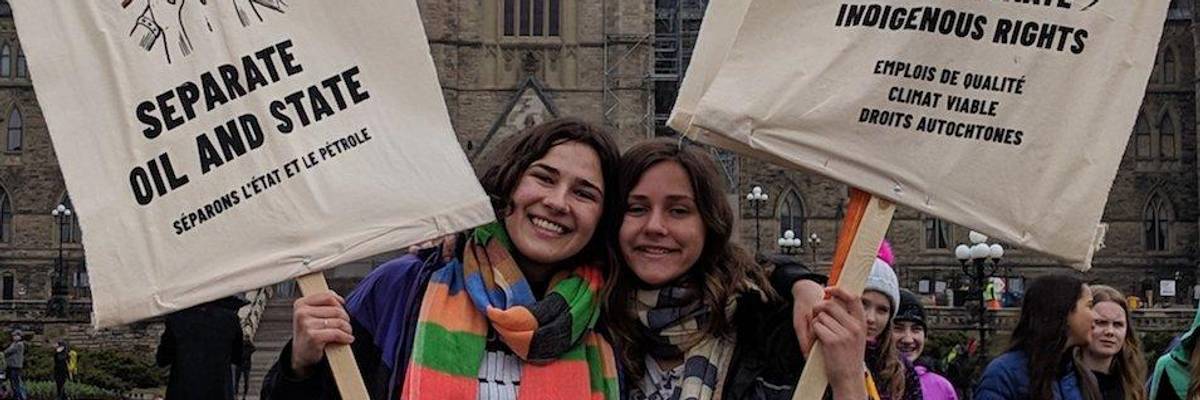
Youth in Ottawa take part in the Friday Climate Strike on May 3, 2019. (Photo: Julie Weder, Twitter)
Time to Follow the Green New Leaders
Young people are rapidly changing the political calculus on climate in this country — even though many of the leaders are too young to vote
Last week, the first state of emergency in what many British Columbians now just call "fire season" got underway. And yet, with her Ottawa riding weeks into an epic flooding emergency of its own, our federal Minister of Environment and Climate Change urged us not to move too fast. "Climate action is a marathon, not a sprint," she declared in an op-ed.
We were born 30 years apart, one of us a veteran filmmaker and organizer, the other a newly graduated environmental science student. We met through our mutual support of The Pact for a Green New Deal. And here's something else we passionately agree on: given the decades of failure by governments of every stripe, the fight against the climate crisis is now a marathon that must be run at the speed of a sprint.
We're pretty sure that Catherine McKenna knows this too. In 2015, she helped ensure the Paris text included the goal of holding global warming to 1.5 C. She's read the followup report that gives humanity 11 years to cut global emissions in half, or put hundreds of millions more people at risk of starvation and death from climate-driven disasters.
And she surely knows that speed must be matched with justice. That means Indigenous leadership on climate action, including full implementation of the UN Declaration on the Rights of Indigenous Peoples, and the foundational right to free, prior and informed consent.
But despite declarations of climate emergency and grand bargains around pipelines and carbon taxes, on Canada's fair share of global climate action, we are not even at the starting line.
You know who is, though? Young people. Hundreds of thousands have walked out of school to demand that governments start responding to this existential emergency with "rapid, far-reaching and unprecedented changes in all aspects of society."
And this is not just a race to reduce emissions. In fact, putting climate action in that technocratic box is one of the reasons we are stuck. The vast changes necessary represent a once-in-a-lifetime opportunity to enact a just transition for everyone: a fairer, more prosperous life for all who live and work in this land.
This idea is catching fire. The Pact for a Green New Deal was launched this month and it already has tens of thousands of signatories, and more than 200 town hall meetings are hastily being scheduled.
Why are youth leading this charge? Consider the experience of a young person finding their voice in the extraordinary climate strike movement.
You're in high school, and it's chaos. Your supersized classes are getting bigger thanks to provincial cuts. Or you're in university, working for peanuts in the gig economy, with a mortgage-sized debt on graduation.
Speaking of mortgages, that's one stress you'll never have, because a house in your city costs more than a lottery jackpot.
And if you're a racialized, Indigenous, queer, or migrant youth, you face all this precariousness plus the heart-racing, everyday fear of discrimination, hate, or violence -- whether from emboldened white supremacists, or the traditional institutions of the state.
Climate is clearly not the only crisis you face, but it's the one that best displays the destructive scale of the economic logic behind all the others. So you go to a meeting with a couple of friends. Somewhere between the first sign-painting party and the final "grieving circle," you find a community of like-minded peers, a sense of purpose and connection. You start to organize your school's next climate strike, calling for a Green New Deal that leaves no one behind.
Young people are rapidly changing the political calculus on climate in this country -- even though many of the leaders are too young to vote. The next step must be a multi-generational, multiracial movement, big enough to force action at the scale and speed that science, justice, and Indigenous knowledge require.
The climate strike movement has been clear in its most revolutionary demand: don't praise us, don't patronize us, join us. That's what has to happen next.
You know how we run a marathon at the speed of a sprint? We make it a relay.
FINAL DAY! This is urgent.
Dear Common Dreams reader, It’s been nearly 30 years since I co-founded Common Dreams with my late wife, Lina Newhouser. We had the radical notion that journalism should serve the public good, not corporate profits. It was clear to us from the outset what it would take to build such a project. No paid advertisements. No corporate sponsors. No millionaire publisher telling us what to think or do. Many people said we wouldn't last a year, but we proved those doubters wrong. Together with a tremendous team of journalists and dedicated staff, we built an independent media outlet free from the constraints of profits and corporate control. Our mission from the outset was simple. To inform. To inspire. To ignite change for the common good. Building Common Dreams was not easy. Our survival was never guaranteed. When you take on the most powerful forces—Wall Street greed, fossil fuel industry destruction, Big Tech lobbyists, and uber-rich oligarchs who have spent billions upon billions rigging the economy and democracy in their favor—the only bulwark you have is supporters who believe in your work. But here’s the urgent message from me today. It’s never been this bad out there. And it’s never been this hard to keep us going. At the very moment Common Dreams is most needed and doing some of its best and most important work, the threats we face are intensifying. Right now, with just hours left in our Spring Campaign, we're still falling short of our make-or-break goal. When everyone does the little they can afford, we are strong. But if that support retreats or dries up, so do we. Can you make a gift right now to make sure Common Dreams not only survives but thrives? There is no backup plan or rainy day fund. There is only you. —Craig Brown, Co-founder |
Last week, the first state of emergency in what many British Columbians now just call "fire season" got underway. And yet, with her Ottawa riding weeks into an epic flooding emergency of its own, our federal Minister of Environment and Climate Change urged us not to move too fast. "Climate action is a marathon, not a sprint," she declared in an op-ed.
We were born 30 years apart, one of us a veteran filmmaker and organizer, the other a newly graduated environmental science student. We met through our mutual support of The Pact for a Green New Deal. And here's something else we passionately agree on: given the decades of failure by governments of every stripe, the fight against the climate crisis is now a marathon that must be run at the speed of a sprint.
We're pretty sure that Catherine McKenna knows this too. In 2015, she helped ensure the Paris text included the goal of holding global warming to 1.5 C. She's read the followup report that gives humanity 11 years to cut global emissions in half, or put hundreds of millions more people at risk of starvation and death from climate-driven disasters.
And she surely knows that speed must be matched with justice. That means Indigenous leadership on climate action, including full implementation of the UN Declaration on the Rights of Indigenous Peoples, and the foundational right to free, prior and informed consent.
But despite declarations of climate emergency and grand bargains around pipelines and carbon taxes, on Canada's fair share of global climate action, we are not even at the starting line.
You know who is, though? Young people. Hundreds of thousands have walked out of school to demand that governments start responding to this existential emergency with "rapid, far-reaching and unprecedented changes in all aspects of society."
And this is not just a race to reduce emissions. In fact, putting climate action in that technocratic box is one of the reasons we are stuck. The vast changes necessary represent a once-in-a-lifetime opportunity to enact a just transition for everyone: a fairer, more prosperous life for all who live and work in this land.
This idea is catching fire. The Pact for a Green New Deal was launched this month and it already has tens of thousands of signatories, and more than 200 town hall meetings are hastily being scheduled.
Why are youth leading this charge? Consider the experience of a young person finding their voice in the extraordinary climate strike movement.
You're in high school, and it's chaos. Your supersized classes are getting bigger thanks to provincial cuts. Or you're in university, working for peanuts in the gig economy, with a mortgage-sized debt on graduation.
Speaking of mortgages, that's one stress you'll never have, because a house in your city costs more than a lottery jackpot.
And if you're a racialized, Indigenous, queer, or migrant youth, you face all this precariousness plus the heart-racing, everyday fear of discrimination, hate, or violence -- whether from emboldened white supremacists, or the traditional institutions of the state.
Climate is clearly not the only crisis you face, but it's the one that best displays the destructive scale of the economic logic behind all the others. So you go to a meeting with a couple of friends. Somewhere between the first sign-painting party and the final "grieving circle," you find a community of like-minded peers, a sense of purpose and connection. You start to organize your school's next climate strike, calling for a Green New Deal that leaves no one behind.
Young people are rapidly changing the political calculus on climate in this country -- even though many of the leaders are too young to vote. The next step must be a multi-generational, multiracial movement, big enough to force action at the scale and speed that science, justice, and Indigenous knowledge require.
The climate strike movement has been clear in its most revolutionary demand: don't praise us, don't patronize us, join us. That's what has to happen next.
You know how we run a marathon at the speed of a sprint? We make it a relay.
Last week, the first state of emergency in what many British Columbians now just call "fire season" got underway. And yet, with her Ottawa riding weeks into an epic flooding emergency of its own, our federal Minister of Environment and Climate Change urged us not to move too fast. "Climate action is a marathon, not a sprint," she declared in an op-ed.
We were born 30 years apart, one of us a veteran filmmaker and organizer, the other a newly graduated environmental science student. We met through our mutual support of The Pact for a Green New Deal. And here's something else we passionately agree on: given the decades of failure by governments of every stripe, the fight against the climate crisis is now a marathon that must be run at the speed of a sprint.
We're pretty sure that Catherine McKenna knows this too. In 2015, she helped ensure the Paris text included the goal of holding global warming to 1.5 C. She's read the followup report that gives humanity 11 years to cut global emissions in half, or put hundreds of millions more people at risk of starvation and death from climate-driven disasters.
And she surely knows that speed must be matched with justice. That means Indigenous leadership on climate action, including full implementation of the UN Declaration on the Rights of Indigenous Peoples, and the foundational right to free, prior and informed consent.
But despite declarations of climate emergency and grand bargains around pipelines and carbon taxes, on Canada's fair share of global climate action, we are not even at the starting line.
You know who is, though? Young people. Hundreds of thousands have walked out of school to demand that governments start responding to this existential emergency with "rapid, far-reaching and unprecedented changes in all aspects of society."
And this is not just a race to reduce emissions. In fact, putting climate action in that technocratic box is one of the reasons we are stuck. The vast changes necessary represent a once-in-a-lifetime opportunity to enact a just transition for everyone: a fairer, more prosperous life for all who live and work in this land.
This idea is catching fire. The Pact for a Green New Deal was launched this month and it already has tens of thousands of signatories, and more than 200 town hall meetings are hastily being scheduled.
Why are youth leading this charge? Consider the experience of a young person finding their voice in the extraordinary climate strike movement.
You're in high school, and it's chaos. Your supersized classes are getting bigger thanks to provincial cuts. Or you're in university, working for peanuts in the gig economy, with a mortgage-sized debt on graduation.
Speaking of mortgages, that's one stress you'll never have, because a house in your city costs more than a lottery jackpot.
And if you're a racialized, Indigenous, queer, or migrant youth, you face all this precariousness plus the heart-racing, everyday fear of discrimination, hate, or violence -- whether from emboldened white supremacists, or the traditional institutions of the state.
Climate is clearly not the only crisis you face, but it's the one that best displays the destructive scale of the economic logic behind all the others. So you go to a meeting with a couple of friends. Somewhere between the first sign-painting party and the final "grieving circle," you find a community of like-minded peers, a sense of purpose and connection. You start to organize your school's next climate strike, calling for a Green New Deal that leaves no one behind.
Young people are rapidly changing the political calculus on climate in this country -- even though many of the leaders are too young to vote. The next step must be a multi-generational, multiracial movement, big enough to force action at the scale and speed that science, justice, and Indigenous knowledge require.
The climate strike movement has been clear in its most revolutionary demand: don't praise us, don't patronize us, join us. That's what has to happen next.
You know how we run a marathon at the speed of a sprint? We make it a relay.