SUBSCRIBE TO OUR FREE NEWSLETTER
Daily news & progressive opinion—funded by the people, not the corporations—delivered straight to your inbox.
5
#000000
#FFFFFF
To donate by check, phone, or other method, see our More Ways to Give page.
Daily news & progressive opinion—funded by the people, not the corporations—delivered straight to your inbox.
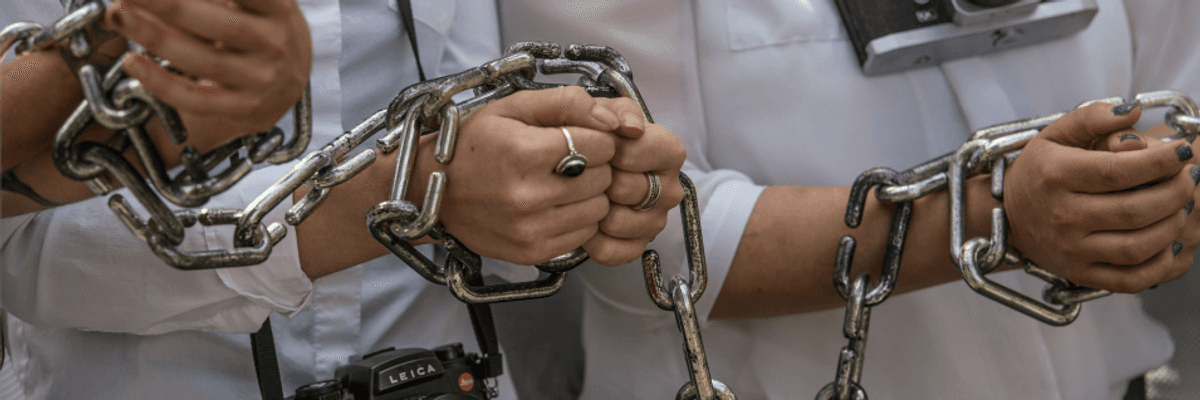
Activists wear chains on their wrists as they protest outside the Egyptian Embassy to highlight the plight of jailed Egyptian photojournalist 'Shawkan', on August 14, 2017 in London, England. One photograph was taken for each of the 1,460 days that photographer 'Shawkan', whose real name is Mahmoud Abu Zeid, has spent in jail since being arrested while taking photographs during a military crackdown in 2013. (Photo: Carl Court/Getty Images)
Today is World Freedom Press Day and it's as good a day as any to be very clear about why this issue remains crucial. Here are ten key reasons:
1. Questioning Power: A truly free and independent press is a fundamental tool for holding those in and with power -- be it political, economic or social -- to account. When journalism aligns itself too closely with, or is co-opted by, any of these agents of power, citizens suffer. And, make no mistake about it...an alignment with corporate power can be just as corrosive to journalism and free press as an alignment with political power.
2. Democracy: A vibrant, critical, free press is absolutely fundamental to a functioning democracy. Yes, it's a cliche, but that doesn't mean it isn't true. A lack of free press could lead citizens to make decisions based on misinformation: decisions which might be against their own best interests and serve the interests of those already holding power.
3. Visions of Citizenship: The presence of high quality, critical press helps to shape a vision of citizenship that goes beyond simply voting once every four years, or of citizenship as being your role as a consumer. It generates a vision of citizenship where there is a sense of engagement with community, and sense of collective destiny and responsibility that extends beyond politics and market.
4. The Local Matters: As we focus much of our attention on the national media, consider the pricelessness of good, local journalism, and what such journalism adds to a sense of community. How much of the nuance and specificity that is lost when stories are framed at the national level are brought back to life. Local journalism shows how issues of power, justice and community work at scales much easier to see and comprehend.
5. The Global Matters: Just as good local journalism matters, so does good international reporting. Our personal experiences of the outside world can be very limited, so the power of journalism to "frame" global politics for us is considerable. An independent, critical press doesn't just tell us what happens abroad, it also explains broader international causes and implications of those events, and does so by avoiding the use of lazy stereotypes and talking points.
6. The Devil is in the Details: There is no substitute for depth, detail and context. None.
7. Storytelling: Good journalism isn't just about giving facts, it's also about presenting facts in an engaging fashion. In other words, it's about storytelling that appeals to multiple facets of our personalities, brains, emotions and intellects. The best journalism is art, and art enriches.
8. There's More to Life: There is life beyond politics, economy or the military. A free and independent press contributes to democracy and society by also covering the arts, culture, sports, etc. This brings us back to the notion of citizenship: good journalism that covers multiple aspects of human existence generates a synergy effect where the total is greater than the sum of the individual parts.
9. Media Investigate Themselves: This is a tough one as it is very rare...but important. A free, vibrant and critical press also interrogates the power of the institutions of journalism and media in society. It interrogates the relationship between media, politics and market. And, it interrogates how media wield their considerable storytelling and agenda-setting power. It is self-reflexive and self-critical. Media are agents of power, and should be investigated as such.
10. The Search for Justice: Some of the very best journalism exposes injustice, and leads to rectification of that injustice. Some people will say that this strays over into "activism." This use of the term "activism" is meant to suggest bias. But, given that justice is about fundamental fairness and the rejection of the exploitation of the less powerful by the more powerful, I see no contradiction.
Dear Common Dreams reader, It’s been nearly 30 years since I co-founded Common Dreams with my late wife, Lina Newhouser. We had the radical notion that journalism should serve the public good, not corporate profits. It was clear to us from the outset what it would take to build such a project. No paid advertisements. No corporate sponsors. No millionaire publisher telling us what to think or do. Many people said we wouldn't last a year, but we proved those doubters wrong. Together with a tremendous team of journalists and dedicated staff, we built an independent media outlet free from the constraints of profits and corporate control. Our mission has always been simple: To inform. To inspire. To ignite change for the common good. Building Common Dreams was not easy. Our survival was never guaranteed. When you take on the most powerful forces—Wall Street greed, fossil fuel industry destruction, Big Tech lobbyists, and uber-rich oligarchs who have spent billions upon billions rigging the economy and democracy in their favor—the only bulwark you have is supporters who believe in your work. But here’s the urgent message from me today. It's never been this bad out there. And it's never been this hard to keep us going. At the very moment Common Dreams is most needed, the threats we face are intensifying. We need your support now more than ever. We don't accept corporate advertising and never will. We don't have a paywall because we don't think people should be blocked from critical news based on their ability to pay. Everything we do is funded by the donations of readers like you. When everyone does the little they can afford, we are strong. But if that support retreats or dries up, so do we. Will you donate now to make sure Common Dreams not only survives but thrives? —Craig Brown, Co-founder |
Today is World Freedom Press Day and it's as good a day as any to be very clear about why this issue remains crucial. Here are ten key reasons:
1. Questioning Power: A truly free and independent press is a fundamental tool for holding those in and with power -- be it political, economic or social -- to account. When journalism aligns itself too closely with, or is co-opted by, any of these agents of power, citizens suffer. And, make no mistake about it...an alignment with corporate power can be just as corrosive to journalism and free press as an alignment with political power.
2. Democracy: A vibrant, critical, free press is absolutely fundamental to a functioning democracy. Yes, it's a cliche, but that doesn't mean it isn't true. A lack of free press could lead citizens to make decisions based on misinformation: decisions which might be against their own best interests and serve the interests of those already holding power.
3. Visions of Citizenship: The presence of high quality, critical press helps to shape a vision of citizenship that goes beyond simply voting once every four years, or of citizenship as being your role as a consumer. It generates a vision of citizenship where there is a sense of engagement with community, and sense of collective destiny and responsibility that extends beyond politics and market.
4. The Local Matters: As we focus much of our attention on the national media, consider the pricelessness of good, local journalism, and what such journalism adds to a sense of community. How much of the nuance and specificity that is lost when stories are framed at the national level are brought back to life. Local journalism shows how issues of power, justice and community work at scales much easier to see and comprehend.
5. The Global Matters: Just as good local journalism matters, so does good international reporting. Our personal experiences of the outside world can be very limited, so the power of journalism to "frame" global politics for us is considerable. An independent, critical press doesn't just tell us what happens abroad, it also explains broader international causes and implications of those events, and does so by avoiding the use of lazy stereotypes and talking points.
6. The Devil is in the Details: There is no substitute for depth, detail and context. None.
7. Storytelling: Good journalism isn't just about giving facts, it's also about presenting facts in an engaging fashion. In other words, it's about storytelling that appeals to multiple facets of our personalities, brains, emotions and intellects. The best journalism is art, and art enriches.
8. There's More to Life: There is life beyond politics, economy or the military. A free and independent press contributes to democracy and society by also covering the arts, culture, sports, etc. This brings us back to the notion of citizenship: good journalism that covers multiple aspects of human existence generates a synergy effect where the total is greater than the sum of the individual parts.
9. Media Investigate Themselves: This is a tough one as it is very rare...but important. A free, vibrant and critical press also interrogates the power of the institutions of journalism and media in society. It interrogates the relationship between media, politics and market. And, it interrogates how media wield their considerable storytelling and agenda-setting power. It is self-reflexive and self-critical. Media are agents of power, and should be investigated as such.
10. The Search for Justice: Some of the very best journalism exposes injustice, and leads to rectification of that injustice. Some people will say that this strays over into "activism." This use of the term "activism" is meant to suggest bias. But, given that justice is about fundamental fairness and the rejection of the exploitation of the less powerful by the more powerful, I see no contradiction.
Today is World Freedom Press Day and it's as good a day as any to be very clear about why this issue remains crucial. Here are ten key reasons:
1. Questioning Power: A truly free and independent press is a fundamental tool for holding those in and with power -- be it political, economic or social -- to account. When journalism aligns itself too closely with, or is co-opted by, any of these agents of power, citizens suffer. And, make no mistake about it...an alignment with corporate power can be just as corrosive to journalism and free press as an alignment with political power.
2. Democracy: A vibrant, critical, free press is absolutely fundamental to a functioning democracy. Yes, it's a cliche, but that doesn't mean it isn't true. A lack of free press could lead citizens to make decisions based on misinformation: decisions which might be against their own best interests and serve the interests of those already holding power.
3. Visions of Citizenship: The presence of high quality, critical press helps to shape a vision of citizenship that goes beyond simply voting once every four years, or of citizenship as being your role as a consumer. It generates a vision of citizenship where there is a sense of engagement with community, and sense of collective destiny and responsibility that extends beyond politics and market.
4. The Local Matters: As we focus much of our attention on the national media, consider the pricelessness of good, local journalism, and what such journalism adds to a sense of community. How much of the nuance and specificity that is lost when stories are framed at the national level are brought back to life. Local journalism shows how issues of power, justice and community work at scales much easier to see and comprehend.
5. The Global Matters: Just as good local journalism matters, so does good international reporting. Our personal experiences of the outside world can be very limited, so the power of journalism to "frame" global politics for us is considerable. An independent, critical press doesn't just tell us what happens abroad, it also explains broader international causes and implications of those events, and does so by avoiding the use of lazy stereotypes and talking points.
6. The Devil is in the Details: There is no substitute for depth, detail and context. None.
7. Storytelling: Good journalism isn't just about giving facts, it's also about presenting facts in an engaging fashion. In other words, it's about storytelling that appeals to multiple facets of our personalities, brains, emotions and intellects. The best journalism is art, and art enriches.
8. There's More to Life: There is life beyond politics, economy or the military. A free and independent press contributes to democracy and society by also covering the arts, culture, sports, etc. This brings us back to the notion of citizenship: good journalism that covers multiple aspects of human existence generates a synergy effect where the total is greater than the sum of the individual parts.
9. Media Investigate Themselves: This is a tough one as it is very rare...but important. A free, vibrant and critical press also interrogates the power of the institutions of journalism and media in society. It interrogates the relationship between media, politics and market. And, it interrogates how media wield their considerable storytelling and agenda-setting power. It is self-reflexive and self-critical. Media are agents of power, and should be investigated as such.
10. The Search for Justice: Some of the very best journalism exposes injustice, and leads to rectification of that injustice. Some people will say that this strays over into "activism." This use of the term "activism" is meant to suggest bias. But, given that justice is about fundamental fairness and the rejection of the exploitation of the less powerful by the more powerful, I see no contradiction.