SUBSCRIBE TO OUR FREE NEWSLETTER
Daily news & progressive opinion—funded by the people, not the corporations—delivered straight to your inbox.
5
#000000
#FFFFFF
To donate by check, phone, or other method, see our More Ways to Give page.
Daily news & progressive opinion—funded by the people, not the corporations—delivered straight to your inbox.
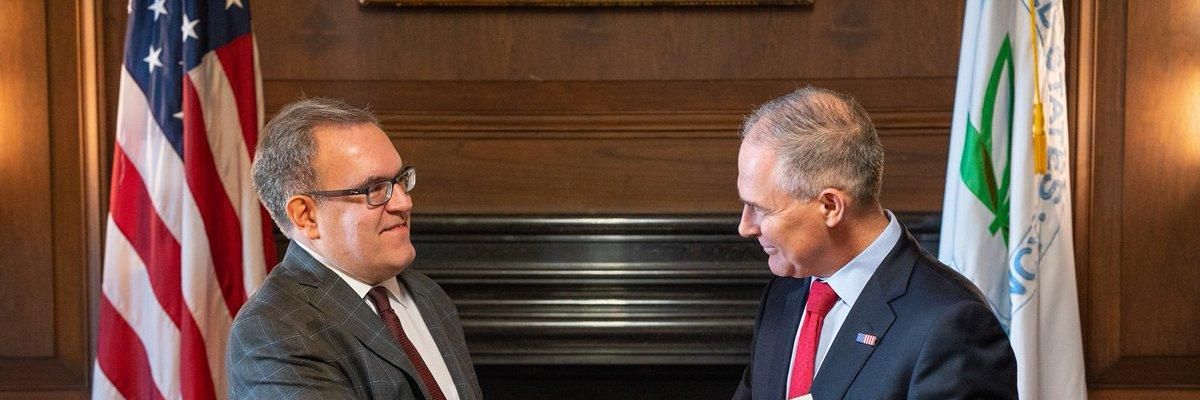
Former coal industry lobbyist Andrew Wheeler getting sworn in on Saturday as EPA administrator. (Photo: EPA)
Current talk of the Green New Deal or the GOP alternative Green Real Deal notwithstanding, the political contrast between the first Earth Day in 1970 and this year's Earth Day is stark. While some still debate Nixon's environmental record, there is no ambiguity in president Trump's. He is sounding the retreat, not leading the charge.
When the first Earth Day was proclaimed in April of 1970, Nixon was working on the creation of the Environmental Protection Agency, and before the year was over, Nixon would sign the landmark Clean Air Act of 1970 into law. The Trump administration's environmental outlook, however, is the mirror image opposite of Nixon's.
Last month, the UN's sixth Global Environment Outlook report, or GEO-6 for short, warned that environmental degradation is "endangering the ecological foundations of society," and called for "bold, urgent, sustainable and inclusive action."
At the White House, GEO-6 was dead on arrival, as the Trump administration was busy unveiling a budget proposal that would slash funds for fighting climate change and other environmental hazards.
GEO-6 identified "population, economic development, and climate change" as the principal "drivers" of environmental degradation. But instead of hitting the brake on those three drivers, the White House is hitting the accelerator.
World population, currently 7.7 billion, is projected to rise to 8.6 billion by 2030 and nearly 10 billion by mid-century. Noting that "long-term sustainability is incompatible with growing populations," the GEO-6 report urges expanding access to contraception in the developing world, where 97 percent of the projected growth is expected to occur. But the president's budget would cut U.S. support for international family planning assistance by more than half.
Gender inequality is a principal driver of high birth rates and rapid population growth in developing countries. Recognizing this, GEO-6 urges support for foreign assistance programs that advance the health and education of girls. But the president's budget would cut State Department and USAID funding by 24 percent, almost certainly requiring major cuts in funding for girls' health and education.
The GEO-6 report stresses the need to "decouple growth from negative environmental impacts." But the Trump administration has slashed dozens of environmental regulations affecting air, land, and water resources, and it now wants to cut EPA funding by 31 percent.
Trump's blithe dismissals of climate change and other environmental threats set him apart, starkly and tragically, from other world leaders.GEO-6 warns anthropogenic climate change, already well under way, will "amplify existing risks and create new risks for natural and human systems," and it argues that world leaders must commit to bringing net greenhouse gases emissions to zero by mid-century. But Trump's repudiation of the Paris Climate Accord and his deregulation of coal-fired plants are aimed at burning more coal.
Some world leaders are publicly supportive of environmental objectives, but fail to walk the walk. President Trump, on the other hand, doesn't even talk the talk. His blithe dismissals of climate change and other environmental threats set him apart, starkly and tragically, from other world leaders.
So far, Congress has rejected Trump's call for draconian cuts in EPA funding, but it has done nothing to stop Trump's derailing of Obama administration plans for reining in greenhouse gases, including the phase out of coal-fired power plants.
We urgently need to change course. As UN Secretary-General Antonio Guterres warned in releasing the GEO-6 report, we need "a significant shift in trajectory." That will likely require change on the scale of the proposed Green New Deal, an approach that was rejected last month by Republicans and a handful of Democrats in the Senate.
There are, however, reasons for hope. A small but growing number of Republicans in Congress are acknowledging the reality of anthropogenic climate change, including Rep. Matt Gaetz, (FL-01). He recently unveiled his Green Real Deal proposal, and while it stops far short of what needs to be done, it's a sign of a warming political climate. After Swedish teenager Greta Thunberg made an emotional appeal to the UN in December, student-led climate change protests have proliferated. A new global movement may be in the making.
The way forward on climate change does not require economic hardship. Just as the U.S. prospered while slashing automobile emissions and setting wastewater standards, we can also prosper while spurring swift reduction in greenhouse gas emissions by phasing in a substantial and economically efficient carbon tax. At the same time, we can slow population growth by improving access to family planning services at home and abroad. Doing these things today would improve the odds of brighter Earth Days ahead.
This article was produced by Earth | Food | Life, a project of the Independent Media Institute.
Dear Common Dreams reader, It’s been nearly 30 years since I co-founded Common Dreams with my late wife, Lina Newhouser. We had the radical notion that journalism should serve the public good, not corporate profits. It was clear to us from the outset what it would take to build such a project. No paid advertisements. No corporate sponsors. No millionaire publisher telling us what to think or do. Many people said we wouldn't last a year, but we proved those doubters wrong. Together with a tremendous team of journalists and dedicated staff, we built an independent media outlet free from the constraints of profits and corporate control. Our mission has always been simple: To inform. To inspire. To ignite change for the common good. Building Common Dreams was not easy. Our survival was never guaranteed. When you take on the most powerful forces—Wall Street greed, fossil fuel industry destruction, Big Tech lobbyists, and uber-rich oligarchs who have spent billions upon billions rigging the economy and democracy in their favor—the only bulwark you have is supporters who believe in your work. But here’s the urgent message from me today. It's never been this bad out there. And it's never been this hard to keep us going. At the very moment Common Dreams is most needed, the threats we face are intensifying. We need your support now more than ever. We don't accept corporate advertising and never will. We don't have a paywall because we don't think people should be blocked from critical news based on their ability to pay. Everything we do is funded by the donations of readers like you. When everyone does the little they can afford, we are strong. But if that support retreats or dries up, so do we. Will you donate now to make sure Common Dreams not only survives but thrives? —Craig Brown, Co-founder |
Current talk of the Green New Deal or the GOP alternative Green Real Deal notwithstanding, the political contrast between the first Earth Day in 1970 and this year's Earth Day is stark. While some still debate Nixon's environmental record, there is no ambiguity in president Trump's. He is sounding the retreat, not leading the charge.
When the first Earth Day was proclaimed in April of 1970, Nixon was working on the creation of the Environmental Protection Agency, and before the year was over, Nixon would sign the landmark Clean Air Act of 1970 into law. The Trump administration's environmental outlook, however, is the mirror image opposite of Nixon's.
Last month, the UN's sixth Global Environment Outlook report, or GEO-6 for short, warned that environmental degradation is "endangering the ecological foundations of society," and called for "bold, urgent, sustainable and inclusive action."
At the White House, GEO-6 was dead on arrival, as the Trump administration was busy unveiling a budget proposal that would slash funds for fighting climate change and other environmental hazards.
GEO-6 identified "population, economic development, and climate change" as the principal "drivers" of environmental degradation. But instead of hitting the brake on those three drivers, the White House is hitting the accelerator.
World population, currently 7.7 billion, is projected to rise to 8.6 billion by 2030 and nearly 10 billion by mid-century. Noting that "long-term sustainability is incompatible with growing populations," the GEO-6 report urges expanding access to contraception in the developing world, where 97 percent of the projected growth is expected to occur. But the president's budget would cut U.S. support for international family planning assistance by more than half.
Gender inequality is a principal driver of high birth rates and rapid population growth in developing countries. Recognizing this, GEO-6 urges support for foreign assistance programs that advance the health and education of girls. But the president's budget would cut State Department and USAID funding by 24 percent, almost certainly requiring major cuts in funding for girls' health and education.
The GEO-6 report stresses the need to "decouple growth from negative environmental impacts." But the Trump administration has slashed dozens of environmental regulations affecting air, land, and water resources, and it now wants to cut EPA funding by 31 percent.
Trump's blithe dismissals of climate change and other environmental threats set him apart, starkly and tragically, from other world leaders.GEO-6 warns anthropogenic climate change, already well under way, will "amplify existing risks and create new risks for natural and human systems," and it argues that world leaders must commit to bringing net greenhouse gases emissions to zero by mid-century. But Trump's repudiation of the Paris Climate Accord and his deregulation of coal-fired plants are aimed at burning more coal.
Some world leaders are publicly supportive of environmental objectives, but fail to walk the walk. President Trump, on the other hand, doesn't even talk the talk. His blithe dismissals of climate change and other environmental threats set him apart, starkly and tragically, from other world leaders.
So far, Congress has rejected Trump's call for draconian cuts in EPA funding, but it has done nothing to stop Trump's derailing of Obama administration plans for reining in greenhouse gases, including the phase out of coal-fired power plants.
We urgently need to change course. As UN Secretary-General Antonio Guterres warned in releasing the GEO-6 report, we need "a significant shift in trajectory." That will likely require change on the scale of the proposed Green New Deal, an approach that was rejected last month by Republicans and a handful of Democrats in the Senate.
There are, however, reasons for hope. A small but growing number of Republicans in Congress are acknowledging the reality of anthropogenic climate change, including Rep. Matt Gaetz, (FL-01). He recently unveiled his Green Real Deal proposal, and while it stops far short of what needs to be done, it's a sign of a warming political climate. After Swedish teenager Greta Thunberg made an emotional appeal to the UN in December, student-led climate change protests have proliferated. A new global movement may be in the making.
The way forward on climate change does not require economic hardship. Just as the U.S. prospered while slashing automobile emissions and setting wastewater standards, we can also prosper while spurring swift reduction in greenhouse gas emissions by phasing in a substantial and economically efficient carbon tax. At the same time, we can slow population growth by improving access to family planning services at home and abroad. Doing these things today would improve the odds of brighter Earth Days ahead.
This article was produced by Earth | Food | Life, a project of the Independent Media Institute.
Current talk of the Green New Deal or the GOP alternative Green Real Deal notwithstanding, the political contrast between the first Earth Day in 1970 and this year's Earth Day is stark. While some still debate Nixon's environmental record, there is no ambiguity in president Trump's. He is sounding the retreat, not leading the charge.
When the first Earth Day was proclaimed in April of 1970, Nixon was working on the creation of the Environmental Protection Agency, and before the year was over, Nixon would sign the landmark Clean Air Act of 1970 into law. The Trump administration's environmental outlook, however, is the mirror image opposite of Nixon's.
Last month, the UN's sixth Global Environment Outlook report, or GEO-6 for short, warned that environmental degradation is "endangering the ecological foundations of society," and called for "bold, urgent, sustainable and inclusive action."
At the White House, GEO-6 was dead on arrival, as the Trump administration was busy unveiling a budget proposal that would slash funds for fighting climate change and other environmental hazards.
GEO-6 identified "population, economic development, and climate change" as the principal "drivers" of environmental degradation. But instead of hitting the brake on those three drivers, the White House is hitting the accelerator.
World population, currently 7.7 billion, is projected to rise to 8.6 billion by 2030 and nearly 10 billion by mid-century. Noting that "long-term sustainability is incompatible with growing populations," the GEO-6 report urges expanding access to contraception in the developing world, where 97 percent of the projected growth is expected to occur. But the president's budget would cut U.S. support for international family planning assistance by more than half.
Gender inequality is a principal driver of high birth rates and rapid population growth in developing countries. Recognizing this, GEO-6 urges support for foreign assistance programs that advance the health and education of girls. But the president's budget would cut State Department and USAID funding by 24 percent, almost certainly requiring major cuts in funding for girls' health and education.
The GEO-6 report stresses the need to "decouple growth from negative environmental impacts." But the Trump administration has slashed dozens of environmental regulations affecting air, land, and water resources, and it now wants to cut EPA funding by 31 percent.
Trump's blithe dismissals of climate change and other environmental threats set him apart, starkly and tragically, from other world leaders.GEO-6 warns anthropogenic climate change, already well under way, will "amplify existing risks and create new risks for natural and human systems," and it argues that world leaders must commit to bringing net greenhouse gases emissions to zero by mid-century. But Trump's repudiation of the Paris Climate Accord and his deregulation of coal-fired plants are aimed at burning more coal.
Some world leaders are publicly supportive of environmental objectives, but fail to walk the walk. President Trump, on the other hand, doesn't even talk the talk. His blithe dismissals of climate change and other environmental threats set him apart, starkly and tragically, from other world leaders.
So far, Congress has rejected Trump's call for draconian cuts in EPA funding, but it has done nothing to stop Trump's derailing of Obama administration plans for reining in greenhouse gases, including the phase out of coal-fired power plants.
We urgently need to change course. As UN Secretary-General Antonio Guterres warned in releasing the GEO-6 report, we need "a significant shift in trajectory." That will likely require change on the scale of the proposed Green New Deal, an approach that was rejected last month by Republicans and a handful of Democrats in the Senate.
There are, however, reasons for hope. A small but growing number of Republicans in Congress are acknowledging the reality of anthropogenic climate change, including Rep. Matt Gaetz, (FL-01). He recently unveiled his Green Real Deal proposal, and while it stops far short of what needs to be done, it's a sign of a warming political climate. After Swedish teenager Greta Thunberg made an emotional appeal to the UN in December, student-led climate change protests have proliferated. A new global movement may be in the making.
The way forward on climate change does not require economic hardship. Just as the U.S. prospered while slashing automobile emissions and setting wastewater standards, we can also prosper while spurring swift reduction in greenhouse gas emissions by phasing in a substantial and economically efficient carbon tax. At the same time, we can slow population growth by improving access to family planning services at home and abroad. Doing these things today would improve the odds of brighter Earth Days ahead.
This article was produced by Earth | Food | Life, a project of the Independent Media Institute.