SUBSCRIBE TO OUR FREE NEWSLETTER
Daily news & progressive opinion—funded by the people, not the corporations—delivered straight to your inbox.
5
#000000
#FFFFFF
To donate by check, phone, or other method, see our More Ways to Give page.
Daily news & progressive opinion—funded by the people, not the corporations—delivered straight to your inbox.
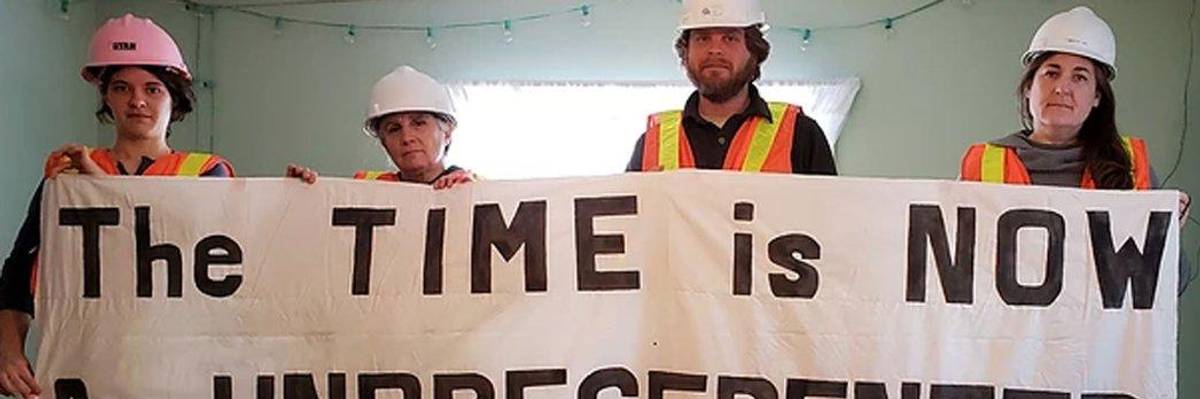
We believe that laws should protect the common good and the community, not corporate interests, and particularly not foreign corporate interests. (Photo: Four Necessity Valve Turners)
In February 4 of this year, four farmers and Catholic workers from the Midwest, myself included, attempted to shut off the flow of deadly, poisonous tar sands oil through Minnesota and the treaty territory of several Ojibwe nations. As the "Four Necessity Valve Turners," we felt compelled to take this necessary, nonviolent action in the face of the imminent threat of the climate crisis - which, according the United Nations' October 2018 report, requires an immediate response.
Given the dramatic failure by governmental bodies to adequately respond to this threat, we felt, as people of faith, that we had to act. Our intent was to responsibly call for a "timeout" from the pumping of poison through the heart of Mother Earth.
Our group - which besides myself includes Brenna Cussen-Anglada, Allyson Polman and Daniel Yildirim - was fully informed of the safest way to proceed with the shutdown process. We put no one in danger. We called Enbridge Energy Corporation (a Canadian company) before attempting to close the valve ourselves, suggesting that they shut off the pressure remotely, which they did. We took responsibility for our action, and waited for the police to arrive. We were charged with a felony and a misdemeanor, and we intend to invoke the necessity defense at our trial.
Actions such as these - combined with a strong Indigenous-led frontline resistance movement, pushback from the nonprofit environmental movement, and the development of new community-based viable green energy projects - seem to be scaring fossil fuel industries. That's why they are insisting on harsher criminal charges, prosecution and consequences.
Since 2016, about three dozen states across the country have considered bills and executive orders explicitly designed to stop dissent against the fossil fuel industry.
Since 2016, about three dozen states across the country have considered bills and executive orders explicitly designed to stop dissent against the fossil fuel industry. Many focus on pipelines that pump tar sands crude oil from Canada through the United States and out to foreign markets.
In March the South Dakota legislature passed and Republican Gov. Kristi Noem signed SB 189, the "Riot-Boosting" bill, which targets anyone who participates in, supports, or encourages protest against pipeline construction infrastructure. In Minnesota, Enbridge has spent 11 million dollars lobbying lawmakers and the state's public utilities commissioners to push forward its Line 3 expansion project, which runs through pristine Mississippi headwaters and wild rice lakes.
Last year, the Minnesota House and Senate passed a punitive bill to end a state water quality standard designed to protect wild rice that was (thankfully) vetoed by then-Governor Mark Dayton. However, with the recent delay in obtaining the necessary permits for Enbridge to go forward with construction, stronger bills against dissent are heading towards the legislature in hopes that current Governor Tim Walz will capitulate. (Both Dayton and Waltz are Democrats.)
We believe that laws should protect the common good and the community, not corporate interests, and particularly not foreign corporate interests.
As for the Four Necessity Valve Turners, our case will be tried before a twelve-person jury, who will decide whether ours was an act of criminality or one of necessity. But the last word will not come from the jury, the judge, or the lawmakers. It will come from our Mother Earth herself.
Dear Common Dreams reader, It’s been nearly 30 years since I co-founded Common Dreams with my late wife, Lina Newhouser. We had the radical notion that journalism should serve the public good, not corporate profits. It was clear to us from the outset what it would take to build such a project. No paid advertisements. No corporate sponsors. No millionaire publisher telling us what to think or do. Many people said we wouldn't last a year, but we proved those doubters wrong. Together with a tremendous team of journalists and dedicated staff, we built an independent media outlet free from the constraints of profits and corporate control. Our mission has always been simple: To inform. To inspire. To ignite change for the common good. Building Common Dreams was not easy. Our survival was never guaranteed. When you take on the most powerful forces—Wall Street greed, fossil fuel industry destruction, Big Tech lobbyists, and uber-rich oligarchs who have spent billions upon billions rigging the economy and democracy in their favor—the only bulwark you have is supporters who believe in your work. But here’s the urgent message from me today. It's never been this bad out there. And it's never been this hard to keep us going. At the very moment Common Dreams is most needed, the threats we face are intensifying. We need your support now more than ever. We don't accept corporate advertising and never will. We don't have a paywall because we don't think people should be blocked from critical news based on their ability to pay. Everything we do is funded by the donations of readers like you. When everyone does the little they can afford, we are strong. But if that support retreats or dries up, so do we. Will you donate now to make sure Common Dreams not only survives but thrives? —Craig Brown, Co-founder |
In February 4 of this year, four farmers and Catholic workers from the Midwest, myself included, attempted to shut off the flow of deadly, poisonous tar sands oil through Minnesota and the treaty territory of several Ojibwe nations. As the "Four Necessity Valve Turners," we felt compelled to take this necessary, nonviolent action in the face of the imminent threat of the climate crisis - which, according the United Nations' October 2018 report, requires an immediate response.
Given the dramatic failure by governmental bodies to adequately respond to this threat, we felt, as people of faith, that we had to act. Our intent was to responsibly call for a "timeout" from the pumping of poison through the heart of Mother Earth.
Our group - which besides myself includes Brenna Cussen-Anglada, Allyson Polman and Daniel Yildirim - was fully informed of the safest way to proceed with the shutdown process. We put no one in danger. We called Enbridge Energy Corporation (a Canadian company) before attempting to close the valve ourselves, suggesting that they shut off the pressure remotely, which they did. We took responsibility for our action, and waited for the police to arrive. We were charged with a felony and a misdemeanor, and we intend to invoke the necessity defense at our trial.
Actions such as these - combined with a strong Indigenous-led frontline resistance movement, pushback from the nonprofit environmental movement, and the development of new community-based viable green energy projects - seem to be scaring fossil fuel industries. That's why they are insisting on harsher criminal charges, prosecution and consequences.
Since 2016, about three dozen states across the country have considered bills and executive orders explicitly designed to stop dissent against the fossil fuel industry.
Since 2016, about three dozen states across the country have considered bills and executive orders explicitly designed to stop dissent against the fossil fuel industry. Many focus on pipelines that pump tar sands crude oil from Canada through the United States and out to foreign markets.
In March the South Dakota legislature passed and Republican Gov. Kristi Noem signed SB 189, the "Riot-Boosting" bill, which targets anyone who participates in, supports, or encourages protest against pipeline construction infrastructure. In Minnesota, Enbridge has spent 11 million dollars lobbying lawmakers and the state's public utilities commissioners to push forward its Line 3 expansion project, which runs through pristine Mississippi headwaters and wild rice lakes.
Last year, the Minnesota House and Senate passed a punitive bill to end a state water quality standard designed to protect wild rice that was (thankfully) vetoed by then-Governor Mark Dayton. However, with the recent delay in obtaining the necessary permits for Enbridge to go forward with construction, stronger bills against dissent are heading towards the legislature in hopes that current Governor Tim Walz will capitulate. (Both Dayton and Waltz are Democrats.)
We believe that laws should protect the common good and the community, not corporate interests, and particularly not foreign corporate interests.
As for the Four Necessity Valve Turners, our case will be tried before a twelve-person jury, who will decide whether ours was an act of criminality or one of necessity. But the last word will not come from the jury, the judge, or the lawmakers. It will come from our Mother Earth herself.
In February 4 of this year, four farmers and Catholic workers from the Midwest, myself included, attempted to shut off the flow of deadly, poisonous tar sands oil through Minnesota and the treaty territory of several Ojibwe nations. As the "Four Necessity Valve Turners," we felt compelled to take this necessary, nonviolent action in the face of the imminent threat of the climate crisis - which, according the United Nations' October 2018 report, requires an immediate response.
Given the dramatic failure by governmental bodies to adequately respond to this threat, we felt, as people of faith, that we had to act. Our intent was to responsibly call for a "timeout" from the pumping of poison through the heart of Mother Earth.
Our group - which besides myself includes Brenna Cussen-Anglada, Allyson Polman and Daniel Yildirim - was fully informed of the safest way to proceed with the shutdown process. We put no one in danger. We called Enbridge Energy Corporation (a Canadian company) before attempting to close the valve ourselves, suggesting that they shut off the pressure remotely, which they did. We took responsibility for our action, and waited for the police to arrive. We were charged with a felony and a misdemeanor, and we intend to invoke the necessity defense at our trial.
Actions such as these - combined with a strong Indigenous-led frontline resistance movement, pushback from the nonprofit environmental movement, and the development of new community-based viable green energy projects - seem to be scaring fossil fuel industries. That's why they are insisting on harsher criminal charges, prosecution and consequences.
Since 2016, about three dozen states across the country have considered bills and executive orders explicitly designed to stop dissent against the fossil fuel industry.
Since 2016, about three dozen states across the country have considered bills and executive orders explicitly designed to stop dissent against the fossil fuel industry. Many focus on pipelines that pump tar sands crude oil from Canada through the United States and out to foreign markets.
In March the South Dakota legislature passed and Republican Gov. Kristi Noem signed SB 189, the "Riot-Boosting" bill, which targets anyone who participates in, supports, or encourages protest against pipeline construction infrastructure. In Minnesota, Enbridge has spent 11 million dollars lobbying lawmakers and the state's public utilities commissioners to push forward its Line 3 expansion project, which runs through pristine Mississippi headwaters and wild rice lakes.
Last year, the Minnesota House and Senate passed a punitive bill to end a state water quality standard designed to protect wild rice that was (thankfully) vetoed by then-Governor Mark Dayton. However, with the recent delay in obtaining the necessary permits for Enbridge to go forward with construction, stronger bills against dissent are heading towards the legislature in hopes that current Governor Tim Walz will capitulate. (Both Dayton and Waltz are Democrats.)
We believe that laws should protect the common good and the community, not corporate interests, and particularly not foreign corporate interests.
As for the Four Necessity Valve Turners, our case will be tried before a twelve-person jury, who will decide whether ours was an act of criminality or one of necessity. But the last word will not come from the jury, the judge, or the lawmakers. It will come from our Mother Earth herself.