SUBSCRIBE TO OUR FREE NEWSLETTER
Daily news & progressive opinion—funded by the people, not the corporations—delivered straight to your inbox.
5
#000000
#FFFFFF
To donate by check, phone, or other method, see our More Ways to Give page.
Daily news & progressive opinion—funded by the people, not the corporations—delivered straight to your inbox.

Illustrative photo of Israeli troops rush through an opening in the separation wall surrounding the Palestinian city of Bethlehem, West Bank, March 28, 2018. (Photo: Wisam Hashlamoun/FLASH90)
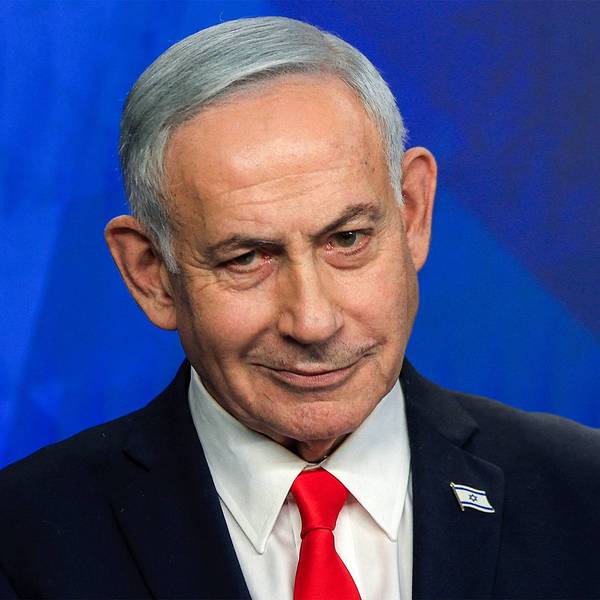
Four years ago, on the eve of Israeli elections, Benjamin Netanyahu promised in a television interview that there would never be a Palestinian state on his watch. He retracted the statement a few days after winning, but only those who wanted to believe him actually did. Opposing Palestinian statehood has always been Netanyahu's policy. He has diverged from it on rare occasions, when he was under enormous pressure to do so, and even then with a conspiratorial wink to his supporters.
On Saturday, again on the eve of Israeli elections, Netanyahu stopped winking. Asked point blank in a television interview if he will annex a bloc of West Bank settlements in his next term, he responded unambiguously in the affirmative.
"Will we move to the next stage? The answer is yes," the prime minister said. "I will apply [Israeli] sovereignty -- and I don't differentiate between settlement blocks and specks of isolated settlements. Each of those specks is Israeli and we have a responsibility as the government of Israel."
Netanyahu's pledge to annex parts of the West Bank should not surprise anyone who has followed Israeli politics in recent years. Others in his political coalitions, and even his own party, have been talking openly about annexation for years. More centrist Israeli thinkers are talking openly about plans for creeping, or de facto, annexation that are almost indiscernible from the right wing's plans, or at least their desired outcome.
Case in point is Micah Goodman's recent article in The Atlantic, published simultaneously in Hebrew and English, that lays out what he claims would be a consensus eight-point plan to "shrink" the conflict instead of solving it. Goodman, a rising public intellectual who claims to spurn labels of right and left, is peddling an idea that is no less an annexation plan than Netanyahu's.
After laying out the various ways in which Israel will continue to control the West Bank more or less as it does today, albeit while granting Palestinians a few more building permits and replacing a few checkpoints with segregated bypass roads, Goodman offers the following:
"So what is this plan's objective? Truthfully, it has no specific end point in mind. These steps and principles are not a waystation en route to a final destination--the way itself is the destination."
Goodman's plan, unlike Netanyahu's ploy to rally the right-wing base on the eve of elections, is, in his words, designed to be something all Jewish Israelis can get behind, from the left to the right. Irrespective of the language one uses -- annexation or shrinking the conflict or even managing the conflict instead of resolving it -- the idea that the occupation will never end is now a mainstream position in Israel.
Netanyahu has declared on many occasions that Israel will never give up security control of the entire territory west of the Jordan River. Among the leaders of mainstream Zionist parties to his left, there is hardly anyone willing to discuss giving up that control. The question that remains is, what does permanent Israeli control over the West Bank and its millions of non-citizen residents look like.
Annexation may have a technical definition, which Israel may or may not ever fulfill. But opponents of annexation are worried not just about crossing an imaginary line in the sand drawn by international law; they fear what permanent Israeli control over the occupied territories would mean, regardless of what form it takes.
Any step meant to further entrench the occupation -- whether by declaring its permanence, as Netanyahu pledged, or by facilitating its permanence, as Goodman's plan outlines -- must therefore be regarded as indistinguishable both in spirit and objective. And if they achieve the same outcome -- keeping the territories under permanent Israeli control -- then any rhetorical attempt to distinguish between them is either an act of deceit or of being deceived.
It's also important to note that annexation as envisioned by both Netanyahu and Goodman doesn't look all that different from the situation on the ground today. (Netanyahu on Saturday did not suggest annexing the entire West Bank, only the Israeli settlements that disfigure it.)
As +972 Magazine's Noam Sheizaf has argued for years, the binary choice between a one-state solution and a two-state solution ignores the third and most likely scenario, one that Israelis have chosen consistently time and again -- maintaining the status quo.
And if the status quo --with Israel as the acting sovereign between the river and the sea -- is made permanent, then the debates and warnings of annexation become nothing more than a rhetorical distraction from reality.
Netanyahu might not be reelected, although I certainly wouldn't bet against him. But considering that Benny Gantz, the only viable alternative, is reasonably likely to adopt an approach similar to Goodman's, it doesn't really matter who wins on April 9. The style might differ, but the substance has long been barreling us down the same path at full speed.
Dear Common Dreams reader, It’s been nearly 30 years since I co-founded Common Dreams with my late wife, Lina Newhouser. We had the radical notion that journalism should serve the public good, not corporate profits. It was clear to us from the outset what it would take to build such a project. No paid advertisements. No corporate sponsors. No millionaire publisher telling us what to think or do. Many people said we wouldn't last a year, but we proved those doubters wrong. Together with a tremendous team of journalists and dedicated staff, we built an independent media outlet free from the constraints of profits and corporate control. Our mission has always been simple: To inform. To inspire. To ignite change for the common good. Building Common Dreams was not easy. Our survival was never guaranteed. When you take on the most powerful forces—Wall Street greed, fossil fuel industry destruction, Big Tech lobbyists, and uber-rich oligarchs who have spent billions upon billions rigging the economy and democracy in their favor—the only bulwark you have is supporters who believe in your work. But here’s the urgent message from me today. It's never been this bad out there. And it's never been this hard to keep us going. At the very moment Common Dreams is most needed, the threats we face are intensifying. We need your support now more than ever. We don't accept corporate advertising and never will. We don't have a paywall because we don't think people should be blocked from critical news based on their ability to pay. Everything we do is funded by the donations of readers like you. When everyone does the little they can afford, we are strong. But if that support retreats or dries up, so do we. Will you donate now to make sure Common Dreams not only survives but thrives? —Craig Brown, Co-founder |
Four years ago, on the eve of Israeli elections, Benjamin Netanyahu promised in a television interview that there would never be a Palestinian state on his watch. He retracted the statement a few days after winning, but only those who wanted to believe him actually did. Opposing Palestinian statehood has always been Netanyahu's policy. He has diverged from it on rare occasions, when he was under enormous pressure to do so, and even then with a conspiratorial wink to his supporters.
On Saturday, again on the eve of Israeli elections, Netanyahu stopped winking. Asked point blank in a television interview if he will annex a bloc of West Bank settlements in his next term, he responded unambiguously in the affirmative.
"Will we move to the next stage? The answer is yes," the prime minister said. "I will apply [Israeli] sovereignty -- and I don't differentiate between settlement blocks and specks of isolated settlements. Each of those specks is Israeli and we have a responsibility as the government of Israel."
Netanyahu's pledge to annex parts of the West Bank should not surprise anyone who has followed Israeli politics in recent years. Others in his political coalitions, and even his own party, have been talking openly about annexation for years. More centrist Israeli thinkers are talking openly about plans for creeping, or de facto, annexation that are almost indiscernible from the right wing's plans, or at least their desired outcome.
Case in point is Micah Goodman's recent article in The Atlantic, published simultaneously in Hebrew and English, that lays out what he claims would be a consensus eight-point plan to "shrink" the conflict instead of solving it. Goodman, a rising public intellectual who claims to spurn labels of right and left, is peddling an idea that is no less an annexation plan than Netanyahu's.
After laying out the various ways in which Israel will continue to control the West Bank more or less as it does today, albeit while granting Palestinians a few more building permits and replacing a few checkpoints with segregated bypass roads, Goodman offers the following:
"So what is this plan's objective? Truthfully, it has no specific end point in mind. These steps and principles are not a waystation en route to a final destination--the way itself is the destination."
Goodman's plan, unlike Netanyahu's ploy to rally the right-wing base on the eve of elections, is, in his words, designed to be something all Jewish Israelis can get behind, from the left to the right. Irrespective of the language one uses -- annexation or shrinking the conflict or even managing the conflict instead of resolving it -- the idea that the occupation will never end is now a mainstream position in Israel.
Netanyahu has declared on many occasions that Israel will never give up security control of the entire territory west of the Jordan River. Among the leaders of mainstream Zionist parties to his left, there is hardly anyone willing to discuss giving up that control. The question that remains is, what does permanent Israeli control over the West Bank and its millions of non-citizen residents look like.
Annexation may have a technical definition, which Israel may or may not ever fulfill. But opponents of annexation are worried not just about crossing an imaginary line in the sand drawn by international law; they fear what permanent Israeli control over the occupied territories would mean, regardless of what form it takes.
Any step meant to further entrench the occupation -- whether by declaring its permanence, as Netanyahu pledged, or by facilitating its permanence, as Goodman's plan outlines -- must therefore be regarded as indistinguishable both in spirit and objective. And if they achieve the same outcome -- keeping the territories under permanent Israeli control -- then any rhetorical attempt to distinguish between them is either an act of deceit or of being deceived.
It's also important to note that annexation as envisioned by both Netanyahu and Goodman doesn't look all that different from the situation on the ground today. (Netanyahu on Saturday did not suggest annexing the entire West Bank, only the Israeli settlements that disfigure it.)
As +972 Magazine's Noam Sheizaf has argued for years, the binary choice between a one-state solution and a two-state solution ignores the third and most likely scenario, one that Israelis have chosen consistently time and again -- maintaining the status quo.
And if the status quo --with Israel as the acting sovereign between the river and the sea -- is made permanent, then the debates and warnings of annexation become nothing more than a rhetorical distraction from reality.
Netanyahu might not be reelected, although I certainly wouldn't bet against him. But considering that Benny Gantz, the only viable alternative, is reasonably likely to adopt an approach similar to Goodman's, it doesn't really matter who wins on April 9. The style might differ, but the substance has long been barreling us down the same path at full speed.
Four years ago, on the eve of Israeli elections, Benjamin Netanyahu promised in a television interview that there would never be a Palestinian state on his watch. He retracted the statement a few days after winning, but only those who wanted to believe him actually did. Opposing Palestinian statehood has always been Netanyahu's policy. He has diverged from it on rare occasions, when he was under enormous pressure to do so, and even then with a conspiratorial wink to his supporters.
On Saturday, again on the eve of Israeli elections, Netanyahu stopped winking. Asked point blank in a television interview if he will annex a bloc of West Bank settlements in his next term, he responded unambiguously in the affirmative.
"Will we move to the next stage? The answer is yes," the prime minister said. "I will apply [Israeli] sovereignty -- and I don't differentiate between settlement blocks and specks of isolated settlements. Each of those specks is Israeli and we have a responsibility as the government of Israel."
Netanyahu's pledge to annex parts of the West Bank should not surprise anyone who has followed Israeli politics in recent years. Others in his political coalitions, and even his own party, have been talking openly about annexation for years. More centrist Israeli thinkers are talking openly about plans for creeping, or de facto, annexation that are almost indiscernible from the right wing's plans, or at least their desired outcome.
Case in point is Micah Goodman's recent article in The Atlantic, published simultaneously in Hebrew and English, that lays out what he claims would be a consensus eight-point plan to "shrink" the conflict instead of solving it. Goodman, a rising public intellectual who claims to spurn labels of right and left, is peddling an idea that is no less an annexation plan than Netanyahu's.
After laying out the various ways in which Israel will continue to control the West Bank more or less as it does today, albeit while granting Palestinians a few more building permits and replacing a few checkpoints with segregated bypass roads, Goodman offers the following:
"So what is this plan's objective? Truthfully, it has no specific end point in mind. These steps and principles are not a waystation en route to a final destination--the way itself is the destination."
Goodman's plan, unlike Netanyahu's ploy to rally the right-wing base on the eve of elections, is, in his words, designed to be something all Jewish Israelis can get behind, from the left to the right. Irrespective of the language one uses -- annexation or shrinking the conflict or even managing the conflict instead of resolving it -- the idea that the occupation will never end is now a mainstream position in Israel.
Netanyahu has declared on many occasions that Israel will never give up security control of the entire territory west of the Jordan River. Among the leaders of mainstream Zionist parties to his left, there is hardly anyone willing to discuss giving up that control. The question that remains is, what does permanent Israeli control over the West Bank and its millions of non-citizen residents look like.
Annexation may have a technical definition, which Israel may or may not ever fulfill. But opponents of annexation are worried not just about crossing an imaginary line in the sand drawn by international law; they fear what permanent Israeli control over the occupied territories would mean, regardless of what form it takes.
Any step meant to further entrench the occupation -- whether by declaring its permanence, as Netanyahu pledged, or by facilitating its permanence, as Goodman's plan outlines -- must therefore be regarded as indistinguishable both in spirit and objective. And if they achieve the same outcome -- keeping the territories under permanent Israeli control -- then any rhetorical attempt to distinguish between them is either an act of deceit or of being deceived.
It's also important to note that annexation as envisioned by both Netanyahu and Goodman doesn't look all that different from the situation on the ground today. (Netanyahu on Saturday did not suggest annexing the entire West Bank, only the Israeli settlements that disfigure it.)
As +972 Magazine's Noam Sheizaf has argued for years, the binary choice between a one-state solution and a two-state solution ignores the third and most likely scenario, one that Israelis have chosen consistently time and again -- maintaining the status quo.
And if the status quo --with Israel as the acting sovereign between the river and the sea -- is made permanent, then the debates and warnings of annexation become nothing more than a rhetorical distraction from reality.
Netanyahu might not be reelected, although I certainly wouldn't bet against him. But considering that Benny Gantz, the only viable alternative, is reasonably likely to adopt an approach similar to Goodman's, it doesn't really matter who wins on April 9. The style might differ, but the substance has long been barreling us down the same path at full speed.