SUBSCRIBE TO OUR FREE NEWSLETTER
Daily news & progressive opinion—funded by the people, not the corporations—delivered straight to your inbox.
5
#000000
#FFFFFF
To donate by check, phone, or other method, see our More Ways to Give page.
Daily news & progressive opinion—funded by the people, not the corporations—delivered straight to your inbox.
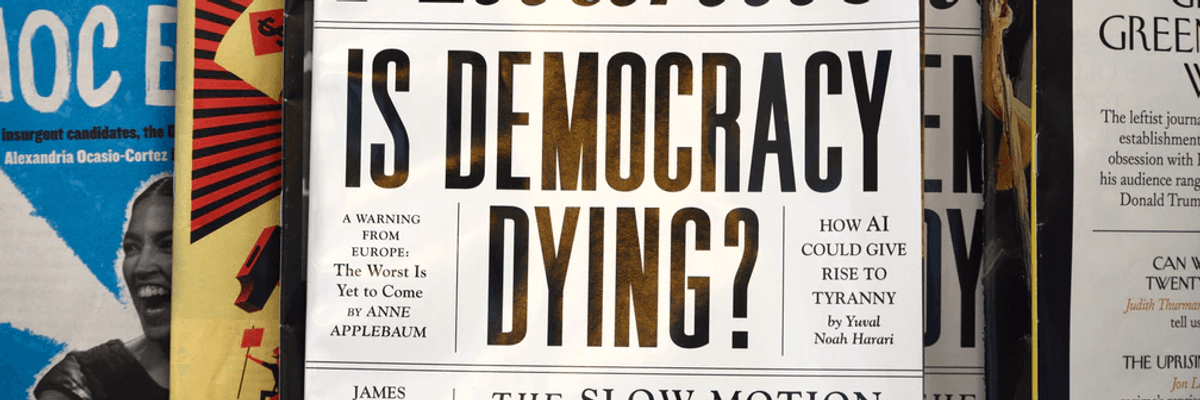
A rack of magazines, including The Atlantic, on display in a bookstore in San Francisco. (Photo: Robert Alexander/Getty Images)
The Atlantic on Tuesday published a sensationalistic series of accusations by reporter Edward-Isaac Dovere aimed at long-time journalist David Sirota, whose hiring by the Sanders 2020 presidential campaign as a speechwriter and adviser had just been announced earlier that day. The Atlantic article predictably and quickly went viral, cited by major media outlets and Democratic Party operatives as proof that Sirota had acted unethically by critically reporting on rival presidential candidates in the prior months while dishonestly concealing his work as an operative or adviser for the Sanders campaign.
In his viral tweet promoting what he hyped as his "SCOOP," Dovere was even more explicitly accusatory, claiming that "Sirota, just hired as Bernie Sanders' speechwriter and senior adviser, has been quietly writing speeches and advising him for months without disclosing it but while bashing pretty much every candidate in the field."
As it turns out, there are indeed serious breaches of journalistic ethics from this episode, but they are ones committed by the Atlantic and Dovere, not by Sirota. That's because the core accusation of the Atlantic article - that Sirota "for months" had been "informally" advising the Sanders campaign as a speechwriter while pretending to be an independent reporter attacking Sanders' opponents - is simply false. It relies on a timeline that simply never happened.
Since publication of Dovere's bombshell, the Atlantic has tweaked and edited the story to reflect the multiple errors and denials that make it appears as though the original version contained those edits. The article at first added what it called an "update" reflecting the Guardian's vehement denial that Sirota, who had been working as a columnist for the paper as well as an investigative reporter for Capital & Main, had performed any work for the Sanders campaign, "informal" or otherwise, while publishing articles at the Guardian: a central claim of the Atlantic story. It now simply includes that denial with no indication that it was added after the fact:
But the various edits and "updates" made by the Atlantic after publication do not begin to reflect what a journalistic debacle this article was. Most critically, the key claim that made the article such a sensation - that Sirota's "informal work for Sanders goes back months" and included "quietly writing speeches" for the Senator - is entire and demonstrably false.
That timeline was so central to the story's significance because it was Sirota's investigation in December of Beto O'Rourke's voting record, donors and funding sources which caused sustained anger and controversy toward Sirota. Sirota's first published his research about O'Rourke's receipt of donations on Twitter in early December, and then his analysis of O'Rourke's voting record was detailed in a widely discussed story that was published by the Guardian on December 20, which fuelled the anger and accusations from Democratic centrists even further against Sirota.
Had it been true, as the Atlantic article claimed, that Sirota's "informal work for Sanders goes back months," it would have meant that Sirota was investigating and reporting on O'Rourke while masquerading as a journalist but in reality working as a concealed Sanders operative: a charge that many establishment Democrats voiced at the time but which Sirota vehemently and aggressively denied.
So the Atlantic's article made it seem not only that the Sanders campaign was behind Sirota's investigative reporting about O'Rourke, but worse, that Sirota outright lied by denying those accusations at the time. The use of the Atlantic's article to claim vindication by the enemies of Sirota, and especially the enemies of Sanders, was so intense and widespread that Sirota's name trended on Twitter for much of the day on Tuesday.
Read the full article, and possible updates, at The Intercept.
Dear Common Dreams reader, It’s been nearly 30 years since I co-founded Common Dreams with my late wife, Lina Newhouser. We had the radical notion that journalism should serve the public good, not corporate profits. It was clear to us from the outset what it would take to build such a project. No paid advertisements. No corporate sponsors. No millionaire publisher telling us what to think or do. Many people said we wouldn't last a year, but we proved those doubters wrong. Together with a tremendous team of journalists and dedicated staff, we built an independent media outlet free from the constraints of profits and corporate control. Our mission has always been simple: To inform. To inspire. To ignite change for the common good. Building Common Dreams was not easy. Our survival was never guaranteed. When you take on the most powerful forces—Wall Street greed, fossil fuel industry destruction, Big Tech lobbyists, and uber-rich oligarchs who have spent billions upon billions rigging the economy and democracy in their favor—the only bulwark you have is supporters who believe in your work. But here’s the urgent message from me today. It's never been this bad out there. And it's never been this hard to keep us going. At the very moment Common Dreams is most needed, the threats we face are intensifying. We need your support now more than ever. We don't accept corporate advertising and never will. We don't have a paywall because we don't think people should be blocked from critical news based on their ability to pay. Everything we do is funded by the donations of readers like you. When everyone does the little they can afford, we are strong. But if that support retreats or dries up, so do we. Will you donate now to make sure Common Dreams not only survives but thrives? —Craig Brown, Co-founder |
The Atlantic on Tuesday published a sensationalistic series of accusations by reporter Edward-Isaac Dovere aimed at long-time journalist David Sirota, whose hiring by the Sanders 2020 presidential campaign as a speechwriter and adviser had just been announced earlier that day. The Atlantic article predictably and quickly went viral, cited by major media outlets and Democratic Party operatives as proof that Sirota had acted unethically by critically reporting on rival presidential candidates in the prior months while dishonestly concealing his work as an operative or adviser for the Sanders campaign.
In his viral tweet promoting what he hyped as his "SCOOP," Dovere was even more explicitly accusatory, claiming that "Sirota, just hired as Bernie Sanders' speechwriter and senior adviser, has been quietly writing speeches and advising him for months without disclosing it but while bashing pretty much every candidate in the field."
As it turns out, there are indeed serious breaches of journalistic ethics from this episode, but they are ones committed by the Atlantic and Dovere, not by Sirota. That's because the core accusation of the Atlantic article - that Sirota "for months" had been "informally" advising the Sanders campaign as a speechwriter while pretending to be an independent reporter attacking Sanders' opponents - is simply false. It relies on a timeline that simply never happened.
Since publication of Dovere's bombshell, the Atlantic has tweaked and edited the story to reflect the multiple errors and denials that make it appears as though the original version contained those edits. The article at first added what it called an "update" reflecting the Guardian's vehement denial that Sirota, who had been working as a columnist for the paper as well as an investigative reporter for Capital & Main, had performed any work for the Sanders campaign, "informal" or otherwise, while publishing articles at the Guardian: a central claim of the Atlantic story. It now simply includes that denial with no indication that it was added after the fact:
But the various edits and "updates" made by the Atlantic after publication do not begin to reflect what a journalistic debacle this article was. Most critically, the key claim that made the article such a sensation - that Sirota's "informal work for Sanders goes back months" and included "quietly writing speeches" for the Senator - is entire and demonstrably false.
That timeline was so central to the story's significance because it was Sirota's investigation in December of Beto O'Rourke's voting record, donors and funding sources which caused sustained anger and controversy toward Sirota. Sirota's first published his research about O'Rourke's receipt of donations on Twitter in early December, and then his analysis of O'Rourke's voting record was detailed in a widely discussed story that was published by the Guardian on December 20, which fuelled the anger and accusations from Democratic centrists even further against Sirota.
Had it been true, as the Atlantic article claimed, that Sirota's "informal work for Sanders goes back months," it would have meant that Sirota was investigating and reporting on O'Rourke while masquerading as a journalist but in reality working as a concealed Sanders operative: a charge that many establishment Democrats voiced at the time but which Sirota vehemently and aggressively denied.
So the Atlantic's article made it seem not only that the Sanders campaign was behind Sirota's investigative reporting about O'Rourke, but worse, that Sirota outright lied by denying those accusations at the time. The use of the Atlantic's article to claim vindication by the enemies of Sirota, and especially the enemies of Sanders, was so intense and widespread that Sirota's name trended on Twitter for much of the day on Tuesday.
Read the full article, and possible updates, at The Intercept.
The Atlantic on Tuesday published a sensationalistic series of accusations by reporter Edward-Isaac Dovere aimed at long-time journalist David Sirota, whose hiring by the Sanders 2020 presidential campaign as a speechwriter and adviser had just been announced earlier that day. The Atlantic article predictably and quickly went viral, cited by major media outlets and Democratic Party operatives as proof that Sirota had acted unethically by critically reporting on rival presidential candidates in the prior months while dishonestly concealing his work as an operative or adviser for the Sanders campaign.
In his viral tweet promoting what he hyped as his "SCOOP," Dovere was even more explicitly accusatory, claiming that "Sirota, just hired as Bernie Sanders' speechwriter and senior adviser, has been quietly writing speeches and advising him for months without disclosing it but while bashing pretty much every candidate in the field."
As it turns out, there are indeed serious breaches of journalistic ethics from this episode, but they are ones committed by the Atlantic and Dovere, not by Sirota. That's because the core accusation of the Atlantic article - that Sirota "for months" had been "informally" advising the Sanders campaign as a speechwriter while pretending to be an independent reporter attacking Sanders' opponents - is simply false. It relies on a timeline that simply never happened.
Since publication of Dovere's bombshell, the Atlantic has tweaked and edited the story to reflect the multiple errors and denials that make it appears as though the original version contained those edits. The article at first added what it called an "update" reflecting the Guardian's vehement denial that Sirota, who had been working as a columnist for the paper as well as an investigative reporter for Capital & Main, had performed any work for the Sanders campaign, "informal" or otherwise, while publishing articles at the Guardian: a central claim of the Atlantic story. It now simply includes that denial with no indication that it was added after the fact:
But the various edits and "updates" made by the Atlantic after publication do not begin to reflect what a journalistic debacle this article was. Most critically, the key claim that made the article such a sensation - that Sirota's "informal work for Sanders goes back months" and included "quietly writing speeches" for the Senator - is entire and demonstrably false.
That timeline was so central to the story's significance because it was Sirota's investigation in December of Beto O'Rourke's voting record, donors and funding sources which caused sustained anger and controversy toward Sirota. Sirota's first published his research about O'Rourke's receipt of donations on Twitter in early December, and then his analysis of O'Rourke's voting record was detailed in a widely discussed story that was published by the Guardian on December 20, which fuelled the anger and accusations from Democratic centrists even further against Sirota.
Had it been true, as the Atlantic article claimed, that Sirota's "informal work for Sanders goes back months," it would have meant that Sirota was investigating and reporting on O'Rourke while masquerading as a journalist but in reality working as a concealed Sanders operative: a charge that many establishment Democrats voiced at the time but which Sirota vehemently and aggressively denied.
So the Atlantic's article made it seem not only that the Sanders campaign was behind Sirota's investigative reporting about O'Rourke, but worse, that Sirota outright lied by denying those accusations at the time. The use of the Atlantic's article to claim vindication by the enemies of Sirota, and especially the enemies of Sanders, was so intense and widespread that Sirota's name trended on Twitter for much of the day on Tuesday.
Read the full article, and possible updates, at The Intercept.