SUBSCRIBE TO OUR FREE NEWSLETTER
Daily news & progressive opinion—funded by the people, not the corporations—delivered straight to your inbox.
5
#000000
#FFFFFF
To donate by check, phone, or other method, see our More Ways to Give page.
Daily news & progressive opinion—funded by the people, not the corporations—delivered straight to your inbox.
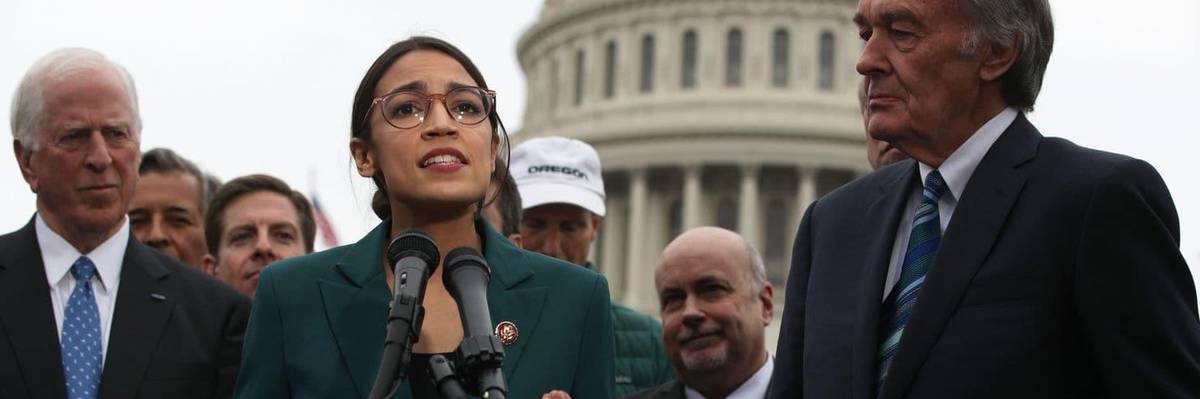
Rep. Alexandria Ocasio-Cortez (D-N.Y.) speaks during a news conference in front of the U.S. Capitol on Feb. 7 in Washington. (Photo: Alex Wong/Getty Images)
Let's consider some real news, for a change: Last year was officially proclaimed the fourth-warmest on record; scientists predict that melting ice in Antarctica and Greenland could not only raise sea levels but also further destabilize weather patterns; and progressive members of Congress are proposing a "Green New Deal," the first policy framework ambitious enough to meet the challenge of global warming.
Please don't stop reading. I know that climate change isn't the sexiest of topics. I could be writing about President Trump's latest tweetstorm, or the shade he was thrown by House Speaker Nancy Pelosi (D-Calif.) at the State of the Union speech, or the blackface and sexual assault scandals that could force Virginia's top three officials to resign, or Sen. Elizabeth Warren's (D-Mass.) ongoing racial-identity crisis, or the House Intelligence Committee's new investigation of some anomalous Trump Organization deals that involved huge and unexplained amounts of cash.
Those are all big and important stories, but climate change is the biggest, most important story of our time. Our grandchildren and great-grandchildren will judge us by how well we meet the challenge, and so far we are failing. Miserably.
Scientists from NASA announced Wednesday that 2018 was the Earth's fourth-warmest year since record-keeping began about 140 years ago. The warmest year of all was 2016, followed in order by 2017 and 2015; the fifth-warmest was 2014. Anyone who is not deliberately being obtuse can see the pattern.
Why is it so hot? Because humankind has increased the concentration of carbon dioxide in the atmosphere by more than 40 percent since the Industrial Revolution. There is now more of the heat-trapping gas in the air than at any time in at least the past 800,000 years. Researchers have looked in vain for any "natural" phenomenon or cycle that could explain the carbon buildup and the rapid warming. Yet global carbon emissions are at an all-time high.
Anyone tempted to shrug -- or even cheer, given the brutal cold that much of the nation suffered last week -- is whistling past the graveyard. Sea-level rise, in part caused by the fact that warmer water takes up more space than cooler water, has already worsened coastal flooding around the world and threatened to erase low-lying islands from the map. Now attention has shifted to the polar regions, where the warming process is proceeding most rapidly and ice is melting at a possibly unprecedented pace.
Hardly a month goes by without some alarming new report about accelerated melting in Antarctica and the various apocalyptic scenarios that might come true. A paper published Wednesday in the journal Nature suggests that a phenomenon known as "marine ice-cliff instability" might not produce as much additional sea-level rise as a 2016 paper had predicted. But a second Nature paper warned that melting ice in Antarctica, Greenland and the Himalayas could seriously disrupt weather and temperature patterns worldwide.
That's the true nature of the scientific debate over climate change. It's not about whether global warming is taking place or what's causing it -- those questions are settled. The open question is whether the effects of human-induced climate change will be really bad, catastrophically bad or threat-to-civilization bad.
Enter the resolution, introduced Thursday by Rep. Alexandria Ocasio-Cortez (D-N.Y.) and Sen. Edward J. Markey (D-Mass.), calling on Congress to create a Green New Deal.
Pelosi has sounded skeptical. "It will be one of several or maybe many suggestions that we receive," she said Wednesday, according to Politico. "The green dream or whatever they call it, nobody knows what it is, but they're for it, right?"
I'm more impressed than the speaker is, however. The point of the resolution is not to propose specific, detailed policy prescriptions. What it does accomplish, though, is to lay out the enormous scale of the climate change problem -- and, as a commensurate response, call for "a new national, social, industrial and economic mobilization on a scale not seen since World War II and the New Deal."
The resolution's goal is to reduce net U.S. carbon emissions to zero through a "10-year national mobilization." Such a crusade, as envisioned, would create jobs and economic development while at the same time safeguarding the biosphere. Yes, proposals such as "upgrading all existing buildings in the United States" and "spurring massive growth in clean manufacturing" and "overhauling transportation systems" sound like pie in the sky. But that's the scale of the crisis.
Sooner or later, we're going to have to go big on climate change. So let's start thinking big.
Dear Common Dreams reader, It’s been nearly 30 years since I co-founded Common Dreams with my late wife, Lina Newhouser. We had the radical notion that journalism should serve the public good, not corporate profits. It was clear to us from the outset what it would take to build such a project. No paid advertisements. No corporate sponsors. No millionaire publisher telling us what to think or do. Many people said we wouldn't last a year, but we proved those doubters wrong. Together with a tremendous team of journalists and dedicated staff, we built an independent media outlet free from the constraints of profits and corporate control. Our mission has always been simple: To inform. To inspire. To ignite change for the common good. Building Common Dreams was not easy. Our survival was never guaranteed. When you take on the most powerful forces—Wall Street greed, fossil fuel industry destruction, Big Tech lobbyists, and uber-rich oligarchs who have spent billions upon billions rigging the economy and democracy in their favor—the only bulwark you have is supporters who believe in your work. But here’s the urgent message from me today. It's never been this bad out there. And it's never been this hard to keep us going. At the very moment Common Dreams is most needed, the threats we face are intensifying. We need your support now more than ever. We don't accept corporate advertising and never will. We don't have a paywall because we don't think people should be blocked from critical news based on their ability to pay. Everything we do is funded by the donations of readers like you. When everyone does the little they can afford, we are strong. But if that support retreats or dries up, so do we. Will you donate now to make sure Common Dreams not only survives but thrives? —Craig Brown, Co-founder |
Let's consider some real news, for a change: Last year was officially proclaimed the fourth-warmest on record; scientists predict that melting ice in Antarctica and Greenland could not only raise sea levels but also further destabilize weather patterns; and progressive members of Congress are proposing a "Green New Deal," the first policy framework ambitious enough to meet the challenge of global warming.
Please don't stop reading. I know that climate change isn't the sexiest of topics. I could be writing about President Trump's latest tweetstorm, or the shade he was thrown by House Speaker Nancy Pelosi (D-Calif.) at the State of the Union speech, or the blackface and sexual assault scandals that could force Virginia's top three officials to resign, or Sen. Elizabeth Warren's (D-Mass.) ongoing racial-identity crisis, or the House Intelligence Committee's new investigation of some anomalous Trump Organization deals that involved huge and unexplained amounts of cash.
Those are all big and important stories, but climate change is the biggest, most important story of our time. Our grandchildren and great-grandchildren will judge us by how well we meet the challenge, and so far we are failing. Miserably.
Scientists from NASA announced Wednesday that 2018 was the Earth's fourth-warmest year since record-keeping began about 140 years ago. The warmest year of all was 2016, followed in order by 2017 and 2015; the fifth-warmest was 2014. Anyone who is not deliberately being obtuse can see the pattern.
Why is it so hot? Because humankind has increased the concentration of carbon dioxide in the atmosphere by more than 40 percent since the Industrial Revolution. There is now more of the heat-trapping gas in the air than at any time in at least the past 800,000 years. Researchers have looked in vain for any "natural" phenomenon or cycle that could explain the carbon buildup and the rapid warming. Yet global carbon emissions are at an all-time high.
Anyone tempted to shrug -- or even cheer, given the brutal cold that much of the nation suffered last week -- is whistling past the graveyard. Sea-level rise, in part caused by the fact that warmer water takes up more space than cooler water, has already worsened coastal flooding around the world and threatened to erase low-lying islands from the map. Now attention has shifted to the polar regions, where the warming process is proceeding most rapidly and ice is melting at a possibly unprecedented pace.
Hardly a month goes by without some alarming new report about accelerated melting in Antarctica and the various apocalyptic scenarios that might come true. A paper published Wednesday in the journal Nature suggests that a phenomenon known as "marine ice-cliff instability" might not produce as much additional sea-level rise as a 2016 paper had predicted. But a second Nature paper warned that melting ice in Antarctica, Greenland and the Himalayas could seriously disrupt weather and temperature patterns worldwide.
That's the true nature of the scientific debate over climate change. It's not about whether global warming is taking place or what's causing it -- those questions are settled. The open question is whether the effects of human-induced climate change will be really bad, catastrophically bad or threat-to-civilization bad.
Enter the resolution, introduced Thursday by Rep. Alexandria Ocasio-Cortez (D-N.Y.) and Sen. Edward J. Markey (D-Mass.), calling on Congress to create a Green New Deal.
Pelosi has sounded skeptical. "It will be one of several or maybe many suggestions that we receive," she said Wednesday, according to Politico. "The green dream or whatever they call it, nobody knows what it is, but they're for it, right?"
I'm more impressed than the speaker is, however. The point of the resolution is not to propose specific, detailed policy prescriptions. What it does accomplish, though, is to lay out the enormous scale of the climate change problem -- and, as a commensurate response, call for "a new national, social, industrial and economic mobilization on a scale not seen since World War II and the New Deal."
The resolution's goal is to reduce net U.S. carbon emissions to zero through a "10-year national mobilization." Such a crusade, as envisioned, would create jobs and economic development while at the same time safeguarding the biosphere. Yes, proposals such as "upgrading all existing buildings in the United States" and "spurring massive growth in clean manufacturing" and "overhauling transportation systems" sound like pie in the sky. But that's the scale of the crisis.
Sooner or later, we're going to have to go big on climate change. So let's start thinking big.
Let's consider some real news, for a change: Last year was officially proclaimed the fourth-warmest on record; scientists predict that melting ice in Antarctica and Greenland could not only raise sea levels but also further destabilize weather patterns; and progressive members of Congress are proposing a "Green New Deal," the first policy framework ambitious enough to meet the challenge of global warming.
Please don't stop reading. I know that climate change isn't the sexiest of topics. I could be writing about President Trump's latest tweetstorm, or the shade he was thrown by House Speaker Nancy Pelosi (D-Calif.) at the State of the Union speech, or the blackface and sexual assault scandals that could force Virginia's top three officials to resign, or Sen. Elizabeth Warren's (D-Mass.) ongoing racial-identity crisis, or the House Intelligence Committee's new investigation of some anomalous Trump Organization deals that involved huge and unexplained amounts of cash.
Those are all big and important stories, but climate change is the biggest, most important story of our time. Our grandchildren and great-grandchildren will judge us by how well we meet the challenge, and so far we are failing. Miserably.
Scientists from NASA announced Wednesday that 2018 was the Earth's fourth-warmest year since record-keeping began about 140 years ago. The warmest year of all was 2016, followed in order by 2017 and 2015; the fifth-warmest was 2014. Anyone who is not deliberately being obtuse can see the pattern.
Why is it so hot? Because humankind has increased the concentration of carbon dioxide in the atmosphere by more than 40 percent since the Industrial Revolution. There is now more of the heat-trapping gas in the air than at any time in at least the past 800,000 years. Researchers have looked in vain for any "natural" phenomenon or cycle that could explain the carbon buildup and the rapid warming. Yet global carbon emissions are at an all-time high.
Anyone tempted to shrug -- or even cheer, given the brutal cold that much of the nation suffered last week -- is whistling past the graveyard. Sea-level rise, in part caused by the fact that warmer water takes up more space than cooler water, has already worsened coastal flooding around the world and threatened to erase low-lying islands from the map. Now attention has shifted to the polar regions, where the warming process is proceeding most rapidly and ice is melting at a possibly unprecedented pace.
Hardly a month goes by without some alarming new report about accelerated melting in Antarctica and the various apocalyptic scenarios that might come true. A paper published Wednesday in the journal Nature suggests that a phenomenon known as "marine ice-cliff instability" might not produce as much additional sea-level rise as a 2016 paper had predicted. But a second Nature paper warned that melting ice in Antarctica, Greenland and the Himalayas could seriously disrupt weather and temperature patterns worldwide.
That's the true nature of the scientific debate over climate change. It's not about whether global warming is taking place or what's causing it -- those questions are settled. The open question is whether the effects of human-induced climate change will be really bad, catastrophically bad or threat-to-civilization bad.
Enter the resolution, introduced Thursday by Rep. Alexandria Ocasio-Cortez (D-N.Y.) and Sen. Edward J. Markey (D-Mass.), calling on Congress to create a Green New Deal.
Pelosi has sounded skeptical. "It will be one of several or maybe many suggestions that we receive," she said Wednesday, according to Politico. "The green dream or whatever they call it, nobody knows what it is, but they're for it, right?"
I'm more impressed than the speaker is, however. The point of the resolution is not to propose specific, detailed policy prescriptions. What it does accomplish, though, is to lay out the enormous scale of the climate change problem -- and, as a commensurate response, call for "a new national, social, industrial and economic mobilization on a scale not seen since World War II and the New Deal."
The resolution's goal is to reduce net U.S. carbon emissions to zero through a "10-year national mobilization." Such a crusade, as envisioned, would create jobs and economic development while at the same time safeguarding the biosphere. Yes, proposals such as "upgrading all existing buildings in the United States" and "spurring massive growth in clean manufacturing" and "overhauling transportation systems" sound like pie in the sky. But that's the scale of the crisis.
Sooner or later, we're going to have to go big on climate change. So let's start thinking big.