SUBSCRIBE TO OUR FREE NEWSLETTER
Daily news & progressive opinion—funded by the people, not the corporations—delivered straight to your inbox.
5
#000000
#FFFFFF
To donate by check, phone, or other method, see our More Ways to Give page.
Daily news & progressive opinion—funded by the people, not the corporations—delivered straight to your inbox.
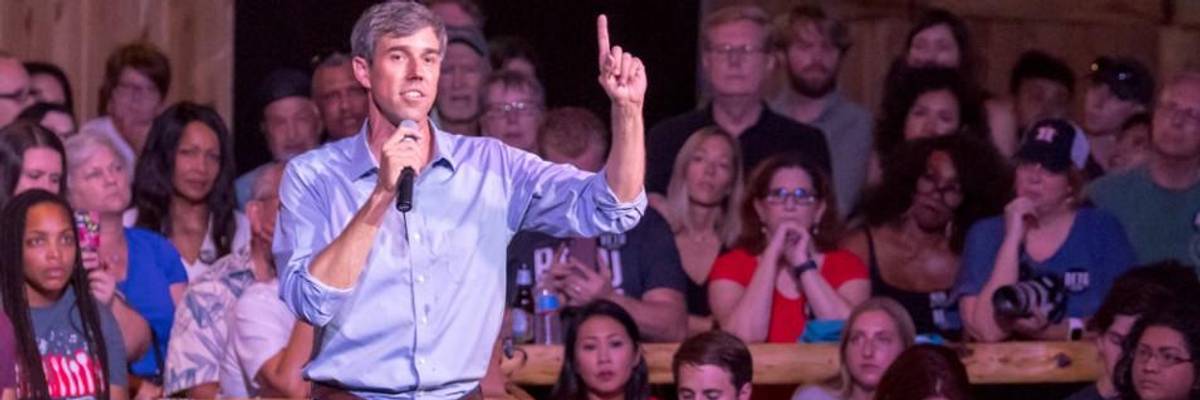
Beto O'Rourke is quickly becoming a favorite among centrist Democrats looking ahead to the 2020 presidential election. (Photo: Shutterstock)
A reductive, but not incorrect view of the Democratic debacle in the 2016 elections holds that when President Trump took office, centrists lost the present and leftists lost the future. In 2020, Democrats will have a new opportunity to either reach backward for the Obama era, or to lay the foundation for a bolder, progressive future. Deciding which goal to pursue will likely become the chief party fault line as the 2020 primaries approach. My advice to progressives: Don't back down.
For the party's center-leaning establishment, a return to the Obama era makes sense. Centrists were happy then -- thrilled to witness the passage of health-care reform that did something but not too much (so long, public option !), comfortable with what one might gently label a muscular foreign policy , pleased with the recovery from the 2008 financial crisis, though it came at the expense of homeowners in foreclosure while coddling Wall Street . All in all, things seemed stable and sustainable. Only tweaks and patches lay ahead.
But then, history -- presumed dead by those who believed, with socialism extinguished, the future held nothing but increasing gains for liberal democracy -- happened again. The 2016 election witnessed a swell of populist disenchantment with the status quo and concluded with the election of Trump. With Trump came a queasy uncertainty that still characterizes politics to this day, leaving old norms dissolved and common sense unequal to its task.
So much of centrist-Democrat fantasizing about 2020 already seems aimed at repeating a golden past. Consider the groundswell of interest in Beto O'Rourke, the Texas congressman who narrowly lost his recent Senate race against Sen. Ted Cruz. For Democrats excited about O'Rourke, his primary draw is his similarity to Barack Obama -- both in form and content. O'Rourke has held conversations with the former president about a possible run, to build on a belief that O'Rourke, as my colleague Matt Viser described it, is "capable of the same kind of inspirational campaign that caught fire in the 2008 presidential election."
O'Rourke's politics also fall into the same ambiguously centrist zone as Obama's. "Like Mr. Obama as he entered the 2008 campaign, Mr. O'Rourke can be difficult to place on an ideological spectrum, allowing supporters to project their own politics onto a messaging palette of national unity and common ground," a recent New York Times report observed . Meanwhile, other candidates straight from Obama's orbit -- such as former vice president Joe Biden and former housing secretary Julian Castro -- are also eyeing the nomination, with appeals to unity and centrist perspectives.
When not absorbed in hopes of re-creating the Obama era, Democrats mainly seem intent on beating Trump, with little comment or insight, at least so far, on what they will do with power once they have it. (After I questioned in my last column whether O'Rourke has demonstrated serious commitment to progressive values, some readers responded by arguing they're glad he hasn't -- that Democrats need to run an Obama-style centrist to win back conservatives who might otherwise favor Trump. "A too-progressive Democratic nominee in 2020," one reader wrote, "would be a gift to President Trump.") Likewise, at a recent event in New York, former FBI director James B. Comey implored Democrats to put aside their political projects in favor of an all-consuming focus on simply beating Trump . "I understand the Democrats have important debates now over who their candidate should be," Comey said, "but they have to win. They have to win."
Presidential elections provide an opportunity for parties to identify and rally around their principles -- and even to radically reshape them. If all the Democrats can manage is to hark back to the past and focus on winning for its own sake, they're missing an opportunity to lay out a blueprint for the future. I don't think that putting forth progressive priorities is incompatible with beating Trump; in fact, I think that having a clear and persuasive vision of what a better America can look like is likely to be more attractive to voters than promising them something vaguely like the past. One of the political lessons of recent years is that history is never over. The future is waiting, if we want to build it.
Dear Common Dreams reader, It’s been nearly 30 years since I co-founded Common Dreams with my late wife, Lina Newhouser. We had the radical notion that journalism should serve the public good, not corporate profits. It was clear to us from the outset what it would take to build such a project. No paid advertisements. No corporate sponsors. No millionaire publisher telling us what to think or do. Many people said we wouldn't last a year, but we proved those doubters wrong. Together with a tremendous team of journalists and dedicated staff, we built an independent media outlet free from the constraints of profits and corporate control. Our mission has always been simple: To inform. To inspire. To ignite change for the common good. Building Common Dreams was not easy. Our survival was never guaranteed. When you take on the most powerful forces—Wall Street greed, fossil fuel industry destruction, Big Tech lobbyists, and uber-rich oligarchs who have spent billions upon billions rigging the economy and democracy in their favor—the only bulwark you have is supporters who believe in your work. But here’s the urgent message from me today. It's never been this bad out there. And it's never been this hard to keep us going. At the very moment Common Dreams is most needed, the threats we face are intensifying. We need your support now more than ever. We don't accept corporate advertising and never will. We don't have a paywall because we don't think people should be blocked from critical news based on their ability to pay. Everything we do is funded by the donations of readers like you. When everyone does the little they can afford, we are strong. But if that support retreats or dries up, so do we. Will you donate now to make sure Common Dreams not only survives but thrives? —Craig Brown, Co-founder |
A reductive, but not incorrect view of the Democratic debacle in the 2016 elections holds that when President Trump took office, centrists lost the present and leftists lost the future. In 2020, Democrats will have a new opportunity to either reach backward for the Obama era, or to lay the foundation for a bolder, progressive future. Deciding which goal to pursue will likely become the chief party fault line as the 2020 primaries approach. My advice to progressives: Don't back down.
For the party's center-leaning establishment, a return to the Obama era makes sense. Centrists were happy then -- thrilled to witness the passage of health-care reform that did something but not too much (so long, public option !), comfortable with what one might gently label a muscular foreign policy , pleased with the recovery from the 2008 financial crisis, though it came at the expense of homeowners in foreclosure while coddling Wall Street . All in all, things seemed stable and sustainable. Only tweaks and patches lay ahead.
But then, history -- presumed dead by those who believed, with socialism extinguished, the future held nothing but increasing gains for liberal democracy -- happened again. The 2016 election witnessed a swell of populist disenchantment with the status quo and concluded with the election of Trump. With Trump came a queasy uncertainty that still characterizes politics to this day, leaving old norms dissolved and common sense unequal to its task.
So much of centrist-Democrat fantasizing about 2020 already seems aimed at repeating a golden past. Consider the groundswell of interest in Beto O'Rourke, the Texas congressman who narrowly lost his recent Senate race against Sen. Ted Cruz. For Democrats excited about O'Rourke, his primary draw is his similarity to Barack Obama -- both in form and content. O'Rourke has held conversations with the former president about a possible run, to build on a belief that O'Rourke, as my colleague Matt Viser described it, is "capable of the same kind of inspirational campaign that caught fire in the 2008 presidential election."
O'Rourke's politics also fall into the same ambiguously centrist zone as Obama's. "Like Mr. Obama as he entered the 2008 campaign, Mr. O'Rourke can be difficult to place on an ideological spectrum, allowing supporters to project their own politics onto a messaging palette of national unity and common ground," a recent New York Times report observed . Meanwhile, other candidates straight from Obama's orbit -- such as former vice president Joe Biden and former housing secretary Julian Castro -- are also eyeing the nomination, with appeals to unity and centrist perspectives.
When not absorbed in hopes of re-creating the Obama era, Democrats mainly seem intent on beating Trump, with little comment or insight, at least so far, on what they will do with power once they have it. (After I questioned in my last column whether O'Rourke has demonstrated serious commitment to progressive values, some readers responded by arguing they're glad he hasn't -- that Democrats need to run an Obama-style centrist to win back conservatives who might otherwise favor Trump. "A too-progressive Democratic nominee in 2020," one reader wrote, "would be a gift to President Trump.") Likewise, at a recent event in New York, former FBI director James B. Comey implored Democrats to put aside their political projects in favor of an all-consuming focus on simply beating Trump . "I understand the Democrats have important debates now over who their candidate should be," Comey said, "but they have to win. They have to win."
Presidential elections provide an opportunity for parties to identify and rally around their principles -- and even to radically reshape them. If all the Democrats can manage is to hark back to the past and focus on winning for its own sake, they're missing an opportunity to lay out a blueprint for the future. I don't think that putting forth progressive priorities is incompatible with beating Trump; in fact, I think that having a clear and persuasive vision of what a better America can look like is likely to be more attractive to voters than promising them something vaguely like the past. One of the political lessons of recent years is that history is never over. The future is waiting, if we want to build it.
A reductive, but not incorrect view of the Democratic debacle in the 2016 elections holds that when President Trump took office, centrists lost the present and leftists lost the future. In 2020, Democrats will have a new opportunity to either reach backward for the Obama era, or to lay the foundation for a bolder, progressive future. Deciding which goal to pursue will likely become the chief party fault line as the 2020 primaries approach. My advice to progressives: Don't back down.
For the party's center-leaning establishment, a return to the Obama era makes sense. Centrists were happy then -- thrilled to witness the passage of health-care reform that did something but not too much (so long, public option !), comfortable with what one might gently label a muscular foreign policy , pleased with the recovery from the 2008 financial crisis, though it came at the expense of homeowners in foreclosure while coddling Wall Street . All in all, things seemed stable and sustainable. Only tweaks and patches lay ahead.
But then, history -- presumed dead by those who believed, with socialism extinguished, the future held nothing but increasing gains for liberal democracy -- happened again. The 2016 election witnessed a swell of populist disenchantment with the status quo and concluded with the election of Trump. With Trump came a queasy uncertainty that still characterizes politics to this day, leaving old norms dissolved and common sense unequal to its task.
So much of centrist-Democrat fantasizing about 2020 already seems aimed at repeating a golden past. Consider the groundswell of interest in Beto O'Rourke, the Texas congressman who narrowly lost his recent Senate race against Sen. Ted Cruz. For Democrats excited about O'Rourke, his primary draw is his similarity to Barack Obama -- both in form and content. O'Rourke has held conversations with the former president about a possible run, to build on a belief that O'Rourke, as my colleague Matt Viser described it, is "capable of the same kind of inspirational campaign that caught fire in the 2008 presidential election."
O'Rourke's politics also fall into the same ambiguously centrist zone as Obama's. "Like Mr. Obama as he entered the 2008 campaign, Mr. O'Rourke can be difficult to place on an ideological spectrum, allowing supporters to project their own politics onto a messaging palette of national unity and common ground," a recent New York Times report observed . Meanwhile, other candidates straight from Obama's orbit -- such as former vice president Joe Biden and former housing secretary Julian Castro -- are also eyeing the nomination, with appeals to unity and centrist perspectives.
When not absorbed in hopes of re-creating the Obama era, Democrats mainly seem intent on beating Trump, with little comment or insight, at least so far, on what they will do with power once they have it. (After I questioned in my last column whether O'Rourke has demonstrated serious commitment to progressive values, some readers responded by arguing they're glad he hasn't -- that Democrats need to run an Obama-style centrist to win back conservatives who might otherwise favor Trump. "A too-progressive Democratic nominee in 2020," one reader wrote, "would be a gift to President Trump.") Likewise, at a recent event in New York, former FBI director James B. Comey implored Democrats to put aside their political projects in favor of an all-consuming focus on simply beating Trump . "I understand the Democrats have important debates now over who their candidate should be," Comey said, "but they have to win. They have to win."
Presidential elections provide an opportunity for parties to identify and rally around their principles -- and even to radically reshape them. If all the Democrats can manage is to hark back to the past and focus on winning for its own sake, they're missing an opportunity to lay out a blueprint for the future. I don't think that putting forth progressive priorities is incompatible with beating Trump; in fact, I think that having a clear and persuasive vision of what a better America can look like is likely to be more attractive to voters than promising them something vaguely like the past. One of the political lessons of recent years is that history is never over. The future is waiting, if we want to build it.