SUBSCRIBE TO OUR FREE NEWSLETTER
Daily news & progressive opinion—funded by the people, not the corporations—delivered straight to your inbox.
5
#000000
#FFFFFF
To donate by check, phone, or other method, see our More Ways to Give page.
Daily news & progressive opinion—funded by the people, not the corporations—delivered straight to your inbox.
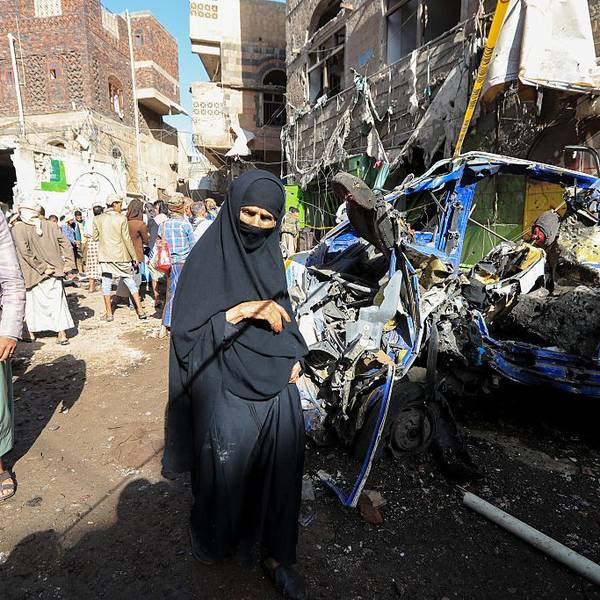
Close to 15 million men, women, and children have no access to health care. (Photo: Mohammed Hamoud/Getty Images)
The numbers are mind-blowing: Since the beginning of the conflict in Yemen, an estimated 85,000 children under five may have died from extreme hunger and disease, according to the last analysis by Save the Children, the international health and human rights organization. Although children are the most affected by the conflict, 14 million people are at risk of famine, according to data compiled by the United Nations.
For almost four years, Yemen, the Arab world's poorest country, has been ravaged by a bloody conflict between Houthi rebels and supporters of Yemen's internationally recognized government. In 2015, Saudi Arabia formed a coalition of Arab states to fight the Houthis, which included Kuwait, the United Arab Emirates (UAE), Bahrain, Egypt, Morocco, Jordan, Sudan, and Senegal. These countries have either sent troops to fight on the ground in Yemen or have carried out air attacks.
Iran has reportedly sent armaments and military advisers to help the Houthis, thus exacerbating their long-held animosity against the Saudis. In addition to fighting the Houthis in Yemen, the Saudis are backing the rebels fighting against Bashar al-Assad's government, while Iran has a strong influence over the Assad regime. In Lebanon, while Iran has shown strong support for Hezbollah, Saudi Arabia supports the Sunni Future Movement, led by Lebanon Prime Minister Saad Hariri.
The Yemen war, however, goes beyond a Saudi-Iranian geopolitical or Sunni-Shia conflict. The Houthis' demands have been primarily economic and political, trying to take the Yemenis out of a cycle of poverty. The brutal and indiscriminate attacks of the Saudi-led coalition have left a ravaged country, with millions of civilians fighting for survival.
Fearing for their lives, more than 3 million Yemenis have become internally displaced persons, and almost 300,000 have sought asylum in other countries, including Djibouti and Somalia. Both the internally displaced, as well as those who have left to other countries often lack adequate nutrition and shelter. According to UNICEF, Yemen's health care system is on the verge of collapse.
There is something pathetic when looking at some of the most powerful countries in the world: the United States, Great Britain, and France plotting with Saudi Arabia's criminal regime to destroy the Houthis' resistance movement in Yemen.
Those remaining in the country must cope with the relentless attacks by the coalition, which don't distinguish between civilian and soldiers. In addition, across the country, aid organizations are unable to provide needed assistance. Hospitals have been bombed, provoking tens of thousands of deaths both as a result of the attacks and those left without urgent care.
Close to 15 million men, women, and children have no access to health care. An outbreak of cholera which started in October 2016 has not yet been controlled. It doesn't help that water infrastructure in Yemen, one of the world's most water-scarce countries, has been continuously attacked by the Saudi coalition. As a consequence, 8.6 million children in Yemen don't have adequate access to water, sanitation and hygiene services. "Since 2015, the escalation of the conflict has only exacerbated this already dire situation, with attacks and military action on and around water infrastructure cutting off even more people from access to safe drinking water," states UNICEF.
Last August, a United Nations report on the situation in Yemen sharply criticized all parties in the conflict but placed stronger blame on the Saudi coalition's attacks on Yemeni civilians. Three UN experts said that the Saudi-led coalition routinely failed to consult its own "no-strike" list of more than 30,000 sites in Yemen, including refugee camps and hospitals. According to the experts' report, restrictions that Saudi Arabia has placed on the delivery of aid by sea or air have had such a severe humanitarian impact that "such acts, together with the requisite intent, may amount to international crimes."
There is something pathetic when looking at some of the most powerful countries in the world: the United States, Great Britain, and France plotting with Saudi Arabia's criminal regime to destroy the Houthis' resistance movement in Yemen. In the last few weeks, hundreds of airstrikes by the Saudi-led coalition in and around Hodeidah have endangered the lives of 150,000 children. These coalition actions violate basic humanitarian rules and the rule of law. The War in Yemen is a massacre, and it is the responsibility of the international community to uphold justice in the face of such tragedy.
Dear Common Dreams reader, It’s been nearly 30 years since I co-founded Common Dreams with my late wife, Lina Newhouser. We had the radical notion that journalism should serve the public good, not corporate profits. It was clear to us from the outset what it would take to build such a project. No paid advertisements. No corporate sponsors. No millionaire publisher telling us what to think or do. Many people said we wouldn't last a year, but we proved those doubters wrong. Together with a tremendous team of journalists and dedicated staff, we built an independent media outlet free from the constraints of profits and corporate control. Our mission has always been simple: To inform. To inspire. To ignite change for the common good. Building Common Dreams was not easy. Our survival was never guaranteed. When you take on the most powerful forces—Wall Street greed, fossil fuel industry destruction, Big Tech lobbyists, and uber-rich oligarchs who have spent billions upon billions rigging the economy and democracy in their favor—the only bulwark you have is supporters who believe in your work. But here’s the urgent message from me today. It's never been this bad out there. And it's never been this hard to keep us going. At the very moment Common Dreams is most needed, the threats we face are intensifying. We need your support now more than ever. We don't accept corporate advertising and never will. We don't have a paywall because we don't think people should be blocked from critical news based on their ability to pay. Everything we do is funded by the donations of readers like you. When everyone does the little they can afford, we are strong. But if that support retreats or dries up, so do we. Will you donate now to make sure Common Dreams not only survives but thrives? —Craig Brown, Co-founder |
The numbers are mind-blowing: Since the beginning of the conflict in Yemen, an estimated 85,000 children under five may have died from extreme hunger and disease, according to the last analysis by Save the Children, the international health and human rights organization. Although children are the most affected by the conflict, 14 million people are at risk of famine, according to data compiled by the United Nations.
For almost four years, Yemen, the Arab world's poorest country, has been ravaged by a bloody conflict between Houthi rebels and supporters of Yemen's internationally recognized government. In 2015, Saudi Arabia formed a coalition of Arab states to fight the Houthis, which included Kuwait, the United Arab Emirates (UAE), Bahrain, Egypt, Morocco, Jordan, Sudan, and Senegal. These countries have either sent troops to fight on the ground in Yemen or have carried out air attacks.
Iran has reportedly sent armaments and military advisers to help the Houthis, thus exacerbating their long-held animosity against the Saudis. In addition to fighting the Houthis in Yemen, the Saudis are backing the rebels fighting against Bashar al-Assad's government, while Iran has a strong influence over the Assad regime. In Lebanon, while Iran has shown strong support for Hezbollah, Saudi Arabia supports the Sunni Future Movement, led by Lebanon Prime Minister Saad Hariri.
The Yemen war, however, goes beyond a Saudi-Iranian geopolitical or Sunni-Shia conflict. The Houthis' demands have been primarily economic and political, trying to take the Yemenis out of a cycle of poverty. The brutal and indiscriminate attacks of the Saudi-led coalition have left a ravaged country, with millions of civilians fighting for survival.
Fearing for their lives, more than 3 million Yemenis have become internally displaced persons, and almost 300,000 have sought asylum in other countries, including Djibouti and Somalia. Both the internally displaced, as well as those who have left to other countries often lack adequate nutrition and shelter. According to UNICEF, Yemen's health care system is on the verge of collapse.
There is something pathetic when looking at some of the most powerful countries in the world: the United States, Great Britain, and France plotting with Saudi Arabia's criminal regime to destroy the Houthis' resistance movement in Yemen.
Those remaining in the country must cope with the relentless attacks by the coalition, which don't distinguish between civilian and soldiers. In addition, across the country, aid organizations are unable to provide needed assistance. Hospitals have been bombed, provoking tens of thousands of deaths both as a result of the attacks and those left without urgent care.
Close to 15 million men, women, and children have no access to health care. An outbreak of cholera which started in October 2016 has not yet been controlled. It doesn't help that water infrastructure in Yemen, one of the world's most water-scarce countries, has been continuously attacked by the Saudi coalition. As a consequence, 8.6 million children in Yemen don't have adequate access to water, sanitation and hygiene services. "Since 2015, the escalation of the conflict has only exacerbated this already dire situation, with attacks and military action on and around water infrastructure cutting off even more people from access to safe drinking water," states UNICEF.
Last August, a United Nations report on the situation in Yemen sharply criticized all parties in the conflict but placed stronger blame on the Saudi coalition's attacks on Yemeni civilians. Three UN experts said that the Saudi-led coalition routinely failed to consult its own "no-strike" list of more than 30,000 sites in Yemen, including refugee camps and hospitals. According to the experts' report, restrictions that Saudi Arabia has placed on the delivery of aid by sea or air have had such a severe humanitarian impact that "such acts, together with the requisite intent, may amount to international crimes."
There is something pathetic when looking at some of the most powerful countries in the world: the United States, Great Britain, and France plotting with Saudi Arabia's criminal regime to destroy the Houthis' resistance movement in Yemen. In the last few weeks, hundreds of airstrikes by the Saudi-led coalition in and around Hodeidah have endangered the lives of 150,000 children. These coalition actions violate basic humanitarian rules and the rule of law. The War in Yemen is a massacre, and it is the responsibility of the international community to uphold justice in the face of such tragedy.
The numbers are mind-blowing: Since the beginning of the conflict in Yemen, an estimated 85,000 children under five may have died from extreme hunger and disease, according to the last analysis by Save the Children, the international health and human rights organization. Although children are the most affected by the conflict, 14 million people are at risk of famine, according to data compiled by the United Nations.
For almost four years, Yemen, the Arab world's poorest country, has been ravaged by a bloody conflict between Houthi rebels and supporters of Yemen's internationally recognized government. In 2015, Saudi Arabia formed a coalition of Arab states to fight the Houthis, which included Kuwait, the United Arab Emirates (UAE), Bahrain, Egypt, Morocco, Jordan, Sudan, and Senegal. These countries have either sent troops to fight on the ground in Yemen or have carried out air attacks.
Iran has reportedly sent armaments and military advisers to help the Houthis, thus exacerbating their long-held animosity against the Saudis. In addition to fighting the Houthis in Yemen, the Saudis are backing the rebels fighting against Bashar al-Assad's government, while Iran has a strong influence over the Assad regime. In Lebanon, while Iran has shown strong support for Hezbollah, Saudi Arabia supports the Sunni Future Movement, led by Lebanon Prime Minister Saad Hariri.
The Yemen war, however, goes beyond a Saudi-Iranian geopolitical or Sunni-Shia conflict. The Houthis' demands have been primarily economic and political, trying to take the Yemenis out of a cycle of poverty. The brutal and indiscriminate attacks of the Saudi-led coalition have left a ravaged country, with millions of civilians fighting for survival.
Fearing for their lives, more than 3 million Yemenis have become internally displaced persons, and almost 300,000 have sought asylum in other countries, including Djibouti and Somalia. Both the internally displaced, as well as those who have left to other countries often lack adequate nutrition and shelter. According to UNICEF, Yemen's health care system is on the verge of collapse.
There is something pathetic when looking at some of the most powerful countries in the world: the United States, Great Britain, and France plotting with Saudi Arabia's criminal regime to destroy the Houthis' resistance movement in Yemen.
Those remaining in the country must cope with the relentless attacks by the coalition, which don't distinguish between civilian and soldiers. In addition, across the country, aid organizations are unable to provide needed assistance. Hospitals have been bombed, provoking tens of thousands of deaths both as a result of the attacks and those left without urgent care.
Close to 15 million men, women, and children have no access to health care. An outbreak of cholera which started in October 2016 has not yet been controlled. It doesn't help that water infrastructure in Yemen, one of the world's most water-scarce countries, has been continuously attacked by the Saudi coalition. As a consequence, 8.6 million children in Yemen don't have adequate access to water, sanitation and hygiene services. "Since 2015, the escalation of the conflict has only exacerbated this already dire situation, with attacks and military action on and around water infrastructure cutting off even more people from access to safe drinking water," states UNICEF.
Last August, a United Nations report on the situation in Yemen sharply criticized all parties in the conflict but placed stronger blame on the Saudi coalition's attacks on Yemeni civilians. Three UN experts said that the Saudi-led coalition routinely failed to consult its own "no-strike" list of more than 30,000 sites in Yemen, including refugee camps and hospitals. According to the experts' report, restrictions that Saudi Arabia has placed on the delivery of aid by sea or air have had such a severe humanitarian impact that "such acts, together with the requisite intent, may amount to international crimes."
There is something pathetic when looking at some of the most powerful countries in the world: the United States, Great Britain, and France plotting with Saudi Arabia's criminal regime to destroy the Houthis' resistance movement in Yemen. In the last few weeks, hundreds of airstrikes by the Saudi-led coalition in and around Hodeidah have endangered the lives of 150,000 children. These coalition actions violate basic humanitarian rules and the rule of law. The War in Yemen is a massacre, and it is the responsibility of the international community to uphold justice in the face of such tragedy.