SUBSCRIBE TO OUR FREE NEWSLETTER
Daily news & progressive opinion—funded by the people, not the corporations—delivered straight to your inbox.
5
#000000
#FFFFFF
To donate by check, phone, or other method, see our More Ways to Give page.
Daily news & progressive opinion—funded by the people, not the corporations—delivered straight to your inbox.
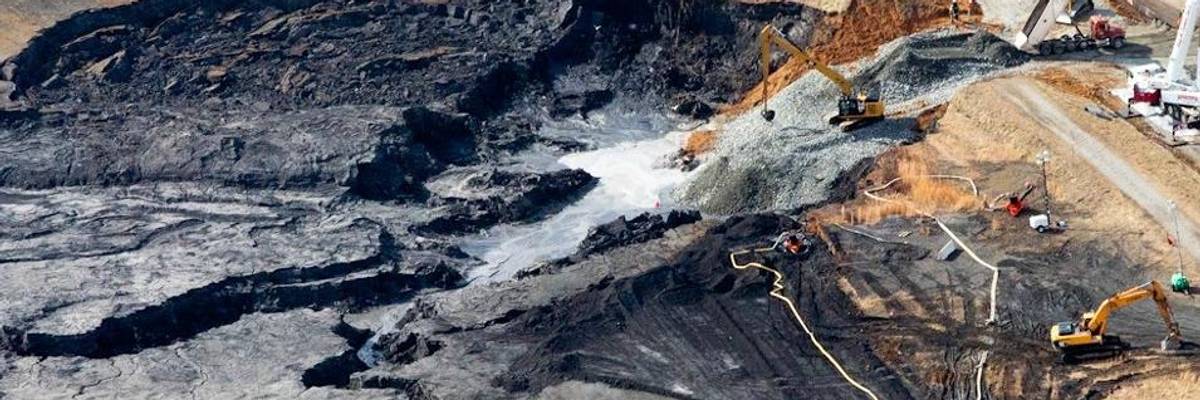
Reasonable people need to connect the dots and demand accountability, such as truly open discussion and evidentiary hearings regarding Duke's 15-year plan.(Photo: Duke Energy in North Carolina/Waterkeeper Alliance)
The latest in a string of monster storms of recent years, Hurricane Florence punctuates the fact that the cost of climate pollution is accelerating.
Duke Energy executives bear much of the blame for Hurricane Florence's devastation. The Charlotte-based corporation is one of the world's largest climate polluters, it's been aggressively expanding its use of climate-wrecking fracked gas (methane), opposing requirements to curb methane venting and leakage, impeding the cheaper, clean-energy solutions that are ready to replace fossil-fueled electricity, and suppressing attention to these interrelated factors.
In short, Duke's Energy's "natural" gas expansion is amplifying global heating at the worst possible time:
There is scientific consensus that global emissions of methane - which is 100 times stronger than carbon dioxide at trapping atmospheric heat in the critical short term - have soared for 12 years and become a key driver of global heating.
NASA scientists recently confirmed that the methane increase is mostly from fossil fuels. The 12-year time period corresponds with the U.S. fracking boom, which spews unburned methane into the air, needlessly.
Due to its potency, methane begins trapping heat immediately, spreads quickly across Earth's atmosphere, and has helped produce record-breaking global temperatures since 2014.
Rising global heat is changing the jet stream and weather systems, which amplifies tropical storms and slows them down for prolonged destruction.
Hurricanes aren't new, but as UNC-CH's Dr. Jason West recently wrote, "climate change is like putting our weather on steroids ... making events like Hurricane Florence more likely or severe ... the media need to report that."
While science can't prove Florence was worsened by Duke Energy decision-makers, a reasonable, conservative approach to the crisis demands extreme caution regarding this known hazard: methane. Plus, since fossil fueled electricity can be phased out quickly while avoiding billions of dollars in unneeded fracked gas investments, shouldn't we at least be openly discussing our energy options?
The gas-climate connection also increases hazards for thousands of dedicated Duke Energy workers who leave their families to restore power even as storms roar.
Is NC WARN exploiting misery by calling out Duke Energy leaders? No. Millions of people and animals are already being devastated each year by climate disasters - disproportionately low-income and communities of color such as those in the eastern Carolinas that Florence has hammered yet again. We're trying to avoid having these disasters keep worsening forever.
United Nations chief Antonio Guterres recently emphasized that "If we do not change course by 2020, we risk missing the point where we can avoid runaway climate change."
Scientists from NOAA, Cornell and other institutions say curbing methane leakage and venting from the gas-to-power system - which is cost-effective according to the Rocky Mountain Institute and others - can have immediate, positive impacts, while buying time to phase out CO2 emissions.
Indeed, if we don't begin slowing methane emissions, it's game over. Humanity will soon cross the threshold toward runaway climate, social and economic chaos.
No wonder indigenous Arctic groups and others already suffering from climate disruption are demanding immediate methane reductions.
Fortunately, we don't need the gas. Proven solutions for phasing out all coal- and gas-fired power - such as local solar-with-storage and energy-balancing programs - are surging in free markets. They're cheaper, can be deployed immediately, and they create resiliency against grid outages (see our NC Clean Path 2025).
By contrast, Duke Energy's new 15-year plan dismisses battery storage while projecting construction of 24 large gas-fired plants in the Carolinas. As other utilities and states are moving to go all-renewable, Duke plans to be only 7% renewable by 2033 - despite all the slick advertising.
Reasonable people need to connect the dots and demand accountability, such as truly open discussion and evidentiary hearings regarding Duke's 15-year plan.
Making climate change controversial, thus stifling media attention, was a greedy corporate strategy that has threatened literally all life on Earth.
The people of North Carolina and the executives of Duke Energy - one of the world's largest utilities - must finally begin an open, democratic discussion of how the Charlotte-based corporation could use its enormous resources to help avert runaway climate chaos instead of blocking climate solutions and selling its "clean natural gas" propaganda.
Media executives must step up and foster that discussion, especially because corporate giants have bought the silence and support of most of our alleged leaders.
Dear Common Dreams reader, It’s been nearly 30 years since I co-founded Common Dreams with my late wife, Lina Newhouser. We had the radical notion that journalism should serve the public good, not corporate profits. It was clear to us from the outset what it would take to build such a project. No paid advertisements. No corporate sponsors. No millionaire publisher telling us what to think or do. Many people said we wouldn't last a year, but we proved those doubters wrong. Together with a tremendous team of journalists and dedicated staff, we built an independent media outlet free from the constraints of profits and corporate control. Our mission has always been simple: To inform. To inspire. To ignite change for the common good. Building Common Dreams was not easy. Our survival was never guaranteed. When you take on the most powerful forces—Wall Street greed, fossil fuel industry destruction, Big Tech lobbyists, and uber-rich oligarchs who have spent billions upon billions rigging the economy and democracy in their favor—the only bulwark you have is supporters who believe in your work. But here’s the urgent message from me today. It's never been this bad out there. And it's never been this hard to keep us going. At the very moment Common Dreams is most needed, the threats we face are intensifying. We need your support now more than ever. We don't accept corporate advertising and never will. We don't have a paywall because we don't think people should be blocked from critical news based on their ability to pay. Everything we do is funded by the donations of readers like you. When everyone does the little they can afford, we are strong. But if that support retreats or dries up, so do we. Will you donate now to make sure Common Dreams not only survives but thrives? —Craig Brown, Co-founder |
The latest in a string of monster storms of recent years, Hurricane Florence punctuates the fact that the cost of climate pollution is accelerating.
Duke Energy executives bear much of the blame for Hurricane Florence's devastation. The Charlotte-based corporation is one of the world's largest climate polluters, it's been aggressively expanding its use of climate-wrecking fracked gas (methane), opposing requirements to curb methane venting and leakage, impeding the cheaper, clean-energy solutions that are ready to replace fossil-fueled electricity, and suppressing attention to these interrelated factors.
In short, Duke's Energy's "natural" gas expansion is amplifying global heating at the worst possible time:
There is scientific consensus that global emissions of methane - which is 100 times stronger than carbon dioxide at trapping atmospheric heat in the critical short term - have soared for 12 years and become a key driver of global heating.
NASA scientists recently confirmed that the methane increase is mostly from fossil fuels. The 12-year time period corresponds with the U.S. fracking boom, which spews unburned methane into the air, needlessly.
Due to its potency, methane begins trapping heat immediately, spreads quickly across Earth's atmosphere, and has helped produce record-breaking global temperatures since 2014.
Rising global heat is changing the jet stream and weather systems, which amplifies tropical storms and slows them down for prolonged destruction.
Hurricanes aren't new, but as UNC-CH's Dr. Jason West recently wrote, "climate change is like putting our weather on steroids ... making events like Hurricane Florence more likely or severe ... the media need to report that."
While science can't prove Florence was worsened by Duke Energy decision-makers, a reasonable, conservative approach to the crisis demands extreme caution regarding this known hazard: methane. Plus, since fossil fueled electricity can be phased out quickly while avoiding billions of dollars in unneeded fracked gas investments, shouldn't we at least be openly discussing our energy options?
The gas-climate connection also increases hazards for thousands of dedicated Duke Energy workers who leave their families to restore power even as storms roar.
Is NC WARN exploiting misery by calling out Duke Energy leaders? No. Millions of people and animals are already being devastated each year by climate disasters - disproportionately low-income and communities of color such as those in the eastern Carolinas that Florence has hammered yet again. We're trying to avoid having these disasters keep worsening forever.
United Nations chief Antonio Guterres recently emphasized that "If we do not change course by 2020, we risk missing the point where we can avoid runaway climate change."
Scientists from NOAA, Cornell and other institutions say curbing methane leakage and venting from the gas-to-power system - which is cost-effective according to the Rocky Mountain Institute and others - can have immediate, positive impacts, while buying time to phase out CO2 emissions.
Indeed, if we don't begin slowing methane emissions, it's game over. Humanity will soon cross the threshold toward runaway climate, social and economic chaos.
No wonder indigenous Arctic groups and others already suffering from climate disruption are demanding immediate methane reductions.
Fortunately, we don't need the gas. Proven solutions for phasing out all coal- and gas-fired power - such as local solar-with-storage and energy-balancing programs - are surging in free markets. They're cheaper, can be deployed immediately, and they create resiliency against grid outages (see our NC Clean Path 2025).
By contrast, Duke Energy's new 15-year plan dismisses battery storage while projecting construction of 24 large gas-fired plants in the Carolinas. As other utilities and states are moving to go all-renewable, Duke plans to be only 7% renewable by 2033 - despite all the slick advertising.
Reasonable people need to connect the dots and demand accountability, such as truly open discussion and evidentiary hearings regarding Duke's 15-year plan.
Making climate change controversial, thus stifling media attention, was a greedy corporate strategy that has threatened literally all life on Earth.
The people of North Carolina and the executives of Duke Energy - one of the world's largest utilities - must finally begin an open, democratic discussion of how the Charlotte-based corporation could use its enormous resources to help avert runaway climate chaos instead of blocking climate solutions and selling its "clean natural gas" propaganda.
Media executives must step up and foster that discussion, especially because corporate giants have bought the silence and support of most of our alleged leaders.
The latest in a string of monster storms of recent years, Hurricane Florence punctuates the fact that the cost of climate pollution is accelerating.
Duke Energy executives bear much of the blame for Hurricane Florence's devastation. The Charlotte-based corporation is one of the world's largest climate polluters, it's been aggressively expanding its use of climate-wrecking fracked gas (methane), opposing requirements to curb methane venting and leakage, impeding the cheaper, clean-energy solutions that are ready to replace fossil-fueled electricity, and suppressing attention to these interrelated factors.
In short, Duke's Energy's "natural" gas expansion is amplifying global heating at the worst possible time:
There is scientific consensus that global emissions of methane - which is 100 times stronger than carbon dioxide at trapping atmospheric heat in the critical short term - have soared for 12 years and become a key driver of global heating.
NASA scientists recently confirmed that the methane increase is mostly from fossil fuels. The 12-year time period corresponds with the U.S. fracking boom, which spews unburned methane into the air, needlessly.
Due to its potency, methane begins trapping heat immediately, spreads quickly across Earth's atmosphere, and has helped produce record-breaking global temperatures since 2014.
Rising global heat is changing the jet stream and weather systems, which amplifies tropical storms and slows them down for prolonged destruction.
Hurricanes aren't new, but as UNC-CH's Dr. Jason West recently wrote, "climate change is like putting our weather on steroids ... making events like Hurricane Florence more likely or severe ... the media need to report that."
While science can't prove Florence was worsened by Duke Energy decision-makers, a reasonable, conservative approach to the crisis demands extreme caution regarding this known hazard: methane. Plus, since fossil fueled electricity can be phased out quickly while avoiding billions of dollars in unneeded fracked gas investments, shouldn't we at least be openly discussing our energy options?
The gas-climate connection also increases hazards for thousands of dedicated Duke Energy workers who leave their families to restore power even as storms roar.
Is NC WARN exploiting misery by calling out Duke Energy leaders? No. Millions of people and animals are already being devastated each year by climate disasters - disproportionately low-income and communities of color such as those in the eastern Carolinas that Florence has hammered yet again. We're trying to avoid having these disasters keep worsening forever.
United Nations chief Antonio Guterres recently emphasized that "If we do not change course by 2020, we risk missing the point where we can avoid runaway climate change."
Scientists from NOAA, Cornell and other institutions say curbing methane leakage and venting from the gas-to-power system - which is cost-effective according to the Rocky Mountain Institute and others - can have immediate, positive impacts, while buying time to phase out CO2 emissions.
Indeed, if we don't begin slowing methane emissions, it's game over. Humanity will soon cross the threshold toward runaway climate, social and economic chaos.
No wonder indigenous Arctic groups and others already suffering from climate disruption are demanding immediate methane reductions.
Fortunately, we don't need the gas. Proven solutions for phasing out all coal- and gas-fired power - such as local solar-with-storage and energy-balancing programs - are surging in free markets. They're cheaper, can be deployed immediately, and they create resiliency against grid outages (see our NC Clean Path 2025).
By contrast, Duke Energy's new 15-year plan dismisses battery storage while projecting construction of 24 large gas-fired plants in the Carolinas. As other utilities and states are moving to go all-renewable, Duke plans to be only 7% renewable by 2033 - despite all the slick advertising.
Reasonable people need to connect the dots and demand accountability, such as truly open discussion and evidentiary hearings regarding Duke's 15-year plan.
Making climate change controversial, thus stifling media attention, was a greedy corporate strategy that has threatened literally all life on Earth.
The people of North Carolina and the executives of Duke Energy - one of the world's largest utilities - must finally begin an open, democratic discussion of how the Charlotte-based corporation could use its enormous resources to help avert runaway climate chaos instead of blocking climate solutions and selling its "clean natural gas" propaganda.
Media executives must step up and foster that discussion, especially because corporate giants have bought the silence and support of most of our alleged leaders.