

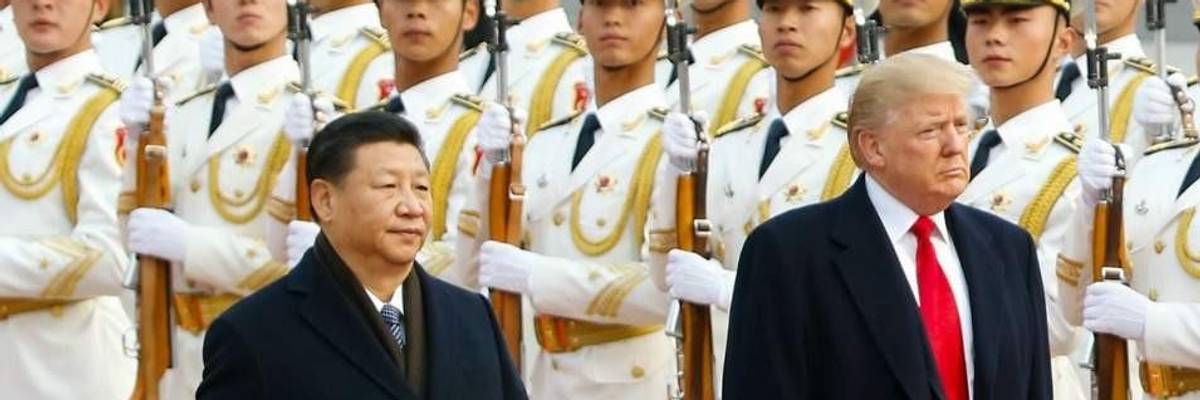
The second reason for Trump's tariff war on China is that it serves a useful political purpose for Trump/GOP posturing. (Photo: Thomas Peter-Pool/Getty Images)
"Stealing Intellectual Property" is Fake News
The claim that the Chinese are stealing our intellectual property—chiefly production technologies—is largely bogus
Trump uses the fake news of "intellectual property theft" to justify his tariff war on China. He boasts that he is going to stop the Chinese stealing that victimizes Americans. In yet another way, he will be the savior of Americans' economic future, a savior who needs/deserves their votes and donations. He takes his cues from the televangelists.
Capitalist enterprises routinely buy, study, and copy parts of other companies' products, especially those of their successful competitors. Economic theories stress that often such replication of successful competitors' products and technologies is how enterprises survive. It is a regular part of capitalist competition and serves a social purpose of lowering average costs of production and thus prices to consumers.
We are left with the question: why then pursue a strategy of trade wars to block intellectual property theft if it is mostly fake news? The answer has two parts. First, the accusation of intellectual property theft (often paired with "forced technology transfer") amounts to a demand for better terms of access for US firms who want to produce and/or sell in China. If they must share their technology, for example, they want bigger shares of profitable joint ventures, etc. The Trump tariff war aims to coerce better terms from China for US companies active there. Trump expects and gets approval from US companies so long as they believe they may gain more from concessions forced on China than they lose from tariff-caused disruptions of their currently profitable global supply chains
We are at a crossroads
This country and this world are at a monumental crossroads. In a few short weeks, US voters will have an opportunity to beat back the forces of fascism and confront the billionaires who are rigging the economy, our media system, and our democracy, making it increasingly impossible for ordinary people to get by. We’re not just talking about the election. We’re talking about what must be done once these fascist elements are vanquished from power. We need a bolder set of solutions than what either major party has so far been willing to offer and a working-class movement ready to fight like hell for it. Trump didn't emerge from nowhere. The conditions that fueled MAGA authoritarianism were created by decades of radical neoliberal economic policies and a corrupt political system dominated by corporate interests. They slashed taxes on the super-rich, promising that the benefits would trickle down. They said giveaways to the corporate titans would make life more affordable for the rest of us. It was all bullshit. And when a bitter, betrayed populace searches for someone to blame, right-wing demagogues have little trouble finding scapegoats. People know when they're being lied to, but you won't hear any of this from the corporate media. Only independent journalism—powered and funded by people who believe in building a better world—can deliver truly trustworthy daily news. Our Fall Campaign is underway, and we need your help. To power our newsroom through the rest of the year, we need to raise $125,000 by midnight on October 31. So if you share our vision, please contribute whatever you can to sustain our work. |
Trump uses the fake news of "intellectual property theft" to justify his tariff war on China. He boasts that he is going to stop the Chinese stealing that victimizes Americans. In yet another way, he will be the savior of Americans' economic future, a savior who needs/deserves their votes and donations. He takes his cues from the televangelists.
Capitalist enterprises routinely buy, study, and copy parts of other companies' products, especially those of their successful competitors. Economic theories stress that often such replication of successful competitors' products and technologies is how enterprises survive. It is a regular part of capitalist competition and serves a social purpose of lowering average costs of production and thus prices to consumers.
We are left with the question: why then pursue a strategy of trade wars to block intellectual property theft if it is mostly fake news? The answer has two parts. First, the accusation of intellectual property theft (often paired with "forced technology transfer") amounts to a demand for better terms of access for US firms who want to produce and/or sell in China. If they must share their technology, for example, they want bigger shares of profitable joint ventures, etc. The Trump tariff war aims to coerce better terms from China for US companies active there. Trump expects and gets approval from US companies so long as they believe they may gain more from concessions forced on China than they lose from tariff-caused disruptions of their currently profitable global supply chains
Trump uses the fake news of "intellectual property theft" to justify his tariff war on China. He boasts that he is going to stop the Chinese stealing that victimizes Americans. In yet another way, he will be the savior of Americans' economic future, a savior who needs/deserves their votes and donations. He takes his cues from the televangelists.
Capitalist enterprises routinely buy, study, and copy parts of other companies' products, especially those of their successful competitors. Economic theories stress that often such replication of successful competitors' products and technologies is how enterprises survive. It is a regular part of capitalist competition and serves a social purpose of lowering average costs of production and thus prices to consumers.
We are left with the question: why then pursue a strategy of trade wars to block intellectual property theft if it is mostly fake news? The answer has two parts. First, the accusation of intellectual property theft (often paired with "forced technology transfer") amounts to a demand for better terms of access for US firms who want to produce and/or sell in China. If they must share their technology, for example, they want bigger shares of profitable joint ventures, etc. The Trump tariff war aims to coerce better terms from China for US companies active there. Trump expects and gets approval from US companies so long as they believe they may gain more from concessions forced on China than they lose from tariff-caused disruptions of their currently profitable global supply chains