SUBSCRIBE TO OUR FREE NEWSLETTER
Daily news & progressive opinion—funded by the people, not the corporations—delivered straight to your inbox.
5
#000000
#FFFFFF
To donate by check, phone, or other method, see our More Ways to Give page.
Daily news & progressive opinion—funded by the people, not the corporations—delivered straight to your inbox.
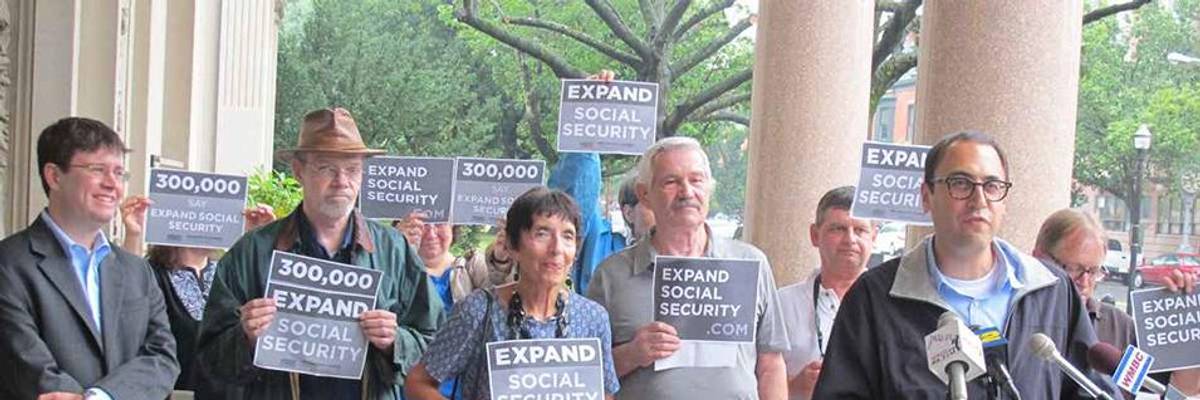
Expand Social Security
Mention Social Security and most people immediately think of the monthly checks received by the program's 62 million beneficiaries. Each day we see and hear how retirement, disability and survivor benefits keep people afloat and prevent them from falling into poverty. (Nearly half of beneficiaries rely on Social Security for all or most of their income). But that money isn't just a lifeline to beneficiaries and their families, it's an economic boon for their communities and the entire nation. Every year, $800 billion dollars flow to beneficiaries who spend much of their income locally. They do business at the grocery store, the pharmacy, the auto repair shop, the theater and the hairstylist. They purchase clothing, pay rent and other basic expenses - stimulating and strengthening the economy.
The spending power of older Americans, bolstered by Social Security benefits, is a potent financial force. Businesses offer senior discounts to entice retirees, who tend to spend more of their money than other age groups. When Social Security beneficiaries help local businesses to prosper, those businesses hire additional workers and order more supplies, infusing the economy with even more money.
Thanks to this 'multiplier effect,' every dollar paid in Social Security benefits produces $2 in stimulus to the economy. That adds up to more than $1.6 trillion dollars in national economic stimulus annually. Social Security benefits are responsible for sustaining some 10 million jobs, including roughly $400 billion in salaries and wages. With figures like these, even Wall Street must acknowledge that Social Security is incredibly good for Main Street.
"Seniors are really important to local businesses," says Abraham Kapusuz, former managing partner of a New Jersey restaurant that thrives on an older customer base. "During the early bird special, at least 80% of the customers are seniors. Most of their income is from Social Security. They contribute to the business - and the economy - bigtime."
But the opposite is also true. If Social Security benefits are cut, seniors will have less income to spend on goods and services - which is bad for Main Street. "If the government cuts Social Security benefits, it would affect the bottom line tremendously," says Kapusuz. "Now you have to start laying off employees, which has a chain reaction throughout the local economy."
The National Committee to Preserve Social Security and Medicare has compiled fresh data on the economic impact of Social Security on congressional districts in all 50 states and U.S. territories. Most Americans would be surprised at how much money flows into their communities from those monthly Social Security checks, including red and purple states represented by aspiring benefit-cutters in Congress:
It's ironic that conservatives who purport to believe in 'fiscal responsibility' and a strong economy do not appreciate - or willfully ignore - these figures. Instead, they blew a $2 trillion hole in the federal debt with the Trump/GOP tax scheme (which has not trickled down to working people) and propose to cut Americans' earned benefits to close the gap. If anything, this is the height of fiscal irresponsibility. The economic engine of Social Security is already humming. Why choke it with benefit cuts?
The political right would like to use not only the Trump/GOP tax cuts, but projections about the program's long-term finances, to cut Social Security. While it's true that the Social Security trust fund will be able to pay roughly 80% of benefits after 2034 if Congress takes no action, legislation has already been introduced that would keep the program financially sound for the rest of the century while modestly boosting benefits, mainly by asking the wealthy to pay their fair share.
In fact, the authors of two of those bills, Senator Bernie Sanders (I-VT) and Rep. John Larson (D-CT) have just launched "Expand Social Security" caucuses in the House and Senate, along with Senator Elizabeth Warren (D-MA) and other key members of Congress. The formation of these caucuses crystallizes the efforts of Social Security advocates and lawmakers to put more - not less - much-needed income into the hands of America's seniors. This means not only boosting monthly benefits, but adopting a more accurate consumer price index for the elderly (CPI-E) and increasing the minimum benefit formula - all of which will provide even greater economic stimulus.
Efforts to boost Social Security have languished in the Republican-controlled Congress. But that could change after November's elections. There is no better way to help Main Street than to elect members of Congress who appreciate Social Security's immensely positive impact on our economy - and will work hard to expand on the program's promise.
Dear Common Dreams reader, It’s been nearly 30 years since I co-founded Common Dreams with my late wife, Lina Newhouser. We had the radical notion that journalism should serve the public good, not corporate profits. It was clear to us from the outset what it would take to build such a project. No paid advertisements. No corporate sponsors. No millionaire publisher telling us what to think or do. Many people said we wouldn't last a year, but we proved those doubters wrong. Together with a tremendous team of journalists and dedicated staff, we built an independent media outlet free from the constraints of profits and corporate control. Our mission has always been simple: To inform. To inspire. To ignite change for the common good. Building Common Dreams was not easy. Our survival was never guaranteed. When you take on the most powerful forces—Wall Street greed, fossil fuel industry destruction, Big Tech lobbyists, and uber-rich oligarchs who have spent billions upon billions rigging the economy and democracy in their favor—the only bulwark you have is supporters who believe in your work. But here’s the urgent message from me today. It's never been this bad out there. And it's never been this hard to keep us going. At the very moment Common Dreams is most needed, the threats we face are intensifying. We need your support now more than ever. We don't accept corporate advertising and never will. We don't have a paywall because we don't think people should be blocked from critical news based on their ability to pay. Everything we do is funded by the donations of readers like you. When everyone does the little they can afford, we are strong. But if that support retreats or dries up, so do we. Will you donate now to make sure Common Dreams not only survives but thrives? —Craig Brown, Co-founder |
Mention Social Security and most people immediately think of the monthly checks received by the program's 62 million beneficiaries. Each day we see and hear how retirement, disability and survivor benefits keep people afloat and prevent them from falling into poverty. (Nearly half of beneficiaries rely on Social Security for all or most of their income). But that money isn't just a lifeline to beneficiaries and their families, it's an economic boon for their communities and the entire nation. Every year, $800 billion dollars flow to beneficiaries who spend much of their income locally. They do business at the grocery store, the pharmacy, the auto repair shop, the theater and the hairstylist. They purchase clothing, pay rent and other basic expenses - stimulating and strengthening the economy.
The spending power of older Americans, bolstered by Social Security benefits, is a potent financial force. Businesses offer senior discounts to entice retirees, who tend to spend more of their money than other age groups. When Social Security beneficiaries help local businesses to prosper, those businesses hire additional workers and order more supplies, infusing the economy with even more money.
Thanks to this 'multiplier effect,' every dollar paid in Social Security benefits produces $2 in stimulus to the economy. That adds up to more than $1.6 trillion dollars in national economic stimulus annually. Social Security benefits are responsible for sustaining some 10 million jobs, including roughly $400 billion in salaries and wages. With figures like these, even Wall Street must acknowledge that Social Security is incredibly good for Main Street.
"Seniors are really important to local businesses," says Abraham Kapusuz, former managing partner of a New Jersey restaurant that thrives on an older customer base. "During the early bird special, at least 80% of the customers are seniors. Most of their income is from Social Security. They contribute to the business - and the economy - bigtime."
But the opposite is also true. If Social Security benefits are cut, seniors will have less income to spend on goods and services - which is bad for Main Street. "If the government cuts Social Security benefits, it would affect the bottom line tremendously," says Kapusuz. "Now you have to start laying off employees, which has a chain reaction throughout the local economy."
The National Committee to Preserve Social Security and Medicare has compiled fresh data on the economic impact of Social Security on congressional districts in all 50 states and U.S. territories. Most Americans would be surprised at how much money flows into their communities from those monthly Social Security checks, including red and purple states represented by aspiring benefit-cutters in Congress:
It's ironic that conservatives who purport to believe in 'fiscal responsibility' and a strong economy do not appreciate - or willfully ignore - these figures. Instead, they blew a $2 trillion hole in the federal debt with the Trump/GOP tax scheme (which has not trickled down to working people) and propose to cut Americans' earned benefits to close the gap. If anything, this is the height of fiscal irresponsibility. The economic engine of Social Security is already humming. Why choke it with benefit cuts?
The political right would like to use not only the Trump/GOP tax cuts, but projections about the program's long-term finances, to cut Social Security. While it's true that the Social Security trust fund will be able to pay roughly 80% of benefits after 2034 if Congress takes no action, legislation has already been introduced that would keep the program financially sound for the rest of the century while modestly boosting benefits, mainly by asking the wealthy to pay their fair share.
In fact, the authors of two of those bills, Senator Bernie Sanders (I-VT) and Rep. John Larson (D-CT) have just launched "Expand Social Security" caucuses in the House and Senate, along with Senator Elizabeth Warren (D-MA) and other key members of Congress. The formation of these caucuses crystallizes the efforts of Social Security advocates and lawmakers to put more - not less - much-needed income into the hands of America's seniors. This means not only boosting monthly benefits, but adopting a more accurate consumer price index for the elderly (CPI-E) and increasing the minimum benefit formula - all of which will provide even greater economic stimulus.
Efforts to boost Social Security have languished in the Republican-controlled Congress. But that could change after November's elections. There is no better way to help Main Street than to elect members of Congress who appreciate Social Security's immensely positive impact on our economy - and will work hard to expand on the program's promise.
Mention Social Security and most people immediately think of the monthly checks received by the program's 62 million beneficiaries. Each day we see and hear how retirement, disability and survivor benefits keep people afloat and prevent them from falling into poverty. (Nearly half of beneficiaries rely on Social Security for all or most of their income). But that money isn't just a lifeline to beneficiaries and their families, it's an economic boon for their communities and the entire nation. Every year, $800 billion dollars flow to beneficiaries who spend much of their income locally. They do business at the grocery store, the pharmacy, the auto repair shop, the theater and the hairstylist. They purchase clothing, pay rent and other basic expenses - stimulating and strengthening the economy.
The spending power of older Americans, bolstered by Social Security benefits, is a potent financial force. Businesses offer senior discounts to entice retirees, who tend to spend more of their money than other age groups. When Social Security beneficiaries help local businesses to prosper, those businesses hire additional workers and order more supplies, infusing the economy with even more money.
Thanks to this 'multiplier effect,' every dollar paid in Social Security benefits produces $2 in stimulus to the economy. That adds up to more than $1.6 trillion dollars in national economic stimulus annually. Social Security benefits are responsible for sustaining some 10 million jobs, including roughly $400 billion in salaries and wages. With figures like these, even Wall Street must acknowledge that Social Security is incredibly good for Main Street.
"Seniors are really important to local businesses," says Abraham Kapusuz, former managing partner of a New Jersey restaurant that thrives on an older customer base. "During the early bird special, at least 80% of the customers are seniors. Most of their income is from Social Security. They contribute to the business - and the economy - bigtime."
But the opposite is also true. If Social Security benefits are cut, seniors will have less income to spend on goods and services - which is bad for Main Street. "If the government cuts Social Security benefits, it would affect the bottom line tremendously," says Kapusuz. "Now you have to start laying off employees, which has a chain reaction throughout the local economy."
The National Committee to Preserve Social Security and Medicare has compiled fresh data on the economic impact of Social Security on congressional districts in all 50 states and U.S. territories. Most Americans would be surprised at how much money flows into their communities from those monthly Social Security checks, including red and purple states represented by aspiring benefit-cutters in Congress:
It's ironic that conservatives who purport to believe in 'fiscal responsibility' and a strong economy do not appreciate - or willfully ignore - these figures. Instead, they blew a $2 trillion hole in the federal debt with the Trump/GOP tax scheme (which has not trickled down to working people) and propose to cut Americans' earned benefits to close the gap. If anything, this is the height of fiscal irresponsibility. The economic engine of Social Security is already humming. Why choke it with benefit cuts?
The political right would like to use not only the Trump/GOP tax cuts, but projections about the program's long-term finances, to cut Social Security. While it's true that the Social Security trust fund will be able to pay roughly 80% of benefits after 2034 if Congress takes no action, legislation has already been introduced that would keep the program financially sound for the rest of the century while modestly boosting benefits, mainly by asking the wealthy to pay their fair share.
In fact, the authors of two of those bills, Senator Bernie Sanders (I-VT) and Rep. John Larson (D-CT) have just launched "Expand Social Security" caucuses in the House and Senate, along with Senator Elizabeth Warren (D-MA) and other key members of Congress. The formation of these caucuses crystallizes the efforts of Social Security advocates and lawmakers to put more - not less - much-needed income into the hands of America's seniors. This means not only boosting monthly benefits, but adopting a more accurate consumer price index for the elderly (CPI-E) and increasing the minimum benefit formula - all of which will provide even greater economic stimulus.
Efforts to boost Social Security have languished in the Republican-controlled Congress. But that could change after November's elections. There is no better way to help Main Street than to elect members of Congress who appreciate Social Security's immensely positive impact on our economy - and will work hard to expand on the program's promise.