SUBSCRIBE TO OUR FREE NEWSLETTER
Daily news & progressive opinion—funded by the people, not the corporations—delivered straight to your inbox.
5
#000000
#FFFFFF
To donate by check, phone, or other method, see our More Ways to Give page.
Daily news & progressive opinion—funded by the people, not the corporations—delivered straight to your inbox.
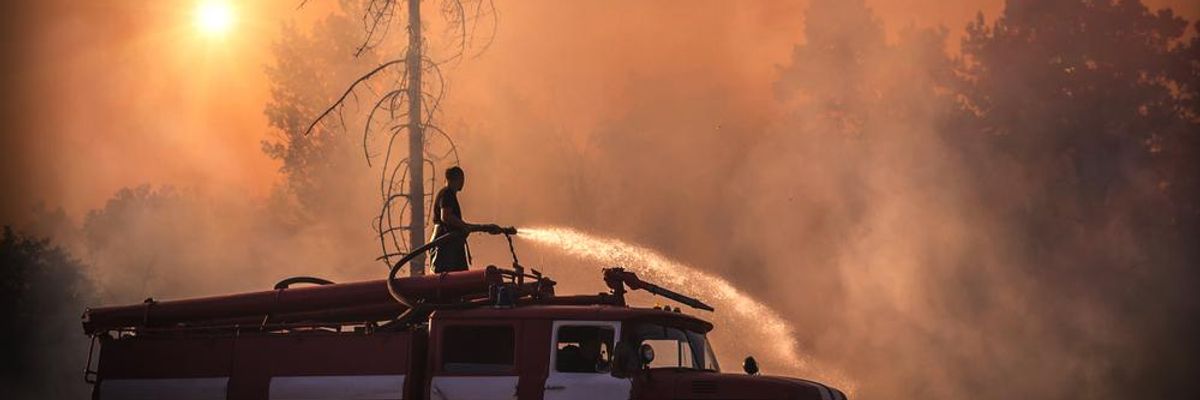
We're going to end up spending money either way: whether we pay to develop non-polluting energy sources, restore forests, and take other steps to prevent catastrophic climate change, or whether we don't, and then we have to pay for the consequences. (Photo: Shutterstock)
Right now, much of the west is affected by wildfires.
An unlucky minority will have to evacuate their homes, and some will lose their homes altogether -- or even their lives. But for millions more across the west, "smoke season" is a real thing.
Vast swaths of the west can be covered in smoke for extended periods, and inhaling the fine particles in the smoke is deleterious to one's health.
This year, fires resulted in the closing of Yosemite National Park and part of Glacier National Park. The Ferguson Fire in Yosemite is just one of many recent fires within the park, including the enormous Rim Fire in 2013, the fifth largest fire in California history.
As a Californian, fires are a regular part of life.
The Cedar Fire of 2003 in San Diego was so massive that the smoke interfered with air traffic. I canceled a backpacking trip in 2015 due to the Rough Fire in King's Canyon National Park.
I went on a road trip that summer and the sky was hazy with smoke in Utah, Idaho, Wyoming, and Colorado. I was told the smoke came from fires in Washington.
In 2016, I spent a few weeks staying with a friend in rural San Diego County. I loved the area, and thought I might like to live there. Then, I thought, "This place looks like it could go up in smoke." Within the month, it did. The aptly named Border Fire broke out in Campo, and my friend had to evacuate.
All of that is nothing compared to what a friend went through last summer in Montana. She and her family (including a toddler) were cooped up in their home for ages, trying to avoid inhaling the smoke. She had to install air filters to attempt to keep at least the indoor air clean.
As the effects of climate change get worse, they're also going to get more costly -- in dollars, lives, and in quality of life. It would be far cheaper to prevent and mitigate the climate crisis.
The increase in wildfires is linked to the climate crisis.
The equation is simple. When it's hotter outside, water evaporates faster, so the "fuel" (trees, vegetation) is drier and more flammable. The many trees killed by drought and bark beetles also contribute to the dryness of the fuel.
As the effects of climate change get worse, they're also going to get more costly -- in dollars, lives, and in quality of life. It would be far cheaper to prevent and mitigate the climate crisis.
Cheaper and better.
We're going to end up spending money either way: whether we pay to develop non-polluting energy sources, restore forests, and take other steps to prevent catastrophic climate change, or whether we don't, and then we have to pay for the consequences.
The costs of inaction? More wildfires and more hurricanes destroy more homes and take more human lives. Inhaled smoke from wildfires leads to increased respiratory illnesses. Sea levels rise and some parts of the world end up under water.
Unfortunately, simply leaving it all up to individuals and to the market isn't enough to prevent this outcome. We need to act collectively -- as a nation and as a world. We've already pulled out of the Paris Climate agreement, which was inadequate but at least it was something.
Climate change is real -- ask anyone living through smoke season. With midterm elections coming up, candidates should be pressed to clarify just what they're going to do about it.
Dear Common Dreams reader, It’s been nearly 30 years since I co-founded Common Dreams with my late wife, Lina Newhouser. We had the radical notion that journalism should serve the public good, not corporate profits. It was clear to us from the outset what it would take to build such a project. No paid advertisements. No corporate sponsors. No millionaire publisher telling us what to think or do. Many people said we wouldn't last a year, but we proved those doubters wrong. Together with a tremendous team of journalists and dedicated staff, we built an independent media outlet free from the constraints of profits and corporate control. Our mission has always been simple: To inform. To inspire. To ignite change for the common good. Building Common Dreams was not easy. Our survival was never guaranteed. When you take on the most powerful forces—Wall Street greed, fossil fuel industry destruction, Big Tech lobbyists, and uber-rich oligarchs who have spent billions upon billions rigging the economy and democracy in their favor—the only bulwark you have is supporters who believe in your work. But here’s the urgent message from me today. It's never been this bad out there. And it's never been this hard to keep us going. At the very moment Common Dreams is most needed, the threats we face are intensifying. We need your support now more than ever. We don't accept corporate advertising and never will. We don't have a paywall because we don't think people should be blocked from critical news based on their ability to pay. Everything we do is funded by the donations of readers like you. When everyone does the little they can afford, we are strong. But if that support retreats or dries up, so do we. Will you donate now to make sure Common Dreams not only survives but thrives? —Craig Brown, Co-founder |
Right now, much of the west is affected by wildfires.
An unlucky minority will have to evacuate their homes, and some will lose their homes altogether -- or even their lives. But for millions more across the west, "smoke season" is a real thing.
Vast swaths of the west can be covered in smoke for extended periods, and inhaling the fine particles in the smoke is deleterious to one's health.
This year, fires resulted in the closing of Yosemite National Park and part of Glacier National Park. The Ferguson Fire in Yosemite is just one of many recent fires within the park, including the enormous Rim Fire in 2013, the fifth largest fire in California history.
As a Californian, fires are a regular part of life.
The Cedar Fire of 2003 in San Diego was so massive that the smoke interfered with air traffic. I canceled a backpacking trip in 2015 due to the Rough Fire in King's Canyon National Park.
I went on a road trip that summer and the sky was hazy with smoke in Utah, Idaho, Wyoming, and Colorado. I was told the smoke came from fires in Washington.
In 2016, I spent a few weeks staying with a friend in rural San Diego County. I loved the area, and thought I might like to live there. Then, I thought, "This place looks like it could go up in smoke." Within the month, it did. The aptly named Border Fire broke out in Campo, and my friend had to evacuate.
All of that is nothing compared to what a friend went through last summer in Montana. She and her family (including a toddler) were cooped up in their home for ages, trying to avoid inhaling the smoke. She had to install air filters to attempt to keep at least the indoor air clean.
As the effects of climate change get worse, they're also going to get more costly -- in dollars, lives, and in quality of life. It would be far cheaper to prevent and mitigate the climate crisis.
The increase in wildfires is linked to the climate crisis.
The equation is simple. When it's hotter outside, water evaporates faster, so the "fuel" (trees, vegetation) is drier and more flammable. The many trees killed by drought and bark beetles also contribute to the dryness of the fuel.
As the effects of climate change get worse, they're also going to get more costly -- in dollars, lives, and in quality of life. It would be far cheaper to prevent and mitigate the climate crisis.
Cheaper and better.
We're going to end up spending money either way: whether we pay to develop non-polluting energy sources, restore forests, and take other steps to prevent catastrophic climate change, or whether we don't, and then we have to pay for the consequences.
The costs of inaction? More wildfires and more hurricanes destroy more homes and take more human lives. Inhaled smoke from wildfires leads to increased respiratory illnesses. Sea levels rise and some parts of the world end up under water.
Unfortunately, simply leaving it all up to individuals and to the market isn't enough to prevent this outcome. We need to act collectively -- as a nation and as a world. We've already pulled out of the Paris Climate agreement, which was inadequate but at least it was something.
Climate change is real -- ask anyone living through smoke season. With midterm elections coming up, candidates should be pressed to clarify just what they're going to do about it.
Right now, much of the west is affected by wildfires.
An unlucky minority will have to evacuate their homes, and some will lose their homes altogether -- or even their lives. But for millions more across the west, "smoke season" is a real thing.
Vast swaths of the west can be covered in smoke for extended periods, and inhaling the fine particles in the smoke is deleterious to one's health.
This year, fires resulted in the closing of Yosemite National Park and part of Glacier National Park. The Ferguson Fire in Yosemite is just one of many recent fires within the park, including the enormous Rim Fire in 2013, the fifth largest fire in California history.
As a Californian, fires are a regular part of life.
The Cedar Fire of 2003 in San Diego was so massive that the smoke interfered with air traffic. I canceled a backpacking trip in 2015 due to the Rough Fire in King's Canyon National Park.
I went on a road trip that summer and the sky was hazy with smoke in Utah, Idaho, Wyoming, and Colorado. I was told the smoke came from fires in Washington.
In 2016, I spent a few weeks staying with a friend in rural San Diego County. I loved the area, and thought I might like to live there. Then, I thought, "This place looks like it could go up in smoke." Within the month, it did. The aptly named Border Fire broke out in Campo, and my friend had to evacuate.
All of that is nothing compared to what a friend went through last summer in Montana. She and her family (including a toddler) were cooped up in their home for ages, trying to avoid inhaling the smoke. She had to install air filters to attempt to keep at least the indoor air clean.
As the effects of climate change get worse, they're also going to get more costly -- in dollars, lives, and in quality of life. It would be far cheaper to prevent and mitigate the climate crisis.
The increase in wildfires is linked to the climate crisis.
The equation is simple. When it's hotter outside, water evaporates faster, so the "fuel" (trees, vegetation) is drier and more flammable. The many trees killed by drought and bark beetles also contribute to the dryness of the fuel.
As the effects of climate change get worse, they're also going to get more costly -- in dollars, lives, and in quality of life. It would be far cheaper to prevent and mitigate the climate crisis.
Cheaper and better.
We're going to end up spending money either way: whether we pay to develop non-polluting energy sources, restore forests, and take other steps to prevent catastrophic climate change, or whether we don't, and then we have to pay for the consequences.
The costs of inaction? More wildfires and more hurricanes destroy more homes and take more human lives. Inhaled smoke from wildfires leads to increased respiratory illnesses. Sea levels rise and some parts of the world end up under water.
Unfortunately, simply leaving it all up to individuals and to the market isn't enough to prevent this outcome. We need to act collectively -- as a nation and as a world. We've already pulled out of the Paris Climate agreement, which was inadequate but at least it was something.
Climate change is real -- ask anyone living through smoke season. With midterm elections coming up, candidates should be pressed to clarify just what they're going to do about it.