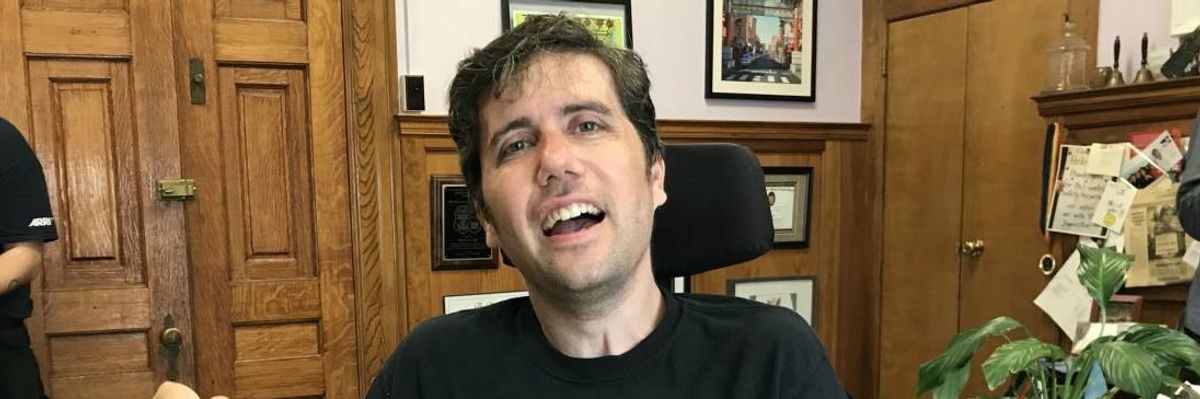
Ady Barkan, activist and co-director of Be A Hero. after participating at a panel discussion about criminal justice reform in City Hall. (Photo: Will Bunch)
Dying From ALS, Ady Barkan Will Save U.S. Democracy if It's the Last Thing He Does
“We’re on the verge of a political revolution.”
A onetime running and outdoor enthusiast who now uses a motorized wheelchair to zip around, Ady Barkan says it's been getting harder just within the last few weeks for him to lift his fork and eat his meals.
His words are slurred and no longer come as quickly as his agile Ivy League-educated mind can create them.
But two years after doctors told the now-34-year-old Barkan that he's terminally ill with amyotrophic lateral sclerosis -- better known as ALS, or Lou Gehrig's disease -- he can still raise his right fist, and that revolutionary gesture means a lot to this career political activist right now.
"Stand up and help make my voice louder, because ALS is taking that away from me!" Barkan exhorted a packed reception room in Philadelphia City Hall where a couple of hundred people had wedged in and others were turned away from hearing his labored yet forceful words. He asked for a "mic check" in the style made famous by 2011's Occupy Wall Street protests.
"I am ready for an economic revolution!" Barkan shouted, as the luminaries he'd just led in a panel discussion on criminal justice reform -- including District Attorney Larry Krasner, City Council member Helen Gym, and social activist Shaun King -- looked on in admiration.
"I am ready for an economic revolution!" the room thundered back.
"I am ... ," said Barkan, as he paused with a wan smile, now raising his right arm just above his head of thick black hair flecked with the faintest touch of gray. "... I am a revolutionary!"
When Donald Trump was elected president on Nov. 8, 2016 -- roughly a month after Barkan was diagnosed with ALS -- there were a lot of folks on the left side of America's political dial who vowed to resist the incoming president's blend of authoritarianism and bigotry as if it's the last thing they do. But few meant it the way Ady Barkan did.
"The explicit reason I'm doing all of this is because our democracy is under incredible threat and we don't have much time to save it -- so I'm doing whatever I can to save and strengthen our democracy," Barkan told me after the event, gazing with curiosity outside Gym's fifth-floor City Hall office at the iconic Jacques Lipchitz sculpture called Government of the People.
"The personal reason that I'm doing it is because it makes me feel hopeful and empowered and connected to people around me," he quickly added.
Right now, Barkan is nearing the end of a 22-state, coast-to-coast "Be a Hero" tour in which he joins with other activists and politicians to rally support to undo the GOP's 2017 tax cuts and for other left-wing causes. He said he finds "personal liberation and salvation" from his tireless political crusade but also said that "it allows me to be bigger than myself -- and, in a way, to outlive my disease."
Before the tumultuous year of 2016, Barkan -- who lives in Santa Barbara, Calif., where his wife, Rachael, is a professor -- was known among a small circle of progressive activists as an innovative policy wonk, who'd shunned the lucrative jobs offered his fellow Yale Law School grads. Instead, he launched a campaign called Fed Up aiming to reform the Federal Reserve Bank toward economic policies that would help working-class people, and worked with officials like Philadelphia's Gym to promote progressive ideas in City Halls through the group Local Progress.
Barkan had just witnessed the birth of his son, Carl, when he felt weakness in his left hand that led to his life-shattering diagnosis. Suddenly, he was faced with an existential choice -- knowing that the degenerative disease would sap his strength and might kill him within a few years. Many people would probably pull back, see the world and focus on spending quality time at home, surrounded by family.
But not many people are like Ady Barkan. To be sure, he cherishes every moment with his wife and child, who'll join him this weekend in New York for the tour's final stops, and he can enjoy the finer things like a trip to Italy where he "ate four plates of pasta every day." But he thinks the best thing he can do for Carl, now 2, is to fight to make sure that he grows up in a democracy.
"Work-life balance is a more acute problem when you're dying and have no time and everything takes so long -- getting dressed, eating, writing an email," he said. "So I feel those tensions and it's hard to know how to balance them, but ultimately I'm trying to build a better world for my son, and I'm having fun in the process."
Having fun while also making some national headlines -- like the viral debate Barkan had last year when he cornered Arizona GOP Sen. Jeff Flake on a cross-country flight and pleaded with him to vote against his party's tax-cut plan, saying that "you can save my life," or getting arrested in the Capitol Rotunda around that same time. The efforts by Barkan and his fellow activists didn't prevent the overall tax bill from passing, but GOP leaders did kill the one provision he'd most aggressively protested, a $25 billion spending cut to Medicare.
Now, he campaigns for Democratic congressional candidates with his eye on a liberal agenda that would be bolder than anything the party has proposed in decades -- a single-payer health-care plan, a guaranteed jobs program, and justice reforms like an end to the death penalty and mass incarceration.
"We're on the verge of a political revolution," Barkan said with clear enthusiasm. "Think about how dark our political life is -- and then think that 27 months from now we can have the most progressive president in 80 years! We could have a progressive Congress!"
Barkan hopes he lives long enough to see it.
Urgent. It's never been this bad.
Dear Common Dreams reader, It’s been nearly 30 years since I co-founded Common Dreams with my late wife, Lina Newhouser. We had the radical notion that journalism should serve the public good, not corporate profits. It was clear to us from the outset what it would take to build such a project. No paid advertisements. No corporate sponsors. No millionaire publisher telling us what to think or do. Many people said we wouldn't last a year, but we proved those doubters wrong. Together with a tremendous team of journalists and dedicated staff, we built an independent media outlet free from the constraints of profits and corporate control. Our mission from the outset was simple. To inform. To inspire. To ignite change for the common good. Building Common Dreams was not easy. Our survival was never guaranteed. When you take on the most powerful forces—Wall Street greed, fossil fuel industry destruction, Big Tech lobbyists, and uber-rich oligarchs who have spent billions upon billions rigging the economy and democracy in their favor—the only bulwark you have is supporters who believe in your work. But here’s the urgent message from me today. It’s never been this bad out there. And it’s never been this hard to keep us going. At the very moment Common Dreams is most needed and doing some of its best and most important work, the threats we face are intensifying. Right now, with just two days to go in our Spring Campaign, we're falling short of our make-or-break goal. When everyone does the little they can afford, we are strong. But if that support retreats or dries up, so do we. Can you make a gift right now to make sure Common Dreams not only survives but thrives? There is no backup plan or rainy day fund. There is only you. —Craig Brown, Co-founder |
A onetime running and outdoor enthusiast who now uses a motorized wheelchair to zip around, Ady Barkan says it's been getting harder just within the last few weeks for him to lift his fork and eat his meals.
His words are slurred and no longer come as quickly as his agile Ivy League-educated mind can create them.
But two years after doctors told the now-34-year-old Barkan that he's terminally ill with amyotrophic lateral sclerosis -- better known as ALS, or Lou Gehrig's disease -- he can still raise his right fist, and that revolutionary gesture means a lot to this career political activist right now.
"Stand up and help make my voice louder, because ALS is taking that away from me!" Barkan exhorted a packed reception room in Philadelphia City Hall where a couple of hundred people had wedged in and others were turned away from hearing his labored yet forceful words. He asked for a "mic check" in the style made famous by 2011's Occupy Wall Street protests.
"I am ready for an economic revolution!" Barkan shouted, as the luminaries he'd just led in a panel discussion on criminal justice reform -- including District Attorney Larry Krasner, City Council member Helen Gym, and social activist Shaun King -- looked on in admiration.
"I am ready for an economic revolution!" the room thundered back.
"I am ... ," said Barkan, as he paused with a wan smile, now raising his right arm just above his head of thick black hair flecked with the faintest touch of gray. "... I am a revolutionary!"
When Donald Trump was elected president on Nov. 8, 2016 -- roughly a month after Barkan was diagnosed with ALS -- there were a lot of folks on the left side of America's political dial who vowed to resist the incoming president's blend of authoritarianism and bigotry as if it's the last thing they do. But few meant it the way Ady Barkan did.
"The explicit reason I'm doing all of this is because our democracy is under incredible threat and we don't have much time to save it -- so I'm doing whatever I can to save and strengthen our democracy," Barkan told me after the event, gazing with curiosity outside Gym's fifth-floor City Hall office at the iconic Jacques Lipchitz sculpture called Government of the People.
"The personal reason that I'm doing it is because it makes me feel hopeful and empowered and connected to people around me," he quickly added.
Right now, Barkan is nearing the end of a 22-state, coast-to-coast "Be a Hero" tour in which he joins with other activists and politicians to rally support to undo the GOP's 2017 tax cuts and for other left-wing causes. He said he finds "personal liberation and salvation" from his tireless political crusade but also said that "it allows me to be bigger than myself -- and, in a way, to outlive my disease."
Before the tumultuous year of 2016, Barkan -- who lives in Santa Barbara, Calif., where his wife, Rachael, is a professor -- was known among a small circle of progressive activists as an innovative policy wonk, who'd shunned the lucrative jobs offered his fellow Yale Law School grads. Instead, he launched a campaign called Fed Up aiming to reform the Federal Reserve Bank toward economic policies that would help working-class people, and worked with officials like Philadelphia's Gym to promote progressive ideas in City Halls through the group Local Progress.
Barkan had just witnessed the birth of his son, Carl, when he felt weakness in his left hand that led to his life-shattering diagnosis. Suddenly, he was faced with an existential choice -- knowing that the degenerative disease would sap his strength and might kill him within a few years. Many people would probably pull back, see the world and focus on spending quality time at home, surrounded by family.
But not many people are like Ady Barkan. To be sure, he cherishes every moment with his wife and child, who'll join him this weekend in New York for the tour's final stops, and he can enjoy the finer things like a trip to Italy where he "ate four plates of pasta every day." But he thinks the best thing he can do for Carl, now 2, is to fight to make sure that he grows up in a democracy.
"Work-life balance is a more acute problem when you're dying and have no time and everything takes so long -- getting dressed, eating, writing an email," he said. "So I feel those tensions and it's hard to know how to balance them, but ultimately I'm trying to build a better world for my son, and I'm having fun in the process."
Having fun while also making some national headlines -- like the viral debate Barkan had last year when he cornered Arizona GOP Sen. Jeff Flake on a cross-country flight and pleaded with him to vote against his party's tax-cut plan, saying that "you can save my life," or getting arrested in the Capitol Rotunda around that same time. The efforts by Barkan and his fellow activists didn't prevent the overall tax bill from passing, but GOP leaders did kill the one provision he'd most aggressively protested, a $25 billion spending cut to Medicare.
Now, he campaigns for Democratic congressional candidates with his eye on a liberal agenda that would be bolder than anything the party has proposed in decades -- a single-payer health-care plan, a guaranteed jobs program, and justice reforms like an end to the death penalty and mass incarceration.
"We're on the verge of a political revolution," Barkan said with clear enthusiasm. "Think about how dark our political life is -- and then think that 27 months from now we can have the most progressive president in 80 years! We could have a progressive Congress!"
Barkan hopes he lives long enough to see it.
A onetime running and outdoor enthusiast who now uses a motorized wheelchair to zip around, Ady Barkan says it's been getting harder just within the last few weeks for him to lift his fork and eat his meals.
His words are slurred and no longer come as quickly as his agile Ivy League-educated mind can create them.
But two years after doctors told the now-34-year-old Barkan that he's terminally ill with amyotrophic lateral sclerosis -- better known as ALS, or Lou Gehrig's disease -- he can still raise his right fist, and that revolutionary gesture means a lot to this career political activist right now.
"Stand up and help make my voice louder, because ALS is taking that away from me!" Barkan exhorted a packed reception room in Philadelphia City Hall where a couple of hundred people had wedged in and others were turned away from hearing his labored yet forceful words. He asked for a "mic check" in the style made famous by 2011's Occupy Wall Street protests.
"I am ready for an economic revolution!" Barkan shouted, as the luminaries he'd just led in a panel discussion on criminal justice reform -- including District Attorney Larry Krasner, City Council member Helen Gym, and social activist Shaun King -- looked on in admiration.
"I am ready for an economic revolution!" the room thundered back.
"I am ... ," said Barkan, as he paused with a wan smile, now raising his right arm just above his head of thick black hair flecked with the faintest touch of gray. "... I am a revolutionary!"
When Donald Trump was elected president on Nov. 8, 2016 -- roughly a month after Barkan was diagnosed with ALS -- there were a lot of folks on the left side of America's political dial who vowed to resist the incoming president's blend of authoritarianism and bigotry as if it's the last thing they do. But few meant it the way Ady Barkan did.
"The explicit reason I'm doing all of this is because our democracy is under incredible threat and we don't have much time to save it -- so I'm doing whatever I can to save and strengthen our democracy," Barkan told me after the event, gazing with curiosity outside Gym's fifth-floor City Hall office at the iconic Jacques Lipchitz sculpture called Government of the People.
"The personal reason that I'm doing it is because it makes me feel hopeful and empowered and connected to people around me," he quickly added.
Right now, Barkan is nearing the end of a 22-state, coast-to-coast "Be a Hero" tour in which he joins with other activists and politicians to rally support to undo the GOP's 2017 tax cuts and for other left-wing causes. He said he finds "personal liberation and salvation" from his tireless political crusade but also said that "it allows me to be bigger than myself -- and, in a way, to outlive my disease."
Before the tumultuous year of 2016, Barkan -- who lives in Santa Barbara, Calif., where his wife, Rachael, is a professor -- was known among a small circle of progressive activists as an innovative policy wonk, who'd shunned the lucrative jobs offered his fellow Yale Law School grads. Instead, he launched a campaign called Fed Up aiming to reform the Federal Reserve Bank toward economic policies that would help working-class people, and worked with officials like Philadelphia's Gym to promote progressive ideas in City Halls through the group Local Progress.
Barkan had just witnessed the birth of his son, Carl, when he felt weakness in his left hand that led to his life-shattering diagnosis. Suddenly, he was faced with an existential choice -- knowing that the degenerative disease would sap his strength and might kill him within a few years. Many people would probably pull back, see the world and focus on spending quality time at home, surrounded by family.
But not many people are like Ady Barkan. To be sure, he cherishes every moment with his wife and child, who'll join him this weekend in New York for the tour's final stops, and he can enjoy the finer things like a trip to Italy where he "ate four plates of pasta every day." But he thinks the best thing he can do for Carl, now 2, is to fight to make sure that he grows up in a democracy.
"Work-life balance is a more acute problem when you're dying and have no time and everything takes so long -- getting dressed, eating, writing an email," he said. "So I feel those tensions and it's hard to know how to balance them, but ultimately I'm trying to build a better world for my son, and I'm having fun in the process."
Having fun while also making some national headlines -- like the viral debate Barkan had last year when he cornered Arizona GOP Sen. Jeff Flake on a cross-country flight and pleaded with him to vote against his party's tax-cut plan, saying that "you can save my life," or getting arrested in the Capitol Rotunda around that same time. The efforts by Barkan and his fellow activists didn't prevent the overall tax bill from passing, but GOP leaders did kill the one provision he'd most aggressively protested, a $25 billion spending cut to Medicare.
Now, he campaigns for Democratic congressional candidates with his eye on a liberal agenda that would be bolder than anything the party has proposed in decades -- a single-payer health-care plan, a guaranteed jobs program, and justice reforms like an end to the death penalty and mass incarceration.
"We're on the verge of a political revolution," Barkan said with clear enthusiasm. "Think about how dark our political life is -- and then think that 27 months from now we can have the most progressive president in 80 years! We could have a progressive Congress!"
Barkan hopes he lives long enough to see it.