SUBSCRIBE TO OUR FREE NEWSLETTER
Daily news & progressive opinion—funded by the people, not the corporations—delivered straight to your inbox.
5
#000000
#FFFFFF
To donate by check, phone, or other method, see our More Ways to Give page.
Daily news & progressive opinion—funded by the people, not the corporations—delivered straight to your inbox.
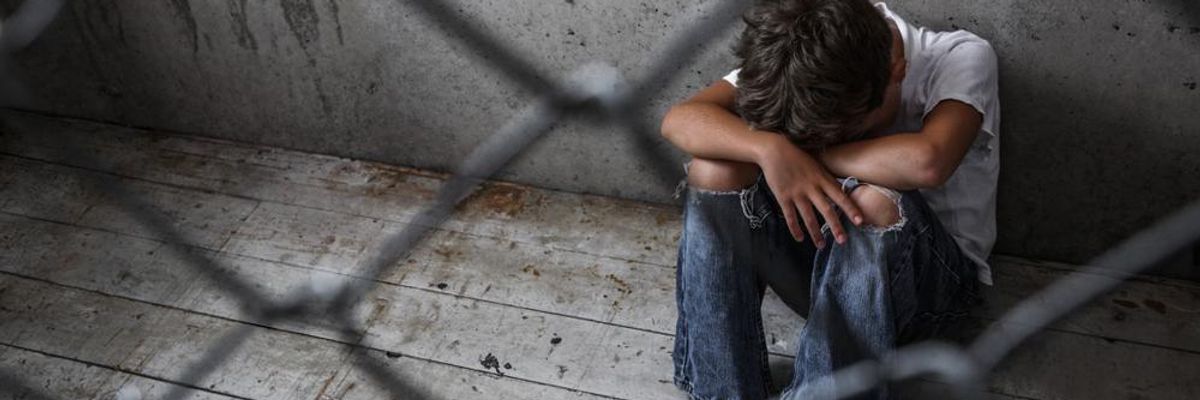
'No human should ever be treated this way. But while we are wounded, we are not broken." (Photo: Shutterstock)
The recent images of immigrant children in cages are incredibly painful to digest.
Still, many people seem to forget that the U.S. has a long track record of forcibly separating families, whether it was African Americans during slavery, the Japanese during World War II, Native Americans during colonization, or poor children whose "unfit" single mothers have lost custody today.
Another common way families are forcibly separated? Juvenile detention.
Tens of thousands of teens and pre-teens -- most often, the poor and people of color -- are locked up in substandard, often privatized penal facilities. Children who go through these forced family separations often wind up experiencing trauma, grief, shame, and dehumanization.
The sad reality is incarceration rates are on the alongside economic inequality, and children aren't exempt. Quite often, the only crime these children have committed is that they're from vulnerable families or suffering from mental health issues.
My son and I personally experienced this.
My son became severely depressed around the time he turned 13. I was a single mother teaching as an adjunct, making less than $20,000 a year, so the treatment he needed wasn't available to us.
My son got into the criminal "justice" system for the initial petty crime of stealing a pair of sneakers, and he remained there for most of his high school years.
Like so many struggling kids, instead of getting the treatment he desperately needed, he was sent to subpar facilities that made his emotional pain worse. He received no real therapy, and they often refused to give him his required medication or messed it up.
He began to see himself as a number, as a terrible person. I saw myself the same way, because I knew how the court system saw me -- as a poor single mother with no husband and a "criminal" son.
From the time he was 14 until he was 18, he was transferred to at least 10 different facilities. I often didn't know where, because I wasn't notified. Despite his chronic depression, he was also put in isolation a number of times -- a tactic known to increase mental suffering among adult prisoners.
At one point, they put him into an adult jail in isolation for at least a month. He was 17 and had just been released from the psych ward that same day. During his once a week phone calls, I could hear the increasing desperation in his voice, as well as the screaming of other adult prisoners in the background.
As a parent, this experience was devastating and terrorizing. There's no way to describe it. The trauma from that pain is still real now.
My son is older now, thankfully alive, and doing the hard work of putting his life back together. "Real therapy would have been so helpful," he told me. "So much pain could have been spared."
"It really desensitizes people all the way around," he said of his experience. "It makes you value yourself less and others less, too, since other people see you as a nonhuman."
No human should ever be treated this way. But while we are wounded, we are not broken.
Social movements are gaining momentum. For example, the immigrant rights movement is growing alongside the Poor People's Economic Human Rights Campaign and other prison liberation movements.
Separating families due to incarceration, immigration status, mental health, and/or race and class is wrong. If the families impacted by incarceration and other traumas join together with advocates for immigrants, we can create a sea of social change.
As one of my students recently wrote, "There are more of us than them."
Dear Common Dreams reader, It’s been nearly 30 years since I co-founded Common Dreams with my late wife, Lina Newhouser. We had the radical notion that journalism should serve the public good, not corporate profits. It was clear to us from the outset what it would take to build such a project. No paid advertisements. No corporate sponsors. No millionaire publisher telling us what to think or do. Many people said we wouldn't last a year, but we proved those doubters wrong. Together with a tremendous team of journalists and dedicated staff, we built an independent media outlet free from the constraints of profits and corporate control. Our mission has always been simple: To inform. To inspire. To ignite change for the common good. Building Common Dreams was not easy. Our survival was never guaranteed. When you take on the most powerful forces—Wall Street greed, fossil fuel industry destruction, Big Tech lobbyists, and uber-rich oligarchs who have spent billions upon billions rigging the economy and democracy in their favor—the only bulwark you have is supporters who believe in your work. But here’s the urgent message from me today. It's never been this bad out there. And it's never been this hard to keep us going. At the very moment Common Dreams is most needed, the threats we face are intensifying. We need your support now more than ever. We don't accept corporate advertising and never will. We don't have a paywall because we don't think people should be blocked from critical news based on their ability to pay. Everything we do is funded by the donations of readers like you. When everyone does the little they can afford, we are strong. But if that support retreats or dries up, so do we. Will you donate now to make sure Common Dreams not only survives but thrives? —Craig Brown, Co-founder |
The recent images of immigrant children in cages are incredibly painful to digest.
Still, many people seem to forget that the U.S. has a long track record of forcibly separating families, whether it was African Americans during slavery, the Japanese during World War II, Native Americans during colonization, or poor children whose "unfit" single mothers have lost custody today.
Another common way families are forcibly separated? Juvenile detention.
Tens of thousands of teens and pre-teens -- most often, the poor and people of color -- are locked up in substandard, often privatized penal facilities. Children who go through these forced family separations often wind up experiencing trauma, grief, shame, and dehumanization.
The sad reality is incarceration rates are on the alongside economic inequality, and children aren't exempt. Quite often, the only crime these children have committed is that they're from vulnerable families or suffering from mental health issues.
My son and I personally experienced this.
My son became severely depressed around the time he turned 13. I was a single mother teaching as an adjunct, making less than $20,000 a year, so the treatment he needed wasn't available to us.
My son got into the criminal "justice" system for the initial petty crime of stealing a pair of sneakers, and he remained there for most of his high school years.
Like so many struggling kids, instead of getting the treatment he desperately needed, he was sent to subpar facilities that made his emotional pain worse. He received no real therapy, and they often refused to give him his required medication or messed it up.
He began to see himself as a number, as a terrible person. I saw myself the same way, because I knew how the court system saw me -- as a poor single mother with no husband and a "criminal" son.
From the time he was 14 until he was 18, he was transferred to at least 10 different facilities. I often didn't know where, because I wasn't notified. Despite his chronic depression, he was also put in isolation a number of times -- a tactic known to increase mental suffering among adult prisoners.
At one point, they put him into an adult jail in isolation for at least a month. He was 17 and had just been released from the psych ward that same day. During his once a week phone calls, I could hear the increasing desperation in his voice, as well as the screaming of other adult prisoners in the background.
As a parent, this experience was devastating and terrorizing. There's no way to describe it. The trauma from that pain is still real now.
My son is older now, thankfully alive, and doing the hard work of putting his life back together. "Real therapy would have been so helpful," he told me. "So much pain could have been spared."
"It really desensitizes people all the way around," he said of his experience. "It makes you value yourself less and others less, too, since other people see you as a nonhuman."
No human should ever be treated this way. But while we are wounded, we are not broken.
Social movements are gaining momentum. For example, the immigrant rights movement is growing alongside the Poor People's Economic Human Rights Campaign and other prison liberation movements.
Separating families due to incarceration, immigration status, mental health, and/or race and class is wrong. If the families impacted by incarceration and other traumas join together with advocates for immigrants, we can create a sea of social change.
As one of my students recently wrote, "There are more of us than them."
The recent images of immigrant children in cages are incredibly painful to digest.
Still, many people seem to forget that the U.S. has a long track record of forcibly separating families, whether it was African Americans during slavery, the Japanese during World War II, Native Americans during colonization, or poor children whose "unfit" single mothers have lost custody today.
Another common way families are forcibly separated? Juvenile detention.
Tens of thousands of teens and pre-teens -- most often, the poor and people of color -- are locked up in substandard, often privatized penal facilities. Children who go through these forced family separations often wind up experiencing trauma, grief, shame, and dehumanization.
The sad reality is incarceration rates are on the alongside economic inequality, and children aren't exempt. Quite often, the only crime these children have committed is that they're from vulnerable families or suffering from mental health issues.
My son and I personally experienced this.
My son became severely depressed around the time he turned 13. I was a single mother teaching as an adjunct, making less than $20,000 a year, so the treatment he needed wasn't available to us.
My son got into the criminal "justice" system for the initial petty crime of stealing a pair of sneakers, and he remained there for most of his high school years.
Like so many struggling kids, instead of getting the treatment he desperately needed, he was sent to subpar facilities that made his emotional pain worse. He received no real therapy, and they often refused to give him his required medication or messed it up.
He began to see himself as a number, as a terrible person. I saw myself the same way, because I knew how the court system saw me -- as a poor single mother with no husband and a "criminal" son.
From the time he was 14 until he was 18, he was transferred to at least 10 different facilities. I often didn't know where, because I wasn't notified. Despite his chronic depression, he was also put in isolation a number of times -- a tactic known to increase mental suffering among adult prisoners.
At one point, they put him into an adult jail in isolation for at least a month. He was 17 and had just been released from the psych ward that same day. During his once a week phone calls, I could hear the increasing desperation in his voice, as well as the screaming of other adult prisoners in the background.
As a parent, this experience was devastating and terrorizing. There's no way to describe it. The trauma from that pain is still real now.
My son is older now, thankfully alive, and doing the hard work of putting his life back together. "Real therapy would have been so helpful," he told me. "So much pain could have been spared."
"It really desensitizes people all the way around," he said of his experience. "It makes you value yourself less and others less, too, since other people see you as a nonhuman."
No human should ever be treated this way. But while we are wounded, we are not broken.
Social movements are gaining momentum. For example, the immigrant rights movement is growing alongside the Poor People's Economic Human Rights Campaign and other prison liberation movements.
Separating families due to incarceration, immigration status, mental health, and/or race and class is wrong. If the families impacted by incarceration and other traumas join together with advocates for immigrants, we can create a sea of social change.
As one of my students recently wrote, "There are more of us than them."