

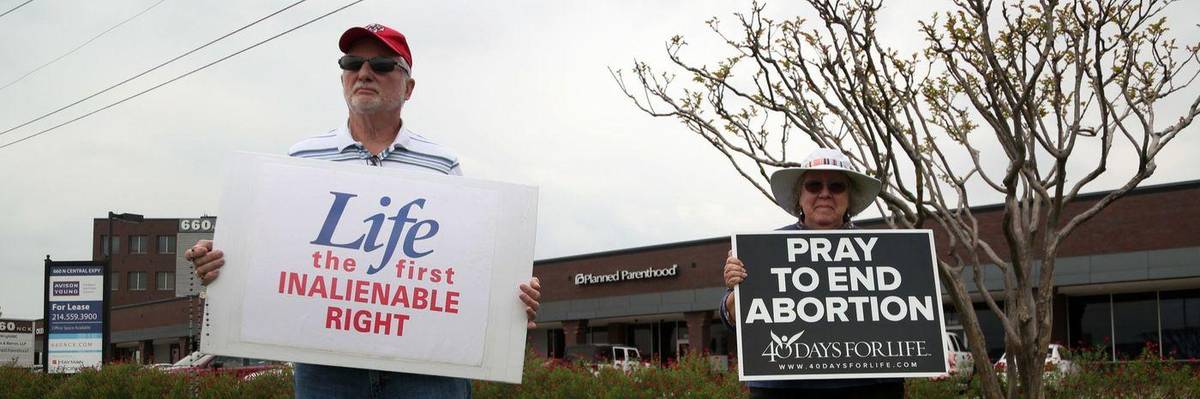
A protest against abortion in front of the Planned Parenthood in Plano, Texas. (Los Angeles Times)
Conservatives Are Fighting to Roll Back Abortion Rights. And They're Winning
Limiting access to abortion does not eliminate the need for abortion; it only makes abortion illegal and unsafe.
When the U.S. Supreme Court refused to hear a challenge to a strict Arkansas abortion law last month, it effectively made Arkansas the first state in the country to ban medication abortion. As a result, anyone seeking an abortion in Arkansas now has to travel out of state or to Little Rock, where the state's only surgical abortion provider is located. (Surgical abortion is still legal.)
There is no medical or health reason for this ban on medication abortion. Approved by the Food and Drug Administration in 2000, non-invasive medication abortion is safe by all measures -- safer than Tylenol and Viagra, even. That's why many women chose it over surgical abortion, which is already one of the safest medical procedures.
The new law requires medication abortion providers to contract with a second doctor who holds hospital admitting privileges. It is nearly identical to a restriction passed in 2013 in my home state of Texas, which I'm sorry to say has one of the most abysmal records on reproductive rights and women's health in the country. In 2016, the Supreme Court heard the case of Whole Woman's Health vs. Hellerstedt and deemed the Texas law unconstitutional.
Abortion has been and will always be essential healthcare.
So what makes Arkansas different? The truth is that it's not. We don't know why the Supreme Court chose not to take the case challenging the Arkansas law, but the case is not over. It is back in the trial court, where Planned Parenthood is continuing to fight to have it blocked.
Arkansas is just the beginning. Conservative politicians, emboldened by the Trump administration, are attempting to roll back abortion rights in many states across the country.
Politicians in Missouri and Louisiana are pushing medically unnecessary restrictions that would make abortion much more difficult in those states. Mississippi and Louisiana have both passed 15-week abortion bans, the fate of which will be decided by the courts. And Iowa has passed one of the country's most restrictive abortion bills into law, banning abortions after six weeks. (A judge has placed a temporary injunction on Iowa's so-called "heartbeat law.")
Before Roe vs. Wade, healthy women routinely died in emergency rooms across the country because of botched abortions. Limiting access to abortion does not eliminate the need for abortion; it only makes abortion illegal and unsafe.
Anyone seeking an abortion in Arkansas now has to travel out of state or to Little Rock, where the state's only surgical abortion provider is located.
A heavy burden has been placed on the Arkansas patients denied care with no backup plan. Women in Fayetteville, for instance, are facing a 380-mile round trip to the only remaining abortion provider in their state. This takes time and money that many don't have. Nearly one in five people in Arkansas live below the poverty line, and women with low incomes already face severe barriers to accessing reproductive care.
On the morning that the court declined to take up the Arkansas appeal, some women were already en route to one of the state's three abortion clinics when they got word that their appointments were canceled.
Dr. Stephanie Ho, a physician at Planned Parenthood Great Plains in Arkansas, had to place some of those calls. "It's incredibly disheartening to call a patient and say you qualified for this last week, but your government says that's a decision you no longer get to make," she said.
Support for Roe vs. Wade is the highest it's ever been, at 70%.
The American Congress of Obstetricians and Gynecologists said the new requirement "does nothing to enhance the quality or safety of abortion care, and in fact creates a grave risk to public health." It's for this reason that Planned Parenthood is continuing to fight the Arkansas law, doing everything possible to protect patients' access to care as the case proceeds.
Abortion has been and will always be essential healthcare. The good news is that the American people know it. Support for Roe vs. Wade is the highest it's ever been, at 70%. With more women running for elected office than ever before, I'm hopeful that these harmful policies will soon become relics of the past.
We are at a crossroads
This country and this world are at a monumental crossroads. In a few short weeks, US voters will have an opportunity to beat back the forces of fascism and confront the billionaires who are rigging the economy, our media system, and our democracy, making it increasingly impossible for ordinary people to get by. We’re not just talking about the election. We’re talking about what must be done once these fascist elements are vanquished from power. We need a bolder set of solutions than what either major party has so far been willing to offer and a working-class movement ready to fight like hell for it. Trump didn't emerge from nowhere. The conditions that fueled MAGA authoritarianism were created by decades of radical neoliberal economic policies and a corrupt political system dominated by corporate interests. They slashed taxes on the super-rich, promising that the benefits would trickle down. They said giveaways to the corporate titans would make life more affordable for the rest of us. It was all bullshit. And when a bitter, betrayed populace searches for someone to blame, right-wing demagogues have little trouble finding scapegoats. People know when they're being lied to, but you won't hear any of this from the corporate media. Only independent journalism—powered and funded by people who believe in building a better world—can deliver truly trustworthy daily news. Our Fall Campaign is underway, and we need your help. To power our newsroom through the rest of the year, we need to raise $125,000 by midnight on October 31. So if you share our vision, please contribute whatever you can to sustain our work. |
When the U.S. Supreme Court refused to hear a challenge to a strict Arkansas abortion law last month, it effectively made Arkansas the first state in the country to ban medication abortion. As a result, anyone seeking an abortion in Arkansas now has to travel out of state or to Little Rock, where the state's only surgical abortion provider is located. (Surgical abortion is still legal.)
There is no medical or health reason for this ban on medication abortion. Approved by the Food and Drug Administration in 2000, non-invasive medication abortion is safe by all measures -- safer than Tylenol and Viagra, even. That's why many women chose it over surgical abortion, which is already one of the safest medical procedures.
The new law requires medication abortion providers to contract with a second doctor who holds hospital admitting privileges. It is nearly identical to a restriction passed in 2013 in my home state of Texas, which I'm sorry to say has one of the most abysmal records on reproductive rights and women's health in the country. In 2016, the Supreme Court heard the case of Whole Woman's Health vs. Hellerstedt and deemed the Texas law unconstitutional.
Abortion has been and will always be essential healthcare.
So what makes Arkansas different? The truth is that it's not. We don't know why the Supreme Court chose not to take the case challenging the Arkansas law, but the case is not over. It is back in the trial court, where Planned Parenthood is continuing to fight to have it blocked.
Arkansas is just the beginning. Conservative politicians, emboldened by the Trump administration, are attempting to roll back abortion rights in many states across the country.
Politicians in Missouri and Louisiana are pushing medically unnecessary restrictions that would make abortion much more difficult in those states. Mississippi and Louisiana have both passed 15-week abortion bans, the fate of which will be decided by the courts. And Iowa has passed one of the country's most restrictive abortion bills into law, banning abortions after six weeks. (A judge has placed a temporary injunction on Iowa's so-called "heartbeat law.")
Before Roe vs. Wade, healthy women routinely died in emergency rooms across the country because of botched abortions. Limiting access to abortion does not eliminate the need for abortion; it only makes abortion illegal and unsafe.
Anyone seeking an abortion in Arkansas now has to travel out of state or to Little Rock, where the state's only surgical abortion provider is located.
A heavy burden has been placed on the Arkansas patients denied care with no backup plan. Women in Fayetteville, for instance, are facing a 380-mile round trip to the only remaining abortion provider in their state. This takes time and money that many don't have. Nearly one in five people in Arkansas live below the poverty line, and women with low incomes already face severe barriers to accessing reproductive care.
On the morning that the court declined to take up the Arkansas appeal, some women were already en route to one of the state's three abortion clinics when they got word that their appointments were canceled.
Dr. Stephanie Ho, a physician at Planned Parenthood Great Plains in Arkansas, had to place some of those calls. "It's incredibly disheartening to call a patient and say you qualified for this last week, but your government says that's a decision you no longer get to make," she said.
Support for Roe vs. Wade is the highest it's ever been, at 70%.
The American Congress of Obstetricians and Gynecologists said the new requirement "does nothing to enhance the quality or safety of abortion care, and in fact creates a grave risk to public health." It's for this reason that Planned Parenthood is continuing to fight the Arkansas law, doing everything possible to protect patients' access to care as the case proceeds.
Abortion has been and will always be essential healthcare. The good news is that the American people know it. Support for Roe vs. Wade is the highest it's ever been, at 70%. With more women running for elected office than ever before, I'm hopeful that these harmful policies will soon become relics of the past.
When the U.S. Supreme Court refused to hear a challenge to a strict Arkansas abortion law last month, it effectively made Arkansas the first state in the country to ban medication abortion. As a result, anyone seeking an abortion in Arkansas now has to travel out of state or to Little Rock, where the state's only surgical abortion provider is located. (Surgical abortion is still legal.)
There is no medical or health reason for this ban on medication abortion. Approved by the Food and Drug Administration in 2000, non-invasive medication abortion is safe by all measures -- safer than Tylenol and Viagra, even. That's why many women chose it over surgical abortion, which is already one of the safest medical procedures.
The new law requires medication abortion providers to contract with a second doctor who holds hospital admitting privileges. It is nearly identical to a restriction passed in 2013 in my home state of Texas, which I'm sorry to say has one of the most abysmal records on reproductive rights and women's health in the country. In 2016, the Supreme Court heard the case of Whole Woman's Health vs. Hellerstedt and deemed the Texas law unconstitutional.
Abortion has been and will always be essential healthcare.
So what makes Arkansas different? The truth is that it's not. We don't know why the Supreme Court chose not to take the case challenging the Arkansas law, but the case is not over. It is back in the trial court, where Planned Parenthood is continuing to fight to have it blocked.
Arkansas is just the beginning. Conservative politicians, emboldened by the Trump administration, are attempting to roll back abortion rights in many states across the country.
Politicians in Missouri and Louisiana are pushing medically unnecessary restrictions that would make abortion much more difficult in those states. Mississippi and Louisiana have both passed 15-week abortion bans, the fate of which will be decided by the courts. And Iowa has passed one of the country's most restrictive abortion bills into law, banning abortions after six weeks. (A judge has placed a temporary injunction on Iowa's so-called "heartbeat law.")
Before Roe vs. Wade, healthy women routinely died in emergency rooms across the country because of botched abortions. Limiting access to abortion does not eliminate the need for abortion; it only makes abortion illegal and unsafe.
Anyone seeking an abortion in Arkansas now has to travel out of state or to Little Rock, where the state's only surgical abortion provider is located.
A heavy burden has been placed on the Arkansas patients denied care with no backup plan. Women in Fayetteville, for instance, are facing a 380-mile round trip to the only remaining abortion provider in their state. This takes time and money that many don't have. Nearly one in five people in Arkansas live below the poverty line, and women with low incomes already face severe barriers to accessing reproductive care.
On the morning that the court declined to take up the Arkansas appeal, some women were already en route to one of the state's three abortion clinics when they got word that their appointments were canceled.
Dr. Stephanie Ho, a physician at Planned Parenthood Great Plains in Arkansas, had to place some of those calls. "It's incredibly disheartening to call a patient and say you qualified for this last week, but your government says that's a decision you no longer get to make," she said.
Support for Roe vs. Wade is the highest it's ever been, at 70%.
The American Congress of Obstetricians and Gynecologists said the new requirement "does nothing to enhance the quality or safety of abortion care, and in fact creates a grave risk to public health." It's for this reason that Planned Parenthood is continuing to fight the Arkansas law, doing everything possible to protect patients' access to care as the case proceeds.
Abortion has been and will always be essential healthcare. The good news is that the American people know it. Support for Roe vs. Wade is the highest it's ever been, at 70%. With more women running for elected office than ever before, I'm hopeful that these harmful policies will soon become relics of the past.