SUBSCRIBE TO OUR FREE NEWSLETTER
Daily news & progressive opinion—funded by the people, not the corporations—delivered straight to your inbox.
5
#000000
#FFFFFF
To donate by check, phone, or other method, see our More Ways to Give page.
Daily news & progressive opinion—funded by the people, not the corporations—delivered straight to your inbox.
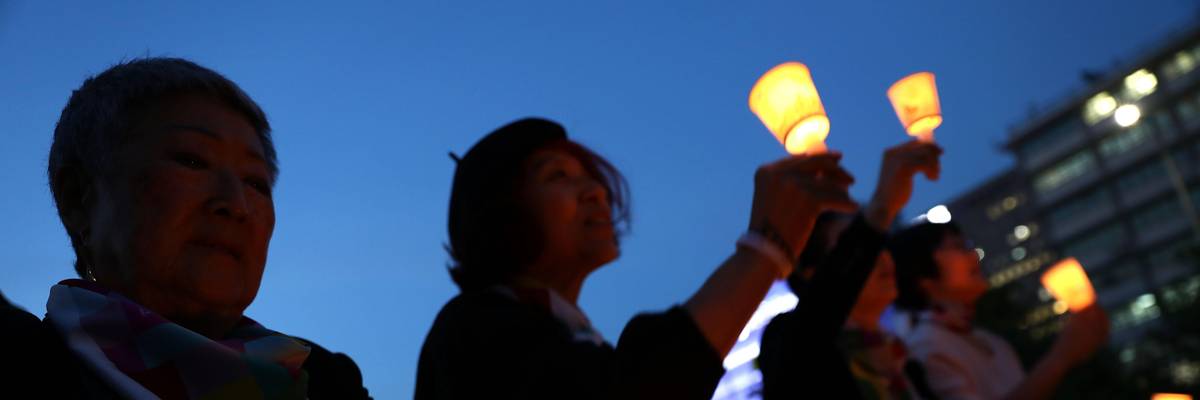
Activists gather in front of the U.S. embassy to demand peace for the Korean peninsula after the cancellation of the U.S. and North Korea summit on May 25, 2018 in Seoul, South Korea. (Photo by Chung Sung-Jun/Getty Images)
Last month, I took part in an international women's peace delegation to South Korea, led by Nobel Peace Laureate Mairead Maguire and Women Cross DMZ founder Christine Ahn.
It was my first visit to my native Korea in over 3 years. Everywhere I went, I witnessed the afterglow of the inspiring candlelight movement that restored democracy to the country, and sensed the deep conviction with which Koreans support the current peace process initiated by President Moon.
Our delegation noted in one of its first official statements following its arrival in Korea: "What initiated the Panmunjom Declaration was the completely non-violent and peaceful civil revolution in 2016 that began with orderly marches of demonstration with warm candlelight through the winter. The candlelight revolution was a true example of the UN's Culture of Peace."
In addition to meeting with diplomatic representatives from the US, U.K, Japan, Sweden, and Canada, we participated in an all-day peace symposium at the National Assembly side by side with South Korean women peace activists. One of our South Korea colleagues commented that while women have been conspicuously absent from the process of warmaking in the Korean peninsula (at least from a policy standpoint) they most certainly ought to be part of the peace process.
On the same day that President Moon and Chairman Kim held their second summit in Panmunjom, our delegation, accompanied by over 1200 Korean women, walked over 5 km in the sweltering 40-degree heat to cross the Unification Bridge on foot. Christine Ahn summed up all our sentiments when she later commented:
"We were the first civilians to walk across the Unification Bridge. As I took my first step onto the bridge, tears streamed down my face as I thought about how Korea was divided by the US and the former Soviet Union after 35 years of Japanese colonial occupation."
Returning to the United States however, I found a starkly different reality in the sustained attacks on the peace process--even the very idea of a peace treaty--by right-wing pundits, Neocon hawks, and corporate media promoting an aggressively maximalist standard.Returning to the United States however, I found a starkly different reality in the sustained attacks on the peace process--even the very idea of a peace treaty--by right-wing pundits, Neocon hawks, and corporate media promoting an aggressively maximalist standard. In this dialogue, the 4 million Korean and 35,000 American lives already lost to the Korean War, as well as the 80 million Koreans whose lives would hang in balance in any renewed conflict, are presented as mere footnotes. North Korea in particular, where poverty is rampant and 25% of children suffer from malnutrition, is presented as the perpetually "Threatening Other," fully deserving to suffer from the US-led sanctions. American exceptionalism is celebrated without reservation.
This disregard for the interests of Koreans themselves in this nominally inter-Korean conflict was a declaration authored by seven leading Democratic Senators, demand that President Trump to hold to a hard line in any negotiations with North Korea. The letter signed by Senators Mendendez, Schumer, Durbin, Warner, Feinstein, Leahy and Brown completely overlooked the recent progress toward peace evinced by the inter-Korean summit and the Panmunjom Declaration, and discounted the overwhelming support for the current peace process by Koreans. Further, it was oblivious to the hopes and interests of 80 million Koreans who, after surviving 35 years of brutal Japanese colonization, were forcibly divided over 65 years ago by the US and the former Soviet Union. The letter offers no alternative vision for peace on the Korean Peninsula and considers Korean interests only insofar as they serve the narrow political agenda of the Democratic party. It represents a bankrupt foreign policy view.
On the occasion of our delegation's visit to Korea, I had reached out to renowned scholar Professor Noam Chomsky, with whom I maintain a correspondence, for a statement in support of our mission. Contrasting the significance of the April 27 Declaration between the two Koreas with the apparently incoherent foreign policy approach of the United States, which plays a dominant role in any prospect for inter-Korean peace, Professor Chomsky commented:
The April 27 Declaration of the two Koreas was a historic event, which promises a bright future for the people of Korea. It calls for the two Koreas to settle their problems "on their own accord" and lays out a careful schedule to proceed, something quite new. It also calls on the international community (meaning Washington) to support this process. Unfortunately, the signals from Washington are at best mixed. National Security Council advisor John Bolton, who has called for bombing North Korea at once, and Vice-President Mike Pence both invoked the "Libya model," knowing full well its import. President Trump cancelled the Singapore summit a few hours after North Korea had destroyed its main testing site as an important gesture of conciliation. But these are pitfalls, not termination of the process. With determination and good will the two Koreas can move forward with the plans outlined in the Declaration. It is the task of the people of the United States to support them in this historic endeavor and to ensure that their own government does not undermine or in any way impede the process. That can succeed. It must succeed, for the welfare of Korea, and all of us.
Professor Chomsky is right in pointing out that this initiative carried forward by the two Koreas is in fact "something quite new." The minimum that the United States can do during this historic moment is to refrain from harming the inter-Korean peace process. It's time that American politicians, both Democratic and Republicans, give Koreans a chance to shape their own destiny.
Dear Common Dreams reader, It’s been nearly 30 years since I co-founded Common Dreams with my late wife, Lina Newhouser. We had the radical notion that journalism should serve the public good, not corporate profits. It was clear to us from the outset what it would take to build such a project. No paid advertisements. No corporate sponsors. No millionaire publisher telling us what to think or do. Many people said we wouldn't last a year, but we proved those doubters wrong. Together with a tremendous team of journalists and dedicated staff, we built an independent media outlet free from the constraints of profits and corporate control. Our mission has always been simple: To inform. To inspire. To ignite change for the common good. Building Common Dreams was not easy. Our survival was never guaranteed. When you take on the most powerful forces—Wall Street greed, fossil fuel industry destruction, Big Tech lobbyists, and uber-rich oligarchs who have spent billions upon billions rigging the economy and democracy in their favor—the only bulwark you have is supporters who believe in your work. But here’s the urgent message from me today. It's never been this bad out there. And it's never been this hard to keep us going. At the very moment Common Dreams is most needed, the threats we face are intensifying. We need your support now more than ever. We don't accept corporate advertising and never will. We don't have a paywall because we don't think people should be blocked from critical news based on their ability to pay. Everything we do is funded by the donations of readers like you. When everyone does the little they can afford, we are strong. But if that support retreats or dries up, so do we. Will you donate now to make sure Common Dreams not only survives but thrives? —Craig Brown, Co-founder |
Last month, I took part in an international women's peace delegation to South Korea, led by Nobel Peace Laureate Mairead Maguire and Women Cross DMZ founder Christine Ahn.
It was my first visit to my native Korea in over 3 years. Everywhere I went, I witnessed the afterglow of the inspiring candlelight movement that restored democracy to the country, and sensed the deep conviction with which Koreans support the current peace process initiated by President Moon.
Our delegation noted in one of its first official statements following its arrival in Korea: "What initiated the Panmunjom Declaration was the completely non-violent and peaceful civil revolution in 2016 that began with orderly marches of demonstration with warm candlelight through the winter. The candlelight revolution was a true example of the UN's Culture of Peace."
In addition to meeting with diplomatic representatives from the US, U.K, Japan, Sweden, and Canada, we participated in an all-day peace symposium at the National Assembly side by side with South Korean women peace activists. One of our South Korea colleagues commented that while women have been conspicuously absent from the process of warmaking in the Korean peninsula (at least from a policy standpoint) they most certainly ought to be part of the peace process.
On the same day that President Moon and Chairman Kim held their second summit in Panmunjom, our delegation, accompanied by over 1200 Korean women, walked over 5 km in the sweltering 40-degree heat to cross the Unification Bridge on foot. Christine Ahn summed up all our sentiments when she later commented:
"We were the first civilians to walk across the Unification Bridge. As I took my first step onto the bridge, tears streamed down my face as I thought about how Korea was divided by the US and the former Soviet Union after 35 years of Japanese colonial occupation."
Returning to the United States however, I found a starkly different reality in the sustained attacks on the peace process--even the very idea of a peace treaty--by right-wing pundits, Neocon hawks, and corporate media promoting an aggressively maximalist standard.Returning to the United States however, I found a starkly different reality in the sustained attacks on the peace process--even the very idea of a peace treaty--by right-wing pundits, Neocon hawks, and corporate media promoting an aggressively maximalist standard. In this dialogue, the 4 million Korean and 35,000 American lives already lost to the Korean War, as well as the 80 million Koreans whose lives would hang in balance in any renewed conflict, are presented as mere footnotes. North Korea in particular, where poverty is rampant and 25% of children suffer from malnutrition, is presented as the perpetually "Threatening Other," fully deserving to suffer from the US-led sanctions. American exceptionalism is celebrated without reservation.
This disregard for the interests of Koreans themselves in this nominally inter-Korean conflict was a declaration authored by seven leading Democratic Senators, demand that President Trump to hold to a hard line in any negotiations with North Korea. The letter signed by Senators Mendendez, Schumer, Durbin, Warner, Feinstein, Leahy and Brown completely overlooked the recent progress toward peace evinced by the inter-Korean summit and the Panmunjom Declaration, and discounted the overwhelming support for the current peace process by Koreans. Further, it was oblivious to the hopes and interests of 80 million Koreans who, after surviving 35 years of brutal Japanese colonization, were forcibly divided over 65 years ago by the US and the former Soviet Union. The letter offers no alternative vision for peace on the Korean Peninsula and considers Korean interests only insofar as they serve the narrow political agenda of the Democratic party. It represents a bankrupt foreign policy view.
On the occasion of our delegation's visit to Korea, I had reached out to renowned scholar Professor Noam Chomsky, with whom I maintain a correspondence, for a statement in support of our mission. Contrasting the significance of the April 27 Declaration between the two Koreas with the apparently incoherent foreign policy approach of the United States, which plays a dominant role in any prospect for inter-Korean peace, Professor Chomsky commented:
The April 27 Declaration of the two Koreas was a historic event, which promises a bright future for the people of Korea. It calls for the two Koreas to settle their problems "on their own accord" and lays out a careful schedule to proceed, something quite new. It also calls on the international community (meaning Washington) to support this process. Unfortunately, the signals from Washington are at best mixed. National Security Council advisor John Bolton, who has called for bombing North Korea at once, and Vice-President Mike Pence both invoked the "Libya model," knowing full well its import. President Trump cancelled the Singapore summit a few hours after North Korea had destroyed its main testing site as an important gesture of conciliation. But these are pitfalls, not termination of the process. With determination and good will the two Koreas can move forward with the plans outlined in the Declaration. It is the task of the people of the United States to support them in this historic endeavor and to ensure that their own government does not undermine or in any way impede the process. That can succeed. It must succeed, for the welfare of Korea, and all of us.
Professor Chomsky is right in pointing out that this initiative carried forward by the two Koreas is in fact "something quite new." The minimum that the United States can do during this historic moment is to refrain from harming the inter-Korean peace process. It's time that American politicians, both Democratic and Republicans, give Koreans a chance to shape their own destiny.
Last month, I took part in an international women's peace delegation to South Korea, led by Nobel Peace Laureate Mairead Maguire and Women Cross DMZ founder Christine Ahn.
It was my first visit to my native Korea in over 3 years. Everywhere I went, I witnessed the afterglow of the inspiring candlelight movement that restored democracy to the country, and sensed the deep conviction with which Koreans support the current peace process initiated by President Moon.
Our delegation noted in one of its first official statements following its arrival in Korea: "What initiated the Panmunjom Declaration was the completely non-violent and peaceful civil revolution in 2016 that began with orderly marches of demonstration with warm candlelight through the winter. The candlelight revolution was a true example of the UN's Culture of Peace."
In addition to meeting with diplomatic representatives from the US, U.K, Japan, Sweden, and Canada, we participated in an all-day peace symposium at the National Assembly side by side with South Korean women peace activists. One of our South Korea colleagues commented that while women have been conspicuously absent from the process of warmaking in the Korean peninsula (at least from a policy standpoint) they most certainly ought to be part of the peace process.
On the same day that President Moon and Chairman Kim held their second summit in Panmunjom, our delegation, accompanied by over 1200 Korean women, walked over 5 km in the sweltering 40-degree heat to cross the Unification Bridge on foot. Christine Ahn summed up all our sentiments when she later commented:
"We were the first civilians to walk across the Unification Bridge. As I took my first step onto the bridge, tears streamed down my face as I thought about how Korea was divided by the US and the former Soviet Union after 35 years of Japanese colonial occupation."
Returning to the United States however, I found a starkly different reality in the sustained attacks on the peace process--even the very idea of a peace treaty--by right-wing pundits, Neocon hawks, and corporate media promoting an aggressively maximalist standard.Returning to the United States however, I found a starkly different reality in the sustained attacks on the peace process--even the very idea of a peace treaty--by right-wing pundits, Neocon hawks, and corporate media promoting an aggressively maximalist standard. In this dialogue, the 4 million Korean and 35,000 American lives already lost to the Korean War, as well as the 80 million Koreans whose lives would hang in balance in any renewed conflict, are presented as mere footnotes. North Korea in particular, where poverty is rampant and 25% of children suffer from malnutrition, is presented as the perpetually "Threatening Other," fully deserving to suffer from the US-led sanctions. American exceptionalism is celebrated without reservation.
This disregard for the interests of Koreans themselves in this nominally inter-Korean conflict was a declaration authored by seven leading Democratic Senators, demand that President Trump to hold to a hard line in any negotiations with North Korea. The letter signed by Senators Mendendez, Schumer, Durbin, Warner, Feinstein, Leahy and Brown completely overlooked the recent progress toward peace evinced by the inter-Korean summit and the Panmunjom Declaration, and discounted the overwhelming support for the current peace process by Koreans. Further, it was oblivious to the hopes and interests of 80 million Koreans who, after surviving 35 years of brutal Japanese colonization, were forcibly divided over 65 years ago by the US and the former Soviet Union. The letter offers no alternative vision for peace on the Korean Peninsula and considers Korean interests only insofar as they serve the narrow political agenda of the Democratic party. It represents a bankrupt foreign policy view.
On the occasion of our delegation's visit to Korea, I had reached out to renowned scholar Professor Noam Chomsky, with whom I maintain a correspondence, for a statement in support of our mission. Contrasting the significance of the April 27 Declaration between the two Koreas with the apparently incoherent foreign policy approach of the United States, which plays a dominant role in any prospect for inter-Korean peace, Professor Chomsky commented:
The April 27 Declaration of the two Koreas was a historic event, which promises a bright future for the people of Korea. It calls for the two Koreas to settle their problems "on their own accord" and lays out a careful schedule to proceed, something quite new. It also calls on the international community (meaning Washington) to support this process. Unfortunately, the signals from Washington are at best mixed. National Security Council advisor John Bolton, who has called for bombing North Korea at once, and Vice-President Mike Pence both invoked the "Libya model," knowing full well its import. President Trump cancelled the Singapore summit a few hours after North Korea had destroyed its main testing site as an important gesture of conciliation. But these are pitfalls, not termination of the process. With determination and good will the two Koreas can move forward with the plans outlined in the Declaration. It is the task of the people of the United States to support them in this historic endeavor and to ensure that their own government does not undermine or in any way impede the process. That can succeed. It must succeed, for the welfare of Korea, and all of us.
Professor Chomsky is right in pointing out that this initiative carried forward by the two Koreas is in fact "something quite new." The minimum that the United States can do during this historic moment is to refrain from harming the inter-Korean peace process. It's time that American politicians, both Democratic and Republicans, give Koreans a chance to shape their own destiny.