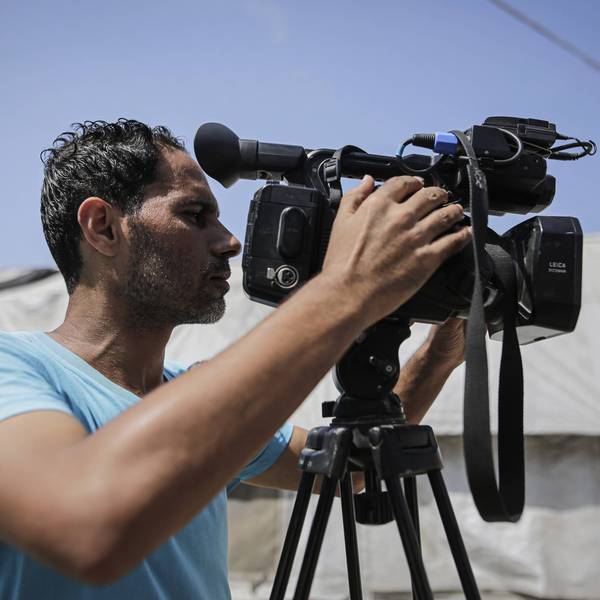
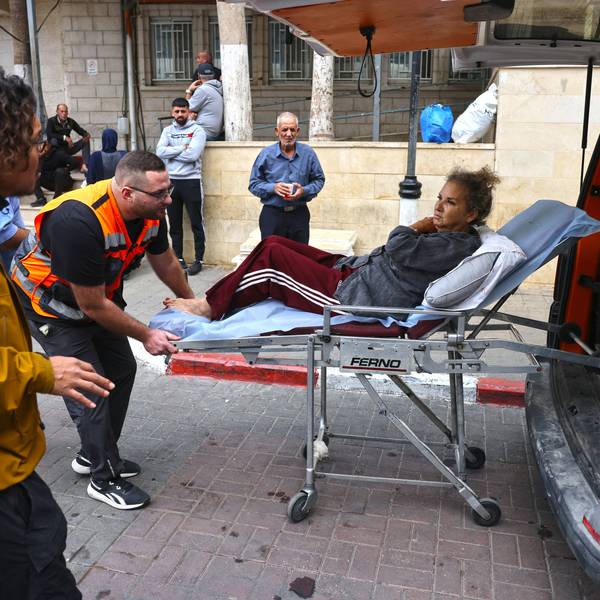

"Being a journalist in Gaza only means death." (Photo: Twitter)
Are Israeli Snipers Censoring Palestinian Journalists by Murder?
“It is both an effort to ensure that the Palestinian story is not told to the world and to tell Palestinians themselves that no one is safe.”
The organization Reporters Sans Frontieres asserts that the Israeli Occupying Forces' targeting of journalists is deliberate and systemic. This would be in direct violation of United Nations Security Council Resolution 2222 (2015), which states: "impunity for crimes committed against journalists, media professionals and associated personnel in armed conflict remains a significant challenge to their protection and that ensuring accountability for crimes committed against them is a key element in preventing future attacks."
Any proper inquiry into the shooting should take into account that the demonstrations are not a matter of "armed conflict." The protests have been largely nonviolent, even celebratory. But Israel is determined to take brutal, punitive measures toward anyone who even approaches the border fence, which marks off its illegally occupied territory. An Israeli investigation into a December 2017 shooting reveals that Israeli soldiers are ordered to shoot anyone who is approaching the border fence, regardless of whether or not they are armed. This military posture has led to hundreds of unarmed Palestinians being hit with live ammunition, including several children.
According to Diana Buttu, a political analyst and Palestinian citizen of Israel, Israel's targeting of journalists is not new and not accidental:
For years the Israeli censorship office, as it is called, has used tactics to try to punish journalists covering Israel's occupation of Palestine. For example, Israel threatened to close down the BBC for its airing of a documentary on Israel's nuclear weapons. Israel is now threatening to close down the offices of Al Jazeera for doing their job: reporting critically on Israel's denial of freedom. The targeting of Palestinian journalists in Gaza is an extension of this: in the eyes of Israel's military establishment there 'are no innocents in Gaza' including journalists.
One might even say, "especially journalists," or indeed, anyone documenting the military's actions. The Middle East Monitor notes a new law that punishes anyone who documents army personnel in action: "The draft law calls for anyone who films soldiers during their military service to be handed a -year [sic] jail term which would increase to ten years if the content is classified as 'detrimental to Israeli security.' The bill also prohibits the publication of video recordings on social media or disseminating them to the media."
Human rights activist and law professor Noura Erakat sums up the situation thus: "It is both an effort to ensure that the Palestinian story is not told to the world and to tell Palestinians themselves that no one is safe."
To understand the significance of Israel's attacks on journalists, it is crucial to understand how their professional lives are inextricable from their private lives under Israeli occupation. Doing journalism under these material, political and military conditions is nearly impossible, in any conventional sense. To try to get the story of what doing journalism is like, I contacted Issam Adwan, a freelance journalist in Gaza. He agreed to listen to my questions, pose them to a few of his colleagues and then translate the interviews. As one begins to learn more about the situation of Palestinian journalists, one understands the particular difficulties of working under not only Israeli censorship and repression, but also under the complexities of the Palestinian political world.
It is not only the Israeli state that is targeting journalists--the Palestinian Authority does so as well. The Committee to Protect Journalists reports the case of Hazem Naser, who was arrested by Palestinian Authority security forces in the middle of the night at his house. Anas Dahode, a 26-year-old journalist with Al-Aqsa TV, vividly describes the result of these pressures. He told Truthdig:
Being a journalist in Gaza only means death. Either you die trying to cover the massacres of Israeli Occupation forces as what happened to my friends like Yasser Mourtaja and others before him who were killed with cold-blood despite showing their identity as press personnel, or you die of watching others dying, it's deadly any way. On one hand you face the political disputes between Hamas and Fatah which are derived from different ideologies and affect our media focus and the future or our jobs. On the other hand, the Israeli occupation that violates human rights almost every single day here in Gaza.
Mohammed Shaheen, 24, from the Voice of Palestine spoke about both the material and psychological challenges of doing his work:
We live in an open-air prison, we have few resources to live daily lives. In terms of my job as journalist, the Israeli authorities occasionally ban cameras, photographic materials, the use of safety gear that we need to do our jobs.
In normal cases, working as journalist omits the normalcy of your life. You should be always ready to work on breaking news to be a successful journalist. Imagine trying to do all this hard work when we are living in Gaza, a place we have martyrs and injuries almost every day. We have drones 24 hours a day, 7 days a week. You live the war--feeling every single moment of your life, not only because you fear to die in any moment or losing someone you always loved but also that you can wake up at dawn for a call from your agency to start working on some cases that related to Israeli massacres.
Shaheen added a striking, terrible afterword:
It is unfortunate that world community turned a blind eye and deaf ears to the Israeli massacres on Gaza. We have had three deadly wars, with Israel vastly armed against a people with few resources, military and otherwise. Thousands are killed and injured when all they wanted was to return their homes and villages, where their grandparents expelled from. We have been calling for the world community for 70 years--even when they know the truth, do you think it care? Israel always has the support of U.S., which will use the veto in any Palestinian-related voting. This is futile.
Despite this sense of futility, he and others still try to carry on their work. It is our responsibility to read and listen and watch the news that is brought to us at such a high cost.
We are at a crossroads
This country and this world are at a monumental crossroads. In a few short weeks, US voters will have an opportunity to beat back the forces of fascism and confront the billionaires who are rigging the economy, our media system, and our democracy, making it increasingly impossible for ordinary people to get by. We’re not just talking about the election. We’re talking about what must be done once these fascist elements are vanquished from power. We need a bolder set of solutions than what either major party has so far been willing to offer and a working-class movement ready to fight like hell for it. Trump didn't emerge from nowhere. The conditions that fueled MAGA authoritarianism were created by decades of radical neoliberal economic policies and a corrupt political system dominated by corporate interests. They slashed taxes on the super-rich, promising that the benefits would trickle down. They said giveaways to the corporate titans would make life more affordable for the rest of us. It was all bullshit. And when a bitter, betrayed populace searches for someone to blame, right-wing demagogues have little trouble finding scapegoats. People know when they're being lied to, but you won't hear any of this from the corporate media. Only independent journalism—powered and funded by people who believe in building a better world—can deliver truly trustworthy daily news. Our Fall Campaign is underway, and we need your help. To power our newsroom through the rest of the year, we need to raise $125,000 by midnight on October 31. So if you share our vision, please contribute whatever you can to sustain our work. |
The organization Reporters Sans Frontieres asserts that the Israeli Occupying Forces' targeting of journalists is deliberate and systemic. This would be in direct violation of United Nations Security Council Resolution 2222 (2015), which states: "impunity for crimes committed against journalists, media professionals and associated personnel in armed conflict remains a significant challenge to their protection and that ensuring accountability for crimes committed against them is a key element in preventing future attacks."
Any proper inquiry into the shooting should take into account that the demonstrations are not a matter of "armed conflict." The protests have been largely nonviolent, even celebratory. But Israel is determined to take brutal, punitive measures toward anyone who even approaches the border fence, which marks off its illegally occupied territory. An Israeli investigation into a December 2017 shooting reveals that Israeli soldiers are ordered to shoot anyone who is approaching the border fence, regardless of whether or not they are armed. This military posture has led to hundreds of unarmed Palestinians being hit with live ammunition, including several children.
According to Diana Buttu, a political analyst and Palestinian citizen of Israel, Israel's targeting of journalists is not new and not accidental:
For years the Israeli censorship office, as it is called, has used tactics to try to punish journalists covering Israel's occupation of Palestine. For example, Israel threatened to close down the BBC for its airing of a documentary on Israel's nuclear weapons. Israel is now threatening to close down the offices of Al Jazeera for doing their job: reporting critically on Israel's denial of freedom. The targeting of Palestinian journalists in Gaza is an extension of this: in the eyes of Israel's military establishment there 'are no innocents in Gaza' including journalists.
One might even say, "especially journalists," or indeed, anyone documenting the military's actions. The Middle East Monitor notes a new law that punishes anyone who documents army personnel in action: "The draft law calls for anyone who films soldiers during their military service to be handed a -year [sic] jail term which would increase to ten years if the content is classified as 'detrimental to Israeli security.' The bill also prohibits the publication of video recordings on social media or disseminating them to the media."
Human rights activist and law professor Noura Erakat sums up the situation thus: "It is both an effort to ensure that the Palestinian story is not told to the world and to tell Palestinians themselves that no one is safe."
To understand the significance of Israel's attacks on journalists, it is crucial to understand how their professional lives are inextricable from their private lives under Israeli occupation. Doing journalism under these material, political and military conditions is nearly impossible, in any conventional sense. To try to get the story of what doing journalism is like, I contacted Issam Adwan, a freelance journalist in Gaza. He agreed to listen to my questions, pose them to a few of his colleagues and then translate the interviews. As one begins to learn more about the situation of Palestinian journalists, one understands the particular difficulties of working under not only Israeli censorship and repression, but also under the complexities of the Palestinian political world.
It is not only the Israeli state that is targeting journalists--the Palestinian Authority does so as well. The Committee to Protect Journalists reports the case of Hazem Naser, who was arrested by Palestinian Authority security forces in the middle of the night at his house. Anas Dahode, a 26-year-old journalist with Al-Aqsa TV, vividly describes the result of these pressures. He told Truthdig:
Being a journalist in Gaza only means death. Either you die trying to cover the massacres of Israeli Occupation forces as what happened to my friends like Yasser Mourtaja and others before him who were killed with cold-blood despite showing their identity as press personnel, or you die of watching others dying, it's deadly any way. On one hand you face the political disputes between Hamas and Fatah which are derived from different ideologies and affect our media focus and the future or our jobs. On the other hand, the Israeli occupation that violates human rights almost every single day here in Gaza.
Mohammed Shaheen, 24, from the Voice of Palestine spoke about both the material and psychological challenges of doing his work:
We live in an open-air prison, we have few resources to live daily lives. In terms of my job as journalist, the Israeli authorities occasionally ban cameras, photographic materials, the use of safety gear that we need to do our jobs.
In normal cases, working as journalist omits the normalcy of your life. You should be always ready to work on breaking news to be a successful journalist. Imagine trying to do all this hard work when we are living in Gaza, a place we have martyrs and injuries almost every day. We have drones 24 hours a day, 7 days a week. You live the war--feeling every single moment of your life, not only because you fear to die in any moment or losing someone you always loved but also that you can wake up at dawn for a call from your agency to start working on some cases that related to Israeli massacres.
Shaheen added a striking, terrible afterword:
It is unfortunate that world community turned a blind eye and deaf ears to the Israeli massacres on Gaza. We have had three deadly wars, with Israel vastly armed against a people with few resources, military and otherwise. Thousands are killed and injured when all they wanted was to return their homes and villages, where their grandparents expelled from. We have been calling for the world community for 70 years--even when they know the truth, do you think it care? Israel always has the support of U.S., which will use the veto in any Palestinian-related voting. This is futile.
Despite this sense of futility, he and others still try to carry on their work. It is our responsibility to read and listen and watch the news that is brought to us at such a high cost.
The organization Reporters Sans Frontieres asserts that the Israeli Occupying Forces' targeting of journalists is deliberate and systemic. This would be in direct violation of United Nations Security Council Resolution 2222 (2015), which states: "impunity for crimes committed against journalists, media professionals and associated personnel in armed conflict remains a significant challenge to their protection and that ensuring accountability for crimes committed against them is a key element in preventing future attacks."
Any proper inquiry into the shooting should take into account that the demonstrations are not a matter of "armed conflict." The protests have been largely nonviolent, even celebratory. But Israel is determined to take brutal, punitive measures toward anyone who even approaches the border fence, which marks off its illegally occupied territory. An Israeli investigation into a December 2017 shooting reveals that Israeli soldiers are ordered to shoot anyone who is approaching the border fence, regardless of whether or not they are armed. This military posture has led to hundreds of unarmed Palestinians being hit with live ammunition, including several children.
According to Diana Buttu, a political analyst and Palestinian citizen of Israel, Israel's targeting of journalists is not new and not accidental:
For years the Israeli censorship office, as it is called, has used tactics to try to punish journalists covering Israel's occupation of Palestine. For example, Israel threatened to close down the BBC for its airing of a documentary on Israel's nuclear weapons. Israel is now threatening to close down the offices of Al Jazeera for doing their job: reporting critically on Israel's denial of freedom. The targeting of Palestinian journalists in Gaza is an extension of this: in the eyes of Israel's military establishment there 'are no innocents in Gaza' including journalists.
One might even say, "especially journalists," or indeed, anyone documenting the military's actions. The Middle East Monitor notes a new law that punishes anyone who documents army personnel in action: "The draft law calls for anyone who films soldiers during their military service to be handed a -year [sic] jail term which would increase to ten years if the content is classified as 'detrimental to Israeli security.' The bill also prohibits the publication of video recordings on social media or disseminating them to the media."
Human rights activist and law professor Noura Erakat sums up the situation thus: "It is both an effort to ensure that the Palestinian story is not told to the world and to tell Palestinians themselves that no one is safe."
To understand the significance of Israel's attacks on journalists, it is crucial to understand how their professional lives are inextricable from their private lives under Israeli occupation. Doing journalism under these material, political and military conditions is nearly impossible, in any conventional sense. To try to get the story of what doing journalism is like, I contacted Issam Adwan, a freelance journalist in Gaza. He agreed to listen to my questions, pose them to a few of his colleagues and then translate the interviews. As one begins to learn more about the situation of Palestinian journalists, one understands the particular difficulties of working under not only Israeli censorship and repression, but also under the complexities of the Palestinian political world.
It is not only the Israeli state that is targeting journalists--the Palestinian Authority does so as well. The Committee to Protect Journalists reports the case of Hazem Naser, who was arrested by Palestinian Authority security forces in the middle of the night at his house. Anas Dahode, a 26-year-old journalist with Al-Aqsa TV, vividly describes the result of these pressures. He told Truthdig:
Being a journalist in Gaza only means death. Either you die trying to cover the massacres of Israeli Occupation forces as what happened to my friends like Yasser Mourtaja and others before him who were killed with cold-blood despite showing their identity as press personnel, or you die of watching others dying, it's deadly any way. On one hand you face the political disputes between Hamas and Fatah which are derived from different ideologies and affect our media focus and the future or our jobs. On the other hand, the Israeli occupation that violates human rights almost every single day here in Gaza.
Mohammed Shaheen, 24, from the Voice of Palestine spoke about both the material and psychological challenges of doing his work:
We live in an open-air prison, we have few resources to live daily lives. In terms of my job as journalist, the Israeli authorities occasionally ban cameras, photographic materials, the use of safety gear that we need to do our jobs.
In normal cases, working as journalist omits the normalcy of your life. You should be always ready to work on breaking news to be a successful journalist. Imagine trying to do all this hard work when we are living in Gaza, a place we have martyrs and injuries almost every day. We have drones 24 hours a day, 7 days a week. You live the war--feeling every single moment of your life, not only because you fear to die in any moment or losing someone you always loved but also that you can wake up at dawn for a call from your agency to start working on some cases that related to Israeli massacres.
Shaheen added a striking, terrible afterword:
It is unfortunate that world community turned a blind eye and deaf ears to the Israeli massacres on Gaza. We have had three deadly wars, with Israel vastly armed against a people with few resources, military and otherwise. Thousands are killed and injured when all they wanted was to return their homes and villages, where their grandparents expelled from. We have been calling for the world community for 70 years--even when they know the truth, do you think it care? Israel always has the support of U.S., which will use the veto in any Palestinian-related voting. This is futile.
Despite this sense of futility, he and others still try to carry on their work. It is our responsibility to read and listen and watch the news that is brought to us at such a high cost.