SUBSCRIBE TO OUR FREE NEWSLETTER
Daily news & progressive opinion—funded by the people, not the corporations—delivered straight to your inbox.
5
#000000
#FFFFFF
To donate by check, phone, or other method, see our More Ways to Give page.
Daily news & progressive opinion—funded by the people, not the corporations—delivered straight to your inbox.
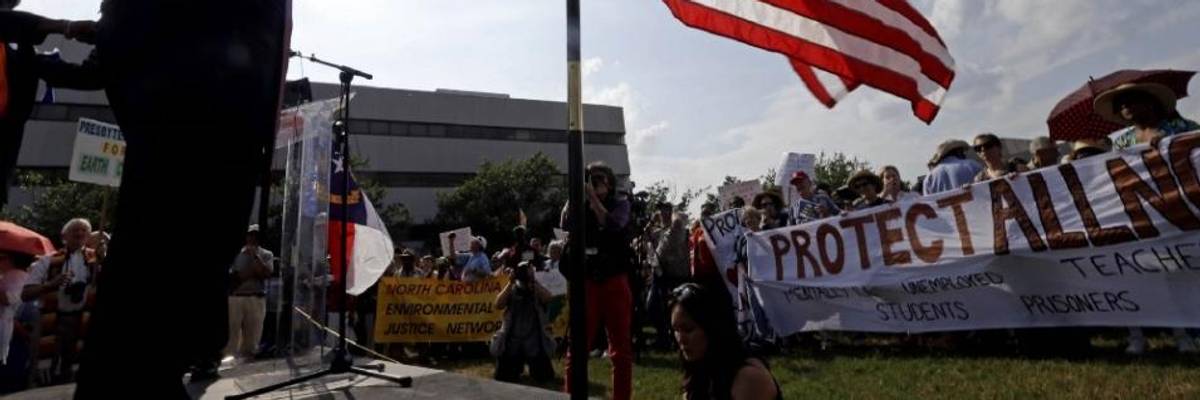
"We are here. And we're ready to take over. Because we may not run the United States, but we make it run. And we are ready to shut it down with our bodies."(Photo: AP/Gerry Broome)
"I am not speaking about the poor. I am not speaking for the poor. I am the poor."
Claudia De la Cruz was speaking at an April 10 press briefing in Washington, D.C. on behalf of the Poor People's Campaign: A National Call for Moral Revival. Inspired by a similar 1968 initiative led by Dr. Martin Luther King and other civil rights leaders, the campaign aims to lift up the voices of people like De la Cruz who've been most affected by our country's persistent poverty.
A descendant of immigrants from the Dominican Republic, De la Cruz was born in the South Bronx, the poorest Congressional district in the country. Median household income there is about $26,000, compared to $116,000 for the wealthiest district, which straddles Virginia's northern suburbs. She's a member of the national steering committee of the Poor People's Campaign and one of the state organizers for the New York City area.
At the briefing, the Poor People's Campaign and the Institute for Policy Studies co-released a 120-page report on poverty and inequality, systemic racism, ecological devastation, the war economy, and militarism. The Souls of Poor Folk draws on empirical data and interviews with grassroots leaders in each of these inter-related areas to make the case for reviving the 1968 campaign. The report points out, for example, that 140 million Americans today are poor or low-income.
"In a country that is filled with wealth, that has an abundant amount of resources, this is immoral and shameful," said De la Cruz.
The report also finds that one of the most dramatic trends since the original Poor People's Campaign is the rising gap between the poor and the extreme rich. While the official poverty rate is about the same today as it was 50 years ago, the share of national income going towards the top 1 percent of earners has nearly doubled. The 400 wealthiest Americans now own more wealth than the bottom 64 percent of the U.S. population (or 204 million people).
Nineteen percent of all U.S. households (60 million people) have zero wealth, or their debts exceed the value of their assets (excluding the family car) -- and that percentage is even higher among people of color. Because of rising housing costs and wage stagnation, there is no state or county in the nation where an individual earning the federal minimum wage of $7.25 an hour can afford a two-bedroom apartment at market rent. Five decades after the original Poor People's Campaign, homelessness continues to be a severe problem in the world's richest nation, with the majority of homeless families headed by single women with young children.
Despite these overwhelmingly dismal indicators, De la Cruz explained that the new Poor People's Campaign is "organizing the hope of the poor, the hope that is often used and abused by politicians -- whether they are Republicans or Democrats -- the hope of a dignified life, our very right to exist."
Campaign Co-Chairs Rev. Liz Theoharis and Rev. William Barber also released an extensive set of preliminary demands for the campaign at the National Press Club event. Among the key priorities: "the repeal of the 2017 federal tax law and the reinvestment of those funds into social programming that helps all" and "relief from crushing household, student, and consumer debt."
For two years, Theoharis, Barber, and other anti-poverty leaders have traveled the country to build a base for the campaign among local faith communities and other grassroots organizations. At the briefing, they announced that 100 national groups have now also endorsed the initiative. Among them are several major labor unions, including SEIU, UFCW, AFSCME, and the United Steelworkers.
This coming Mother's Day, the Poor People's Campaign will launch 40 days of coordinated protests, including civil disobedience, in 30 states. On June 23, they will organize a mobilization in the nation's capital, just as the 1968 campaign did only a couple months after the assassination of Dr. King.
De la Cruz ended her statement by sending this message to politicians about America's poor: "We are here. And we're ready to take over. Because we may not run the United States, but we make it run. And we are ready to shut it down with our bodies."
Dear Common Dreams reader, It’s been nearly 30 years since I co-founded Common Dreams with my late wife, Lina Newhouser. We had the radical notion that journalism should serve the public good, not corporate profits. It was clear to us from the outset what it would take to build such a project. No paid advertisements. No corporate sponsors. No millionaire publisher telling us what to think or do. Many people said we wouldn't last a year, but we proved those doubters wrong. Together with a tremendous team of journalists and dedicated staff, we built an independent media outlet free from the constraints of profits and corporate control. Our mission has always been simple: To inform. To inspire. To ignite change for the common good. Building Common Dreams was not easy. Our survival was never guaranteed. When you take on the most powerful forces—Wall Street greed, fossil fuel industry destruction, Big Tech lobbyists, and uber-rich oligarchs who have spent billions upon billions rigging the economy and democracy in their favor—the only bulwark you have is supporters who believe in your work. But here’s the urgent message from me today. It's never been this bad out there. And it's never been this hard to keep us going. At the very moment Common Dreams is most needed, the threats we face are intensifying. We need your support now more than ever. We don't accept corporate advertising and never will. We don't have a paywall because we don't think people should be blocked from critical news based on their ability to pay. Everything we do is funded by the donations of readers like you. When everyone does the little they can afford, we are strong. But if that support retreats or dries up, so do we. Will you donate now to make sure Common Dreams not only survives but thrives? —Craig Brown, Co-founder |
"I am not speaking about the poor. I am not speaking for the poor. I am the poor."
Claudia De la Cruz was speaking at an April 10 press briefing in Washington, D.C. on behalf of the Poor People's Campaign: A National Call for Moral Revival. Inspired by a similar 1968 initiative led by Dr. Martin Luther King and other civil rights leaders, the campaign aims to lift up the voices of people like De la Cruz who've been most affected by our country's persistent poverty.
A descendant of immigrants from the Dominican Republic, De la Cruz was born in the South Bronx, the poorest Congressional district in the country. Median household income there is about $26,000, compared to $116,000 for the wealthiest district, which straddles Virginia's northern suburbs. She's a member of the national steering committee of the Poor People's Campaign and one of the state organizers for the New York City area.
At the briefing, the Poor People's Campaign and the Institute for Policy Studies co-released a 120-page report on poverty and inequality, systemic racism, ecological devastation, the war economy, and militarism. The Souls of Poor Folk draws on empirical data and interviews with grassroots leaders in each of these inter-related areas to make the case for reviving the 1968 campaign. The report points out, for example, that 140 million Americans today are poor or low-income.
"In a country that is filled with wealth, that has an abundant amount of resources, this is immoral and shameful," said De la Cruz.
The report also finds that one of the most dramatic trends since the original Poor People's Campaign is the rising gap between the poor and the extreme rich. While the official poverty rate is about the same today as it was 50 years ago, the share of national income going towards the top 1 percent of earners has nearly doubled. The 400 wealthiest Americans now own more wealth than the bottom 64 percent of the U.S. population (or 204 million people).
Nineteen percent of all U.S. households (60 million people) have zero wealth, or their debts exceed the value of their assets (excluding the family car) -- and that percentage is even higher among people of color. Because of rising housing costs and wage stagnation, there is no state or county in the nation where an individual earning the federal minimum wage of $7.25 an hour can afford a two-bedroom apartment at market rent. Five decades after the original Poor People's Campaign, homelessness continues to be a severe problem in the world's richest nation, with the majority of homeless families headed by single women with young children.
Despite these overwhelmingly dismal indicators, De la Cruz explained that the new Poor People's Campaign is "organizing the hope of the poor, the hope that is often used and abused by politicians -- whether they are Republicans or Democrats -- the hope of a dignified life, our very right to exist."
Campaign Co-Chairs Rev. Liz Theoharis and Rev. William Barber also released an extensive set of preliminary demands for the campaign at the National Press Club event. Among the key priorities: "the repeal of the 2017 federal tax law and the reinvestment of those funds into social programming that helps all" and "relief from crushing household, student, and consumer debt."
For two years, Theoharis, Barber, and other anti-poverty leaders have traveled the country to build a base for the campaign among local faith communities and other grassroots organizations. At the briefing, they announced that 100 national groups have now also endorsed the initiative. Among them are several major labor unions, including SEIU, UFCW, AFSCME, and the United Steelworkers.
This coming Mother's Day, the Poor People's Campaign will launch 40 days of coordinated protests, including civil disobedience, in 30 states. On June 23, they will organize a mobilization in the nation's capital, just as the 1968 campaign did only a couple months after the assassination of Dr. King.
De la Cruz ended her statement by sending this message to politicians about America's poor: "We are here. And we're ready to take over. Because we may not run the United States, but we make it run. And we are ready to shut it down with our bodies."
"I am not speaking about the poor. I am not speaking for the poor. I am the poor."
Claudia De la Cruz was speaking at an April 10 press briefing in Washington, D.C. on behalf of the Poor People's Campaign: A National Call for Moral Revival. Inspired by a similar 1968 initiative led by Dr. Martin Luther King and other civil rights leaders, the campaign aims to lift up the voices of people like De la Cruz who've been most affected by our country's persistent poverty.
A descendant of immigrants from the Dominican Republic, De la Cruz was born in the South Bronx, the poorest Congressional district in the country. Median household income there is about $26,000, compared to $116,000 for the wealthiest district, which straddles Virginia's northern suburbs. She's a member of the national steering committee of the Poor People's Campaign and one of the state organizers for the New York City area.
At the briefing, the Poor People's Campaign and the Institute for Policy Studies co-released a 120-page report on poverty and inequality, systemic racism, ecological devastation, the war economy, and militarism. The Souls of Poor Folk draws on empirical data and interviews with grassroots leaders in each of these inter-related areas to make the case for reviving the 1968 campaign. The report points out, for example, that 140 million Americans today are poor or low-income.
"In a country that is filled with wealth, that has an abundant amount of resources, this is immoral and shameful," said De la Cruz.
The report also finds that one of the most dramatic trends since the original Poor People's Campaign is the rising gap between the poor and the extreme rich. While the official poverty rate is about the same today as it was 50 years ago, the share of national income going towards the top 1 percent of earners has nearly doubled. The 400 wealthiest Americans now own more wealth than the bottom 64 percent of the U.S. population (or 204 million people).
Nineteen percent of all U.S. households (60 million people) have zero wealth, or their debts exceed the value of their assets (excluding the family car) -- and that percentage is even higher among people of color. Because of rising housing costs and wage stagnation, there is no state or county in the nation where an individual earning the federal minimum wage of $7.25 an hour can afford a two-bedroom apartment at market rent. Five decades after the original Poor People's Campaign, homelessness continues to be a severe problem in the world's richest nation, with the majority of homeless families headed by single women with young children.
Despite these overwhelmingly dismal indicators, De la Cruz explained that the new Poor People's Campaign is "organizing the hope of the poor, the hope that is often used and abused by politicians -- whether they are Republicans or Democrats -- the hope of a dignified life, our very right to exist."
Campaign Co-Chairs Rev. Liz Theoharis and Rev. William Barber also released an extensive set of preliminary demands for the campaign at the National Press Club event. Among the key priorities: "the repeal of the 2017 federal tax law and the reinvestment of those funds into social programming that helps all" and "relief from crushing household, student, and consumer debt."
For two years, Theoharis, Barber, and other anti-poverty leaders have traveled the country to build a base for the campaign among local faith communities and other grassroots organizations. At the briefing, they announced that 100 national groups have now also endorsed the initiative. Among them are several major labor unions, including SEIU, UFCW, AFSCME, and the United Steelworkers.
This coming Mother's Day, the Poor People's Campaign will launch 40 days of coordinated protests, including civil disobedience, in 30 states. On June 23, they will organize a mobilization in the nation's capital, just as the 1968 campaign did only a couple months after the assassination of Dr. King.
De la Cruz ended her statement by sending this message to politicians about America's poor: "We are here. And we're ready to take over. Because we may not run the United States, but we make it run. And we are ready to shut it down with our bodies."