SUBSCRIBE TO OUR FREE NEWSLETTER
Daily news & progressive opinion—funded by the people, not the corporations—delivered straight to your inbox.
5
#000000
#FFFFFF
To donate by check, phone, or other method, see our More Ways to Give page.
Daily news & progressive opinion—funded by the people, not the corporations—delivered straight to your inbox.
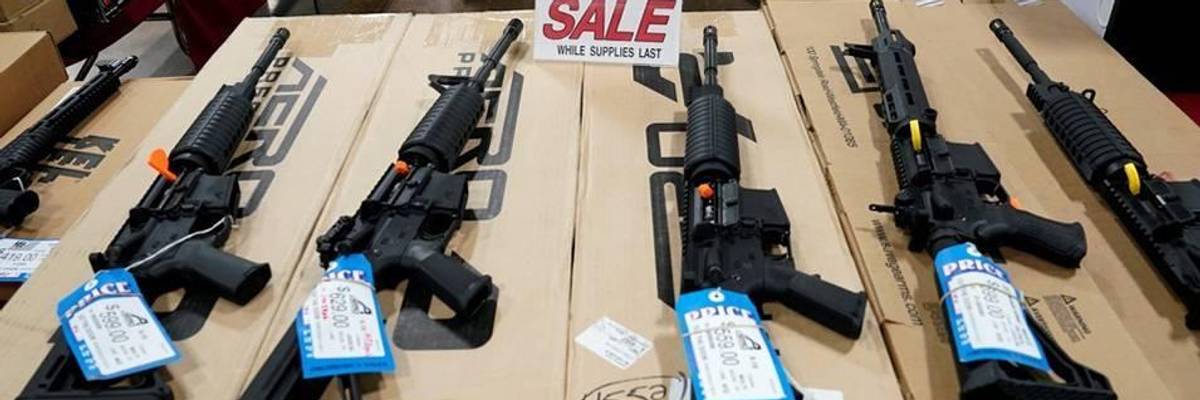
"When violence is normal and ongoing and, in the case of war, celebrated and glorified, it feeds on itself." (Joshua Roberts/Reuters)
Addressing the Parkland shootings last month, and the apparent emergence of a movement for tougher, saner gun laws that has followed, aUSA Today article asked: "What has been so different from all the other mass shootings over the years?"
In one sense, this is a reasonable question. Why now? Why didn't it happen after, you know . . . Las Vegas, Sutherland Springs, Orlando, Charleston, Sandy Hook, Aurora? And the list goes on.
But, come on. Doesn't something stunningly horrifying resonate, however faintly, in these words? How can this phrase -- "all the other mass shootings?" -- be out there with such matter-of-fact, cheerful neutrality, such ordinariness?
The answer, of course, is that this is a violent -- an increasingly violent -- country. But I still feel a disbelieving cry echo somewhere deep in my being as I read these words, and refuse to simply push on. It's almost as though the wording in this paragraph contains not just the question but the answer: If the slaughter of innocent people can be folded so neatly into a phrase, "mass shooting," allowing us to categorize one, then another, then another act of senseless carnage and file it away as recent history, then move on with our lives, might that not be a serious cause of the nothing-we-can-do-about-it syndrome gripping America?
"For the United States, war has become a permanent condition."
Andrew Bacevich, writing recently about the 15-year anniversary of the Iraq war -- framing it as a letter to A.G. Sulzberger, newly ordained publisher of the New York Times -- throws out a serious challenge to the paper. There's an issue out there that's bigger than Donald Trump, oh Paper of Record, and it's time for you to address it.
"That issue," he writes, "is the normalization of armed conflict, with your writers, editors, and editorial board having tacitly accepted that, for the United States, war has become a permanent condition."
Bacevich proceeded to shred the paper's coverage of an unending barrage of bombs and missiles unleashed across the planet in the 21st century, of the steady flow of invasions, raids, missions -- in Afghanistan, Iraq, Syria, Libya, Somalia, the Arabian Peninsula and on and on and on. Each fragmented war is covered in isolation, without perspective. "What's missing is any sort of Big Picture."
And what this all adds up to is a normalcy that is positively Big Brotheresque. It's just who we are, American public. The forces driving us are none of your business. We're keeping you safe, but the details are classified.
I would push Bacevich's point ever further. Armed violence has also been normalized here at home, both intentionally and unwittingly. Killings happen just like wars happen. And we have to fight back: militarize our police departments, arm our teachers, keep gun-control regulations out of our homes. We. Are. At. War.
Oh yeah, one other thing. When violence is normal and ongoing and, in the case of war, celebrated and glorified, it feeds on itself. People see it as the solution to problems that are otherwise unsolvable. Even better: Violence as we understand it, and as it is portrayed in the media (both news and entertainment), is consequence-free. It solves problems; it doesn't create them. And when violence is normalized, the necessity for violence is also normalized. It's how you stay safe and it's how you do what's right.
And this brings me back to the question posed in the USA Today story: Why has the February murder of 17 students and teachers at Stoneman Douglas High School seemingly sparked a unique, long-sought (long-feared) national movement against gun violence?
"What we have emerging here is not simply a movement for stricter gun laws but a new civil rights movement."
The article makes a number of reasonable points, regarding the youth and cohesion of the survivors, the power of social media and the possibility that the national environment is ripe for this to happen. But to me the most crucial point to make is that the survivors, as they have spoken out -- and as they have been joined by other young people across the nation -- fully and intensely know that what happened at their school is not "normal." It's not simply one in a series of mass murders, worth a politician's thoughts and prayers, followed by a shrug. The raw cruelty and wrongness of it, the theft of 17 human lives, will never go away. The only response that is equal to the scope of the tragedy is to vow that it will never happen again.
And if this is so, then what we have emerging here is not simply a movement for stricter gun laws but a new civil rights movement, with a voice as clarion and courageous as the voices of that earlier movement. And the scope of the movement is violence itself.
"The war in Vietnam is but a symptom of a far deeper malady within the American spirit," Martin Luther King told the nation, and the world, at Riverside Church, a year before he himself was murdered.
". . . The Western arrogance of feeling that it has everything to teach others and nothing to learn from them is not just. A true revolution of values will lay hands on the world order and say of war: 'This way of settling differences is not just.' This business of burning human beings with napalm, of filling our nation's homes with orphans and widows, of injecting poisonous drugs of hate into veins of people normally humane, of sending men home from dark and bloody battlefields physically handicapped and psychologically deranged, cannot be reconciled with wisdom, justice and love. A nation that continues year after year to spend more money on military defense than on programs of social uplift is approaching spiritual death."
Here's how educator Gabriel Paez put it recently in The Socialist Worker: "Ultimately, we need a completely different society that is freed from terror and mass murder, from mass incarceration and war. In the society we strive for, prosperity and freedom would not be measured by access to automatic weapons, but rather by access to health care, including mental health care, housing as a human right and global peace."
I have no doubt this is what America's teenagers are demanding: a legal and social structure that values life rather than feeds on it.
Dear Common Dreams reader, It’s been nearly 30 years since I co-founded Common Dreams with my late wife, Lina Newhouser. We had the radical notion that journalism should serve the public good, not corporate profits. It was clear to us from the outset what it would take to build such a project. No paid advertisements. No corporate sponsors. No millionaire publisher telling us what to think or do. Many people said we wouldn't last a year, but we proved those doubters wrong. Together with a tremendous team of journalists and dedicated staff, we built an independent media outlet free from the constraints of profits and corporate control. Our mission has always been simple: To inform. To inspire. To ignite change for the common good. Building Common Dreams was not easy. Our survival was never guaranteed. When you take on the most powerful forces—Wall Street greed, fossil fuel industry destruction, Big Tech lobbyists, and uber-rich oligarchs who have spent billions upon billions rigging the economy and democracy in their favor—the only bulwark you have is supporters who believe in your work. But here’s the urgent message from me today. It's never been this bad out there. And it's never been this hard to keep us going. At the very moment Common Dreams is most needed, the threats we face are intensifying. We need your support now more than ever. We don't accept corporate advertising and never will. We don't have a paywall because we don't think people should be blocked from critical news based on their ability to pay. Everything we do is funded by the donations of readers like you. When everyone does the little they can afford, we are strong. But if that support retreats or dries up, so do we. Will you donate now to make sure Common Dreams not only survives but thrives? —Craig Brown, Co-founder |
Addressing the Parkland shootings last month, and the apparent emergence of a movement for tougher, saner gun laws that has followed, aUSA Today article asked: "What has been so different from all the other mass shootings over the years?"
In one sense, this is a reasonable question. Why now? Why didn't it happen after, you know . . . Las Vegas, Sutherland Springs, Orlando, Charleston, Sandy Hook, Aurora? And the list goes on.
But, come on. Doesn't something stunningly horrifying resonate, however faintly, in these words? How can this phrase -- "all the other mass shootings?" -- be out there with such matter-of-fact, cheerful neutrality, such ordinariness?
The answer, of course, is that this is a violent -- an increasingly violent -- country. But I still feel a disbelieving cry echo somewhere deep in my being as I read these words, and refuse to simply push on. It's almost as though the wording in this paragraph contains not just the question but the answer: If the slaughter of innocent people can be folded so neatly into a phrase, "mass shooting," allowing us to categorize one, then another, then another act of senseless carnage and file it away as recent history, then move on with our lives, might that not be a serious cause of the nothing-we-can-do-about-it syndrome gripping America?
"For the United States, war has become a permanent condition."
Andrew Bacevich, writing recently about the 15-year anniversary of the Iraq war -- framing it as a letter to A.G. Sulzberger, newly ordained publisher of the New York Times -- throws out a serious challenge to the paper. There's an issue out there that's bigger than Donald Trump, oh Paper of Record, and it's time for you to address it.
"That issue," he writes, "is the normalization of armed conflict, with your writers, editors, and editorial board having tacitly accepted that, for the United States, war has become a permanent condition."
Bacevich proceeded to shred the paper's coverage of an unending barrage of bombs and missiles unleashed across the planet in the 21st century, of the steady flow of invasions, raids, missions -- in Afghanistan, Iraq, Syria, Libya, Somalia, the Arabian Peninsula and on and on and on. Each fragmented war is covered in isolation, without perspective. "What's missing is any sort of Big Picture."
And what this all adds up to is a normalcy that is positively Big Brotheresque. It's just who we are, American public. The forces driving us are none of your business. We're keeping you safe, but the details are classified.
I would push Bacevich's point ever further. Armed violence has also been normalized here at home, both intentionally and unwittingly. Killings happen just like wars happen. And we have to fight back: militarize our police departments, arm our teachers, keep gun-control regulations out of our homes. We. Are. At. War.
Oh yeah, one other thing. When violence is normal and ongoing and, in the case of war, celebrated and glorified, it feeds on itself. People see it as the solution to problems that are otherwise unsolvable. Even better: Violence as we understand it, and as it is portrayed in the media (both news and entertainment), is consequence-free. It solves problems; it doesn't create them. And when violence is normalized, the necessity for violence is also normalized. It's how you stay safe and it's how you do what's right.
And this brings me back to the question posed in the USA Today story: Why has the February murder of 17 students and teachers at Stoneman Douglas High School seemingly sparked a unique, long-sought (long-feared) national movement against gun violence?
"What we have emerging here is not simply a movement for stricter gun laws but a new civil rights movement."
The article makes a number of reasonable points, regarding the youth and cohesion of the survivors, the power of social media and the possibility that the national environment is ripe for this to happen. But to me the most crucial point to make is that the survivors, as they have spoken out -- and as they have been joined by other young people across the nation -- fully and intensely know that what happened at their school is not "normal." It's not simply one in a series of mass murders, worth a politician's thoughts and prayers, followed by a shrug. The raw cruelty and wrongness of it, the theft of 17 human lives, will never go away. The only response that is equal to the scope of the tragedy is to vow that it will never happen again.
And if this is so, then what we have emerging here is not simply a movement for stricter gun laws but a new civil rights movement, with a voice as clarion and courageous as the voices of that earlier movement. And the scope of the movement is violence itself.
"The war in Vietnam is but a symptom of a far deeper malady within the American spirit," Martin Luther King told the nation, and the world, at Riverside Church, a year before he himself was murdered.
". . . The Western arrogance of feeling that it has everything to teach others and nothing to learn from them is not just. A true revolution of values will lay hands on the world order and say of war: 'This way of settling differences is not just.' This business of burning human beings with napalm, of filling our nation's homes with orphans and widows, of injecting poisonous drugs of hate into veins of people normally humane, of sending men home from dark and bloody battlefields physically handicapped and psychologically deranged, cannot be reconciled with wisdom, justice and love. A nation that continues year after year to spend more money on military defense than on programs of social uplift is approaching spiritual death."
Here's how educator Gabriel Paez put it recently in The Socialist Worker: "Ultimately, we need a completely different society that is freed from terror and mass murder, from mass incarceration and war. In the society we strive for, prosperity and freedom would not be measured by access to automatic weapons, but rather by access to health care, including mental health care, housing as a human right and global peace."
I have no doubt this is what America's teenagers are demanding: a legal and social structure that values life rather than feeds on it.
Addressing the Parkland shootings last month, and the apparent emergence of a movement for tougher, saner gun laws that has followed, aUSA Today article asked: "What has been so different from all the other mass shootings over the years?"
In one sense, this is a reasonable question. Why now? Why didn't it happen after, you know . . . Las Vegas, Sutherland Springs, Orlando, Charleston, Sandy Hook, Aurora? And the list goes on.
But, come on. Doesn't something stunningly horrifying resonate, however faintly, in these words? How can this phrase -- "all the other mass shootings?" -- be out there with such matter-of-fact, cheerful neutrality, such ordinariness?
The answer, of course, is that this is a violent -- an increasingly violent -- country. But I still feel a disbelieving cry echo somewhere deep in my being as I read these words, and refuse to simply push on. It's almost as though the wording in this paragraph contains not just the question but the answer: If the slaughter of innocent people can be folded so neatly into a phrase, "mass shooting," allowing us to categorize one, then another, then another act of senseless carnage and file it away as recent history, then move on with our lives, might that not be a serious cause of the nothing-we-can-do-about-it syndrome gripping America?
"For the United States, war has become a permanent condition."
Andrew Bacevich, writing recently about the 15-year anniversary of the Iraq war -- framing it as a letter to A.G. Sulzberger, newly ordained publisher of the New York Times -- throws out a serious challenge to the paper. There's an issue out there that's bigger than Donald Trump, oh Paper of Record, and it's time for you to address it.
"That issue," he writes, "is the normalization of armed conflict, with your writers, editors, and editorial board having tacitly accepted that, for the United States, war has become a permanent condition."
Bacevich proceeded to shred the paper's coverage of an unending barrage of bombs and missiles unleashed across the planet in the 21st century, of the steady flow of invasions, raids, missions -- in Afghanistan, Iraq, Syria, Libya, Somalia, the Arabian Peninsula and on and on and on. Each fragmented war is covered in isolation, without perspective. "What's missing is any sort of Big Picture."
And what this all adds up to is a normalcy that is positively Big Brotheresque. It's just who we are, American public. The forces driving us are none of your business. We're keeping you safe, but the details are classified.
I would push Bacevich's point ever further. Armed violence has also been normalized here at home, both intentionally and unwittingly. Killings happen just like wars happen. And we have to fight back: militarize our police departments, arm our teachers, keep gun-control regulations out of our homes. We. Are. At. War.
Oh yeah, one other thing. When violence is normal and ongoing and, in the case of war, celebrated and glorified, it feeds on itself. People see it as the solution to problems that are otherwise unsolvable. Even better: Violence as we understand it, and as it is portrayed in the media (both news and entertainment), is consequence-free. It solves problems; it doesn't create them. And when violence is normalized, the necessity for violence is also normalized. It's how you stay safe and it's how you do what's right.
And this brings me back to the question posed in the USA Today story: Why has the February murder of 17 students and teachers at Stoneman Douglas High School seemingly sparked a unique, long-sought (long-feared) national movement against gun violence?
"What we have emerging here is not simply a movement for stricter gun laws but a new civil rights movement."
The article makes a number of reasonable points, regarding the youth and cohesion of the survivors, the power of social media and the possibility that the national environment is ripe for this to happen. But to me the most crucial point to make is that the survivors, as they have spoken out -- and as they have been joined by other young people across the nation -- fully and intensely know that what happened at their school is not "normal." It's not simply one in a series of mass murders, worth a politician's thoughts and prayers, followed by a shrug. The raw cruelty and wrongness of it, the theft of 17 human lives, will never go away. The only response that is equal to the scope of the tragedy is to vow that it will never happen again.
And if this is so, then what we have emerging here is not simply a movement for stricter gun laws but a new civil rights movement, with a voice as clarion and courageous as the voices of that earlier movement. And the scope of the movement is violence itself.
"The war in Vietnam is but a symptom of a far deeper malady within the American spirit," Martin Luther King told the nation, and the world, at Riverside Church, a year before he himself was murdered.
". . . The Western arrogance of feeling that it has everything to teach others and nothing to learn from them is not just. A true revolution of values will lay hands on the world order and say of war: 'This way of settling differences is not just.' This business of burning human beings with napalm, of filling our nation's homes with orphans and widows, of injecting poisonous drugs of hate into veins of people normally humane, of sending men home from dark and bloody battlefields physically handicapped and psychologically deranged, cannot be reconciled with wisdom, justice and love. A nation that continues year after year to spend more money on military defense than on programs of social uplift is approaching spiritual death."
Here's how educator Gabriel Paez put it recently in The Socialist Worker: "Ultimately, we need a completely different society that is freed from terror and mass murder, from mass incarceration and war. In the society we strive for, prosperity and freedom would not be measured by access to automatic weapons, but rather by access to health care, including mental health care, housing as a human right and global peace."
I have no doubt this is what America's teenagers are demanding: a legal and social structure that values life rather than feeds on it.