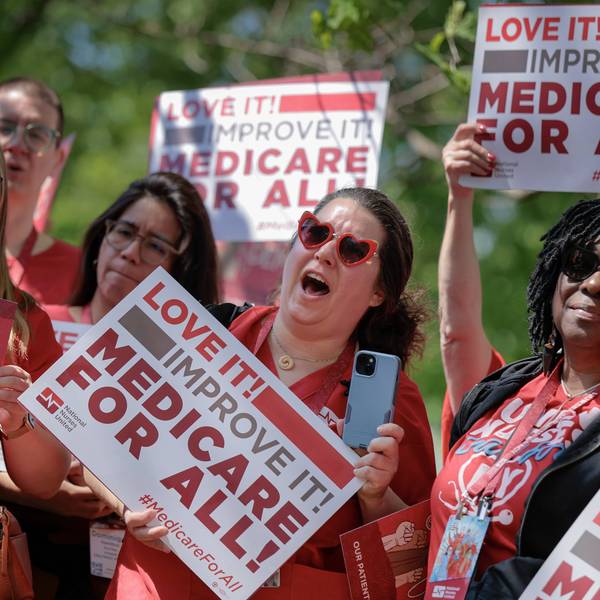
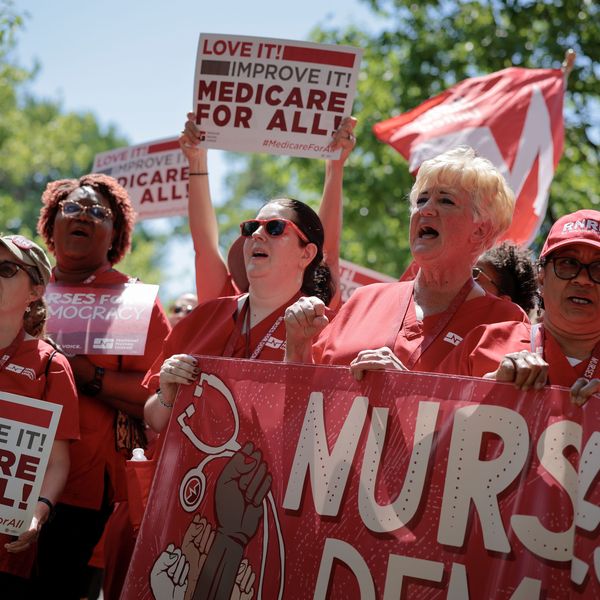
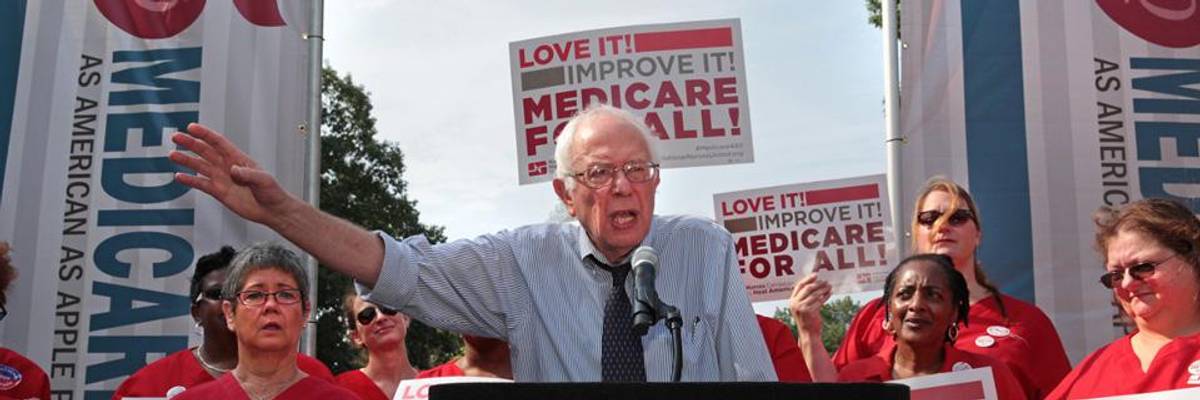
National Nurses Union activists for single-payer at a rally with Bernie Sanders in 2015. (Photo: Rick Reinhard / NNU)
A Labor-Based Movement For Medicare for All
A defensive posture and incremental demands have not worked. Let’s play offense instead.
Healthcare is the crossroads where the assault on workers meets the juggernaut of "crony capitalism." That's the term used by the mainstream neo-classical and Nobel prize-winning economist Angus Deaton to describe the coziness between the healthcare industry and its government "regulators." In fact, Deaton argues, how healthcare is financed and delivered is a driver of inequality.
Registered Nurses see that inequity everyday in hospitals and clinics, where the standard of care patients receive depends on the quality (and cost) of the health plan they buy. Not only the benefits but access to treatments, prescription drugs, certain facilities, the latest technologies, all depend on what you can pay. And guess who has the money to buy the best: the wealthy. So for the first time, after the Great Recession two unprecedented trends occurred: the 1% increased their share of income spent on healthcare, and the average life expectancy people in the US declined.
"So for the first time, after the Great Recession two unprecedented trends occurred: the 1% increased their share of income spent on healthcare, and the average life expectancy of people living in the US declined."Historically, the labor movement has stepped into this breach of injustice and inequality. Yet today only 7% of all workers belong to a union (12% in the public sector). Unions established the system of job-based health benefits after World War II, in part to provide better coverage to encourage new memberships, and now employers run it for the benefit of the insurance industry's bottom line.
"Controlling" healthcare costs for businesses has meant a huge cost shift to workers. Rather than pay the annual double-digit insurance premium increases out of their profits - soon to go up under the tax bill - companies raise the workers' share, increase deductibles and co-pays, and promote employee-funded health savings accounts. Though it expanded coverage for low-wage workers, the ACA also lessened the "union advantage" in health benefits, established new taxes on union plans and created incentives via an excise tax to lessen benefits.
The decades of incremental erosion of health benefits, escalating costs, deferring wages in favor of funding benefits, and the thousands of strikes over just keeping the health plans workers have fought to win, has taken a huge toll on the quality of those plans and on attitude toward unions. In short, "unions have become the bearers of bad news," unable to stem the tide of concessions. And the incremental progress - expansions of insurance for kids, limits on the worst abuses by HMO's, expanded private coverage under Medicare for prescription drugs, the ACA itself - none has slowed the increasing costs or the decreasing numbers of employers providing benefits, or the decline in membership of unions.
"Historically, the labor movement has stepped into this breach of injustice and inequality. Yet today only 7% of all workers belong to a union."A defensive posture and incremental demands have not worked. Let's play offense instead. In the face of existential threats to unions' ability to fund their operations, and the continuing assault on health benefits, let's unite with the growing public demand for Medicare for All. We don't need insurance, we need healthcare. This is the strategy that can turn the tide: building a broad movement of workers to demand economic and health justice. That's not an alliance with insurers and employers to "fix" the system in order to stabilize the healthcare industry. Rather, based on the economic interests of workers, we need to make healthcare a public good. Only if it is not compromised by high premiums, deductibles, and co-pays, without narrow networks and "gatekeeping" that restrict access, can we guarantee healthcare as a human right. Parsing out healthcare through insurance based on ability to pay simply means we'll only get the healthcare we can afford.
The labor movement exists to stop money from being the metric of value and power. Healthcare is exhibit A for money as the metric (see Elizabeth Rosenthal's book, "American Sickness"). Unions derive power from members, engaged in fights to win a better life at work, home and in society. Medicare for All enjoys strong majority support among the general public, and overwhelming support among union members and Democrats (70-80% in recent polls). Medicare works and is popular. A movement led by labor, inspired like the Fight for 15 by a broad, popular demand for fairness and security, can build the solidarity we need. A movement positioned as the 99%, can assert that all workers are part of the labor movement.
"A defensive posture and incremental demands have not worked. Let's play offense instead."Let's understand this movement moment: the uprising in Wisconsin, Occupy Wall Street, Black Lives Matter and now #MeToo have created social movements and a political/ideological context that infused the Sanders campaign for President, and provides the well-spring for a broader health justice demand, linked to and reinforcing the demands for social and economic justice. Medicare for All can be the health wing of the broader justice movements.
In the most personal area of public policy - whether we will get the healthcare we need - Registered Nurses, who are predominantly women, bring the values of caring, compassion and community to work and to their advocacy. Let that inspire others to join this movement for guaranteed healthcare based on our shared humanity. Promoting these values combined with organizing workers for health and economic security can overcome the deep pockets of the healthcare industry; it is only through mobilizing public opinion that people have overcome politically powerful economic forces.
"A movement led by labor, inspired like the Fight for 15 by a broad, popular demand for fairness and security, can build the solidarity we need."In demanding guaranteed healthcare through Medicare for All, we are demanding a more just and humane society. Socio-economic status is the major factor in determining health status, and disparities based on race are rampant in healthcare access and outcomes. Here we see the confluence of addressing race-specific barriers to equality in healthcare and in society and the need for economic and health justice. Addressing the causes of poverty, overcoming structural racism, establishing $15/hour as the minimum wage, building more affordable housing and winning guaranteed healthcare are necessarily linked - we cannot achieve them individually in isolation. A fighting labor movement - that encompasses the broadly defined working class - is in the best position to make those connections and organize on a multi-racial basis to win. Medicare for All not only motivates millions to organize for justice, but winning it would help win justice for all.
We are at a crossroads
This country and this world are at a monumental crossroads. In a few short weeks, US voters will have an opportunity to beat back the forces of fascism and confront the billionaires who are rigging the economy, our media system, and our democracy, making it increasingly impossible for ordinary people to get by. We’re not just talking about the election. We’re talking about what must be done once these fascist elements are vanquished from power. We need a bolder set of solutions than what either major party has so far been willing to offer and a working-class movement ready to fight like hell for it. Trump didn't emerge from nowhere. The conditions that fueled MAGA authoritarianism were created by decades of radical neoliberal economic policies and a corrupt political system dominated by corporate interests. They slashed taxes on the super-rich, promising that the benefits would trickle down. They said giveaways to the corporate titans would make life more affordable for the rest of us. It was all bullshit. And when a bitter, betrayed populace searches for someone to blame, right-wing demagogues have little trouble finding scapegoats. People know when they're being lied to, but you won't hear any of this from the corporate media. Only independent journalism—powered and funded by people who believe in building a better world—can deliver truly trustworthy daily news. Our Fall Campaign is underway, and we need your help. To power our newsroom through the rest of the year, we need to raise $125,000 by midnight on October 31. So if you share our vision, please contribute whatever you can to sustain our work. |
Healthcare is the crossroads where the assault on workers meets the juggernaut of "crony capitalism." That's the term used by the mainstream neo-classical and Nobel prize-winning economist Angus Deaton to describe the coziness between the healthcare industry and its government "regulators." In fact, Deaton argues, how healthcare is financed and delivered is a driver of inequality.
Registered Nurses see that inequity everyday in hospitals and clinics, where the standard of care patients receive depends on the quality (and cost) of the health plan they buy. Not only the benefits but access to treatments, prescription drugs, certain facilities, the latest technologies, all depend on what you can pay. And guess who has the money to buy the best: the wealthy. So for the first time, after the Great Recession two unprecedented trends occurred: the 1% increased their share of income spent on healthcare, and the average life expectancy people in the US declined.
"So for the first time, after the Great Recession two unprecedented trends occurred: the 1% increased their share of income spent on healthcare, and the average life expectancy of people living in the US declined."Historically, the labor movement has stepped into this breach of injustice and inequality. Yet today only 7% of all workers belong to a union (12% in the public sector). Unions established the system of job-based health benefits after World War II, in part to provide better coverage to encourage new memberships, and now employers run it for the benefit of the insurance industry's bottom line.
"Controlling" healthcare costs for businesses has meant a huge cost shift to workers. Rather than pay the annual double-digit insurance premium increases out of their profits - soon to go up under the tax bill - companies raise the workers' share, increase deductibles and co-pays, and promote employee-funded health savings accounts. Though it expanded coverage for low-wage workers, the ACA also lessened the "union advantage" in health benefits, established new taxes on union plans and created incentives via an excise tax to lessen benefits.
The decades of incremental erosion of health benefits, escalating costs, deferring wages in favor of funding benefits, and the thousands of strikes over just keeping the health plans workers have fought to win, has taken a huge toll on the quality of those plans and on attitude toward unions. In short, "unions have become the bearers of bad news," unable to stem the tide of concessions. And the incremental progress - expansions of insurance for kids, limits on the worst abuses by HMO's, expanded private coverage under Medicare for prescription drugs, the ACA itself - none has slowed the increasing costs or the decreasing numbers of employers providing benefits, or the decline in membership of unions.
"Historically, the labor movement has stepped into this breach of injustice and inequality. Yet today only 7% of all workers belong to a union."A defensive posture and incremental demands have not worked. Let's play offense instead. In the face of existential threats to unions' ability to fund their operations, and the continuing assault on health benefits, let's unite with the growing public demand for Medicare for All. We don't need insurance, we need healthcare. This is the strategy that can turn the tide: building a broad movement of workers to demand economic and health justice. That's not an alliance with insurers and employers to "fix" the system in order to stabilize the healthcare industry. Rather, based on the economic interests of workers, we need to make healthcare a public good. Only if it is not compromised by high premiums, deductibles, and co-pays, without narrow networks and "gatekeeping" that restrict access, can we guarantee healthcare as a human right. Parsing out healthcare through insurance based on ability to pay simply means we'll only get the healthcare we can afford.
The labor movement exists to stop money from being the metric of value and power. Healthcare is exhibit A for money as the metric (see Elizabeth Rosenthal's book, "American Sickness"). Unions derive power from members, engaged in fights to win a better life at work, home and in society. Medicare for All enjoys strong majority support among the general public, and overwhelming support among union members and Democrats (70-80% in recent polls). Medicare works and is popular. A movement led by labor, inspired like the Fight for 15 by a broad, popular demand for fairness and security, can build the solidarity we need. A movement positioned as the 99%, can assert that all workers are part of the labor movement.
"A defensive posture and incremental demands have not worked. Let's play offense instead."Let's understand this movement moment: the uprising in Wisconsin, Occupy Wall Street, Black Lives Matter and now #MeToo have created social movements and a political/ideological context that infused the Sanders campaign for President, and provides the well-spring for a broader health justice demand, linked to and reinforcing the demands for social and economic justice. Medicare for All can be the health wing of the broader justice movements.
In the most personal area of public policy - whether we will get the healthcare we need - Registered Nurses, who are predominantly women, bring the values of caring, compassion and community to work and to their advocacy. Let that inspire others to join this movement for guaranteed healthcare based on our shared humanity. Promoting these values combined with organizing workers for health and economic security can overcome the deep pockets of the healthcare industry; it is only through mobilizing public opinion that people have overcome politically powerful economic forces.
"A movement led by labor, inspired like the Fight for 15 by a broad, popular demand for fairness and security, can build the solidarity we need."In demanding guaranteed healthcare through Medicare for All, we are demanding a more just and humane society. Socio-economic status is the major factor in determining health status, and disparities based on race are rampant in healthcare access and outcomes. Here we see the confluence of addressing race-specific barriers to equality in healthcare and in society and the need for economic and health justice. Addressing the causes of poverty, overcoming structural racism, establishing $15/hour as the minimum wage, building more affordable housing and winning guaranteed healthcare are necessarily linked - we cannot achieve them individually in isolation. A fighting labor movement - that encompasses the broadly defined working class - is in the best position to make those connections and organize on a multi-racial basis to win. Medicare for All not only motivates millions to organize for justice, but winning it would help win justice for all.
Healthcare is the crossroads where the assault on workers meets the juggernaut of "crony capitalism." That's the term used by the mainstream neo-classical and Nobel prize-winning economist Angus Deaton to describe the coziness between the healthcare industry and its government "regulators." In fact, Deaton argues, how healthcare is financed and delivered is a driver of inequality.
Registered Nurses see that inequity everyday in hospitals and clinics, where the standard of care patients receive depends on the quality (and cost) of the health plan they buy. Not only the benefits but access to treatments, prescription drugs, certain facilities, the latest technologies, all depend on what you can pay. And guess who has the money to buy the best: the wealthy. So for the first time, after the Great Recession two unprecedented trends occurred: the 1% increased their share of income spent on healthcare, and the average life expectancy people in the US declined.
"So for the first time, after the Great Recession two unprecedented trends occurred: the 1% increased their share of income spent on healthcare, and the average life expectancy of people living in the US declined."Historically, the labor movement has stepped into this breach of injustice and inequality. Yet today only 7% of all workers belong to a union (12% in the public sector). Unions established the system of job-based health benefits after World War II, in part to provide better coverage to encourage new memberships, and now employers run it for the benefit of the insurance industry's bottom line.
"Controlling" healthcare costs for businesses has meant a huge cost shift to workers. Rather than pay the annual double-digit insurance premium increases out of their profits - soon to go up under the tax bill - companies raise the workers' share, increase deductibles and co-pays, and promote employee-funded health savings accounts. Though it expanded coverage for low-wage workers, the ACA also lessened the "union advantage" in health benefits, established new taxes on union plans and created incentives via an excise tax to lessen benefits.
The decades of incremental erosion of health benefits, escalating costs, deferring wages in favor of funding benefits, and the thousands of strikes over just keeping the health plans workers have fought to win, has taken a huge toll on the quality of those plans and on attitude toward unions. In short, "unions have become the bearers of bad news," unable to stem the tide of concessions. And the incremental progress - expansions of insurance for kids, limits on the worst abuses by HMO's, expanded private coverage under Medicare for prescription drugs, the ACA itself - none has slowed the increasing costs or the decreasing numbers of employers providing benefits, or the decline in membership of unions.
"Historically, the labor movement has stepped into this breach of injustice and inequality. Yet today only 7% of all workers belong to a union."A defensive posture and incremental demands have not worked. Let's play offense instead. In the face of existential threats to unions' ability to fund their operations, and the continuing assault on health benefits, let's unite with the growing public demand for Medicare for All. We don't need insurance, we need healthcare. This is the strategy that can turn the tide: building a broad movement of workers to demand economic and health justice. That's not an alliance with insurers and employers to "fix" the system in order to stabilize the healthcare industry. Rather, based on the economic interests of workers, we need to make healthcare a public good. Only if it is not compromised by high premiums, deductibles, and co-pays, without narrow networks and "gatekeeping" that restrict access, can we guarantee healthcare as a human right. Parsing out healthcare through insurance based on ability to pay simply means we'll only get the healthcare we can afford.
The labor movement exists to stop money from being the metric of value and power. Healthcare is exhibit A for money as the metric (see Elizabeth Rosenthal's book, "American Sickness"). Unions derive power from members, engaged in fights to win a better life at work, home and in society. Medicare for All enjoys strong majority support among the general public, and overwhelming support among union members and Democrats (70-80% in recent polls). Medicare works and is popular. A movement led by labor, inspired like the Fight for 15 by a broad, popular demand for fairness and security, can build the solidarity we need. A movement positioned as the 99%, can assert that all workers are part of the labor movement.
"A defensive posture and incremental demands have not worked. Let's play offense instead."Let's understand this movement moment: the uprising in Wisconsin, Occupy Wall Street, Black Lives Matter and now #MeToo have created social movements and a political/ideological context that infused the Sanders campaign for President, and provides the well-spring for a broader health justice demand, linked to and reinforcing the demands for social and economic justice. Medicare for All can be the health wing of the broader justice movements.
In the most personal area of public policy - whether we will get the healthcare we need - Registered Nurses, who are predominantly women, bring the values of caring, compassion and community to work and to their advocacy. Let that inspire others to join this movement for guaranteed healthcare based on our shared humanity. Promoting these values combined with organizing workers for health and economic security can overcome the deep pockets of the healthcare industry; it is only through mobilizing public opinion that people have overcome politically powerful economic forces.
"A movement led by labor, inspired like the Fight for 15 by a broad, popular demand for fairness and security, can build the solidarity we need."In demanding guaranteed healthcare through Medicare for All, we are demanding a more just and humane society. Socio-economic status is the major factor in determining health status, and disparities based on race are rampant in healthcare access and outcomes. Here we see the confluence of addressing race-specific barriers to equality in healthcare and in society and the need for economic and health justice. Addressing the causes of poverty, overcoming structural racism, establishing $15/hour as the minimum wage, building more affordable housing and winning guaranteed healthcare are necessarily linked - we cannot achieve them individually in isolation. A fighting labor movement - that encompasses the broadly defined working class - is in the best position to make those connections and organize on a multi-racial basis to win. Medicare for All not only motivates millions to organize for justice, but winning it would help win justice for all.