

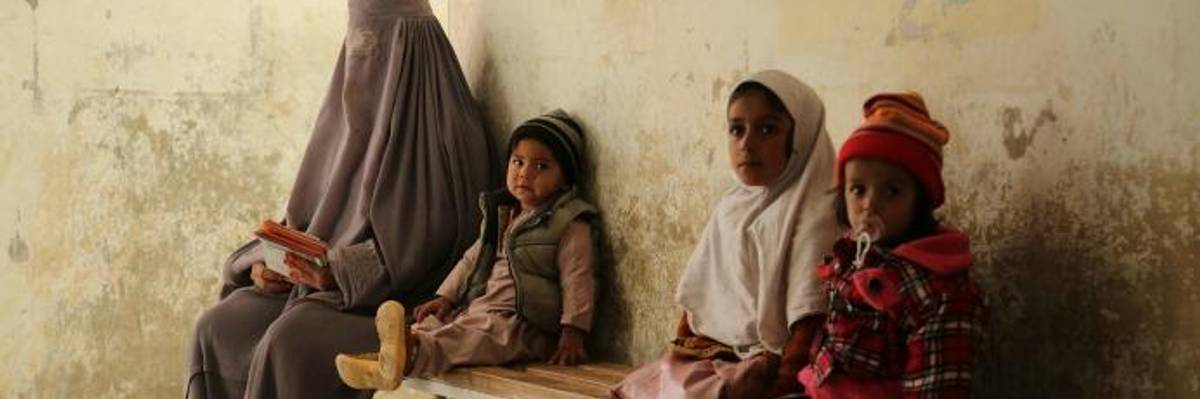
Patients wait at Shams Kakal Hospital in Kandahar province, Afghanistan on Dec. 21, 2015. (Photo: Ishaq Anis/Rumi Consultancy/World Bank via flickr/cc)
Afghanistan's Dire Health Situation
To continue sending troops to try to win an unwinnable war will only increase the suffering of the Afghan people.
As the war in Afghanistan shows no signs of abating, the health of the people in the country continues to be cause for concern. Afghanistan's health care system is considered one of the worst in the world, and decades of war and international neglect have contributed to its deterioration. An estimated 6 million people, out of a population of 35 million, have no access or adequate access to health care.
Most doctors, nurses and other medical professionals have left the country, causing a shortage of personnel and medical training programs, thus failing to solve people's most pressing needs. War has caused not only deaths and injuries; it has also led to increased poverty among many households. At the same time, the physical and psychological effects of war have increased the need for medical care.
The British Red Cross reports that 770 hospitals have been closed because of damage. Health services cover only limited regions and even in the areas where they are available they don't totally cover people's needs. In addition, there are inadequate supplies of medicines, vaccines, equipment and fuel. As a result, almost 6 million people have no access or adequate access to health care.
According to the World Health Organization (WHO,) diseases controlled in most countries in the world continue to cause deaths and disabilities in Afghanistan. For example, it has been estimated that approximately 60 percent of all childhood deaths and disabilities in Afghanistan are due to respiratory and intestinal infections and vaccine-preventable deaths, particularly measles, of which there are approximately 35,000 cases every year.
The WHO reports that infant and under-five mortality rates are estimated at 165 and 257 per 1,000 live births per year, respectively, which are among the highest in the world. These rates are only surpassed by Sierra Leone, Niger and Angola. With regard to immunization coverage, less than 40 percent of Afghan children receive life-saving vaccinations.
It is estimated that about half of children less than five years of age are stunted due to chronic malnutrition, and up to 10 percent have acute malnutrition. More than half of Afghan children suffer mental and physical damage because they are poorly nourished in the first two years of life.
In addition, although billions of dollars have been spent on poppy eradication and the control of the drug problem, it continues to be unsolved. According to a 2015 U.S. funded study, one in every nine Afghans (including women and children) use illegal drugs.
A study conducted by researchers hired by the U.S. State Department found staggering levels of opium in Afghan children. Some of them were only 14 months old, and had been passively exposed to opium by adult drug users in their homes. In 25 percent of homes where adult addicts were living, tested children showed significant signs of drug exposure. Those adults who inject drugs face the additional risk of HIV infection through sharing of contaminated syringes.
Statistics on women's health are difficult to obtain, due to societal restrictions and gender relations and behavior. Women's access to health care is limited, due to a large extent to lack of female medical facilities. Seventeen mothers die during delivery for every 1,000 live births, again one of the highest rates in the world. One of the reasons is that 90 percent of deliveries take place at home, without the help of skilled midwives.
Afghanistan is one of the most heavily mined nations in the world. Mines were planted extensively throughout the country, particularly during the period of Soviet occupation (1979-1989). Almost every family in the country has been affected by unexploded ordnance and the remaining land mines, which daily add new victims both through physical injuries and mental stress. It is estimated that over 800,000 Afghans are disabled, many of them children.
British Labour Party leader Jeremy Corbyn aptly summed up the situation in Afghanistan today. He recently told the Mirror, "After 16 years of bloodshed and destruction, the Taliban are undefeated and terrorism is no less of a threat at home. In fact it has spread. The British Government should make clear to Donald Trump that his strategy of more bombing and a new troop surge will continue this failure." To continue sending troops to try to win an unwinnable war will only increase the suffering of the Afghan people.
An Urgent Message From Our Co-Founder
Dear Common Dreams reader, It’s been nearly 30 years since I co-founded Common Dreams with my late wife, Lina Newhouser. We had the radical notion that journalism should serve the public good, not corporate profits. It was clear to us from the outset what it would take to build such a project. No paid advertisements. No corporate sponsors. No millionaire publisher telling us what to think or do. Many people said we wouldn't last a year, but we proved those doubters wrong. Together with a tremendous team of journalists and dedicated staff, we built an independent media outlet free from the constraints of profits and corporate control. Our mission has always been simple: To inform. To inspire. To ignite change for the common good. Building Common Dreams was not easy. Our survival was never guaranteed. When you take on the most powerful forces—Wall Street greed, fossil fuel industry destruction, Big Tech lobbyists, and uber-rich oligarchs who have spent billions upon billions rigging the economy and democracy in their favor—the only bulwark you have is supporters who believe in your work. But here’s the urgent message from me today. It's never been this bad out there. And it's never been this hard to keep us going. At the very moment Common Dreams is most needed, the threats we face are intensifying. We need your support now more than ever. We don't accept corporate advertising and never will. We don't have a paywall because we don't think people should be blocked from critical news based on their ability to pay. Everything we do is funded by the donations of readers like you. When everyone does the little they can afford, we are strong. But if that support retreats or dries up, so do we. Will you donate now to make sure Common Dreams not only survives but thrives? —Craig Brown, Co-founder |
As the war in Afghanistan shows no signs of abating, the health of the people in the country continues to be cause for concern. Afghanistan's health care system is considered one of the worst in the world, and decades of war and international neglect have contributed to its deterioration. An estimated 6 million people, out of a population of 35 million, have no access or adequate access to health care.
Most doctors, nurses and other medical professionals have left the country, causing a shortage of personnel and medical training programs, thus failing to solve people's most pressing needs. War has caused not only deaths and injuries; it has also led to increased poverty among many households. At the same time, the physical and psychological effects of war have increased the need for medical care.
The British Red Cross reports that 770 hospitals have been closed because of damage. Health services cover only limited regions and even in the areas where they are available they don't totally cover people's needs. In addition, there are inadequate supplies of medicines, vaccines, equipment and fuel. As a result, almost 6 million people have no access or adequate access to health care.
According to the World Health Organization (WHO,) diseases controlled in most countries in the world continue to cause deaths and disabilities in Afghanistan. For example, it has been estimated that approximately 60 percent of all childhood deaths and disabilities in Afghanistan are due to respiratory and intestinal infections and vaccine-preventable deaths, particularly measles, of which there are approximately 35,000 cases every year.
The WHO reports that infant and under-five mortality rates are estimated at 165 and 257 per 1,000 live births per year, respectively, which are among the highest in the world. These rates are only surpassed by Sierra Leone, Niger and Angola. With regard to immunization coverage, less than 40 percent of Afghan children receive life-saving vaccinations.
It is estimated that about half of children less than five years of age are stunted due to chronic malnutrition, and up to 10 percent have acute malnutrition. More than half of Afghan children suffer mental and physical damage because they are poorly nourished in the first two years of life.
In addition, although billions of dollars have been spent on poppy eradication and the control of the drug problem, it continues to be unsolved. According to a 2015 U.S. funded study, one in every nine Afghans (including women and children) use illegal drugs.
A study conducted by researchers hired by the U.S. State Department found staggering levels of opium in Afghan children. Some of them were only 14 months old, and had been passively exposed to opium by adult drug users in their homes. In 25 percent of homes where adult addicts were living, tested children showed significant signs of drug exposure. Those adults who inject drugs face the additional risk of HIV infection through sharing of contaminated syringes.
Statistics on women's health are difficult to obtain, due to societal restrictions and gender relations and behavior. Women's access to health care is limited, due to a large extent to lack of female medical facilities. Seventeen mothers die during delivery for every 1,000 live births, again one of the highest rates in the world. One of the reasons is that 90 percent of deliveries take place at home, without the help of skilled midwives.
Afghanistan is one of the most heavily mined nations in the world. Mines were planted extensively throughout the country, particularly during the period of Soviet occupation (1979-1989). Almost every family in the country has been affected by unexploded ordnance and the remaining land mines, which daily add new victims both through physical injuries and mental stress. It is estimated that over 800,000 Afghans are disabled, many of them children.
British Labour Party leader Jeremy Corbyn aptly summed up the situation in Afghanistan today. He recently told the Mirror, "After 16 years of bloodshed and destruction, the Taliban are undefeated and terrorism is no less of a threat at home. In fact it has spread. The British Government should make clear to Donald Trump that his strategy of more bombing and a new troop surge will continue this failure." To continue sending troops to try to win an unwinnable war will only increase the suffering of the Afghan people.
As the war in Afghanistan shows no signs of abating, the health of the people in the country continues to be cause for concern. Afghanistan's health care system is considered one of the worst in the world, and decades of war and international neglect have contributed to its deterioration. An estimated 6 million people, out of a population of 35 million, have no access or adequate access to health care.
Most doctors, nurses and other medical professionals have left the country, causing a shortage of personnel and medical training programs, thus failing to solve people's most pressing needs. War has caused not only deaths and injuries; it has also led to increased poverty among many households. At the same time, the physical and psychological effects of war have increased the need for medical care.
The British Red Cross reports that 770 hospitals have been closed because of damage. Health services cover only limited regions and even in the areas where they are available they don't totally cover people's needs. In addition, there are inadequate supplies of medicines, vaccines, equipment and fuel. As a result, almost 6 million people have no access or adequate access to health care.
According to the World Health Organization (WHO,) diseases controlled in most countries in the world continue to cause deaths and disabilities in Afghanistan. For example, it has been estimated that approximately 60 percent of all childhood deaths and disabilities in Afghanistan are due to respiratory and intestinal infections and vaccine-preventable deaths, particularly measles, of which there are approximately 35,000 cases every year.
The WHO reports that infant and under-five mortality rates are estimated at 165 and 257 per 1,000 live births per year, respectively, which are among the highest in the world. These rates are only surpassed by Sierra Leone, Niger and Angola. With regard to immunization coverage, less than 40 percent of Afghan children receive life-saving vaccinations.
It is estimated that about half of children less than five years of age are stunted due to chronic malnutrition, and up to 10 percent have acute malnutrition. More than half of Afghan children suffer mental and physical damage because they are poorly nourished in the first two years of life.
In addition, although billions of dollars have been spent on poppy eradication and the control of the drug problem, it continues to be unsolved. According to a 2015 U.S. funded study, one in every nine Afghans (including women and children) use illegal drugs.
A study conducted by researchers hired by the U.S. State Department found staggering levels of opium in Afghan children. Some of them were only 14 months old, and had been passively exposed to opium by adult drug users in their homes. In 25 percent of homes where adult addicts were living, tested children showed significant signs of drug exposure. Those adults who inject drugs face the additional risk of HIV infection through sharing of contaminated syringes.
Statistics on women's health are difficult to obtain, due to societal restrictions and gender relations and behavior. Women's access to health care is limited, due to a large extent to lack of female medical facilities. Seventeen mothers die during delivery for every 1,000 live births, again one of the highest rates in the world. One of the reasons is that 90 percent of deliveries take place at home, without the help of skilled midwives.
Afghanistan is one of the most heavily mined nations in the world. Mines were planted extensively throughout the country, particularly during the period of Soviet occupation (1979-1989). Almost every family in the country has been affected by unexploded ordnance and the remaining land mines, which daily add new victims both through physical injuries and mental stress. It is estimated that over 800,000 Afghans are disabled, many of them children.
British Labour Party leader Jeremy Corbyn aptly summed up the situation in Afghanistan today. He recently told the Mirror, "After 16 years of bloodshed and destruction, the Taliban are undefeated and terrorism is no less of a threat at home. In fact it has spread. The British Government should make clear to Donald Trump that his strategy of more bombing and a new troop surge will continue this failure." To continue sending troops to try to win an unwinnable war will only increase the suffering of the Afghan people.