SUBSCRIBE TO OUR FREE NEWSLETTER
Daily news & progressive opinion—funded by the people, not the corporations—delivered straight to your inbox.
5
#000000
#FFFFFF
To donate by check, phone, or other method, see our More Ways to Give page.
Daily news & progressive opinion—funded by the people, not the corporations—delivered straight to your inbox.
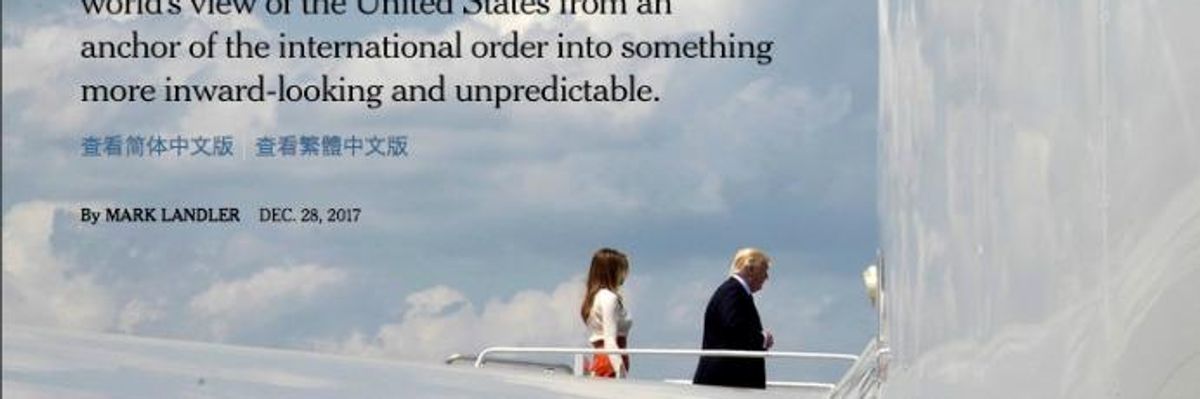
Adam Johnson of the media watchdog group FAIR criticizes Mark Landler's New York Times piece about how President Donald Trump "has transformed the world's view of the United States from an anchor of hte international order." (Photo: New York Times/Screenshot)
Trumpwashing--defined as whitewashing, obscuring, or rewriting the broader U.S. record by presenting Donald Trump as an aberration (FAIR.org, 6/3/16)--was on full display Thursday in a nominally straight news report from the New York Times' Mark Landler (12/28/17) on how Trump has reshaped U.S. foreign policy. Buried in the otherwise banal analysis was this gem of U.S. imperial agitprop:
Above all, Mr. Trump has transformed the world's view of the United States from a reliable anchor of the liberal, rules-based international order into something more inward-looking and unpredictable. That is a seminal change from the role the country has played for 70 years, under presidents from both parties, and it has lasting implications for how other countries chart their futures.
There's lots of ideology to unpack here, but let's start with the empirically false assertion that the "world" viewed the United States as a "reliable anchor of the liberal, rules-based international order." Poll (Guardian, 6/15/06) after poll (Pew, 3/14/07) after poll (PRI, 1/3/14) throughout the years has shown that much of the world views the United States as threat to peace, often taking the top spot as the single greatest threat. What evidence Landler has for the world viewing the U.S. as a sort of good-natured global babysitter is unclear, as he cites nothing to support this hugely important claim (since if Trump's cynical disregard for "human rights" is nothing new, then there's no real story here). It's just thrown out with the assumption the Times readership is sufficiently nationalistic and/or amnesiac to either not notice or not care. It's designed to flatter, not to elucidate.
The second dubious assertion is the idea that the U.S. is "viewed" as being (or, by implication, objectively is) concerned with "liberal, rules-based international order." Perhaps Landler missed the part where the U.S. runs offshore penal colonies for untried political prisoners, and a decade-long drone war that's killed thousands--both entirely outside the scope of international law. Or the time the U.S. invaded and destroyed Iraq without any international authorization, killing hundreds of thousands. Or perhaps he missed the part where the United States refuses to sign "liberal, rules-based international order" treaties such as the International Criminal Court or the ban on bombs and or a prohibition on nuclear weapons. Or the part where the U.S. not only doesn't recognize the International Criminal Court, but has a law on its books (dubbed "the Hague Invasion Act," passed in 2002) that if an American is ever held by the ICC for committing war crimes, the U.S. is obligated to literally invade the Hague and free them.
And this is just in the past 15 years. Landler, even more laughably, starts the clock in 1947, which would include dozens of non-"liberal," non-"rules-based" coups, invasions, bombing campaigns, assassinations, extrajudicial murders, and so forth. The number of actions carried out by the U.S. not sanctioned by even the thinnest pretext of "international order" is too long to list.
What exactly is this "liberal, rules-based international order," and when did "the world" view the United States as its most reliable anchor? Landler doesn't say, he simply asserts this highly contestable and ideological claim, and moves on to pearl-clutch about Trump ruining the U.S.'s hard-won moral authority. He has some 100 percent uncut pro-U.S. ideology to push under the guise of criticizing Trump, and no amount of basic historical facts will get in his way.
Dear Common Dreams reader, It’s been nearly 30 years since I co-founded Common Dreams with my late wife, Lina Newhouser. We had the radical notion that journalism should serve the public good, not corporate profits. It was clear to us from the outset what it would take to build such a project. No paid advertisements. No corporate sponsors. No millionaire publisher telling us what to think or do. Many people said we wouldn't last a year, but we proved those doubters wrong. Together with a tremendous team of journalists and dedicated staff, we built an independent media outlet free from the constraints of profits and corporate control. Our mission has always been simple: To inform. To inspire. To ignite change for the common good. Building Common Dreams was not easy. Our survival was never guaranteed. When you take on the most powerful forces—Wall Street greed, fossil fuel industry destruction, Big Tech lobbyists, and uber-rich oligarchs who have spent billions upon billions rigging the economy and democracy in their favor—the only bulwark you have is supporters who believe in your work. But here’s the urgent message from me today. It's never been this bad out there. And it's never been this hard to keep us going. At the very moment Common Dreams is most needed, the threats we face are intensifying. We need your support now more than ever. We don't accept corporate advertising and never will. We don't have a paywall because we don't think people should be blocked from critical news based on their ability to pay. Everything we do is funded by the donations of readers like you. When everyone does the little they can afford, we are strong. But if that support retreats or dries up, so do we. Will you donate now to make sure Common Dreams not only survives but thrives? —Craig Brown, Co-founder |
Trumpwashing--defined as whitewashing, obscuring, or rewriting the broader U.S. record by presenting Donald Trump as an aberration (FAIR.org, 6/3/16)--was on full display Thursday in a nominally straight news report from the New York Times' Mark Landler (12/28/17) on how Trump has reshaped U.S. foreign policy. Buried in the otherwise banal analysis was this gem of U.S. imperial agitprop:
Above all, Mr. Trump has transformed the world's view of the United States from a reliable anchor of the liberal, rules-based international order into something more inward-looking and unpredictable. That is a seminal change from the role the country has played for 70 years, under presidents from both parties, and it has lasting implications for how other countries chart their futures.
There's lots of ideology to unpack here, but let's start with the empirically false assertion that the "world" viewed the United States as a "reliable anchor of the liberal, rules-based international order." Poll (Guardian, 6/15/06) after poll (Pew, 3/14/07) after poll (PRI, 1/3/14) throughout the years has shown that much of the world views the United States as threat to peace, often taking the top spot as the single greatest threat. What evidence Landler has for the world viewing the U.S. as a sort of good-natured global babysitter is unclear, as he cites nothing to support this hugely important claim (since if Trump's cynical disregard for "human rights" is nothing new, then there's no real story here). It's just thrown out with the assumption the Times readership is sufficiently nationalistic and/or amnesiac to either not notice or not care. It's designed to flatter, not to elucidate.
The second dubious assertion is the idea that the U.S. is "viewed" as being (or, by implication, objectively is) concerned with "liberal, rules-based international order." Perhaps Landler missed the part where the U.S. runs offshore penal colonies for untried political prisoners, and a decade-long drone war that's killed thousands--both entirely outside the scope of international law. Or the time the U.S. invaded and destroyed Iraq without any international authorization, killing hundreds of thousands. Or perhaps he missed the part where the United States refuses to sign "liberal, rules-based international order" treaties such as the International Criminal Court or the ban on bombs and or a prohibition on nuclear weapons. Or the part where the U.S. not only doesn't recognize the International Criminal Court, but has a law on its books (dubbed "the Hague Invasion Act," passed in 2002) that if an American is ever held by the ICC for committing war crimes, the U.S. is obligated to literally invade the Hague and free them.
And this is just in the past 15 years. Landler, even more laughably, starts the clock in 1947, which would include dozens of non-"liberal," non-"rules-based" coups, invasions, bombing campaigns, assassinations, extrajudicial murders, and so forth. The number of actions carried out by the U.S. not sanctioned by even the thinnest pretext of "international order" is too long to list.
What exactly is this "liberal, rules-based international order," and when did "the world" view the United States as its most reliable anchor? Landler doesn't say, he simply asserts this highly contestable and ideological claim, and moves on to pearl-clutch about Trump ruining the U.S.'s hard-won moral authority. He has some 100 percent uncut pro-U.S. ideology to push under the guise of criticizing Trump, and no amount of basic historical facts will get in his way.
Trumpwashing--defined as whitewashing, obscuring, or rewriting the broader U.S. record by presenting Donald Trump as an aberration (FAIR.org, 6/3/16)--was on full display Thursday in a nominally straight news report from the New York Times' Mark Landler (12/28/17) on how Trump has reshaped U.S. foreign policy. Buried in the otherwise banal analysis was this gem of U.S. imperial agitprop:
Above all, Mr. Trump has transformed the world's view of the United States from a reliable anchor of the liberal, rules-based international order into something more inward-looking and unpredictable. That is a seminal change from the role the country has played for 70 years, under presidents from both parties, and it has lasting implications for how other countries chart their futures.
There's lots of ideology to unpack here, but let's start with the empirically false assertion that the "world" viewed the United States as a "reliable anchor of the liberal, rules-based international order." Poll (Guardian, 6/15/06) after poll (Pew, 3/14/07) after poll (PRI, 1/3/14) throughout the years has shown that much of the world views the United States as threat to peace, often taking the top spot as the single greatest threat. What evidence Landler has for the world viewing the U.S. as a sort of good-natured global babysitter is unclear, as he cites nothing to support this hugely important claim (since if Trump's cynical disregard for "human rights" is nothing new, then there's no real story here). It's just thrown out with the assumption the Times readership is sufficiently nationalistic and/or amnesiac to either not notice or not care. It's designed to flatter, not to elucidate.
The second dubious assertion is the idea that the U.S. is "viewed" as being (or, by implication, objectively is) concerned with "liberal, rules-based international order." Perhaps Landler missed the part where the U.S. runs offshore penal colonies for untried political prisoners, and a decade-long drone war that's killed thousands--both entirely outside the scope of international law. Or the time the U.S. invaded and destroyed Iraq without any international authorization, killing hundreds of thousands. Or perhaps he missed the part where the United States refuses to sign "liberal, rules-based international order" treaties such as the International Criminal Court or the ban on bombs and or a prohibition on nuclear weapons. Or the part where the U.S. not only doesn't recognize the International Criminal Court, but has a law on its books (dubbed "the Hague Invasion Act," passed in 2002) that if an American is ever held by the ICC for committing war crimes, the U.S. is obligated to literally invade the Hague and free them.
And this is just in the past 15 years. Landler, even more laughably, starts the clock in 1947, which would include dozens of non-"liberal," non-"rules-based" coups, invasions, bombing campaigns, assassinations, extrajudicial murders, and so forth. The number of actions carried out by the U.S. not sanctioned by even the thinnest pretext of "international order" is too long to list.
What exactly is this "liberal, rules-based international order," and when did "the world" view the United States as its most reliable anchor? Landler doesn't say, he simply asserts this highly contestable and ideological claim, and moves on to pearl-clutch about Trump ruining the U.S.'s hard-won moral authority. He has some 100 percent uncut pro-U.S. ideology to push under the guise of criticizing Trump, and no amount of basic historical facts will get in his way.