SUBSCRIBE TO OUR FREE NEWSLETTER
Daily news & progressive opinion—funded by the people, not the corporations—delivered straight to your inbox.
5
#000000
#FFFFFF
To donate by check, phone, or other method, see our More Ways to Give page.
Daily news & progressive opinion—funded by the people, not the corporations—delivered straight to your inbox.
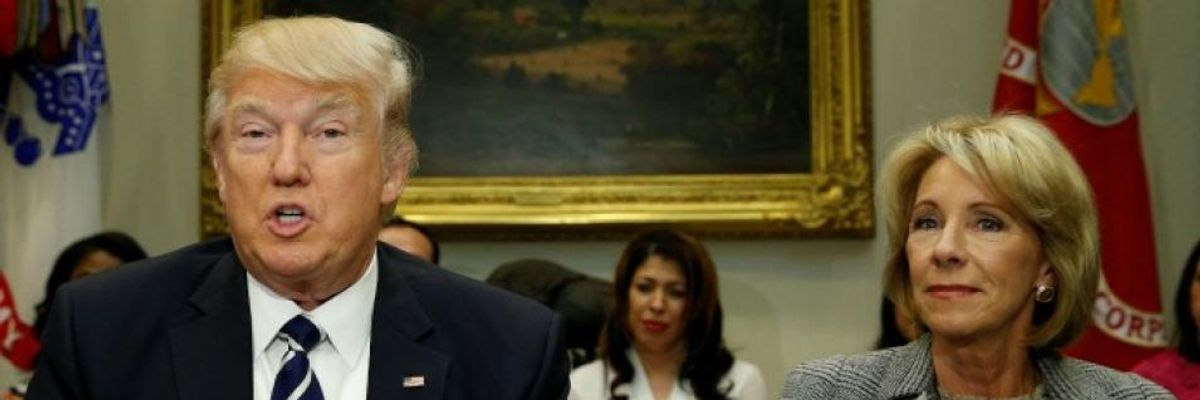
"Ending DACA is a big hit to the nation's economy, taking away a huge chunk of skilled workers, reducing tax revenues by hundreds of billions, and costing government more billions in the costs of deportations." (Photo: Reuters)
U.S. Secretary of Education Betsy DeVos proclaims her agenda is to "focus everything about education on individual students," but if she really cared about the welfare of students she would speak out about what her boss President Trump is doing to hundreds of thousands of undocumented students whose fate he has cast to the wind by ordering an end to the Obama-era program shielding young undocumented immigrants from deportation.
Trump's decision to cancel the Deferred Action for Childhood Arrivals program, or DACA, also has an immediate impact on thousands of teachers whose DACA deferral made it possible for them to enroll in teacher preparation programs, earn certification, and gain employment in schools. For students with undocumented parents, cancelling DACA throws them into a state of fear that while they're in school their mother or father could be deported. Many DACA beneficiaries, often called "Dreamers," have become parents and now face the prospect of being ripped away from their children and families. Further, Trump's action to crack down on DACA recipients has a chilling effect on all immigrant students - full citizens and otherwise - who fear they, or a friend or family member of theirs, are next to be targeted by the heavy rule of the Trump administration.
Yet, as of this writing, neither DeVos or her Department of Education have issued a statement addressing the plight of these students. Indeed, the last time DeVos spoke about DACA, she said, "Undocumented immigrants shouldn't worry about the Trump administration's support for educational opportunities."
Of course, the impact of Trump's decision to end DACA goes way beyond students and public schools. The number of undocumented immigrants eligible for DACA far exceeds the 800,000 currently enrolled in the program and is likely over 2 million, according to data cited by an article in USA Today. And ending DACA is a big hit to the nation's economy, taking away a huge chunk of skilled workers, reducing tax revenues by hundreds of billions, and costing government more billions in the costs of deportations.
But DACA "is inextricably tied to education," experts at the Migration Policy Institute explain, "as applicants must have at least a high school diploma or its equivalent or be enrolled in school."
MPI's analysis finds tens of thousands of DACA eligible students around the country are still in the school pipeline for the program. Of the nearly 1.2 million children and youth who were eligible for DACA in 2014, 365,000 were in middle and high school and 241,000 were in college. Over 250,000 school-age children have become DACA-eligible since President Obama began the program in 2012. And numerous news outlets cite an analysis by the National Immigration Law Center estimating that 65,000 undocumented youth graduate from high school each year.
As many as 20,000 Dreamers work as teachers, reports Univision.
"It's impossible to know the exact number of teachers with DACA because the federal government does not track that information," the Univision reporter explains, but he cites estimates for 2016 of 5,000 in California, 2,000 each in New York and Texas, and "sizable populations" in at least seven other states.
"These teachers bring extra value to immigrant communities because they know the community's stressors," the article quotes an NEA official. "They contribute with their culture, their language, their personal experience. Students and families trust these teachers."
A national coalition of education leaders has urged Trump to protect DACA-protected students, the Washington Post reports, saying that ending DACA would create uncertainty for their students, ratchet up stress in schools, and discourage students from enrolling in schools and colleges and showing up for classes.
"It seems that this administration is trying to go above and beyond to target, intimidate, and create fear among our immigrant families and communities of color," writes National Education Association President Lily Eskelsen Garcia on her personal blog. "As educators and NEA members, defending DACA is personal. This is about our students and our colleagues."
Teachers unions are taking the lead in defending their colleagues and their students.
Shortly after Trump's announcement, which came through Attorney General Jeff Sessions, the American Federation of Teachers issued a statement pledging its support for cities and school districts - including New York City, Chicago, and elsewhere - that have become "sanctuaries" for undocumented immigrants.
AFT vowed to provide "know your rights" advice to schools on how to handle an Immigration and Customs Enforcement raid and lesson plans to address the health and emotional needs of students affected by canceling DACA. AFT also urges governments at all levels "to reaffirm that children cannot be barred from enrolling in public schools based on their immigration status or their parents'."
NEA is also providing educators resources and tools for supporting Dreamers, including guidance on legal status and employment and steps for dealing with acts of racism and hate.
So where's DeVos?
DeVos has said all along that her emphasis would be on the interests of students and parents. She has long maintained that giving them more choice will ensure more education opportunities and better education outcomes. Now she is part of a regime taking away one of the most precious opportunities students and parents have - the opportunity to live, go to school, and have a future in the country they grew up in. And there's little sign she cares about that kind of education opportunity at all.
Dear Common Dreams reader, It’s been nearly 30 years since I co-founded Common Dreams with my late wife, Lina Newhouser. We had the radical notion that journalism should serve the public good, not corporate profits. It was clear to us from the outset what it would take to build such a project. No paid advertisements. No corporate sponsors. No millionaire publisher telling us what to think or do. Many people said we wouldn't last a year, but we proved those doubters wrong. Together with a tremendous team of journalists and dedicated staff, we built an independent media outlet free from the constraints of profits and corporate control. Our mission has always been simple: To inform. To inspire. To ignite change for the common good. Building Common Dreams was not easy. Our survival was never guaranteed. When you take on the most powerful forces—Wall Street greed, fossil fuel industry destruction, Big Tech lobbyists, and uber-rich oligarchs who have spent billions upon billions rigging the economy and democracy in their favor—the only bulwark you have is supporters who believe in your work. But here’s the urgent message from me today. It's never been this bad out there. And it's never been this hard to keep us going. At the very moment Common Dreams is most needed, the threats we face are intensifying. We need your support now more than ever. We don't accept corporate advertising and never will. We don't have a paywall because we don't think people should be blocked from critical news based on their ability to pay. Everything we do is funded by the donations of readers like you. When everyone does the little they can afford, we are strong. But if that support retreats or dries up, so do we. Will you donate now to make sure Common Dreams not only survives but thrives? —Craig Brown, Co-founder |
U.S. Secretary of Education Betsy DeVos proclaims her agenda is to "focus everything about education on individual students," but if she really cared about the welfare of students she would speak out about what her boss President Trump is doing to hundreds of thousands of undocumented students whose fate he has cast to the wind by ordering an end to the Obama-era program shielding young undocumented immigrants from deportation.
Trump's decision to cancel the Deferred Action for Childhood Arrivals program, or DACA, also has an immediate impact on thousands of teachers whose DACA deferral made it possible for them to enroll in teacher preparation programs, earn certification, and gain employment in schools. For students with undocumented parents, cancelling DACA throws them into a state of fear that while they're in school their mother or father could be deported. Many DACA beneficiaries, often called "Dreamers," have become parents and now face the prospect of being ripped away from their children and families. Further, Trump's action to crack down on DACA recipients has a chilling effect on all immigrant students - full citizens and otherwise - who fear they, or a friend or family member of theirs, are next to be targeted by the heavy rule of the Trump administration.
Yet, as of this writing, neither DeVos or her Department of Education have issued a statement addressing the plight of these students. Indeed, the last time DeVos spoke about DACA, she said, "Undocumented immigrants shouldn't worry about the Trump administration's support for educational opportunities."
Of course, the impact of Trump's decision to end DACA goes way beyond students and public schools. The number of undocumented immigrants eligible for DACA far exceeds the 800,000 currently enrolled in the program and is likely over 2 million, according to data cited by an article in USA Today. And ending DACA is a big hit to the nation's economy, taking away a huge chunk of skilled workers, reducing tax revenues by hundreds of billions, and costing government more billions in the costs of deportations.
But DACA "is inextricably tied to education," experts at the Migration Policy Institute explain, "as applicants must have at least a high school diploma or its equivalent or be enrolled in school."
MPI's analysis finds tens of thousands of DACA eligible students around the country are still in the school pipeline for the program. Of the nearly 1.2 million children and youth who were eligible for DACA in 2014, 365,000 were in middle and high school and 241,000 were in college. Over 250,000 school-age children have become DACA-eligible since President Obama began the program in 2012. And numerous news outlets cite an analysis by the National Immigration Law Center estimating that 65,000 undocumented youth graduate from high school each year.
As many as 20,000 Dreamers work as teachers, reports Univision.
"It's impossible to know the exact number of teachers with DACA because the federal government does not track that information," the Univision reporter explains, but he cites estimates for 2016 of 5,000 in California, 2,000 each in New York and Texas, and "sizable populations" in at least seven other states.
"These teachers bring extra value to immigrant communities because they know the community's stressors," the article quotes an NEA official. "They contribute with their culture, their language, their personal experience. Students and families trust these teachers."
A national coalition of education leaders has urged Trump to protect DACA-protected students, the Washington Post reports, saying that ending DACA would create uncertainty for their students, ratchet up stress in schools, and discourage students from enrolling in schools and colleges and showing up for classes.
"It seems that this administration is trying to go above and beyond to target, intimidate, and create fear among our immigrant families and communities of color," writes National Education Association President Lily Eskelsen Garcia on her personal blog. "As educators and NEA members, defending DACA is personal. This is about our students and our colleagues."
Teachers unions are taking the lead in defending their colleagues and their students.
Shortly after Trump's announcement, which came through Attorney General Jeff Sessions, the American Federation of Teachers issued a statement pledging its support for cities and school districts - including New York City, Chicago, and elsewhere - that have become "sanctuaries" for undocumented immigrants.
AFT vowed to provide "know your rights" advice to schools on how to handle an Immigration and Customs Enforcement raid and lesson plans to address the health and emotional needs of students affected by canceling DACA. AFT also urges governments at all levels "to reaffirm that children cannot be barred from enrolling in public schools based on their immigration status or their parents'."
NEA is also providing educators resources and tools for supporting Dreamers, including guidance on legal status and employment and steps for dealing with acts of racism and hate.
So where's DeVos?
DeVos has said all along that her emphasis would be on the interests of students and parents. She has long maintained that giving them more choice will ensure more education opportunities and better education outcomes. Now she is part of a regime taking away one of the most precious opportunities students and parents have - the opportunity to live, go to school, and have a future in the country they grew up in. And there's little sign she cares about that kind of education opportunity at all.
U.S. Secretary of Education Betsy DeVos proclaims her agenda is to "focus everything about education on individual students," but if she really cared about the welfare of students she would speak out about what her boss President Trump is doing to hundreds of thousands of undocumented students whose fate he has cast to the wind by ordering an end to the Obama-era program shielding young undocumented immigrants from deportation.
Trump's decision to cancel the Deferred Action for Childhood Arrivals program, or DACA, also has an immediate impact on thousands of teachers whose DACA deferral made it possible for them to enroll in teacher preparation programs, earn certification, and gain employment in schools. For students with undocumented parents, cancelling DACA throws them into a state of fear that while they're in school their mother or father could be deported. Many DACA beneficiaries, often called "Dreamers," have become parents and now face the prospect of being ripped away from their children and families. Further, Trump's action to crack down on DACA recipients has a chilling effect on all immigrant students - full citizens and otherwise - who fear they, or a friend or family member of theirs, are next to be targeted by the heavy rule of the Trump administration.
Yet, as of this writing, neither DeVos or her Department of Education have issued a statement addressing the plight of these students. Indeed, the last time DeVos spoke about DACA, she said, "Undocumented immigrants shouldn't worry about the Trump administration's support for educational opportunities."
Of course, the impact of Trump's decision to end DACA goes way beyond students and public schools. The number of undocumented immigrants eligible for DACA far exceeds the 800,000 currently enrolled in the program and is likely over 2 million, according to data cited by an article in USA Today. And ending DACA is a big hit to the nation's economy, taking away a huge chunk of skilled workers, reducing tax revenues by hundreds of billions, and costing government more billions in the costs of deportations.
But DACA "is inextricably tied to education," experts at the Migration Policy Institute explain, "as applicants must have at least a high school diploma or its equivalent or be enrolled in school."
MPI's analysis finds tens of thousands of DACA eligible students around the country are still in the school pipeline for the program. Of the nearly 1.2 million children and youth who were eligible for DACA in 2014, 365,000 were in middle and high school and 241,000 were in college. Over 250,000 school-age children have become DACA-eligible since President Obama began the program in 2012. And numerous news outlets cite an analysis by the National Immigration Law Center estimating that 65,000 undocumented youth graduate from high school each year.
As many as 20,000 Dreamers work as teachers, reports Univision.
"It's impossible to know the exact number of teachers with DACA because the federal government does not track that information," the Univision reporter explains, but he cites estimates for 2016 of 5,000 in California, 2,000 each in New York and Texas, and "sizable populations" in at least seven other states.
"These teachers bring extra value to immigrant communities because they know the community's stressors," the article quotes an NEA official. "They contribute with their culture, their language, their personal experience. Students and families trust these teachers."
A national coalition of education leaders has urged Trump to protect DACA-protected students, the Washington Post reports, saying that ending DACA would create uncertainty for their students, ratchet up stress in schools, and discourage students from enrolling in schools and colleges and showing up for classes.
"It seems that this administration is trying to go above and beyond to target, intimidate, and create fear among our immigrant families and communities of color," writes National Education Association President Lily Eskelsen Garcia on her personal blog. "As educators and NEA members, defending DACA is personal. This is about our students and our colleagues."
Teachers unions are taking the lead in defending their colleagues and their students.
Shortly after Trump's announcement, which came through Attorney General Jeff Sessions, the American Federation of Teachers issued a statement pledging its support for cities and school districts - including New York City, Chicago, and elsewhere - that have become "sanctuaries" for undocumented immigrants.
AFT vowed to provide "know your rights" advice to schools on how to handle an Immigration and Customs Enforcement raid and lesson plans to address the health and emotional needs of students affected by canceling DACA. AFT also urges governments at all levels "to reaffirm that children cannot be barred from enrolling in public schools based on their immigration status or their parents'."
NEA is also providing educators resources and tools for supporting Dreamers, including guidance on legal status and employment and steps for dealing with acts of racism and hate.
So where's DeVos?
DeVos has said all along that her emphasis would be on the interests of students and parents. She has long maintained that giving them more choice will ensure more education opportunities and better education outcomes. Now she is part of a regime taking away one of the most precious opportunities students and parents have - the opportunity to live, go to school, and have a future in the country they grew up in. And there's little sign she cares about that kind of education opportunity at all.