SUBSCRIBE TO OUR FREE NEWSLETTER
Daily news & progressive opinion—funded by the people, not the corporations—delivered straight to your inbox.
5
#000000
#FFFFFF
To donate by check, phone, or other method, see our More Ways to Give page.
Daily news & progressive opinion—funded by the people, not the corporations—delivered straight to your inbox.
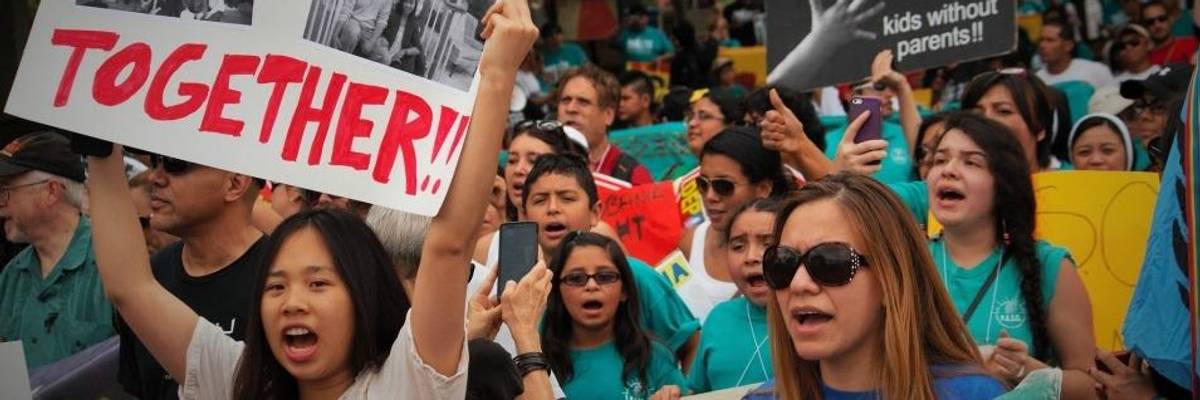
An anti-deportation rally in Washington, D.C. on August 2, 2014. (Photo: mar is sea Y)
This morning, the Trump is expected to announce the rescinding of Deferred Action for Childhood Arrivals ("DACA"), an Obama-era policy benefiting certain undocumented individuals who were brought to the United States as children. Under DACA, these individuals were protected from deportation and eligible for work authorization if they had lived in the United States for at least five years, refrained from serious criminal activity, and either completed high school or served in the military.
This morning, the Trump is expected to announce the rescinding of Deferred Action for Childhood Arrivals ("DACA"), an Obama-era policy benefiting certain undocumented individuals who were brought to the United States as children. Under DACA, these individuals were protected from deportation and eligible for work authorization if they had lived in the United States for at least five years, refrained from serious criminal activity, and either completed high school or served in the military. Some 800,000 young men and women (commonly referred to as "Dreamers") benefitted from this program.
By Trump's own admission, the Dreamers are "absolutely incredible kids." Yet Trump's decision means all 800,000 of them now face the threat of deportation--of being ripped apart from the only country they have ever known and shipped to another country where they may not even speak the language. Once deported, these individuals will be barred from returning to the United States for at least ten years.
If Congress fails to take action to protect DACA, the humanitarian consequences for Dreamers and their families will be severe. What is more, our communities will be irreparably damaged. Dreamers have been making tremendous contributions to our country, working as doctors and lawyers, starting businesses, and serving in our military. Absent a legislative fix, the United States risks losing some of its best and brightest.
Of course, Dreamers aren't the only undocumented individuals in need of protection. Mothers and fathers who have lived in the United States for decades are also being targeted for deportation. In Las Cruces, New Mexico, where I live, federal agents recently deported a mother of two Americans, even though she lived there for 18 years, paid her taxes every year, and never had any trouble with the law. In San Diego, federal agents detained a husband and wife who had lived there without incident for 20 years; their minor children--all U.S. citizens--were left to fend for themselves. In Durango, Colorado, a law-abiding woman who has lived in the U.S. for 30 years has been forced to take sanctuary in her church.
I have drafted legislation called the Reuniting, Embracing, Understanding, and Nurturing Immigrants in Our Nation (REUNION) Act to respond to this crisis. The REUNION Act would protect Dreamers, parents of Americans, and other undocumented individuals by creating a five-year statute of limitations on deportation. Under federal law, the government is generally prohibited from bringing criminal or civil penalty actions after five years. But courts have mistakenly concluded that this time limit does not apply to deportation. The REUNION Act corrects that erroneous interpretation, ensuring that deportation is subject to the same limitations period as other criminal and civil penalties.
The REUNION Act would also provide relief to law-abiding long-term residents who have already been deported. Under existing law, people who have been deported are barred from returning to the United States for ten years. The REUNION Act would lift this bar for people who lived continuously in the United States for five years prior to deportation.
Of course, there are sometimes very good reasons to deport or exclude someone--e.g., where an individual poses a threat to public safety of has been convicted of a serious crime. The REUNION Act does not limit the government's authority in these cases. But cases like this are few and far between. The vast majority of immigrants are law-abiding, hard-working folks who just want their shot at the American dream. We should allow them to continue contributing to our society while we work to enact a comprehensive fix to our broken immigration system.
Dear Common Dreams reader, It’s been nearly 30 years since I co-founded Common Dreams with my late wife, Lina Newhouser. We had the radical notion that journalism should serve the public good, not corporate profits. It was clear to us from the outset what it would take to build such a project. No paid advertisements. No corporate sponsors. No millionaire publisher telling us what to think or do. Many people said we wouldn't last a year, but we proved those doubters wrong. Together with a tremendous team of journalists and dedicated staff, we built an independent media outlet free from the constraints of profits and corporate control. Our mission has always been simple: To inform. To inspire. To ignite change for the common good. Building Common Dreams was not easy. Our survival was never guaranteed. When you take on the most powerful forces—Wall Street greed, fossil fuel industry destruction, Big Tech lobbyists, and uber-rich oligarchs who have spent billions upon billions rigging the economy and democracy in their favor—the only bulwark you have is supporters who believe in your work. But here’s the urgent message from me today. It's never been this bad out there. And it's never been this hard to keep us going. At the very moment Common Dreams is most needed, the threats we face are intensifying. We need your support now more than ever. We don't accept corporate advertising and never will. We don't have a paywall because we don't think people should be blocked from critical news based on their ability to pay. Everything we do is funded by the donations of readers like you. When everyone does the little they can afford, we are strong. But if that support retreats or dries up, so do we. Will you donate now to make sure Common Dreams not only survives but thrives? —Craig Brown, Co-founder |
This morning, the Trump is expected to announce the rescinding of Deferred Action for Childhood Arrivals ("DACA"), an Obama-era policy benefiting certain undocumented individuals who were brought to the United States as children. Under DACA, these individuals were protected from deportation and eligible for work authorization if they had lived in the United States for at least five years, refrained from serious criminal activity, and either completed high school or served in the military. Some 800,000 young men and women (commonly referred to as "Dreamers") benefitted from this program.
By Trump's own admission, the Dreamers are "absolutely incredible kids." Yet Trump's decision means all 800,000 of them now face the threat of deportation--of being ripped apart from the only country they have ever known and shipped to another country where they may not even speak the language. Once deported, these individuals will be barred from returning to the United States for at least ten years.
If Congress fails to take action to protect DACA, the humanitarian consequences for Dreamers and their families will be severe. What is more, our communities will be irreparably damaged. Dreamers have been making tremendous contributions to our country, working as doctors and lawyers, starting businesses, and serving in our military. Absent a legislative fix, the United States risks losing some of its best and brightest.
Of course, Dreamers aren't the only undocumented individuals in need of protection. Mothers and fathers who have lived in the United States for decades are also being targeted for deportation. In Las Cruces, New Mexico, where I live, federal agents recently deported a mother of two Americans, even though she lived there for 18 years, paid her taxes every year, and never had any trouble with the law. In San Diego, federal agents detained a husband and wife who had lived there without incident for 20 years; their minor children--all U.S. citizens--were left to fend for themselves. In Durango, Colorado, a law-abiding woman who has lived in the U.S. for 30 years has been forced to take sanctuary in her church.
I have drafted legislation called the Reuniting, Embracing, Understanding, and Nurturing Immigrants in Our Nation (REUNION) Act to respond to this crisis. The REUNION Act would protect Dreamers, parents of Americans, and other undocumented individuals by creating a five-year statute of limitations on deportation. Under federal law, the government is generally prohibited from bringing criminal or civil penalty actions after five years. But courts have mistakenly concluded that this time limit does not apply to deportation. The REUNION Act corrects that erroneous interpretation, ensuring that deportation is subject to the same limitations period as other criminal and civil penalties.
The REUNION Act would also provide relief to law-abiding long-term residents who have already been deported. Under existing law, people who have been deported are barred from returning to the United States for ten years. The REUNION Act would lift this bar for people who lived continuously in the United States for five years prior to deportation.
Of course, there are sometimes very good reasons to deport or exclude someone--e.g., where an individual poses a threat to public safety of has been convicted of a serious crime. The REUNION Act does not limit the government's authority in these cases. But cases like this are few and far between. The vast majority of immigrants are law-abiding, hard-working folks who just want their shot at the American dream. We should allow them to continue contributing to our society while we work to enact a comprehensive fix to our broken immigration system.
This morning, the Trump is expected to announce the rescinding of Deferred Action for Childhood Arrivals ("DACA"), an Obama-era policy benefiting certain undocumented individuals who were brought to the United States as children. Under DACA, these individuals were protected from deportation and eligible for work authorization if they had lived in the United States for at least five years, refrained from serious criminal activity, and either completed high school or served in the military. Some 800,000 young men and women (commonly referred to as "Dreamers") benefitted from this program.
By Trump's own admission, the Dreamers are "absolutely incredible kids." Yet Trump's decision means all 800,000 of them now face the threat of deportation--of being ripped apart from the only country they have ever known and shipped to another country where they may not even speak the language. Once deported, these individuals will be barred from returning to the United States for at least ten years.
If Congress fails to take action to protect DACA, the humanitarian consequences for Dreamers and their families will be severe. What is more, our communities will be irreparably damaged. Dreamers have been making tremendous contributions to our country, working as doctors and lawyers, starting businesses, and serving in our military. Absent a legislative fix, the United States risks losing some of its best and brightest.
Of course, Dreamers aren't the only undocumented individuals in need of protection. Mothers and fathers who have lived in the United States for decades are also being targeted for deportation. In Las Cruces, New Mexico, where I live, federal agents recently deported a mother of two Americans, even though she lived there for 18 years, paid her taxes every year, and never had any trouble with the law. In San Diego, federal agents detained a husband and wife who had lived there without incident for 20 years; their minor children--all U.S. citizens--were left to fend for themselves. In Durango, Colorado, a law-abiding woman who has lived in the U.S. for 30 years has been forced to take sanctuary in her church.
I have drafted legislation called the Reuniting, Embracing, Understanding, and Nurturing Immigrants in Our Nation (REUNION) Act to respond to this crisis. The REUNION Act would protect Dreamers, parents of Americans, and other undocumented individuals by creating a five-year statute of limitations on deportation. Under federal law, the government is generally prohibited from bringing criminal or civil penalty actions after five years. But courts have mistakenly concluded that this time limit does not apply to deportation. The REUNION Act corrects that erroneous interpretation, ensuring that deportation is subject to the same limitations period as other criminal and civil penalties.
The REUNION Act would also provide relief to law-abiding long-term residents who have already been deported. Under existing law, people who have been deported are barred from returning to the United States for ten years. The REUNION Act would lift this bar for people who lived continuously in the United States for five years prior to deportation.
Of course, there are sometimes very good reasons to deport or exclude someone--e.g., where an individual poses a threat to public safety of has been convicted of a serious crime. The REUNION Act does not limit the government's authority in these cases. But cases like this are few and far between. The vast majority of immigrants are law-abiding, hard-working folks who just want their shot at the American dream. We should allow them to continue contributing to our society while we work to enact a comprehensive fix to our broken immigration system.