SUBSCRIBE TO OUR FREE NEWSLETTER
Daily news & progressive opinion—funded by the people, not the corporations—delivered straight to your inbox.
5
#000000
#FFFFFF
To donate by check, phone, or other method, see our More Ways to Give page.
Daily news & progressive opinion—funded by the people, not the corporations—delivered straight to your inbox.
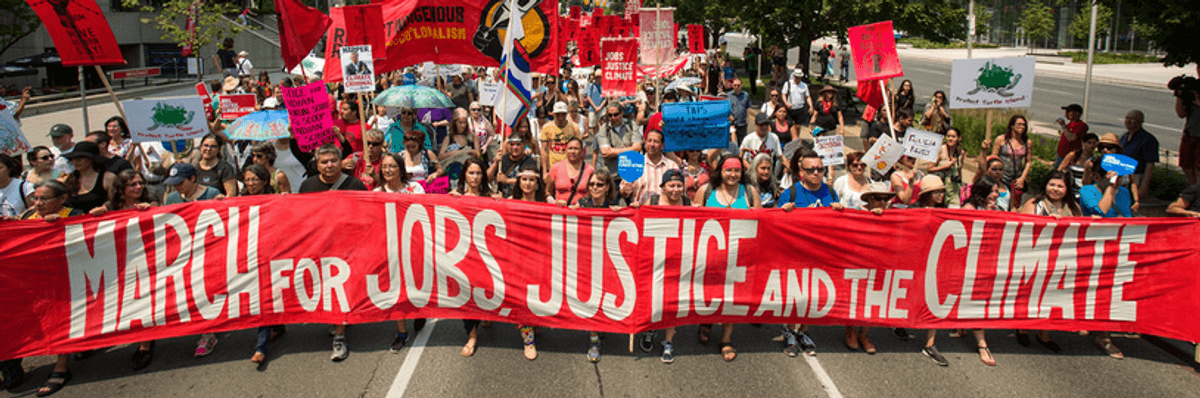
"We can connect the fight for a safe climate with the struggle of workers," writes Arte, "by embracing the cause of climate justice." (Photo: Robert van Waarden/Survival Media)
Everyone gets a day off for Labour Day, right?
Wrong.
There's no doubt the labour movement in North America has made countless strides and gains over the last century, from the weekend to the eight hour work day, to paid maternity leave and increases to minimum wage. But there are still too many workers left behind.
"We cannot wait for governments to take action: everyday people like us can be part of building the solution."
Care workers, service workers, precarious workers, migrant workers, homeless workers, undocumented workers, Indigenous workers, young workers, sex workers, racialized workers, disabled workers, queer and trans workers and many other workers on the margins of our society don't even have the luxury of stable employment or an organized workplace, much less a guaranteed day off on Labour Day.
This reality isn't news if your life looks anything like mine did growing up. As a young Black child from a Muslim and refugee household in Canada, I witnessed my mother working every single day of my entire life to feed, clothe and house me and my four siblings. Be it weekends, evenings or holidays, I never saw her take a single day off.
25 years later, gratitude cannot even begin to describe my feelings for my mother's tireless efforts to keep us alive. Today, I am the first person in my family to have graduated from university. I now have a full-time job with the privilege of a paid day off this Labour Day, and a chance to reflect on the state of workers on our changing planet.
I'll be honest - I'm worried.
I'm worried because our climate is changing and we have political leaders who either deny the reality of this crisis or are in denial about how much we really need to do to respond. All the while, our economy and our workplaces are headed for a massive transition that will impact the livelihoods of marginalized communities the hardest.
I'm worried because we are still not seriously planning for this transition. And we are quickly losing time.
This Labour day, we have an opportunity to frame our celebrations in a different way.
We can claim, boldy, loudly and proudly, that a workers rights celebration cannot leave any of our communities behind.
We can connect the fight for a safe climate with the struggle of workers by embracing the cause of climate justice.
We can recognize the leadership of communities that may be at the margins of our society but have been on the front lines of climate justice work for generations.
Naomi Klein put it best when she said recently, "Now is exactly the time to talk about climate change, and all the other systemic injustices -- from racial profiling to economic austerity -- that turn disasters like Harvey into human catastrophes."
We cannot wait for governments to take action: everyday people like us can be part of building the solution. Through grassroots organizing and pooling of resources, a people-powered movement can build a world that cares for all of us and all of the work that we do. This is the vision put forth by many organizations, including where I work at The Leap.
From Alberta, to Nebraska, to Thunder Bay and Los Angeles, communities across North America are powering a vision for climate justice. A vision of a world in which we care for the earth and one another. A world where we get serious about fighting the climate crisis and plan for a just transition that creates huge numbers of good jobs.
I feel both the pride and the weight of my achievements in my family. And I work to honour the tireless labour of love from my mother on this day, by working towards an economy that includes her, and countless others like her in our workforce.
Are you ready to be part of a just transition?
Dear Common Dreams reader, It’s been nearly 30 years since I co-founded Common Dreams with my late wife, Lina Newhouser. We had the radical notion that journalism should serve the public good, not corporate profits. It was clear to us from the outset what it would take to build such a project. No paid advertisements. No corporate sponsors. No millionaire publisher telling us what to think or do. Many people said we wouldn't last a year, but we proved those doubters wrong. Together with a tremendous team of journalists and dedicated staff, we built an independent media outlet free from the constraints of profits and corporate control. Our mission has always been simple: To inform. To inspire. To ignite change for the common good. Building Common Dreams was not easy. Our survival was never guaranteed. When you take on the most powerful forces—Wall Street greed, fossil fuel industry destruction, Big Tech lobbyists, and uber-rich oligarchs who have spent billions upon billions rigging the economy and democracy in their favor—the only bulwark you have is supporters who believe in your work. But here’s the urgent message from me today. It's never been this bad out there. And it's never been this hard to keep us going. At the very moment Common Dreams is most needed, the threats we face are intensifying. We need your support now more than ever. We don't accept corporate advertising and never will. We don't have a paywall because we don't think people should be blocked from critical news based on their ability to pay. Everything we do is funded by the donations of readers like you. When everyone does the little they can afford, we are strong. But if that support retreats or dries up, so do we. Will you donate now to make sure Common Dreams not only survives but thrives? —Craig Brown, Co-founder |
Everyone gets a day off for Labour Day, right?
Wrong.
There's no doubt the labour movement in North America has made countless strides and gains over the last century, from the weekend to the eight hour work day, to paid maternity leave and increases to minimum wage. But there are still too many workers left behind.
"We cannot wait for governments to take action: everyday people like us can be part of building the solution."
Care workers, service workers, precarious workers, migrant workers, homeless workers, undocumented workers, Indigenous workers, young workers, sex workers, racialized workers, disabled workers, queer and trans workers and many other workers on the margins of our society don't even have the luxury of stable employment or an organized workplace, much less a guaranteed day off on Labour Day.
This reality isn't news if your life looks anything like mine did growing up. As a young Black child from a Muslim and refugee household in Canada, I witnessed my mother working every single day of my entire life to feed, clothe and house me and my four siblings. Be it weekends, evenings or holidays, I never saw her take a single day off.
25 years later, gratitude cannot even begin to describe my feelings for my mother's tireless efforts to keep us alive. Today, I am the first person in my family to have graduated from university. I now have a full-time job with the privilege of a paid day off this Labour Day, and a chance to reflect on the state of workers on our changing planet.
I'll be honest - I'm worried.
I'm worried because our climate is changing and we have political leaders who either deny the reality of this crisis or are in denial about how much we really need to do to respond. All the while, our economy and our workplaces are headed for a massive transition that will impact the livelihoods of marginalized communities the hardest.
I'm worried because we are still not seriously planning for this transition. And we are quickly losing time.
This Labour day, we have an opportunity to frame our celebrations in a different way.
We can claim, boldy, loudly and proudly, that a workers rights celebration cannot leave any of our communities behind.
We can connect the fight for a safe climate with the struggle of workers by embracing the cause of climate justice.
We can recognize the leadership of communities that may be at the margins of our society but have been on the front lines of climate justice work for generations.
Naomi Klein put it best when she said recently, "Now is exactly the time to talk about climate change, and all the other systemic injustices -- from racial profiling to economic austerity -- that turn disasters like Harvey into human catastrophes."
We cannot wait for governments to take action: everyday people like us can be part of building the solution. Through grassroots organizing and pooling of resources, a people-powered movement can build a world that cares for all of us and all of the work that we do. This is the vision put forth by many organizations, including where I work at The Leap.
From Alberta, to Nebraska, to Thunder Bay and Los Angeles, communities across North America are powering a vision for climate justice. A vision of a world in which we care for the earth and one another. A world where we get serious about fighting the climate crisis and plan for a just transition that creates huge numbers of good jobs.
I feel both the pride and the weight of my achievements in my family. And I work to honour the tireless labour of love from my mother on this day, by working towards an economy that includes her, and countless others like her in our workforce.
Are you ready to be part of a just transition?
Everyone gets a day off for Labour Day, right?
Wrong.
There's no doubt the labour movement in North America has made countless strides and gains over the last century, from the weekend to the eight hour work day, to paid maternity leave and increases to minimum wage. But there are still too many workers left behind.
"We cannot wait for governments to take action: everyday people like us can be part of building the solution."
Care workers, service workers, precarious workers, migrant workers, homeless workers, undocumented workers, Indigenous workers, young workers, sex workers, racialized workers, disabled workers, queer and trans workers and many other workers on the margins of our society don't even have the luxury of stable employment or an organized workplace, much less a guaranteed day off on Labour Day.
This reality isn't news if your life looks anything like mine did growing up. As a young Black child from a Muslim and refugee household in Canada, I witnessed my mother working every single day of my entire life to feed, clothe and house me and my four siblings. Be it weekends, evenings or holidays, I never saw her take a single day off.
25 years later, gratitude cannot even begin to describe my feelings for my mother's tireless efforts to keep us alive. Today, I am the first person in my family to have graduated from university. I now have a full-time job with the privilege of a paid day off this Labour Day, and a chance to reflect on the state of workers on our changing planet.
I'll be honest - I'm worried.
I'm worried because our climate is changing and we have political leaders who either deny the reality of this crisis or are in denial about how much we really need to do to respond. All the while, our economy and our workplaces are headed for a massive transition that will impact the livelihoods of marginalized communities the hardest.
I'm worried because we are still not seriously planning for this transition. And we are quickly losing time.
This Labour day, we have an opportunity to frame our celebrations in a different way.
We can claim, boldy, loudly and proudly, that a workers rights celebration cannot leave any of our communities behind.
We can connect the fight for a safe climate with the struggle of workers by embracing the cause of climate justice.
We can recognize the leadership of communities that may be at the margins of our society but have been on the front lines of climate justice work for generations.
Naomi Klein put it best when she said recently, "Now is exactly the time to talk about climate change, and all the other systemic injustices -- from racial profiling to economic austerity -- that turn disasters like Harvey into human catastrophes."
We cannot wait for governments to take action: everyday people like us can be part of building the solution. Through grassroots organizing and pooling of resources, a people-powered movement can build a world that cares for all of us and all of the work that we do. This is the vision put forth by many organizations, including where I work at The Leap.
From Alberta, to Nebraska, to Thunder Bay and Los Angeles, communities across North America are powering a vision for climate justice. A vision of a world in which we care for the earth and one another. A world where we get serious about fighting the climate crisis and plan for a just transition that creates huge numbers of good jobs.
I feel both the pride and the weight of my achievements in my family. And I work to honour the tireless labour of love from my mother on this day, by working towards an economy that includes her, and countless others like her in our workforce.
Are you ready to be part of a just transition?