SUBSCRIBE TO OUR FREE NEWSLETTER
Daily news & progressive opinion—funded by the people, not the corporations—delivered straight to your inbox.
5
#000000
#FFFFFF
To donate by check, phone, or other method, see our More Ways to Give page.
Daily news & progressive opinion—funded by the people, not the corporations—delivered straight to your inbox.
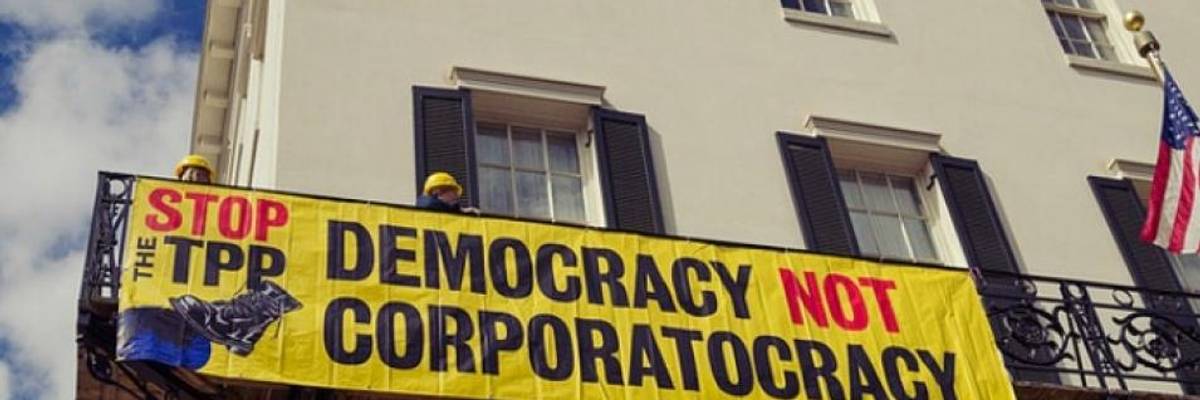
"Although EFF has been keeping an open mind about the agreement until we have a better idea of what it will contain, the secrecy of its first negotiation round augurs poorly for what is to come," Malcolm writes. (Photo: cool revolution/Flickr/cc)
The opening round of a series of negotiations over a proposed revised North American Free Trade Agreement (NAFTA) began this week in Washington, D.C. between trade representatives from the United States, Canada, and Mexico.
The opening round of a series of negotiations over a proposed revised North American Free Trade Agreement (NAFTA) began this week in Washington, D.C. between trade representatives from the United States, Canada, and Mexico.
Already it is clear that the office of the U.S. Trade Representative (USTR) has ignored our specific recommendations (to say nothing of USTR Robert Lighthizer's personal promises) about making the negotiations more open and transparent. Once again, following the failed model of the Trans-Pacific Partnership (TPP), the USTR will be keeping the negotiating texts secret, and in an actual regression from the TPP will be holding no public stakeholder events alongside the first round. This may or may not set a precedent for future rounds, that will rotate between the three countries every few weeks thereafter, with a scheduled end date of mid-2018.
Although EFF has been keeping an open mind about the agreement until we have a better idea of what it will contain, the secrecy of its first negotiation round augurs poorly for what is to come. Already, the usual copyright lobbyists have descended upon the negotiations, sending a letter to the USTR this week which directly opposes the inclusion of a "fair use" copyright exception in the agreement, as EFF had suggested. This "creative industry" letterrelevantly states:
The three-step test strikes the appropriate balance in copyright, and any language mandating broader exceptions and limitations only serves as a vehicle to introduce uncertainty into copyright law, distort markets and weaken the rights of the small and medium businesses and creators we represent. For that reason, we strongly urge USTR to not include "balance" language similar to what appeared in the TPP or any reference to vague, open-ended limitations.
But more than two dozen public interest groups, including EFF, Creative Commons, Public Knowledge, Public Citizen, and OpenMedia, have written a letter of our own, in which we counter this argument and raise some of our own key concerns. Aside from the fact that we have been shamefully shut out of the negotiations, without any opportunity to see the texts that are being negotiated on our behalf, our letter also warns against the inclusion of one-sided copyright and digital trade provisions in NAFTA, such as those that had previously been part of the failed TPP:
We also share concerns about the suitability of trade mechanisms to create prescriptive policies that govern Internet use, cultural sharing and innovation. In general, developments in technology happen quickly, and trade processes that do not keep pace with technological and social advancement may inhibit each of our respective governments from making necessary and appropriate changes to related rules, especially with regard to intellectual property regulations that impact our rights to culture and free expression.
The letter was delivered to the trade ministries of the three countries on Friday. You can read it in full below.
Joint letter on Transparency, Digital Rights, and NAFTA (pdf)
Dear Common Dreams reader, It’s been nearly 30 years since I co-founded Common Dreams with my late wife, Lina Newhouser. We had the radical notion that journalism should serve the public good, not corporate profits. It was clear to us from the outset what it would take to build such a project. No paid advertisements. No corporate sponsors. No millionaire publisher telling us what to think or do. Many people said we wouldn't last a year, but we proved those doubters wrong. Together with a tremendous team of journalists and dedicated staff, we built an independent media outlet free from the constraints of profits and corporate control. Our mission has always been simple: To inform. To inspire. To ignite change for the common good. Building Common Dreams was not easy. Our survival was never guaranteed. When you take on the most powerful forces—Wall Street greed, fossil fuel industry destruction, Big Tech lobbyists, and uber-rich oligarchs who have spent billions upon billions rigging the economy and democracy in their favor—the only bulwark you have is supporters who believe in your work. But here’s the urgent message from me today. It's never been this bad out there. And it's never been this hard to keep us going. At the very moment Common Dreams is most needed, the threats we face are intensifying. We need your support now more than ever. We don't accept corporate advertising and never will. We don't have a paywall because we don't think people should be blocked from critical news based on their ability to pay. Everything we do is funded by the donations of readers like you. When everyone does the little they can afford, we are strong. But if that support retreats or dries up, so do we. Will you donate now to make sure Common Dreams not only survives but thrives? —Craig Brown, Co-founder |
The opening round of a series of negotiations over a proposed revised North American Free Trade Agreement (NAFTA) began this week in Washington, D.C. between trade representatives from the United States, Canada, and Mexico.
Already it is clear that the office of the U.S. Trade Representative (USTR) has ignored our specific recommendations (to say nothing of USTR Robert Lighthizer's personal promises) about making the negotiations more open and transparent. Once again, following the failed model of the Trans-Pacific Partnership (TPP), the USTR will be keeping the negotiating texts secret, and in an actual regression from the TPP will be holding no public stakeholder events alongside the first round. This may or may not set a precedent for future rounds, that will rotate between the three countries every few weeks thereafter, with a scheduled end date of mid-2018.
Although EFF has been keeping an open mind about the agreement until we have a better idea of what it will contain, the secrecy of its first negotiation round augurs poorly for what is to come. Already, the usual copyright lobbyists have descended upon the negotiations, sending a letter to the USTR this week which directly opposes the inclusion of a "fair use" copyright exception in the agreement, as EFF had suggested. This "creative industry" letterrelevantly states:
The three-step test strikes the appropriate balance in copyright, and any language mandating broader exceptions and limitations only serves as a vehicle to introduce uncertainty into copyright law, distort markets and weaken the rights of the small and medium businesses and creators we represent. For that reason, we strongly urge USTR to not include "balance" language similar to what appeared in the TPP or any reference to vague, open-ended limitations.
But more than two dozen public interest groups, including EFF, Creative Commons, Public Knowledge, Public Citizen, and OpenMedia, have written a letter of our own, in which we counter this argument and raise some of our own key concerns. Aside from the fact that we have been shamefully shut out of the negotiations, without any opportunity to see the texts that are being negotiated on our behalf, our letter also warns against the inclusion of one-sided copyright and digital trade provisions in NAFTA, such as those that had previously been part of the failed TPP:
We also share concerns about the suitability of trade mechanisms to create prescriptive policies that govern Internet use, cultural sharing and innovation. In general, developments in technology happen quickly, and trade processes that do not keep pace with technological and social advancement may inhibit each of our respective governments from making necessary and appropriate changes to related rules, especially with regard to intellectual property regulations that impact our rights to culture and free expression.
The letter was delivered to the trade ministries of the three countries on Friday. You can read it in full below.
Joint letter on Transparency, Digital Rights, and NAFTA (pdf)
The opening round of a series of negotiations over a proposed revised North American Free Trade Agreement (NAFTA) began this week in Washington, D.C. between trade representatives from the United States, Canada, and Mexico.
Already it is clear that the office of the U.S. Trade Representative (USTR) has ignored our specific recommendations (to say nothing of USTR Robert Lighthizer's personal promises) about making the negotiations more open and transparent. Once again, following the failed model of the Trans-Pacific Partnership (TPP), the USTR will be keeping the negotiating texts secret, and in an actual regression from the TPP will be holding no public stakeholder events alongside the first round. This may or may not set a precedent for future rounds, that will rotate between the three countries every few weeks thereafter, with a scheduled end date of mid-2018.
Although EFF has been keeping an open mind about the agreement until we have a better idea of what it will contain, the secrecy of its first negotiation round augurs poorly for what is to come. Already, the usual copyright lobbyists have descended upon the negotiations, sending a letter to the USTR this week which directly opposes the inclusion of a "fair use" copyright exception in the agreement, as EFF had suggested. This "creative industry" letterrelevantly states:
The three-step test strikes the appropriate balance in copyright, and any language mandating broader exceptions and limitations only serves as a vehicle to introduce uncertainty into copyright law, distort markets and weaken the rights of the small and medium businesses and creators we represent. For that reason, we strongly urge USTR to not include "balance" language similar to what appeared in the TPP or any reference to vague, open-ended limitations.
But more than two dozen public interest groups, including EFF, Creative Commons, Public Knowledge, Public Citizen, and OpenMedia, have written a letter of our own, in which we counter this argument and raise some of our own key concerns. Aside from the fact that we have been shamefully shut out of the negotiations, without any opportunity to see the texts that are being negotiated on our behalf, our letter also warns against the inclusion of one-sided copyright and digital trade provisions in NAFTA, such as those that had previously been part of the failed TPP:
We also share concerns about the suitability of trade mechanisms to create prescriptive policies that govern Internet use, cultural sharing and innovation. In general, developments in technology happen quickly, and trade processes that do not keep pace with technological and social advancement may inhibit each of our respective governments from making necessary and appropriate changes to related rules, especially with regard to intellectual property regulations that impact our rights to culture and free expression.
The letter was delivered to the trade ministries of the three countries on Friday. You can read it in full below.
Joint letter on Transparency, Digital Rights, and NAFTA (pdf)