SUBSCRIBE TO OUR FREE NEWSLETTER
Daily news & progressive opinion—funded by the people, not the corporations—delivered straight to your inbox.
5
#000000
#FFFFFF
To donate by check, phone, or other method, see our More Ways to Give page.
Daily news & progressive opinion—funded by the people, not the corporations—delivered straight to your inbox.

Trumpcare's basic purpose is to "give millionaires and billionaires a massive new tax cut by slashing health benefits for millions of Americans, and take care away altogether from millions more," writes Richard Eskow.(Photo/Reuters)
The Republican Senate's draft health bill differs from the House version, but its basic purpose is the same: give millionaires and billionaires a massive new tax cut by slashing health benefits for millions of Americans, and take care away altogether from millions more.
"The Republicans want to give us less and make us think it's more. It's time to tell them we've had enough."
People will die if this bill becomes law, but that doesn't seem to trouble the Republicans' conscience. The only thing they seem to fear is losing their jobs. That's why this bill was written in unprecedented secrecy. That's why it, like the House version, obfuscates and misdirects to conceal its true goals.
Once, as a young health financing consultant, I met with the CEO of one of Wall Street's most powerful firms. He had a reputation for both brilliance and meanness, and he was proposing some complicated changes to his company's health plan. His own staff seemed reluctant to question him, so I asked him instead: "What are you trying to accomplish?"
"It's my employees," he answered. "I want to give them less and make them think it's more."
Give them less and make them think it's more. That's the Republican Party's goal with "Trumpcare."
Why? They're doing it to provide enormous tax breaks to the wealthiest among us, after we have already achieved levels of inequality not seen since the Roaring Twenties or the Gilded Age of the Nineteenth Century.
We did the math when the House bill came out: Ten Americans would die each year, according to the best available data, to give each of the 400 richest households in America a new tax cut. An estimated 43,000 people would die each year under the House plan, and there's no reason to believe the Senate bill would be any better.
Here are some more details:
It's going to be hell to get older if this bill passes. People who are nearing or past 60, but are not yet eligible for Medicare, will be forced to pay as much as 16.2 percent of their income on premiums. Worse, that would only cover a high deductible plan that could render routine medical care unaffordable--and at a time of life when people should be preparing for retirement.
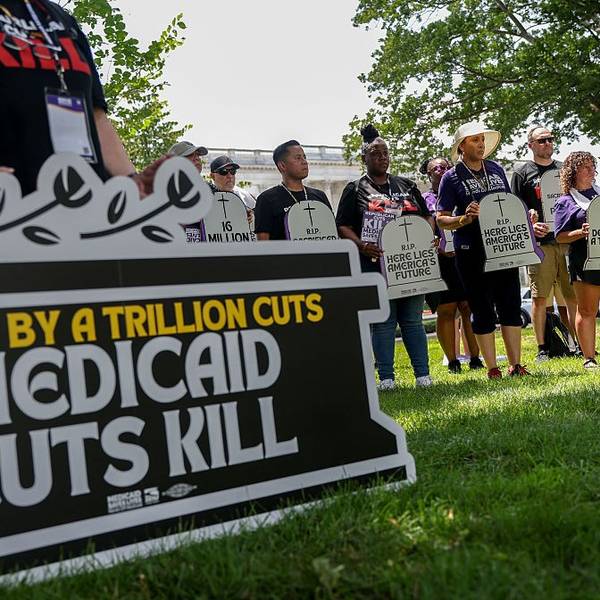
The Senate bill imposes even harsher cuts to Medicaid than the House version does. Both bills limit the Medicaid budget's ability to keep pace with inflation without doing anything to control healthcare costs. While the Congressional Budget Office has not yet analyzed the Senate bill, it found that the House bill would deprive 14 million people of coverage over a 10-year period. The Senate bill is even more draconian, meaning that even more will lose coverage if it becomes law.
"There's nothing in either the House or Senate bills that would control runaway drug costs or challenge Big Pharma's greed and patent monopolies."
The Senate bill, like its House equivalent, guts the Affordable Care Act's "essential benefits" provision. That means insurance companies could charge you for coverage, but could arbitrarily decide not to cover vital and life-saving treatments - something you might not know until it was too late.
It does keep one piece of the ACA. Unfortunately, it's that law's worst provision: The so-called "Cadillac tax" provision lays an additional tax burden on employer health plans with higher-than-expected costs, even if the plan provides substantially less coverage than citizens receive in other developed countries through their government's healthcare program.
The omissions are still there: There's nothing in either the House or Senate bills that would control runaway drug costs or challenge Big Pharma's greed and patent monopolies. There is no expansion of Medicare coverage to under-65 Americans, even though Medicare is much more cost-effective than private health insurance.
NPR has drawn up a useful chart that compares the House and Senate Republican bills with each other and the ACA. The New York Times also compared the bills, concluding that the Senate draft is somewhat less terrible in some ways and somewhat more terrible in others.
Bottom line: They're both disastrous.
The Democrats can't stop the Republicans from gutting Obamacare, because they don't have the votes. Will Republicans of good conscience block the bill? Right now, four GOP Senators have publicly withheld their support for the bill. But they're objecting to it from the right, presumably because it's not terrible enough. Ted Cruz and his friends won't be riding to the rescue anytime soon.
If the Democrats can't help, and the Republicans won't, that leaves the rest of us. The one thing every politician understands is an angry electorate. Senators need to hear about this bill. They can be reached at 202-224-3121--or through visits, calls, and demonstrations at their offices.
The Republicans want to give us less and make us think it's more. It's time to tell them we've had enough.
Dear Common Dreams reader, It’s been nearly 30 years since I co-founded Common Dreams with my late wife, Lina Newhouser. We had the radical notion that journalism should serve the public good, not corporate profits. It was clear to us from the outset what it would take to build such a project. No paid advertisements. No corporate sponsors. No millionaire publisher telling us what to think or do. Many people said we wouldn't last a year, but we proved those doubters wrong. Together with a tremendous team of journalists and dedicated staff, we built an independent media outlet free from the constraints of profits and corporate control. Our mission has always been simple: To inform. To inspire. To ignite change for the common good. Building Common Dreams was not easy. Our survival was never guaranteed. When you take on the most powerful forces—Wall Street greed, fossil fuel industry destruction, Big Tech lobbyists, and uber-rich oligarchs who have spent billions upon billions rigging the economy and democracy in their favor—the only bulwark you have is supporters who believe in your work. But here’s the urgent message from me today. It's never been this bad out there. And it's never been this hard to keep us going. At the very moment Common Dreams is most needed, the threats we face are intensifying. We need your support now more than ever. We don't accept corporate advertising and never will. We don't have a paywall because we don't think people should be blocked from critical news based on their ability to pay. Everything we do is funded by the donations of readers like you. When everyone does the little they can afford, we are strong. But if that support retreats or dries up, so do we. Will you donate now to make sure Common Dreams not only survives but thrives? —Craig Brown, Co-founder |
Richard (RJ) Eskow is a journalist who has written for a number of major publications. His weekly program, The Zero Hour, can be found on cable television, radio, Spotify, and podcast media.
The Republican Senate's draft health bill differs from the House version, but its basic purpose is the same: give millionaires and billionaires a massive new tax cut by slashing health benefits for millions of Americans, and take care away altogether from millions more.
"The Republicans want to give us less and make us think it's more. It's time to tell them we've had enough."
People will die if this bill becomes law, but that doesn't seem to trouble the Republicans' conscience. The only thing they seem to fear is losing their jobs. That's why this bill was written in unprecedented secrecy. That's why it, like the House version, obfuscates and misdirects to conceal its true goals.
Once, as a young health financing consultant, I met with the CEO of one of Wall Street's most powerful firms. He had a reputation for both brilliance and meanness, and he was proposing some complicated changes to his company's health plan. His own staff seemed reluctant to question him, so I asked him instead: "What are you trying to accomplish?"
"It's my employees," he answered. "I want to give them less and make them think it's more."
Give them less and make them think it's more. That's the Republican Party's goal with "Trumpcare."
Why? They're doing it to provide enormous tax breaks to the wealthiest among us, after we have already achieved levels of inequality not seen since the Roaring Twenties or the Gilded Age of the Nineteenth Century.
We did the math when the House bill came out: Ten Americans would die each year, according to the best available data, to give each of the 400 richest households in America a new tax cut. An estimated 43,000 people would die each year under the House plan, and there's no reason to believe the Senate bill would be any better.
Here are some more details:
It's going to be hell to get older if this bill passes. People who are nearing or past 60, but are not yet eligible for Medicare, will be forced to pay as much as 16.2 percent of their income on premiums. Worse, that would only cover a high deductible plan that could render routine medical care unaffordable--and at a time of life when people should be preparing for retirement.
The Senate bill imposes even harsher cuts to Medicaid than the House version does. Both bills limit the Medicaid budget's ability to keep pace with inflation without doing anything to control healthcare costs. While the Congressional Budget Office has not yet analyzed the Senate bill, it found that the House bill would deprive 14 million people of coverage over a 10-year period. The Senate bill is even more draconian, meaning that even more will lose coverage if it becomes law.
"There's nothing in either the House or Senate bills that would control runaway drug costs or challenge Big Pharma's greed and patent monopolies."
The Senate bill, like its House equivalent, guts the Affordable Care Act's "essential benefits" provision. That means insurance companies could charge you for coverage, but could arbitrarily decide not to cover vital and life-saving treatments - something you might not know until it was too late.
It does keep one piece of the ACA. Unfortunately, it's that law's worst provision: The so-called "Cadillac tax" provision lays an additional tax burden on employer health plans with higher-than-expected costs, even if the plan provides substantially less coverage than citizens receive in other developed countries through their government's healthcare program.
The omissions are still there: There's nothing in either the House or Senate bills that would control runaway drug costs or challenge Big Pharma's greed and patent monopolies. There is no expansion of Medicare coverage to under-65 Americans, even though Medicare is much more cost-effective than private health insurance.
NPR has drawn up a useful chart that compares the House and Senate Republican bills with each other and the ACA. The New York Times also compared the bills, concluding that the Senate draft is somewhat less terrible in some ways and somewhat more terrible in others.
Bottom line: They're both disastrous.
The Democrats can't stop the Republicans from gutting Obamacare, because they don't have the votes. Will Republicans of good conscience block the bill? Right now, four GOP Senators have publicly withheld their support for the bill. But they're objecting to it from the right, presumably because it's not terrible enough. Ted Cruz and his friends won't be riding to the rescue anytime soon.
If the Democrats can't help, and the Republicans won't, that leaves the rest of us. The one thing every politician understands is an angry electorate. Senators need to hear about this bill. They can be reached at 202-224-3121--or through visits, calls, and demonstrations at their offices.
The Republicans want to give us less and make us think it's more. It's time to tell them we've had enough.
Richard (RJ) Eskow is a journalist who has written for a number of major publications. His weekly program, The Zero Hour, can be found on cable television, radio, Spotify, and podcast media.
The Republican Senate's draft health bill differs from the House version, but its basic purpose is the same: give millionaires and billionaires a massive new tax cut by slashing health benefits for millions of Americans, and take care away altogether from millions more.
"The Republicans want to give us less and make us think it's more. It's time to tell them we've had enough."
People will die if this bill becomes law, but that doesn't seem to trouble the Republicans' conscience. The only thing they seem to fear is losing their jobs. That's why this bill was written in unprecedented secrecy. That's why it, like the House version, obfuscates and misdirects to conceal its true goals.
Once, as a young health financing consultant, I met with the CEO of one of Wall Street's most powerful firms. He had a reputation for both brilliance and meanness, and he was proposing some complicated changes to his company's health plan. His own staff seemed reluctant to question him, so I asked him instead: "What are you trying to accomplish?"
"It's my employees," he answered. "I want to give them less and make them think it's more."
Give them less and make them think it's more. That's the Republican Party's goal with "Trumpcare."
Why? They're doing it to provide enormous tax breaks to the wealthiest among us, after we have already achieved levels of inequality not seen since the Roaring Twenties or the Gilded Age of the Nineteenth Century.
We did the math when the House bill came out: Ten Americans would die each year, according to the best available data, to give each of the 400 richest households in America a new tax cut. An estimated 43,000 people would die each year under the House plan, and there's no reason to believe the Senate bill would be any better.
Here are some more details:
It's going to be hell to get older if this bill passes. People who are nearing or past 60, but are not yet eligible for Medicare, will be forced to pay as much as 16.2 percent of their income on premiums. Worse, that would only cover a high deductible plan that could render routine medical care unaffordable--and at a time of life when people should be preparing for retirement.
The Senate bill imposes even harsher cuts to Medicaid than the House version does. Both bills limit the Medicaid budget's ability to keep pace with inflation without doing anything to control healthcare costs. While the Congressional Budget Office has not yet analyzed the Senate bill, it found that the House bill would deprive 14 million people of coverage over a 10-year period. The Senate bill is even more draconian, meaning that even more will lose coverage if it becomes law.
"There's nothing in either the House or Senate bills that would control runaway drug costs or challenge Big Pharma's greed and patent monopolies."
The Senate bill, like its House equivalent, guts the Affordable Care Act's "essential benefits" provision. That means insurance companies could charge you for coverage, but could arbitrarily decide not to cover vital and life-saving treatments - something you might not know until it was too late.
It does keep one piece of the ACA. Unfortunately, it's that law's worst provision: The so-called "Cadillac tax" provision lays an additional tax burden on employer health plans with higher-than-expected costs, even if the plan provides substantially less coverage than citizens receive in other developed countries through their government's healthcare program.
The omissions are still there: There's nothing in either the House or Senate bills that would control runaway drug costs or challenge Big Pharma's greed and patent monopolies. There is no expansion of Medicare coverage to under-65 Americans, even though Medicare is much more cost-effective than private health insurance.
NPR has drawn up a useful chart that compares the House and Senate Republican bills with each other and the ACA. The New York Times also compared the bills, concluding that the Senate draft is somewhat less terrible in some ways and somewhat more terrible in others.
Bottom line: They're both disastrous.
The Democrats can't stop the Republicans from gutting Obamacare, because they don't have the votes. Will Republicans of good conscience block the bill? Right now, four GOP Senators have publicly withheld their support for the bill. But they're objecting to it from the right, presumably because it's not terrible enough. Ted Cruz and his friends won't be riding to the rescue anytime soon.
If the Democrats can't help, and the Republicans won't, that leaves the rest of us. The one thing every politician understands is an angry electorate. Senators need to hear about this bill. They can be reached at 202-224-3121--or through visits, calls, and demonstrations at their offices.
The Republicans want to give us less and make us think it's more. It's time to tell them we've had enough.