SUBSCRIBE TO OUR FREE NEWSLETTER
Daily news & progressive opinion—funded by the people, not the corporations—delivered straight to your inbox.
5
#000000
#FFFFFF
To donate by check, phone, or other method, see our More Ways to Give page.
I read hundreds of bylined works of journalism a week. Every so often one of them forces me to go back and read it over and over...
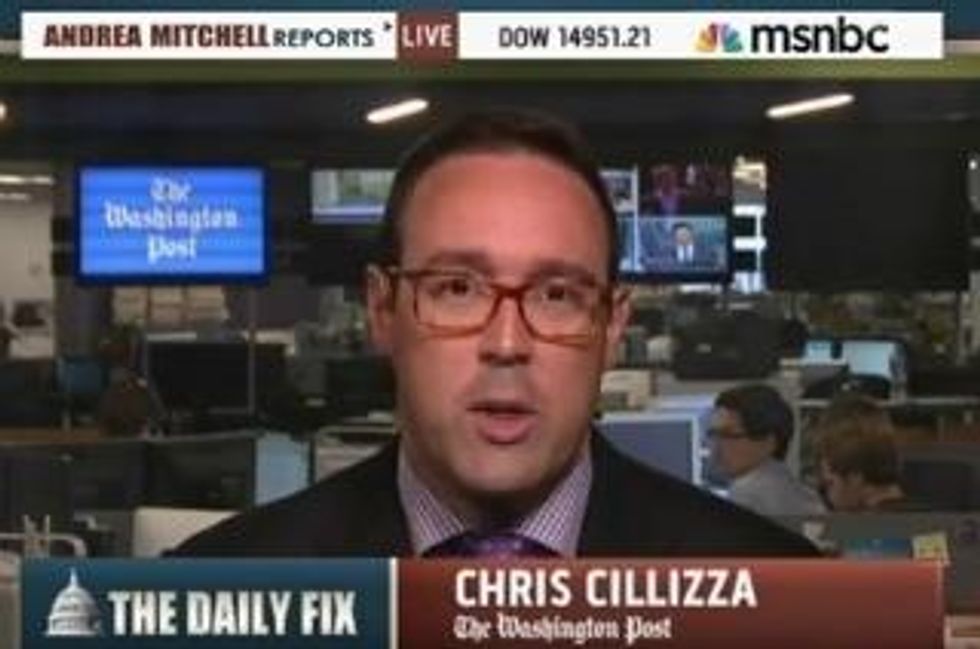
This is usually because the writing contains within it a density of pressthink -- my subject here -- that cannot be gotten through in one or two tries. It happened this week with a post by Chris Cillizza, one of the Washington Post's franchise players on the national politics beat: Why the CBO report is (still) bad news for Democrats.
Ordinarily I would summarize what Cillizza was writing about, quote from his piece, and try to isolate what's screwy or revealing about it. But Dave Wiegel did that at Slate already. And I did it for a very similar piece published on Cillizza's site in 2012. See my post: Everything That's Wrong with Political Journalism in One Washington Post Item.
Instead, I have written a short reader's guide to Cillizza's post. Your instructions are to absorb the guide, then click the link at the end and re-read what @TheFix wrote. Got it? Alright then...
Nobody knows exactly when it happened. But at some point between Teddy White's The Making of the President, 1960 and the Willie Horton ads in 1988, political journalism in this country lost the plot. When it got overly interested in the inside game, it turned you and me and everyone who has to go into the voting booth and make a decision into an object of technique, which it then tried to assess. We became the people on whom the masters of politics practiced their craft. Then political journalism tried to recover an audience from the people it had turned into poll numbers and respondents to packaged stimuli. Tricky maneuver.
This is what led to the cult of the savvy, my term for the ideology and political style that journalists like Chris Cillizza and Mark Halperin spread through their work. The savvy severs any lingering solidarity between journalists as the providers of information, and voters as decision-makers in need of it. The savvy sets up -- so it can speak to and cultivate -- a third group between these two: close followers of the game. The most common term for them is "political junkies." The site that Cillizza runs was created by that term. It's called The Fix because that's what political junkies need: their fix of inside-the-game news.
Junkies are not normal, but they accept their deformed status because it comes with compensations. They get to feel superior to ordinary voters, who are the objects of technique and of the savvy analyst's smart read on what is likely to work in the next election. For while the junkies can hope to understand the game and how it operates, the voters are merely operated on. Not only does the savvy sever any solidarity between political journalists and the public they were once supposed to inform, it also draws a portion of the attentive public into emotional alliance with the ad makers, poll takers, claim fakers and buck rakers within the political class-- the people who, as Max Weber put it in his famous essay "Politics as a Vocation," live off politics.
But we're not done. The savvy sets up a fifth group. (The first four: savvy journalists, political junkies, masters of the game, and an abstraction, The Voters.) These are the people who, as Weber put it, live for politics. They are involved as determined participants, not just occasional voters. Whereas the junkies can hope for admission to the secrets of the game (by taking cues from Chris Cillizza and Mark Halperin and the guys at Politico) the activists are hopelessly deluded, always placing their own ideology before the cold hard facts.
If you follow the Twitter feeds of Ron Fournier of National Journal and Chuck Todd of NBC News you routinely see a category they call "partisans" described as silly, insane, overheated, unreasonable, absurd. Click here for Fournier doing it and here for Todd. Somewhere in their dinosaur brains those who "live off" politics understand that the people who live for it could steal their constituency and turn the savvy into the absurd creatures. Thus the constant ridicule of partisans. Thus the self-description on Ron Fournier's Twitter bio. Political affiliation: Agnostic.
So this is what the savvy in the press do. Cultivate the political junkies. Dismiss and ridicule the activists, the "partisans." Assess the tactics by which the masters of the game struggle to win. Turn the voters into an object, the behavior of which is subject to a kind of law that savvy journalists feel entitled to write. Here's Cillizza, writing one:
Remember that most voters -- people who don't follow this stuff as closely as me, you or, likely, most people we know -- make their decisions based on 30-second TV ads."
I'll remember, Chris. Your assignment: Inhale that sentence, click this link and behold how badly our political journalists have lost the plot.
I read hundreds of bylined works of journalism a week. Every so often one of them forces me to go back and read it over and over...
This is usually because the writing contains within it a density of pressthink -- my subject here -- that cannot be gotten through in one or two tries. It happened this week with a post by Chris Cillizza, one of the Washington Post's franchise players on the national politics beat: Why the CBO report is (still) bad news for Democrats.
Ordinarily I would summarize what Cillizza was writing about, quote from his piece, and try to isolate what's screwy or revealing about it. But Dave Wiegel did that at Slate already. And I did it for a very similar piece published on Cillizza's site in 2012. See my post: Everything That's Wrong with Political Journalism in One Washington Post Item.
Instead, I have written a short reader's guide to Cillizza's post. Your instructions are to absorb the guide, then click the link at the end and re-read what @TheFix wrote. Got it? Alright then...
Nobody knows exactly when it happened. But at some point between Teddy White's The Making of the President, 1960 and the Willie Horton ads in 1988, political journalism in this country lost the plot. When it got overly interested in the inside game, it turned you and me and everyone who has to go into the voting booth and make a decision into an object of technique, which it then tried to assess. We became the people on whom the masters of politics practiced their craft. Then political journalism tried to recover an audience from the people it had turned into poll numbers and respondents to packaged stimuli. Tricky maneuver.
This is what led to the cult of the savvy, my term for the ideology and political style that journalists like Chris Cillizza and Mark Halperin spread through their work. The savvy severs any lingering solidarity between journalists as the providers of information, and voters as decision-makers in need of it. The savvy sets up -- so it can speak to and cultivate -- a third group between these two: close followers of the game. The most common term for them is "political junkies." The site that Cillizza runs was created by that term. It's called The Fix because that's what political junkies need: their fix of inside-the-game news.
Junkies are not normal, but they accept their deformed status because it comes with compensations. They get to feel superior to ordinary voters, who are the objects of technique and of the savvy analyst's smart read on what is likely to work in the next election. For while the junkies can hope to understand the game and how it operates, the voters are merely operated on. Not only does the savvy sever any solidarity between political journalists and the public they were once supposed to inform, it also draws a portion of the attentive public into emotional alliance with the ad makers, poll takers, claim fakers and buck rakers within the political class-- the people who, as Max Weber put it in his famous essay "Politics as a Vocation," live off politics.
But we're not done. The savvy sets up a fifth group. (The first four: savvy journalists, political junkies, masters of the game, and an abstraction, The Voters.) These are the people who, as Weber put it, live for politics. They are involved as determined participants, not just occasional voters. Whereas the junkies can hope for admission to the secrets of the game (by taking cues from Chris Cillizza and Mark Halperin and the guys at Politico) the activists are hopelessly deluded, always placing their own ideology before the cold hard facts.
If you follow the Twitter feeds of Ron Fournier of National Journal and Chuck Todd of NBC News you routinely see a category they call "partisans" described as silly, insane, overheated, unreasonable, absurd. Click here for Fournier doing it and here for Todd. Somewhere in their dinosaur brains those who "live off" politics understand that the people who live for it could steal their constituency and turn the savvy into the absurd creatures. Thus the constant ridicule of partisans. Thus the self-description on Ron Fournier's Twitter bio. Political affiliation: Agnostic.
So this is what the savvy in the press do. Cultivate the political junkies. Dismiss and ridicule the activists, the "partisans." Assess the tactics by which the masters of the game struggle to win. Turn the voters into an object, the behavior of which is subject to a kind of law that savvy journalists feel entitled to write. Here's Cillizza, writing one:
Remember that most voters -- people who don't follow this stuff as closely as me, you or, likely, most people we know -- make their decisions based on 30-second TV ads."
I'll remember, Chris. Your assignment: Inhale that sentence, click this link and behold how badly our political journalists have lost the plot.
I read hundreds of bylined works of journalism a week. Every so often one of them forces me to go back and read it over and over...
This is usually because the writing contains within it a density of pressthink -- my subject here -- that cannot be gotten through in one or two tries. It happened this week with a post by Chris Cillizza, one of the Washington Post's franchise players on the national politics beat: Why the CBO report is (still) bad news for Democrats.
Ordinarily I would summarize what Cillizza was writing about, quote from his piece, and try to isolate what's screwy or revealing about it. But Dave Wiegel did that at Slate already. And I did it for a very similar piece published on Cillizza's site in 2012. See my post: Everything That's Wrong with Political Journalism in One Washington Post Item.
Instead, I have written a short reader's guide to Cillizza's post. Your instructions are to absorb the guide, then click the link at the end and re-read what @TheFix wrote. Got it? Alright then...
Nobody knows exactly when it happened. But at some point between Teddy White's The Making of the President, 1960 and the Willie Horton ads in 1988, political journalism in this country lost the plot. When it got overly interested in the inside game, it turned you and me and everyone who has to go into the voting booth and make a decision into an object of technique, which it then tried to assess. We became the people on whom the masters of politics practiced their craft. Then political journalism tried to recover an audience from the people it had turned into poll numbers and respondents to packaged stimuli. Tricky maneuver.
This is what led to the cult of the savvy, my term for the ideology and political style that journalists like Chris Cillizza and Mark Halperin spread through their work. The savvy severs any lingering solidarity between journalists as the providers of information, and voters as decision-makers in need of it. The savvy sets up -- so it can speak to and cultivate -- a third group between these two: close followers of the game. The most common term for them is "political junkies." The site that Cillizza runs was created by that term. It's called The Fix because that's what political junkies need: their fix of inside-the-game news.
Junkies are not normal, but they accept their deformed status because it comes with compensations. They get to feel superior to ordinary voters, who are the objects of technique and of the savvy analyst's smart read on what is likely to work in the next election. For while the junkies can hope to understand the game and how it operates, the voters are merely operated on. Not only does the savvy sever any solidarity between political journalists and the public they were once supposed to inform, it also draws a portion of the attentive public into emotional alliance with the ad makers, poll takers, claim fakers and buck rakers within the political class-- the people who, as Max Weber put it in his famous essay "Politics as a Vocation," live off politics.
But we're not done. The savvy sets up a fifth group. (The first four: savvy journalists, political junkies, masters of the game, and an abstraction, The Voters.) These are the people who, as Weber put it, live for politics. They are involved as determined participants, not just occasional voters. Whereas the junkies can hope for admission to the secrets of the game (by taking cues from Chris Cillizza and Mark Halperin and the guys at Politico) the activists are hopelessly deluded, always placing their own ideology before the cold hard facts.
If you follow the Twitter feeds of Ron Fournier of National Journal and Chuck Todd of NBC News you routinely see a category they call "partisans" described as silly, insane, overheated, unreasonable, absurd. Click here for Fournier doing it and here for Todd. Somewhere in their dinosaur brains those who "live off" politics understand that the people who live for it could steal their constituency and turn the savvy into the absurd creatures. Thus the constant ridicule of partisans. Thus the self-description on Ron Fournier's Twitter bio. Political affiliation: Agnostic.
So this is what the savvy in the press do. Cultivate the political junkies. Dismiss and ridicule the activists, the "partisans." Assess the tactics by which the masters of the game struggle to win. Turn the voters into an object, the behavior of which is subject to a kind of law that savvy journalists feel entitled to write. Here's Cillizza, writing one:
Remember that most voters -- people who don't follow this stuff as closely as me, you or, likely, most people we know -- make their decisions based on 30-second TV ads."
I'll remember, Chris. Your assignment: Inhale that sentence, click this link and behold how badly our political journalists have lost the plot.