SUBSCRIBE TO OUR FREE NEWSLETTER
Daily news & progressive opinion—funded by the people, not the corporations—delivered straight to your inbox.
5
#000000
#FFFFFF
To donate by check, phone, or other method, see our More Ways to Give page.
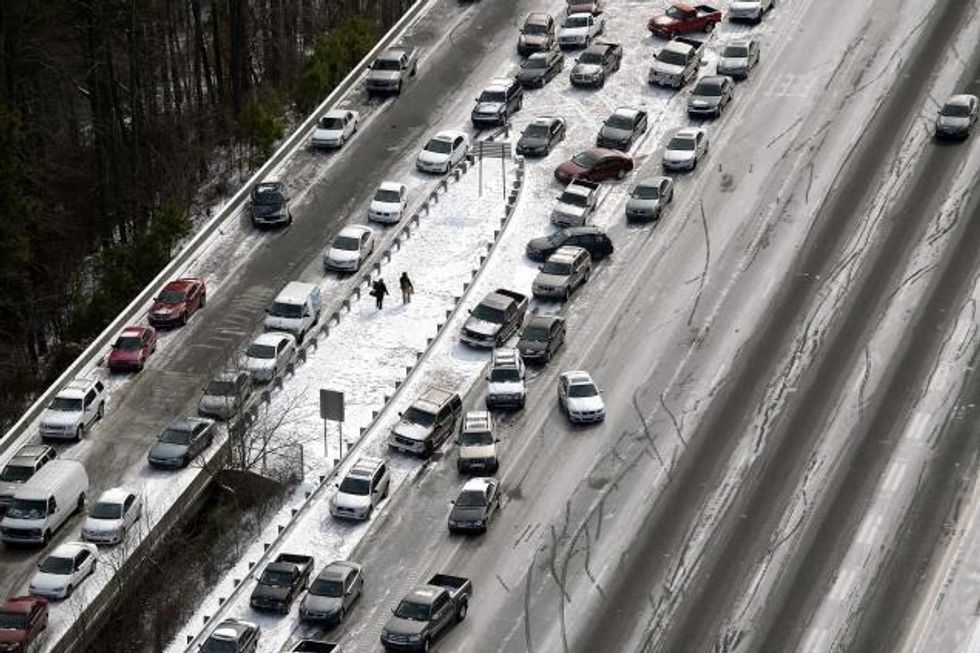
But there will be no better example of how the austerity mindset warps the understanding of what government can and should be doing than the explanations Georgia officials are peddling for their failure to respond in a rational manner to warnings that their state was about to experience a winter storm. Instead of taking reasonable precautions such as closing schools, preparing major thoroughfares and highways, ordering truckers to use tire chains and imposing basic traffic-control measures, they allowed a nightmare scenario to play out.
With reports of deaths, thousands of stranded motorists, children stuck on school buses and trapped in schools, and commerce ground to a half, the Associated Press was describing the Atlanta metro area as "Exhibit A for how a Southern city could be sent reeling by winter weather that, in the North, might be no more than an inconvenience." But what happened in Atlanta has more to do with the austerity mindset than snow and ice.
Weather forecasters did their job; the National Weather Service warned a day before the storm that snow on Atlanta-area roads "will make travel difficult." And at 3:30 am Tuesday, the weather service issued a winter storm warning that cautioned against travel except in emergencies.
Yet Georgia Governor Nathan Deal and Atlanta Mayor Kasim Reed took few of the precautionary steps that might be expected. Instead, they both attended a Tuesday afternoon event honoring Reed as the "2014 Georgian of the Year." At the same time the politicians were celebrating, the roads were beginning to gridlock into a mess that would eventually bring the region--"home to major corporations and the world's busiest airport"--to a standstill.
Why? Deal first attempted to blame the forecasters, suggesting that it was unclear where exactly the "unexpected storm" would hit. But the storm wasn't unexpected or unpredicted. It is almost always unclear precisely where storms will hit. The job of officials is to err on the side of caution, as lives and livelihoods are at stake.
Unless, of course, those officials are operating with an austerity mindset in which their biggest fear is not chaos but accusations that they might expend dollars that do not need to be spent--or that the officials are somehow failing to make the service of big business their highest priority.
"I would have acted sooner, and I think we learn from that and then we will act sooner the next time," announced Deal, who made a similar promise after failing to prepare for a 2011 storm. "But," the governor added, ""we don't want to be accused of crying wolf. Because if we had been wrong, y'all would have all been in here saying, 'Do you know how many millions of dollars you cost the economies of the city of Atlanta and the state of Georgia by shutting down businesses all over this city and this state?' "
Reasonable people can, and do, disagree about the role of government. But when we have politicians like Deal, who is up for re-election this year, "explaining" a failure to make basic emergency preparations by saying they didn't want to be accused of harming commerce, the austerity mindset has taken hold. And it is not just trumping common sense, it is failing citizens, communities and the very businesses that misguided politicians like Nathan Deal say that they seek to serve.
But there will be no better example of how the austerity mindset warps the understanding of what government can and should be doing than the explanations Georgia officials are peddling for their failure to respond in a rational manner to warnings that their state was about to experience a winter storm. Instead of taking reasonable precautions such as closing schools, preparing major thoroughfares and highways, ordering truckers to use tire chains and imposing basic traffic-control measures, they allowed a nightmare scenario to play out.
With reports of deaths, thousands of stranded motorists, children stuck on school buses and trapped in schools, and commerce ground to a half, the Associated Press was describing the Atlanta metro area as "Exhibit A for how a Southern city could be sent reeling by winter weather that, in the North, might be no more than an inconvenience." But what happened in Atlanta has more to do with the austerity mindset than snow and ice.
Weather forecasters did their job; the National Weather Service warned a day before the storm that snow on Atlanta-area roads "will make travel difficult." And at 3:30 am Tuesday, the weather service issued a winter storm warning that cautioned against travel except in emergencies.
Yet Georgia Governor Nathan Deal and Atlanta Mayor Kasim Reed took few of the precautionary steps that might be expected. Instead, they both attended a Tuesday afternoon event honoring Reed as the "2014 Georgian of the Year." At the same time the politicians were celebrating, the roads were beginning to gridlock into a mess that would eventually bring the region--"home to major corporations and the world's busiest airport"--to a standstill.
Why? Deal first attempted to blame the forecasters, suggesting that it was unclear where exactly the "unexpected storm" would hit. But the storm wasn't unexpected or unpredicted. It is almost always unclear precisely where storms will hit. The job of officials is to err on the side of caution, as lives and livelihoods are at stake.
Unless, of course, those officials are operating with an austerity mindset in which their biggest fear is not chaos but accusations that they might expend dollars that do not need to be spent--or that the officials are somehow failing to make the service of big business their highest priority.
"I would have acted sooner, and I think we learn from that and then we will act sooner the next time," announced Deal, who made a similar promise after failing to prepare for a 2011 storm. "But," the governor added, ""we don't want to be accused of crying wolf. Because if we had been wrong, y'all would have all been in here saying, 'Do you know how many millions of dollars you cost the economies of the city of Atlanta and the state of Georgia by shutting down businesses all over this city and this state?' "
Reasonable people can, and do, disagree about the role of government. But when we have politicians like Deal, who is up for re-election this year, "explaining" a failure to make basic emergency preparations by saying they didn't want to be accused of harming commerce, the austerity mindset has taken hold. And it is not just trumping common sense, it is failing citizens, communities and the very businesses that misguided politicians like Nathan Deal say that they seek to serve.
But there will be no better example of how the austerity mindset warps the understanding of what government can and should be doing than the explanations Georgia officials are peddling for their failure to respond in a rational manner to warnings that their state was about to experience a winter storm. Instead of taking reasonable precautions such as closing schools, preparing major thoroughfares and highways, ordering truckers to use tire chains and imposing basic traffic-control measures, they allowed a nightmare scenario to play out.
With reports of deaths, thousands of stranded motorists, children stuck on school buses and trapped in schools, and commerce ground to a half, the Associated Press was describing the Atlanta metro area as "Exhibit A for how a Southern city could be sent reeling by winter weather that, in the North, might be no more than an inconvenience." But what happened in Atlanta has more to do with the austerity mindset than snow and ice.
Weather forecasters did their job; the National Weather Service warned a day before the storm that snow on Atlanta-area roads "will make travel difficult." And at 3:30 am Tuesday, the weather service issued a winter storm warning that cautioned against travel except in emergencies.
Yet Georgia Governor Nathan Deal and Atlanta Mayor Kasim Reed took few of the precautionary steps that might be expected. Instead, they both attended a Tuesday afternoon event honoring Reed as the "2014 Georgian of the Year." At the same time the politicians were celebrating, the roads were beginning to gridlock into a mess that would eventually bring the region--"home to major corporations and the world's busiest airport"--to a standstill.
Why? Deal first attempted to blame the forecasters, suggesting that it was unclear where exactly the "unexpected storm" would hit. But the storm wasn't unexpected or unpredicted. It is almost always unclear precisely where storms will hit. The job of officials is to err on the side of caution, as lives and livelihoods are at stake.
Unless, of course, those officials are operating with an austerity mindset in which their biggest fear is not chaos but accusations that they might expend dollars that do not need to be spent--or that the officials are somehow failing to make the service of big business their highest priority.
"I would have acted sooner, and I think we learn from that and then we will act sooner the next time," announced Deal, who made a similar promise after failing to prepare for a 2011 storm. "But," the governor added, ""we don't want to be accused of crying wolf. Because if we had been wrong, y'all would have all been in here saying, 'Do you know how many millions of dollars you cost the economies of the city of Atlanta and the state of Georgia by shutting down businesses all over this city and this state?' "
Reasonable people can, and do, disagree about the role of government. But when we have politicians like Deal, who is up for re-election this year, "explaining" a failure to make basic emergency preparations by saying they didn't want to be accused of harming commerce, the austerity mindset has taken hold. And it is not just trumping common sense, it is failing citizens, communities and the very businesses that misguided politicians like Nathan Deal say that they seek to serve.