SUBSCRIBE TO OUR FREE NEWSLETTER
Daily news & progressive opinion—funded by the people, not the corporations—delivered straight to your inbox.
5
#000000
#FFFFFF
To donate by check, phone, or other method, see our More Ways to Give page.
"A foolish consistency is the hobgoblin of little minds, adored by little statesmen and philosophers and divines."
-- Ralph Waldo Emerson, Self-Reliance
PARIS -- As I observe, from a nation where health care is universal, simple, cheap and far more healthful that the free-market medical blackmail that afflicts and sickens the United States, I think of a question not asked.
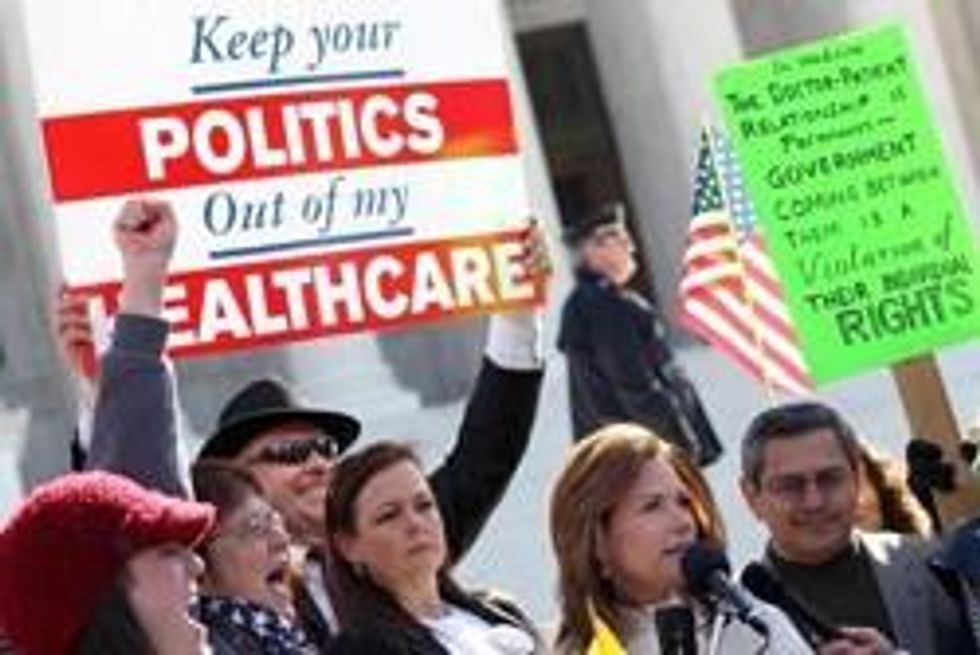
But the question they never ask of either side in the latest stalemate is "What principle?" What exactly are all these blowhards standing their ground for?
Now, when President Obama defends his position, I can clearly discern hints of actual principle. He says the government needs to keep running because it's responsible -- for providing public employees with the livelihood they earn for delivering a vast array of services for which the American people are paying.
"Responsibility" is a principle.
The President reminds the tea-party fringe that Obamacare, passed by Congress, is the law of the land.
"It's the law" is also a principle.
Obama defends the necessity of preserving "the full faith and credit of the United States." America, like everyone else, buys stuff on credit. The debt-ceiling increase is a periodic measure, passed routinely by Congress (and currently overdue), to make sure that the U.S.A. pays the check for stuff -- approved by Congress -- that America has already bought.
"The full faith and credit of the United States," a principle enshrined in the Constitution, is as clear, fixed and inflexible as the Ten Commandments.
So, what are the competing principles? What are the arguments against "responsibility," "the rule of law" and the "full faith and credit" of the U.S.A.?
Obviously, it's hard for the Right to argue against responsibility. Republicans tend to pontificate ad nauseam about the "responsibilities" of the poor, the young, the swarthy, the homeless, the wretched refuse of our teeming shore.
The closest our tea-party types can get to staking out a principled position is to claim that Obamacare will be bad for people. This isn't supported by the many objective studies that predict it will be good for people. But until it's up and running, either position boils down to speculation. We do know for certain, based on experience, that the current U.S. health care system is a bureaucratic hell that toys with the lives of the sick while sentencing countless patients to an early death -- over nickels and dimes -- at a rate that would inspire envy in Hannibal Lecter.
Occasionally, a Republican blurts out the paradox that haunts the right wing, as did Michelle Bachmann when she said, "Obama can't wait to get Americans addicted to the crack cocaine of dependency on more government health care."
Bachmann admits, unintentionally, that Obamacare was a good idea when it was conceived by conservatives at the Heritage Foundation and first implemented by a conservative governor of Massachusetts. But conservatives can't support it now because it's identified with that uppity black bastard in the White House.
I know. Not exactly a principle. But it has the ring of honesty.
There is -- perhaps -- a principle lurking beneath the surface of GOP intransigence. It applies to both Obamacare and the debt ceiling. If stated simply, it would be, "Obamacare is the law but we won't obey. We got bills but we won't pay 'em." If this is the point, what Republicans are up to is civil disobedience, a form of principled resistance that evokes Thomas More, Jean d'Arc, Crispus Attucks and John Brown (all killed), not to mention Henry David Thoreau, Mohandas Ghandi, Rev. Martin Luther King, Jr., (who all went to jail) and James Chaney, Andrew Goodman, Michael Schwerner and Viola Liuzzo (again, killed).
I'm not suggesting that anti-Obamacare firebrands like Ted Cruz, Rand Paul and Mike Lee should be murdered by night-riding vigilantes and buried in an earthworks dam in Mississippi. But if tea-party heroes are serious about civil disobedience, shouldn't they embrace the consequences? Shouldn't we send in the State Police to hose 'em down, cuff 'em up and drag 'em to the drunk tank? Don't they deserve the same civic martrydom afforded to civil disobeyers like Eugene V. Debs, Rosa Parks John Lewis, the Berrigan brothers and the Solidarity Singers?
If these zealots don't suffer for making us all suffer, then what principle applies? If they go unpersecuted for flouting the law, what do they stand for? Is "principled opposition" to Obamacare and the debt ceiling just the Tea Party's way of proving that they can moon the President and get away with it?
Or is all this high-blown rhetoric a "foolish consistency," a stubborn position that immunizes its advocates not only from consequences, but from the necessity of receiving more information, pondering it and risking a change of mind?
When Emerson's composed the "foolish consistency" passage in Self-Reliance, he also wrote: "With consistency a great soul has simply nothing to do. He may as well concern himself with his shadow on the wall. Speak what you think now in hard words, and to-morrow speak what to-morrow thinks in hard words again, though it contradict every thing you said to-day. -- 'Ah, so you shall be sure to be misunderstood.' -- Is it so bad, then, to be misunderstood?... To be great is to be misunderstood."
"A foolish consistency is the hobgoblin of little minds, adored by little statesmen and philosophers and divines."
-- Ralph Waldo Emerson, Self-Reliance
PARIS -- As I observe, from a nation where health care is universal, simple, cheap and far more healthful that the free-market medical blackmail that afflicts and sickens the United States, I think of a question not asked.
But the question they never ask of either side in the latest stalemate is "What principle?" What exactly are all these blowhards standing their ground for?
Now, when President Obama defends his position, I can clearly discern hints of actual principle. He says the government needs to keep running because it's responsible -- for providing public employees with the livelihood they earn for delivering a vast array of services for which the American people are paying.
"Responsibility" is a principle.
The President reminds the tea-party fringe that Obamacare, passed by Congress, is the law of the land.
"It's the law" is also a principle.
Obama defends the necessity of preserving "the full faith and credit of the United States." America, like everyone else, buys stuff on credit. The debt-ceiling increase is a periodic measure, passed routinely by Congress (and currently overdue), to make sure that the U.S.A. pays the check for stuff -- approved by Congress -- that America has already bought.
"The full faith and credit of the United States," a principle enshrined in the Constitution, is as clear, fixed and inflexible as the Ten Commandments.
So, what are the competing principles? What are the arguments against "responsibility," "the rule of law" and the "full faith and credit" of the U.S.A.?
Obviously, it's hard for the Right to argue against responsibility. Republicans tend to pontificate ad nauseam about the "responsibilities" of the poor, the young, the swarthy, the homeless, the wretched refuse of our teeming shore.
The closest our tea-party types can get to staking out a principled position is to claim that Obamacare will be bad for people. This isn't supported by the many objective studies that predict it will be good for people. But until it's up and running, either position boils down to speculation. We do know for certain, based on experience, that the current U.S. health care system is a bureaucratic hell that toys with the lives of the sick while sentencing countless patients to an early death -- over nickels and dimes -- at a rate that would inspire envy in Hannibal Lecter.
Occasionally, a Republican blurts out the paradox that haunts the right wing, as did Michelle Bachmann when she said, "Obama can't wait to get Americans addicted to the crack cocaine of dependency on more government health care."
Bachmann admits, unintentionally, that Obamacare was a good idea when it was conceived by conservatives at the Heritage Foundation and first implemented by a conservative governor of Massachusetts. But conservatives can't support it now because it's identified with that uppity black bastard in the White House.
I know. Not exactly a principle. But it has the ring of honesty.
There is -- perhaps -- a principle lurking beneath the surface of GOP intransigence. It applies to both Obamacare and the debt ceiling. If stated simply, it would be, "Obamacare is the law but we won't obey. We got bills but we won't pay 'em." If this is the point, what Republicans are up to is civil disobedience, a form of principled resistance that evokes Thomas More, Jean d'Arc, Crispus Attucks and John Brown (all killed), not to mention Henry David Thoreau, Mohandas Ghandi, Rev. Martin Luther King, Jr., (who all went to jail) and James Chaney, Andrew Goodman, Michael Schwerner and Viola Liuzzo (again, killed).
I'm not suggesting that anti-Obamacare firebrands like Ted Cruz, Rand Paul and Mike Lee should be murdered by night-riding vigilantes and buried in an earthworks dam in Mississippi. But if tea-party heroes are serious about civil disobedience, shouldn't they embrace the consequences? Shouldn't we send in the State Police to hose 'em down, cuff 'em up and drag 'em to the drunk tank? Don't they deserve the same civic martrydom afforded to civil disobeyers like Eugene V. Debs, Rosa Parks John Lewis, the Berrigan brothers and the Solidarity Singers?
If these zealots don't suffer for making us all suffer, then what principle applies? If they go unpersecuted for flouting the law, what do they stand for? Is "principled opposition" to Obamacare and the debt ceiling just the Tea Party's way of proving that they can moon the President and get away with it?
Or is all this high-blown rhetoric a "foolish consistency," a stubborn position that immunizes its advocates not only from consequences, but from the necessity of receiving more information, pondering it and risking a change of mind?
When Emerson's composed the "foolish consistency" passage in Self-Reliance, he also wrote: "With consistency a great soul has simply nothing to do. He may as well concern himself with his shadow on the wall. Speak what you think now in hard words, and to-morrow speak what to-morrow thinks in hard words again, though it contradict every thing you said to-day. -- 'Ah, so you shall be sure to be misunderstood.' -- Is it so bad, then, to be misunderstood?... To be great is to be misunderstood."
"A foolish consistency is the hobgoblin of little minds, adored by little statesmen and philosophers and divines."
-- Ralph Waldo Emerson, Self-Reliance
PARIS -- As I observe, from a nation where health care is universal, simple, cheap and far more healthful that the free-market medical blackmail that afflicts and sickens the United States, I think of a question not asked.
But the question they never ask of either side in the latest stalemate is "What principle?" What exactly are all these blowhards standing their ground for?
Now, when President Obama defends his position, I can clearly discern hints of actual principle. He says the government needs to keep running because it's responsible -- for providing public employees with the livelihood they earn for delivering a vast array of services for which the American people are paying.
"Responsibility" is a principle.
The President reminds the tea-party fringe that Obamacare, passed by Congress, is the law of the land.
"It's the law" is also a principle.
Obama defends the necessity of preserving "the full faith and credit of the United States." America, like everyone else, buys stuff on credit. The debt-ceiling increase is a periodic measure, passed routinely by Congress (and currently overdue), to make sure that the U.S.A. pays the check for stuff -- approved by Congress -- that America has already bought.
"The full faith and credit of the United States," a principle enshrined in the Constitution, is as clear, fixed and inflexible as the Ten Commandments.
So, what are the competing principles? What are the arguments against "responsibility," "the rule of law" and the "full faith and credit" of the U.S.A.?
Obviously, it's hard for the Right to argue against responsibility. Republicans tend to pontificate ad nauseam about the "responsibilities" of the poor, the young, the swarthy, the homeless, the wretched refuse of our teeming shore.
The closest our tea-party types can get to staking out a principled position is to claim that Obamacare will be bad for people. This isn't supported by the many objective studies that predict it will be good for people. But until it's up and running, either position boils down to speculation. We do know for certain, based on experience, that the current U.S. health care system is a bureaucratic hell that toys with the lives of the sick while sentencing countless patients to an early death -- over nickels and dimes -- at a rate that would inspire envy in Hannibal Lecter.
Occasionally, a Republican blurts out the paradox that haunts the right wing, as did Michelle Bachmann when she said, "Obama can't wait to get Americans addicted to the crack cocaine of dependency on more government health care."
Bachmann admits, unintentionally, that Obamacare was a good idea when it was conceived by conservatives at the Heritage Foundation and first implemented by a conservative governor of Massachusetts. But conservatives can't support it now because it's identified with that uppity black bastard in the White House.
I know. Not exactly a principle. But it has the ring of honesty.
There is -- perhaps -- a principle lurking beneath the surface of GOP intransigence. It applies to both Obamacare and the debt ceiling. If stated simply, it would be, "Obamacare is the law but we won't obey. We got bills but we won't pay 'em." If this is the point, what Republicans are up to is civil disobedience, a form of principled resistance that evokes Thomas More, Jean d'Arc, Crispus Attucks and John Brown (all killed), not to mention Henry David Thoreau, Mohandas Ghandi, Rev. Martin Luther King, Jr., (who all went to jail) and James Chaney, Andrew Goodman, Michael Schwerner and Viola Liuzzo (again, killed).
I'm not suggesting that anti-Obamacare firebrands like Ted Cruz, Rand Paul and Mike Lee should be murdered by night-riding vigilantes and buried in an earthworks dam in Mississippi. But if tea-party heroes are serious about civil disobedience, shouldn't they embrace the consequences? Shouldn't we send in the State Police to hose 'em down, cuff 'em up and drag 'em to the drunk tank? Don't they deserve the same civic martrydom afforded to civil disobeyers like Eugene V. Debs, Rosa Parks John Lewis, the Berrigan brothers and the Solidarity Singers?
If these zealots don't suffer for making us all suffer, then what principle applies? If they go unpersecuted for flouting the law, what do they stand for? Is "principled opposition" to Obamacare and the debt ceiling just the Tea Party's way of proving that they can moon the President and get away with it?
Or is all this high-blown rhetoric a "foolish consistency," a stubborn position that immunizes its advocates not only from consequences, but from the necessity of receiving more information, pondering it and risking a change of mind?
When Emerson's composed the "foolish consistency" passage in Self-Reliance, he also wrote: "With consistency a great soul has simply nothing to do. He may as well concern himself with his shadow on the wall. Speak what you think now in hard words, and to-morrow speak what to-morrow thinks in hard words again, though it contradict every thing you said to-day. -- 'Ah, so you shall be sure to be misunderstood.' -- Is it so bad, then, to be misunderstood?... To be great is to be misunderstood."