SUBSCRIBE TO OUR FREE NEWSLETTER
Daily news & progressive opinion—funded by the people, not the corporations—delivered straight to your inbox.
5
#000000
#FFFFFF
To donate by check, phone, or other method, see our More Ways to Give page.
Critics of President Obama's trip to Africa are focusing on the wrong issue.
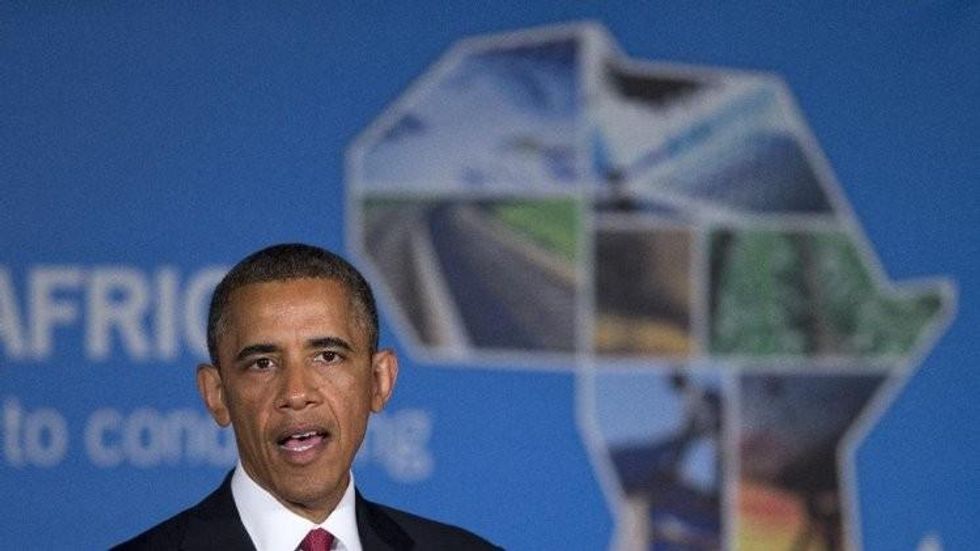
The first family's visit is expected to cost between $60 million and $100 million, a price tag that has brought controversy, given the nation's budget crunch.
But presidential visits are part of the job, and the price tag for this one is on par with past presidential trips to Africa.
A more pointed criticism has to do with the destructive policies the United States has long pursued -- and continues to pursue -- in Africa.
During the era of independence, Cold War politics dictated the American relationship with emerging African nations. This had disastrous consequences for leaders who were viewed as pro-Soviet.
The CIA authorized the assassination of Patrice Lumumba in the Congo, and the United States backed the coup that overthrew Kwame Nkrumah of Ghana. The United States also supported Jonas Savimbi and his guerrillas against the government of Angola, fueling a civil war that killed upward of 500,000 people. These are but three examples; there are many more.
Today the so-called War on Terror has emerged as the new paradigm for Washington's policy toward Africa. Framed as ungoverned territory ripe for Islamic extremism, wide swaths of the African continent are now on the Pentagon's radar.
The Pentagon has been trying unsuccessfully to gain a foothold on the continent for its Africa Command (AFRICOM), but no country wants to host it.
Still based in Stuttgart, Germany, AFRICOM is billed as part of Washington's "efforts to bring peace and security to the people of Africa and promote our common goals of development, health, education, democracy, and economic growth in Africa." Its real purpose, however, is to secure the interests of America's biggest companies and expand the reach of the Pentagon.
Take AFRICOM's leading role in NATO's intervention in Libya, which opened up the country's vast oil reserves for ExxonMobil and other oil giants, unencumbered by Moammar Gadhafi's restrictive policies.
That intervention had unfortunate consequences. It fueled the crisis in nearby Mali, for instance. But the United States kept with its interventionist approach, justifying its support of the French invasion in the north of that country by framing it as part of the War on Terror. Never mind the fact that the complex origins of the conflict in Mali are rooted in the historical marginalization of the Tuareg and their quest for sovereignty, not Islam.
Now the Pentagon has announced that it will soon establish drone bases in northwest Africa to bolster its counterterrorism efforts, a move that will not endear it to the nations whose sovereignty will be violated.
There is little room for optimism that Obama will transform America's militaristic Africa agenda into one that promotes peace and development in accordance with what Africans envision for themselves. The longstanding U.S. approach, which Obama has unfortunately continued, foments underdevelopment, violence and anti-Americanism.
With such a poor track record, it is easy to forget that Obama is Africa's son, too.
Critics of President Obama's trip to Africa are focusing on the wrong issue.
The first family's visit is expected to cost between $60 million and $100 million, a price tag that has brought controversy, given the nation's budget crunch.
But presidential visits are part of the job, and the price tag for this one is on par with past presidential trips to Africa.
A more pointed criticism has to do with the destructive policies the United States has long pursued -- and continues to pursue -- in Africa.
During the era of independence, Cold War politics dictated the American relationship with emerging African nations. This had disastrous consequences for leaders who were viewed as pro-Soviet.
The CIA authorized the assassination of Patrice Lumumba in the Congo, and the United States backed the coup that overthrew Kwame Nkrumah of Ghana. The United States also supported Jonas Savimbi and his guerrillas against the government of Angola, fueling a civil war that killed upward of 500,000 people. These are but three examples; there are many more.
Today the so-called War on Terror has emerged as the new paradigm for Washington's policy toward Africa. Framed as ungoverned territory ripe for Islamic extremism, wide swaths of the African continent are now on the Pentagon's radar.
The Pentagon has been trying unsuccessfully to gain a foothold on the continent for its Africa Command (AFRICOM), but no country wants to host it.
Still based in Stuttgart, Germany, AFRICOM is billed as part of Washington's "efforts to bring peace and security to the people of Africa and promote our common goals of development, health, education, democracy, and economic growth in Africa." Its real purpose, however, is to secure the interests of America's biggest companies and expand the reach of the Pentagon.
Take AFRICOM's leading role in NATO's intervention in Libya, which opened up the country's vast oil reserves for ExxonMobil and other oil giants, unencumbered by Moammar Gadhafi's restrictive policies.
That intervention had unfortunate consequences. It fueled the crisis in nearby Mali, for instance. But the United States kept with its interventionist approach, justifying its support of the French invasion in the north of that country by framing it as part of the War on Terror. Never mind the fact that the complex origins of the conflict in Mali are rooted in the historical marginalization of the Tuareg and their quest for sovereignty, not Islam.
Now the Pentagon has announced that it will soon establish drone bases in northwest Africa to bolster its counterterrorism efforts, a move that will not endear it to the nations whose sovereignty will be violated.
There is little room for optimism that Obama will transform America's militaristic Africa agenda into one that promotes peace and development in accordance with what Africans envision for themselves. The longstanding U.S. approach, which Obama has unfortunately continued, foments underdevelopment, violence and anti-Americanism.
With such a poor track record, it is easy to forget that Obama is Africa's son, too.
Critics of President Obama's trip to Africa are focusing on the wrong issue.
The first family's visit is expected to cost between $60 million and $100 million, a price tag that has brought controversy, given the nation's budget crunch.
But presidential visits are part of the job, and the price tag for this one is on par with past presidential trips to Africa.
A more pointed criticism has to do with the destructive policies the United States has long pursued -- and continues to pursue -- in Africa.
During the era of independence, Cold War politics dictated the American relationship with emerging African nations. This had disastrous consequences for leaders who were viewed as pro-Soviet.
The CIA authorized the assassination of Patrice Lumumba in the Congo, and the United States backed the coup that overthrew Kwame Nkrumah of Ghana. The United States also supported Jonas Savimbi and his guerrillas against the government of Angola, fueling a civil war that killed upward of 500,000 people. These are but three examples; there are many more.
Today the so-called War on Terror has emerged as the new paradigm for Washington's policy toward Africa. Framed as ungoverned territory ripe for Islamic extremism, wide swaths of the African continent are now on the Pentagon's radar.
The Pentagon has been trying unsuccessfully to gain a foothold on the continent for its Africa Command (AFRICOM), but no country wants to host it.
Still based in Stuttgart, Germany, AFRICOM is billed as part of Washington's "efforts to bring peace and security to the people of Africa and promote our common goals of development, health, education, democracy, and economic growth in Africa." Its real purpose, however, is to secure the interests of America's biggest companies and expand the reach of the Pentagon.
Take AFRICOM's leading role in NATO's intervention in Libya, which opened up the country's vast oil reserves for ExxonMobil and other oil giants, unencumbered by Moammar Gadhafi's restrictive policies.
That intervention had unfortunate consequences. It fueled the crisis in nearby Mali, for instance. But the United States kept with its interventionist approach, justifying its support of the French invasion in the north of that country by framing it as part of the War on Terror. Never mind the fact that the complex origins of the conflict in Mali are rooted in the historical marginalization of the Tuareg and their quest for sovereignty, not Islam.
Now the Pentagon has announced that it will soon establish drone bases in northwest Africa to bolster its counterterrorism efforts, a move that will not endear it to the nations whose sovereignty will be violated.
There is little room for optimism that Obama will transform America's militaristic Africa agenda into one that promotes peace and development in accordance with what Africans envision for themselves. The longstanding U.S. approach, which Obama has unfortunately continued, foments underdevelopment, violence and anti-Americanism.
With such a poor track record, it is easy to forget that Obama is Africa's son, too.