SUBSCRIBE TO OUR FREE NEWSLETTER
Daily news & progressive opinion—funded by the people, not the corporations—delivered straight to your inbox.
5
#000000
#FFFFFF
To donate by check, phone, or other method, see our More Ways to Give page.
It's a shame when the very people appointed to safeguard justice are the same people who vote to destroy one of the most powerful equal-opportunity shields from injustice in American history. This week, the Supreme Court voted 5-4 to strike down Section 4 of the Voting Rights Act (VRA), the crown jewel of the Civil Rights movement, and one of the most famous pieces of legislation in US history.
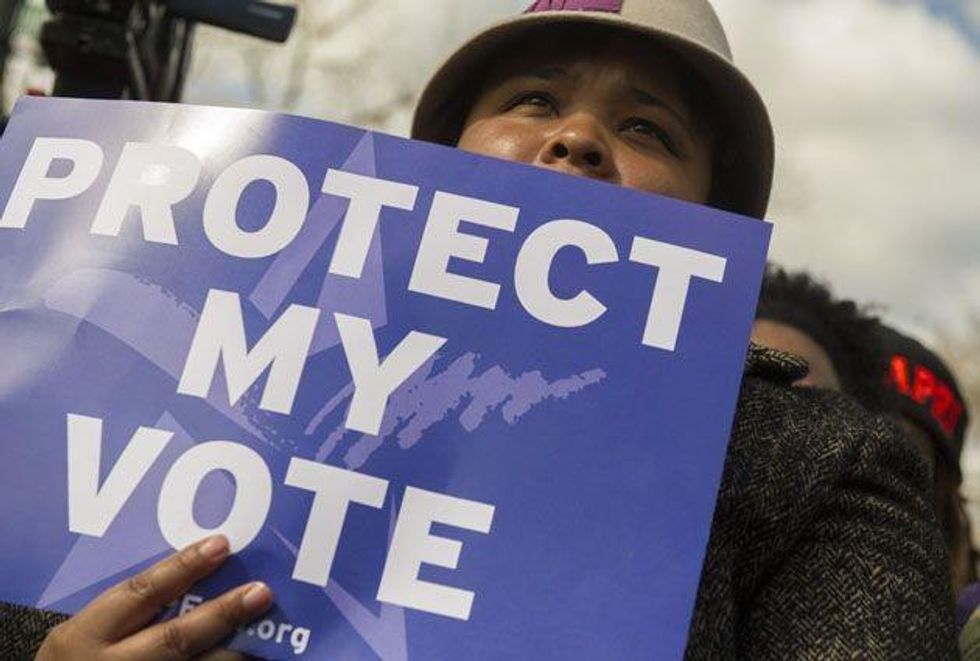
Chief Justice Roberts stated in his ruling that, "things have changed dramatically," implying that Section 4 is now unnecessary. Yet, since 2000 the VRA has been invoked 74 times in order to protect voter equality. According to dissenting Justice Ruth Ginsberg, throwing out Section 4 is like "throwing away your umbrella in a rainstorm because you are not getting wet."
The Voting Rights Act was passed in 1965 to ensure equality for all American voters. Tuesday's decision technically left the VRA in place, but just barely. The Supreme Court struck down Section 4, which designated that particular parts of the country with histories of intense racism, like Alabama, Texas, and Arizona, must have any changes to their voting laws cleared by the federal government before enactment, to ensure that voting equality was preserved equally throughout the United States.
Chief Justice Roberts may believe things have 'changed' but it only took Texas two hours after Section 4 was overturned to announce plans to implement the most stringent voter ID in the country, as well as a controversial redistricting measure - and five other states are moving similar legislation forward as well. "The Court today declared racism dead in this country despite mountains of evidence to the contrary," said J. Gerald Hebert of the Campaign Legal Center.
It is obvious the Supreme Court has lost its connection to America's citizens. Their decision to overturn Section 4 proves how isolated they are. Benjamin Todd Jealous, President and CEO of the NAACP - someone who works directly with citizens to ensure racial equality - publicly stated, that "this case comes on the heels of an election year in which our nation witnessed the greatest assault on voting rights since the Jim Crow era." The eradication of Section 4 means those facing racial discrimination will lose a crucial protection, in a time where there are millions more people of color in the United States than ever before.
Section 5 of the VRA (the section that allows Congress to draft new rules) is still in place, suggesting Congress could develop new guidelines to protect voters disenfranchised by the decision. Although the decision was not couched in those words, it is clear that the Justices understood that disenfranchisement of the voters for which the law was intended to protect was a likely outcome, but they forged ahead anyway. To assume any Congress in the foreseeable future would forget partisanship to ensure voter equality lacks familiarity with reality - most of the potentially and newly disenfranchised voters lean Democratic.
In 2006, the last time the Voting Rights Act was renewed, it passed by an overwhelming majority in Congress, with a margin of 390-22 in the House of Representatives and a unanimous vote in favor in the Senate (98-0). Republicans and Democrats alike were anxious to improve their credibility with black and brown voters before an election. Just six years later with partisanship at an all time high and the VRA gutted, one must ask if the bill could even make it out of committee?
There are some that argued that rather than striking down Section 4 of the VRA on the (ridiculous) basis that racism is no longer relevant to voter discrimination, the Court should have expanded the law to apply to all states, not just the historically segregated South. Indeed, there is ample evidence that the practices of racially targeted voter discrimination have spread well beyond the Mason-Dixon Line.
Unfortunately, the Supreme Court has a long history of ruling against "We the People." In the 1800s with Santa Clara County v. the Southern Pacific Railroad, the Supreme Court chipped away at America's democracy with their statement that corporations are people. In Buckley v. Valeo, they decided spending money is protected political speech, and in Citizens United v. the Federal Elections Commission, they decided that because corporations are people and money is free speech, corporations can spend unlimited amounts of money in our electoral process.
There is a movement building to challenge the Court's overreach - to make clear and explicit in the Constitution that corporations are not people and money is not speech. Such an amendment would be a good beginning - a critical beginning - and a platform upon which to build a society where those with money don't have undue control over the political, legal or electoral process. But we also need a Constitutional Right to Vote.
If the Constitution clearly recognized the right of all people to vote, have their vote counted, and to meaningfully participate in the political process, communities targeted by racist disenfranchisement measures wouldn't be at the mercy of a Court majority whose clear agenda isn't administering justice for all or protecting human rights.
Whether supporting corporate "rights" over the people's Constitutional rights, or disenfranchising millions of American voters, the Supreme Court's record in this arena is alarming. Voting is inherent to democracy. And like unregulated campaign spending is an affront to democracy, disabling safeguards in place to ensure equal voting is an atrocious attack on the American democratic system. It is a sad day when the American people must defend their democracy from the very structures put in place to protect it.
It's a shame when the very people appointed to safeguard justice are the same people who vote to destroy one of the most powerful equal-opportunity shields from injustice in American history. This week, the Supreme Court voted 5-4 to strike down Section 4 of the Voting Rights Act (VRA), the crown jewel of the Civil Rights movement, and one of the most famous pieces of legislation in US history.
Chief Justice Roberts stated in his ruling that, "things have changed dramatically," implying that Section 4 is now unnecessary. Yet, since 2000 the VRA has been invoked 74 times in order to protect voter equality. According to dissenting Justice Ruth Ginsberg, throwing out Section 4 is like "throwing away your umbrella in a rainstorm because you are not getting wet."
The Voting Rights Act was passed in 1965 to ensure equality for all American voters. Tuesday's decision technically left the VRA in place, but just barely. The Supreme Court struck down Section 4, which designated that particular parts of the country with histories of intense racism, like Alabama, Texas, and Arizona, must have any changes to their voting laws cleared by the federal government before enactment, to ensure that voting equality was preserved equally throughout the United States.
Chief Justice Roberts may believe things have 'changed' but it only took Texas two hours after Section 4 was overturned to announce plans to implement the most stringent voter ID in the country, as well as a controversial redistricting measure - and five other states are moving similar legislation forward as well. "The Court today declared racism dead in this country despite mountains of evidence to the contrary," said J. Gerald Hebert of the Campaign Legal Center.
It is obvious the Supreme Court has lost its connection to America's citizens. Their decision to overturn Section 4 proves how isolated they are. Benjamin Todd Jealous, President and CEO of the NAACP - someone who works directly with citizens to ensure racial equality - publicly stated, that "this case comes on the heels of an election year in which our nation witnessed the greatest assault on voting rights since the Jim Crow era." The eradication of Section 4 means those facing racial discrimination will lose a crucial protection, in a time where there are millions more people of color in the United States than ever before.
Section 5 of the VRA (the section that allows Congress to draft new rules) is still in place, suggesting Congress could develop new guidelines to protect voters disenfranchised by the decision. Although the decision was not couched in those words, it is clear that the Justices understood that disenfranchisement of the voters for which the law was intended to protect was a likely outcome, but they forged ahead anyway. To assume any Congress in the foreseeable future would forget partisanship to ensure voter equality lacks familiarity with reality - most of the potentially and newly disenfranchised voters lean Democratic.
In 2006, the last time the Voting Rights Act was renewed, it passed by an overwhelming majority in Congress, with a margin of 390-22 in the House of Representatives and a unanimous vote in favor in the Senate (98-0). Republicans and Democrats alike were anxious to improve their credibility with black and brown voters before an election. Just six years later with partisanship at an all time high and the VRA gutted, one must ask if the bill could even make it out of committee?
There are some that argued that rather than striking down Section 4 of the VRA on the (ridiculous) basis that racism is no longer relevant to voter discrimination, the Court should have expanded the law to apply to all states, not just the historically segregated South. Indeed, there is ample evidence that the practices of racially targeted voter discrimination have spread well beyond the Mason-Dixon Line.
Unfortunately, the Supreme Court has a long history of ruling against "We the People." In the 1800s with Santa Clara County v. the Southern Pacific Railroad, the Supreme Court chipped away at America's democracy with their statement that corporations are people. In Buckley v. Valeo, they decided spending money is protected political speech, and in Citizens United v. the Federal Elections Commission, they decided that because corporations are people and money is free speech, corporations can spend unlimited amounts of money in our electoral process.
There is a movement building to challenge the Court's overreach - to make clear and explicit in the Constitution that corporations are not people and money is not speech. Such an amendment would be a good beginning - a critical beginning - and a platform upon which to build a society where those with money don't have undue control over the political, legal or electoral process. But we also need a Constitutional Right to Vote.
If the Constitution clearly recognized the right of all people to vote, have their vote counted, and to meaningfully participate in the political process, communities targeted by racist disenfranchisement measures wouldn't be at the mercy of a Court majority whose clear agenda isn't administering justice for all or protecting human rights.
Whether supporting corporate "rights" over the people's Constitutional rights, or disenfranchising millions of American voters, the Supreme Court's record in this arena is alarming. Voting is inherent to democracy. And like unregulated campaign spending is an affront to democracy, disabling safeguards in place to ensure equal voting is an atrocious attack on the American democratic system. It is a sad day when the American people must defend their democracy from the very structures put in place to protect it.
It's a shame when the very people appointed to safeguard justice are the same people who vote to destroy one of the most powerful equal-opportunity shields from injustice in American history. This week, the Supreme Court voted 5-4 to strike down Section 4 of the Voting Rights Act (VRA), the crown jewel of the Civil Rights movement, and one of the most famous pieces of legislation in US history.
Chief Justice Roberts stated in his ruling that, "things have changed dramatically," implying that Section 4 is now unnecessary. Yet, since 2000 the VRA has been invoked 74 times in order to protect voter equality. According to dissenting Justice Ruth Ginsberg, throwing out Section 4 is like "throwing away your umbrella in a rainstorm because you are not getting wet."
The Voting Rights Act was passed in 1965 to ensure equality for all American voters. Tuesday's decision technically left the VRA in place, but just barely. The Supreme Court struck down Section 4, which designated that particular parts of the country with histories of intense racism, like Alabama, Texas, and Arizona, must have any changes to their voting laws cleared by the federal government before enactment, to ensure that voting equality was preserved equally throughout the United States.
Chief Justice Roberts may believe things have 'changed' but it only took Texas two hours after Section 4 was overturned to announce plans to implement the most stringent voter ID in the country, as well as a controversial redistricting measure - and five other states are moving similar legislation forward as well. "The Court today declared racism dead in this country despite mountains of evidence to the contrary," said J. Gerald Hebert of the Campaign Legal Center.
It is obvious the Supreme Court has lost its connection to America's citizens. Their decision to overturn Section 4 proves how isolated they are. Benjamin Todd Jealous, President and CEO of the NAACP - someone who works directly with citizens to ensure racial equality - publicly stated, that "this case comes on the heels of an election year in which our nation witnessed the greatest assault on voting rights since the Jim Crow era." The eradication of Section 4 means those facing racial discrimination will lose a crucial protection, in a time where there are millions more people of color in the United States than ever before.
Section 5 of the VRA (the section that allows Congress to draft new rules) is still in place, suggesting Congress could develop new guidelines to protect voters disenfranchised by the decision. Although the decision was not couched in those words, it is clear that the Justices understood that disenfranchisement of the voters for which the law was intended to protect was a likely outcome, but they forged ahead anyway. To assume any Congress in the foreseeable future would forget partisanship to ensure voter equality lacks familiarity with reality - most of the potentially and newly disenfranchised voters lean Democratic.
In 2006, the last time the Voting Rights Act was renewed, it passed by an overwhelming majority in Congress, with a margin of 390-22 in the House of Representatives and a unanimous vote in favor in the Senate (98-0). Republicans and Democrats alike were anxious to improve their credibility with black and brown voters before an election. Just six years later with partisanship at an all time high and the VRA gutted, one must ask if the bill could even make it out of committee?
There are some that argued that rather than striking down Section 4 of the VRA on the (ridiculous) basis that racism is no longer relevant to voter discrimination, the Court should have expanded the law to apply to all states, not just the historically segregated South. Indeed, there is ample evidence that the practices of racially targeted voter discrimination have spread well beyond the Mason-Dixon Line.
Unfortunately, the Supreme Court has a long history of ruling against "We the People." In the 1800s with Santa Clara County v. the Southern Pacific Railroad, the Supreme Court chipped away at America's democracy with their statement that corporations are people. In Buckley v. Valeo, they decided spending money is protected political speech, and in Citizens United v. the Federal Elections Commission, they decided that because corporations are people and money is free speech, corporations can spend unlimited amounts of money in our electoral process.
There is a movement building to challenge the Court's overreach - to make clear and explicit in the Constitution that corporations are not people and money is not speech. Such an amendment would be a good beginning - a critical beginning - and a platform upon which to build a society where those with money don't have undue control over the political, legal or electoral process. But we also need a Constitutional Right to Vote.
If the Constitution clearly recognized the right of all people to vote, have their vote counted, and to meaningfully participate in the political process, communities targeted by racist disenfranchisement measures wouldn't be at the mercy of a Court majority whose clear agenda isn't administering justice for all or protecting human rights.
Whether supporting corporate "rights" over the people's Constitutional rights, or disenfranchising millions of American voters, the Supreme Court's record in this arena is alarming. Voting is inherent to democracy. And like unregulated campaign spending is an affront to democracy, disabling safeguards in place to ensure equal voting is an atrocious attack on the American democratic system. It is a sad day when the American people must defend their democracy from the very structures put in place to protect it.