SUBSCRIBE TO OUR FREE NEWSLETTER
Daily news & progressive opinion—funded by the people, not the corporations—delivered straight to your inbox.
5
#000000
#FFFFFF
To donate by check, phone, or other method, see our More Ways to Give page.
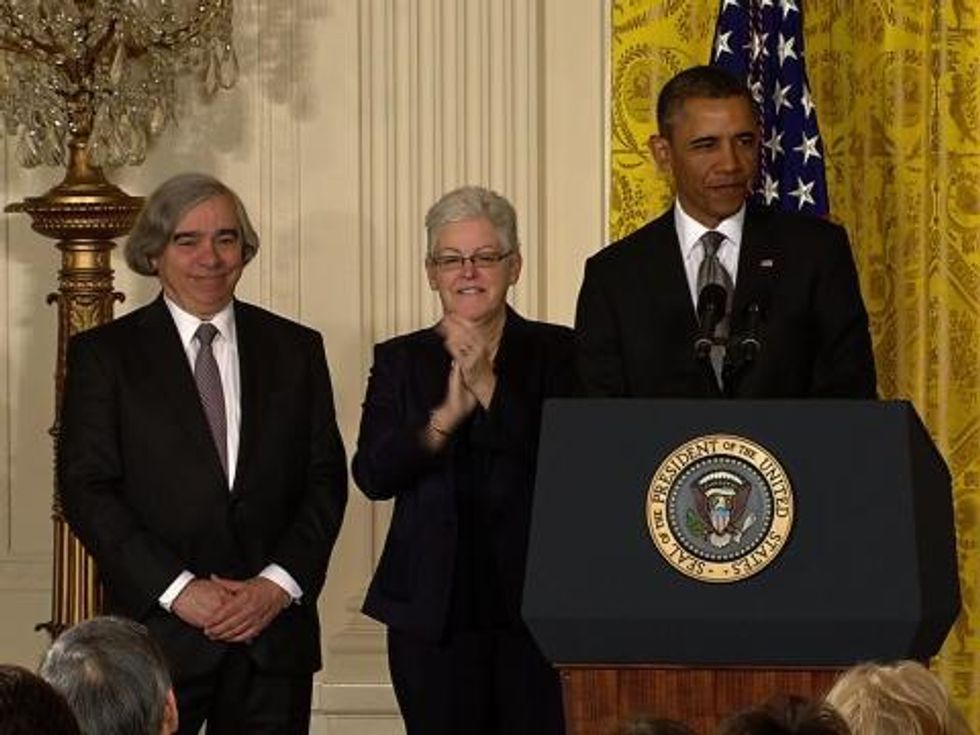
It doesn't take a nuclear physicist to know that the process of hydraulic fracturing ("fracking") threatens our communities and their most essential resources, so why has President Obama appointed Dr. Ernest Moniz, a proponent of the process, to guide
With the perils of climate change ever looming, you'd think that President Obama would consider experts with a proven plan to aggressively deploy renewable resources like wind and solar power to usher the nation's energy agenda into the post-Sandy age. Instead, we have Moniz, whose MIT Energy Initiative has received more than $125 million in pledges from the oil and gas industry, according to the Public Accountability Initiative. The founding members of the MIT Energy Initiative, BP, Shell, ENI and Saudi Aramco, each promised $25 million over five years in exchange for managing and participating in research projects.
The initiative's ties to the industry don't stop there. The Clean Skies Foundation, chaired by former Chesapeake Energy Corp. CEO Aubrey McClendon, influenced one high-profile study, a report titled "The Future of Natural Gas", which promotes natural gas as a "bridge fuel" to renewables that will help address climate change. The study has been widely criticized for pandering to the interests of the oil and gas industry, and debunked by a team of independent Cornell University professors led by Anthony Ingraffea and Robert Howarth, who directly linked fracking and drilling for oil and natural gas to climate change.
Ingraffea and Howarth's study found that methane emissions from shale gas drilling are at least 30 percent higher than those from conventional gas, and may be just as severe as coal. Methane is a potent greenhouse gas, 33 times more efficient at trapping heat than carbon dioxide over 100 years, and about 100 times more potent than carbon dioxide over 20 years.
Yet Moniz has continued to tout the so-called "benefits" of natural gas, viewing it as a key piece of our nation's energy plan "over the next couple of decades." In testimony before Congress in July 2011, he called "environmental risks, which arise from shale development" including "contamination of groundwater aquifers with drilling fluids or natural gas" "challenging but manageable." Never mind that a peer-reviewed study by researchers at Duke University showed a statistically significant correlation between methane contamination of drinking water wells and their proximity to shale gas drilling sites.
Meanwhile, policymakers and concerned citizens are rejecting fracking en mass. To date, more than 330 U.S. communities have taken action against the process. Residents in small towns and big cities alike have mobilized to protect their families, friends and neighbors from the contaminated water and polluted air that fracking leaves in its wake, as well as illnesses such as cardiovascular disease, cancer and asthma linked to these phenomena. They're rejecting the industrialization of their communities, ravaged property values in areas near fracking operations, the threat imposed on tourism and agriculture and the dizzying costs of cleaning up after fracking related accidents.
While many were heartened by the President's recent proclaimed intention to tackle climate change, appointing Dr. Ernest Moniz to energy secretary will only undermine those efforts. Instead he needs to consider a leader who can help the U.S. chart its course away from dirty, polluting fossil fuels, towards a green energy future. Dr. Ernest Moniz does not have the vision or independence to do this. The Senate should act swiftly and reject Dr. Ernest Moniz for Secretary of Energy.
It doesn't take a nuclear physicist to know that the process of hydraulic fracturing ("fracking") threatens our communities and their most essential resources, so why has President Obama appointed Dr. Ernest Moniz, a proponent of the process, to guide
With the perils of climate change ever looming, you'd think that President Obama would consider experts with a proven plan to aggressively deploy renewable resources like wind and solar power to usher the nation's energy agenda into the post-Sandy age. Instead, we have Moniz, whose MIT Energy Initiative has received more than $125 million in pledges from the oil and gas industry, according to the Public Accountability Initiative. The founding members of the MIT Energy Initiative, BP, Shell, ENI and Saudi Aramco, each promised $25 million over five years in exchange for managing and participating in research projects.
The initiative's ties to the industry don't stop there. The Clean Skies Foundation, chaired by former Chesapeake Energy Corp. CEO Aubrey McClendon, influenced one high-profile study, a report titled "The Future of Natural Gas", which promotes natural gas as a "bridge fuel" to renewables that will help address climate change. The study has been widely criticized for pandering to the interests of the oil and gas industry, and debunked by a team of independent Cornell University professors led by Anthony Ingraffea and Robert Howarth, who directly linked fracking and drilling for oil and natural gas to climate change.
Ingraffea and Howarth's study found that methane emissions from shale gas drilling are at least 30 percent higher than those from conventional gas, and may be just as severe as coal. Methane is a potent greenhouse gas, 33 times more efficient at trapping heat than carbon dioxide over 100 years, and about 100 times more potent than carbon dioxide over 20 years.
Yet Moniz has continued to tout the so-called "benefits" of natural gas, viewing it as a key piece of our nation's energy plan "over the next couple of decades." In testimony before Congress in July 2011, he called "environmental risks, which arise from shale development" including "contamination of groundwater aquifers with drilling fluids or natural gas" "challenging but manageable." Never mind that a peer-reviewed study by researchers at Duke University showed a statistically significant correlation between methane contamination of drinking water wells and their proximity to shale gas drilling sites.
Meanwhile, policymakers and concerned citizens are rejecting fracking en mass. To date, more than 330 U.S. communities have taken action against the process. Residents in small towns and big cities alike have mobilized to protect their families, friends and neighbors from the contaminated water and polluted air that fracking leaves in its wake, as well as illnesses such as cardiovascular disease, cancer and asthma linked to these phenomena. They're rejecting the industrialization of their communities, ravaged property values in areas near fracking operations, the threat imposed on tourism and agriculture and the dizzying costs of cleaning up after fracking related accidents.
While many were heartened by the President's recent proclaimed intention to tackle climate change, appointing Dr. Ernest Moniz to energy secretary will only undermine those efforts. Instead he needs to consider a leader who can help the U.S. chart its course away from dirty, polluting fossil fuels, towards a green energy future. Dr. Ernest Moniz does not have the vision or independence to do this. The Senate should act swiftly and reject Dr. Ernest Moniz for Secretary of Energy.
It doesn't take a nuclear physicist to know that the process of hydraulic fracturing ("fracking") threatens our communities and their most essential resources, so why has President Obama appointed Dr. Ernest Moniz, a proponent of the process, to guide
With the perils of climate change ever looming, you'd think that President Obama would consider experts with a proven plan to aggressively deploy renewable resources like wind and solar power to usher the nation's energy agenda into the post-Sandy age. Instead, we have Moniz, whose MIT Energy Initiative has received more than $125 million in pledges from the oil and gas industry, according to the Public Accountability Initiative. The founding members of the MIT Energy Initiative, BP, Shell, ENI and Saudi Aramco, each promised $25 million over five years in exchange for managing and participating in research projects.
The initiative's ties to the industry don't stop there. The Clean Skies Foundation, chaired by former Chesapeake Energy Corp. CEO Aubrey McClendon, influenced one high-profile study, a report titled "The Future of Natural Gas", which promotes natural gas as a "bridge fuel" to renewables that will help address climate change. The study has been widely criticized for pandering to the interests of the oil and gas industry, and debunked by a team of independent Cornell University professors led by Anthony Ingraffea and Robert Howarth, who directly linked fracking and drilling for oil and natural gas to climate change.
Ingraffea and Howarth's study found that methane emissions from shale gas drilling are at least 30 percent higher than those from conventional gas, and may be just as severe as coal. Methane is a potent greenhouse gas, 33 times more efficient at trapping heat than carbon dioxide over 100 years, and about 100 times more potent than carbon dioxide over 20 years.
Yet Moniz has continued to tout the so-called "benefits" of natural gas, viewing it as a key piece of our nation's energy plan "over the next couple of decades." In testimony before Congress in July 2011, he called "environmental risks, which arise from shale development" including "contamination of groundwater aquifers with drilling fluids or natural gas" "challenging but manageable." Never mind that a peer-reviewed study by researchers at Duke University showed a statistically significant correlation between methane contamination of drinking water wells and their proximity to shale gas drilling sites.
Meanwhile, policymakers and concerned citizens are rejecting fracking en mass. To date, more than 330 U.S. communities have taken action against the process. Residents in small towns and big cities alike have mobilized to protect their families, friends and neighbors from the contaminated water and polluted air that fracking leaves in its wake, as well as illnesses such as cardiovascular disease, cancer and asthma linked to these phenomena. They're rejecting the industrialization of their communities, ravaged property values in areas near fracking operations, the threat imposed on tourism and agriculture and the dizzying costs of cleaning up after fracking related accidents.
While many were heartened by the President's recent proclaimed intention to tackle climate change, appointing Dr. Ernest Moniz to energy secretary will only undermine those efforts. Instead he needs to consider a leader who can help the U.S. chart its course away from dirty, polluting fossil fuels, towards a green energy future. Dr. Ernest Moniz does not have the vision or independence to do this. The Senate should act swiftly and reject Dr. Ernest Moniz for Secretary of Energy.