SUBSCRIBE TO OUR FREE NEWSLETTER
Daily news & progressive opinion—funded by the people, not the corporations—delivered straight to your inbox.
5
#000000
#FFFFFF
To donate by check, phone, or other method, see our More Ways to Give page.
Another day, another Wall Street scandal--and yet another instance where the perpetrators will quite certainly get little more than a slap on the wrist.
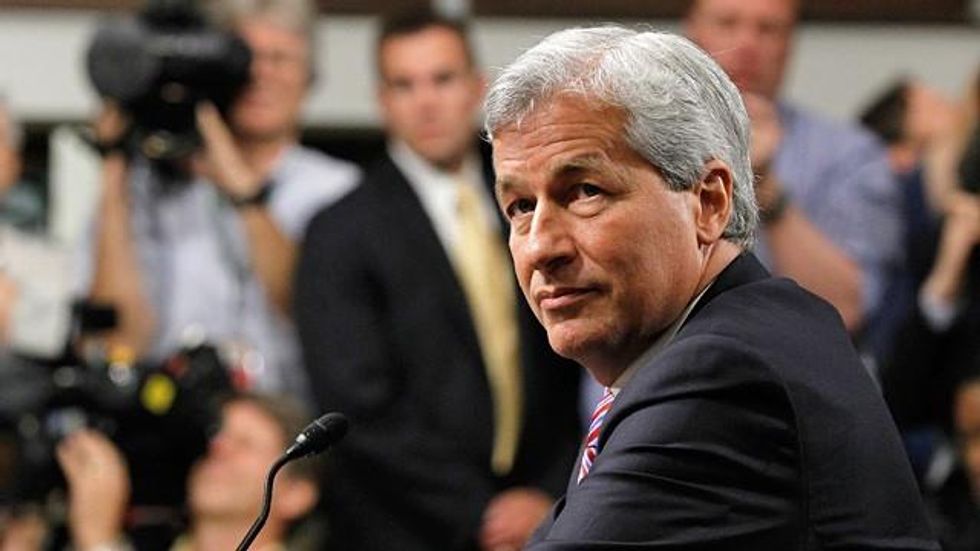
"The 300-page report, released a day before a Senate subcommittee plans to question bank executives and regulators at a hearing, will escalate the debate over how to police complex risk-taking on Wall Street," the New York Times reports. "It may also foreshadow a criminal case against employees at the heart of the troubled wager."
Let's hope so, for so far not a single financial sector honcho has seen the inside of a prison. This is in spite of the fact that every couple of months we see a fresh instance of wrongdoing emerging from the alleys of Wall Street--from interest rate fixing and shadowy trading to collusion with terrorists and drug dealers.
"If you're caught with an ounce of cocaine, the chances are good you're going to jail," newly elected Senator Elizabeth Warren recently said on the Senate floor in a reference to HSBC Bank. "But, evidently, if you launder nearly a billion dollars for drug cartels and violate our international sanctions, your company pays a fine and you go home and sleep in your own bed at night."
Wall Street learned quickly from the economic bust that no matter what malfeasance it engaged in, the financial sector would not be held responsible.
"What it did in the bubble and the crisis really was criminal," Charles Ferguson, director of the Oscar-winning "Inside Job" and author of "Predator Nation," said in an interview last year. "It's really important and dangerous that the criminal justice system has not been used. If the criminal justice system were used properly, these kinds of things would be much less frequent and much less severe than they are in fact becoming."
The inimitable Matt Taibbi of Rolling Stone got a blunter assessment from a Capitol Hill source.
"You put [Goldman Sachs CEO] Lloyd Blankfein in pound-me-in-the-ass prison for one six-month term, and all this bullshit would stop, all over Wall Street," the former congressional aide told Taibbi two years ago. "That's all it would take. Just once."
A recent PBS Frontline expose confirmed yet again how the Obama Administration's Justice Department has been AWOL when it comes to financial skullduggery.
"You're telling me that not one banker, not one executive on Wall Street, not one player in this entire financial crisis committed provable fraud?" asked Jeff Connaughton, the chief of staff to interim Delaware Senator Ted Kaufman, who worked heroically but in vain to ensure accountability before his departure. "I mean, I just don't believe that."
In addition to the known reasons for official inaction (such as corporate money power), director and author Ferguson gave another explanation in his interview as to why prosecutors are hesitant to go after the financial sector.
"After you've had the job for five years, or maybe ten at the most, you go to work doing defense work, defending the people you used to be prosecuting or threatening to prosecute, and your income goes way up," Ferguson said. "If that is the kind of calculation you're making in your mind, you don't really go after the structural situation; you don't go after people who are really going to fight back, like Goldman Sachs."
Ferguson specifically named Mary Jo White, who at the time was with a corporate law firm that has banks among its biggest clients. Prior to that, White had been the lead prosecutor in the New York City area. White is exiting her lucrative private practice. President Obama recently nominated her to head the Securities and Exchange Commission.
It's no surprise that not one of the serial offenders on Wall Street will ever spend a single day in the slammer.
Another day, another Wall Street scandal--and yet another instance where the perpetrators will quite certainly get little more than a slap on the wrist.
"The 300-page report, released a day before a Senate subcommittee plans to question bank executives and regulators at a hearing, will escalate the debate over how to police complex risk-taking on Wall Street," the New York Times reports. "It may also foreshadow a criminal case against employees at the heart of the troubled wager."
Let's hope so, for so far not a single financial sector honcho has seen the inside of a prison. This is in spite of the fact that every couple of months we see a fresh instance of wrongdoing emerging from the alleys of Wall Street--from interest rate fixing and shadowy trading to collusion with terrorists and drug dealers.
"If you're caught with an ounce of cocaine, the chances are good you're going to jail," newly elected Senator Elizabeth Warren recently said on the Senate floor in a reference to HSBC Bank. "But, evidently, if you launder nearly a billion dollars for drug cartels and violate our international sanctions, your company pays a fine and you go home and sleep in your own bed at night."
Wall Street learned quickly from the economic bust that no matter what malfeasance it engaged in, the financial sector would not be held responsible.
"What it did in the bubble and the crisis really was criminal," Charles Ferguson, director of the Oscar-winning "Inside Job" and author of "Predator Nation," said in an interview last year. "It's really important and dangerous that the criminal justice system has not been used. If the criminal justice system were used properly, these kinds of things would be much less frequent and much less severe than they are in fact becoming."
The inimitable Matt Taibbi of Rolling Stone got a blunter assessment from a Capitol Hill source.
"You put [Goldman Sachs CEO] Lloyd Blankfein in pound-me-in-the-ass prison for one six-month term, and all this bullshit would stop, all over Wall Street," the former congressional aide told Taibbi two years ago. "That's all it would take. Just once."
A recent PBS Frontline expose confirmed yet again how the Obama Administration's Justice Department has been AWOL when it comes to financial skullduggery.
"You're telling me that not one banker, not one executive on Wall Street, not one player in this entire financial crisis committed provable fraud?" asked Jeff Connaughton, the chief of staff to interim Delaware Senator Ted Kaufman, who worked heroically but in vain to ensure accountability before his departure. "I mean, I just don't believe that."
In addition to the known reasons for official inaction (such as corporate money power), director and author Ferguson gave another explanation in his interview as to why prosecutors are hesitant to go after the financial sector.
"After you've had the job for five years, or maybe ten at the most, you go to work doing defense work, defending the people you used to be prosecuting or threatening to prosecute, and your income goes way up," Ferguson said. "If that is the kind of calculation you're making in your mind, you don't really go after the structural situation; you don't go after people who are really going to fight back, like Goldman Sachs."
Ferguson specifically named Mary Jo White, who at the time was with a corporate law firm that has banks among its biggest clients. Prior to that, White had been the lead prosecutor in the New York City area. White is exiting her lucrative private practice. President Obama recently nominated her to head the Securities and Exchange Commission.
It's no surprise that not one of the serial offenders on Wall Street will ever spend a single day in the slammer.
Another day, another Wall Street scandal--and yet another instance where the perpetrators will quite certainly get little more than a slap on the wrist.
"The 300-page report, released a day before a Senate subcommittee plans to question bank executives and regulators at a hearing, will escalate the debate over how to police complex risk-taking on Wall Street," the New York Times reports. "It may also foreshadow a criminal case against employees at the heart of the troubled wager."
Let's hope so, for so far not a single financial sector honcho has seen the inside of a prison. This is in spite of the fact that every couple of months we see a fresh instance of wrongdoing emerging from the alleys of Wall Street--from interest rate fixing and shadowy trading to collusion with terrorists and drug dealers.
"If you're caught with an ounce of cocaine, the chances are good you're going to jail," newly elected Senator Elizabeth Warren recently said on the Senate floor in a reference to HSBC Bank. "But, evidently, if you launder nearly a billion dollars for drug cartels and violate our international sanctions, your company pays a fine and you go home and sleep in your own bed at night."
Wall Street learned quickly from the economic bust that no matter what malfeasance it engaged in, the financial sector would not be held responsible.
"What it did in the bubble and the crisis really was criminal," Charles Ferguson, director of the Oscar-winning "Inside Job" and author of "Predator Nation," said in an interview last year. "It's really important and dangerous that the criminal justice system has not been used. If the criminal justice system were used properly, these kinds of things would be much less frequent and much less severe than they are in fact becoming."
The inimitable Matt Taibbi of Rolling Stone got a blunter assessment from a Capitol Hill source.
"You put [Goldman Sachs CEO] Lloyd Blankfein in pound-me-in-the-ass prison for one six-month term, and all this bullshit would stop, all over Wall Street," the former congressional aide told Taibbi two years ago. "That's all it would take. Just once."
A recent PBS Frontline expose confirmed yet again how the Obama Administration's Justice Department has been AWOL when it comes to financial skullduggery.
"You're telling me that not one banker, not one executive on Wall Street, not one player in this entire financial crisis committed provable fraud?" asked Jeff Connaughton, the chief of staff to interim Delaware Senator Ted Kaufman, who worked heroically but in vain to ensure accountability before his departure. "I mean, I just don't believe that."
In addition to the known reasons for official inaction (such as corporate money power), director and author Ferguson gave another explanation in his interview as to why prosecutors are hesitant to go after the financial sector.
"After you've had the job for five years, or maybe ten at the most, you go to work doing defense work, defending the people you used to be prosecuting or threatening to prosecute, and your income goes way up," Ferguson said. "If that is the kind of calculation you're making in your mind, you don't really go after the structural situation; you don't go after people who are really going to fight back, like Goldman Sachs."
Ferguson specifically named Mary Jo White, who at the time was with a corporate law firm that has banks among its biggest clients. Prior to that, White had been the lead prosecutor in the New York City area. White is exiting her lucrative private practice. President Obama recently nominated her to head the Securities and Exchange Commission.
It's no surprise that not one of the serial offenders on Wall Street will ever spend a single day in the slammer.