SUBSCRIBE TO OUR FREE NEWSLETTER
Daily news & progressive opinion—funded by the people, not the corporations—delivered straight to your inbox.
5
#000000
#FFFFFF
To donate by check, phone, or other method, see our More Ways to Give page.
"When Black Friday comes,
I'm gonna stake my claim."
--from lyrics to "Black Friday" by Steely Dan
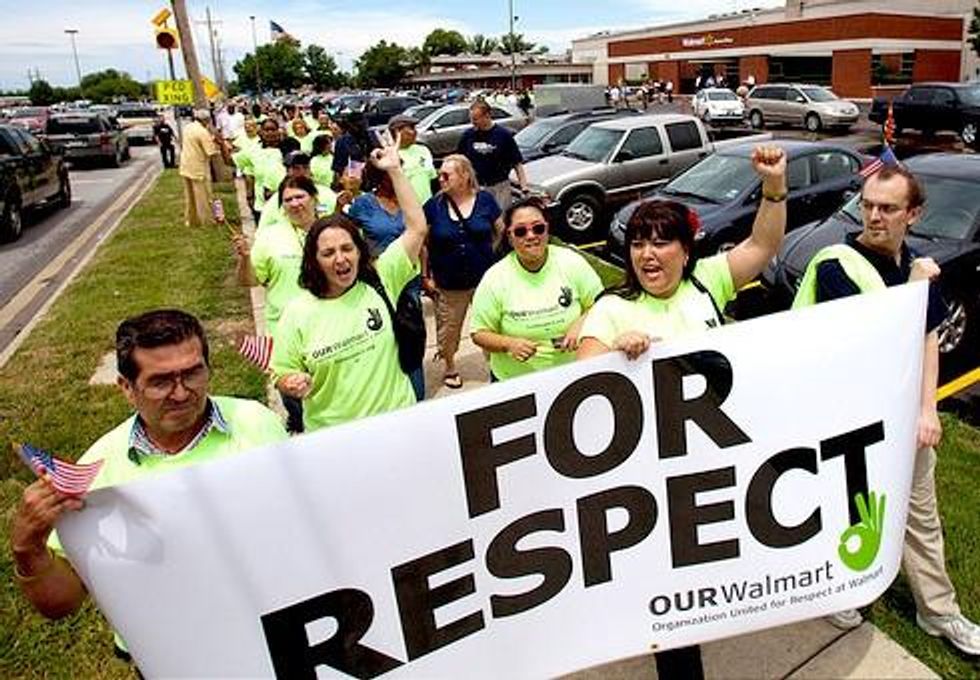
For Walmart, this Black Friday--which actually started with store openings at 8 pm on Thanksgiving, disrupting family celebrations --meant not just the kickoff of its lucrative Christmas buying season, but the first truly national challenge to shake its once rock-solid control over its 1.3 million "associates. Rallies by its workers and their supporters took place at an estimated 1,000 of its stores across the nation.
The protests were hugely significant: first, as a sign of the new worker assertiveness at a corporation that had seemingly mastered the art of enforced docility among its workers; and second, because of Walmart's powerful role in defining down wages and conditions across the globe.
Early Friday morning, the OUR (Organization United for Respect) Walmart movement opened up on Walmart management, lashing them for their immoral treatment of their workers.
A pre-dawn gathering in Milwaukee attracted more than 100 Walmart workers and supporters from labor, community organizations, and the faith community, despite bone-chilling winds outside Walmart's northside store, which was subsidized by $4.5 million in taxpayer dollars. The store's entrance was fenced off by temporary metal barriers and surrounded by six Milwaukee police vehicles as a half-dozen Walmart managers watched vigilantly and decline any comment to The Progressive.
"The worst kind of poverty is working poverty created by rich corporations," thundered Rev. Willie Briscoe, president of Milwaukee Inner-City Congregations Allied for Hope.
Several Walmart workers at the rally recounted their demeaning plight. A Kenosha worker named Jerry, an eight-year Walmart veteran, noted that he has never enjoyed a holiday with his family during his entire time at Walmart, having to work each and every one. Walmart also makes educational advancement impossible for its "associates" by constantly juggling schedules, thereby preventing workers from taking classes in technical colleges or universities impossible, he noted.
Steve French, a worker at the Midtown Milwaukee Walmart, also pointed to the treadmill of poverty Walmart maintains with its combination of low wages and high-cost healthcare benefits, soon due to rise up to 36% for workers, according to CBS News. "They give you a choice of feeding your family or taking care of your family [with health benefits], but you can't do both and that's not right," he declared.
With their protests, the Walmart workers forcefully staked their claim for decent pay and dignity. This day of action was another crucial step in confronting the deeply-rooted inequality of a broader US economy built along the Walmart model: a tiny elite raking in billions--$16 billion for Walmart's owners in 2011--while holding down the wages of its workers that average just $8.81 an hour and mean perpetual poverty for them and their families.
(The $8.81 figure is consistent with data from the independent consulting group IBIS World and numerous interviews with Walmart workers recounted by the NY Times' Steven Greenhouse, author of The Big Sqeeze, but some pro-corporate media outlets like the Milwaukee Journal Sentinel propagated Walmart's almost laughable claim of a $12.54 an hour average.)
Volcanic rumblings from within the long-silent workforce began in early October with associates initiating brief strikes starting in California warehouses among foreign-born Wal-Mart workers officially employed through temp agencies (so that Walmart could insulate itself from their brutal practices), and then spread to 28 sites in 12 states.
Until that point, Walmart had seemingly succeeded for a full half-century in using a sophisticated full-court press to stifle worker dissent inside its ever-metastasizing empire of stores built on miserable wages, degrading treatment of "associates," promotion of environmentally-destructive suburban sprawl, elimination of competition from locally-owned stores thanks in part to Walmart's advantage gained by exploiting of taxpayer-funded health programs and skillful reaping of other public subsidies.
As the big provider of jobs in American communities increasingly hollowed out by the offshoring of family-supporting industrial work to Mexico and China, Walmart has up until now managed to establish its low-wage system across the nation with a workforce desperate for a job at any rate. When workers in two instances (one among meatcutters in Texas and once in Canada) voted to unionize, Walmart responded by closing the stores. Widespread complaints of abuses like wage theft (i.e., forcing workers to toil off the timeclock) and sex discrimination accumulated and occasionally were picked up by the major media, but Walmart has generally prevailed through its political clout (Hillary Clinton once served on its board), and its stellar public relations operation. Touting its "low prices all the time" slogan, Walmart has cultivated a following among consumers whose wages were plummeting and have thus been grateful for Walmart's apparent bargains.
But events like the Black Friday protests are helping to drive home the message that Walmart's "low prices" actually carry far too high a price in human misery and hidden costs to the public.
"When Black Friday comes,
I'm gonna stake my claim."
--from lyrics to "Black Friday" by Steely Dan
For Walmart, this Black Friday--which actually started with store openings at 8 pm on Thanksgiving, disrupting family celebrations --meant not just the kickoff of its lucrative Christmas buying season, but the first truly national challenge to shake its once rock-solid control over its 1.3 million "associates. Rallies by its workers and their supporters took place at an estimated 1,000 of its stores across the nation.
The protests were hugely significant: first, as a sign of the new worker assertiveness at a corporation that had seemingly mastered the art of enforced docility among its workers; and second, because of Walmart's powerful role in defining down wages and conditions across the globe.
Early Friday morning, the OUR (Organization United for Respect) Walmart movement opened up on Walmart management, lashing them for their immoral treatment of their workers.
A pre-dawn gathering in Milwaukee attracted more than 100 Walmart workers and supporters from labor, community organizations, and the faith community, despite bone-chilling winds outside Walmart's northside store, which was subsidized by $4.5 million in taxpayer dollars. The store's entrance was fenced off by temporary metal barriers and surrounded by six Milwaukee police vehicles as a half-dozen Walmart managers watched vigilantly and decline any comment to The Progressive.
"The worst kind of poverty is working poverty created by rich corporations," thundered Rev. Willie Briscoe, president of Milwaukee Inner-City Congregations Allied for Hope.
Several Walmart workers at the rally recounted their demeaning plight. A Kenosha worker named Jerry, an eight-year Walmart veteran, noted that he has never enjoyed a holiday with his family during his entire time at Walmart, having to work each and every one. Walmart also makes educational advancement impossible for its "associates" by constantly juggling schedules, thereby preventing workers from taking classes in technical colleges or universities impossible, he noted.
Steve French, a worker at the Midtown Milwaukee Walmart, also pointed to the treadmill of poverty Walmart maintains with its combination of low wages and high-cost healthcare benefits, soon due to rise up to 36% for workers, according to CBS News. "They give you a choice of feeding your family or taking care of your family [with health benefits], but you can't do both and that's not right," he declared.
With their protests, the Walmart workers forcefully staked their claim for decent pay and dignity. This day of action was another crucial step in confronting the deeply-rooted inequality of a broader US economy built along the Walmart model: a tiny elite raking in billions--$16 billion for Walmart's owners in 2011--while holding down the wages of its workers that average just $8.81 an hour and mean perpetual poverty for them and their families.
(The $8.81 figure is consistent with data from the independent consulting group IBIS World and numerous interviews with Walmart workers recounted by the NY Times' Steven Greenhouse, author of The Big Sqeeze, but some pro-corporate media outlets like the Milwaukee Journal Sentinel propagated Walmart's almost laughable claim of a $12.54 an hour average.)
Volcanic rumblings from within the long-silent workforce began in early October with associates initiating brief strikes starting in California warehouses among foreign-born Wal-Mart workers officially employed through temp agencies (so that Walmart could insulate itself from their brutal practices), and then spread to 28 sites in 12 states.
Until that point, Walmart had seemingly succeeded for a full half-century in using a sophisticated full-court press to stifle worker dissent inside its ever-metastasizing empire of stores built on miserable wages, degrading treatment of "associates," promotion of environmentally-destructive suburban sprawl, elimination of competition from locally-owned stores thanks in part to Walmart's advantage gained by exploiting of taxpayer-funded health programs and skillful reaping of other public subsidies.
As the big provider of jobs in American communities increasingly hollowed out by the offshoring of family-supporting industrial work to Mexico and China, Walmart has up until now managed to establish its low-wage system across the nation with a workforce desperate for a job at any rate. When workers in two instances (one among meatcutters in Texas and once in Canada) voted to unionize, Walmart responded by closing the stores. Widespread complaints of abuses like wage theft (i.e., forcing workers to toil off the timeclock) and sex discrimination accumulated and occasionally were picked up by the major media, but Walmart has generally prevailed through its political clout (Hillary Clinton once served on its board), and its stellar public relations operation. Touting its "low prices all the time" slogan, Walmart has cultivated a following among consumers whose wages were plummeting and have thus been grateful for Walmart's apparent bargains.
But events like the Black Friday protests are helping to drive home the message that Walmart's "low prices" actually carry far too high a price in human misery and hidden costs to the public.
"When Black Friday comes,
I'm gonna stake my claim."
--from lyrics to "Black Friday" by Steely Dan
For Walmart, this Black Friday--which actually started with store openings at 8 pm on Thanksgiving, disrupting family celebrations --meant not just the kickoff of its lucrative Christmas buying season, but the first truly national challenge to shake its once rock-solid control over its 1.3 million "associates. Rallies by its workers and their supporters took place at an estimated 1,000 of its stores across the nation.
The protests were hugely significant: first, as a sign of the new worker assertiveness at a corporation that had seemingly mastered the art of enforced docility among its workers; and second, because of Walmart's powerful role in defining down wages and conditions across the globe.
Early Friday morning, the OUR (Organization United for Respect) Walmart movement opened up on Walmart management, lashing them for their immoral treatment of their workers.
A pre-dawn gathering in Milwaukee attracted more than 100 Walmart workers and supporters from labor, community organizations, and the faith community, despite bone-chilling winds outside Walmart's northside store, which was subsidized by $4.5 million in taxpayer dollars. The store's entrance was fenced off by temporary metal barriers and surrounded by six Milwaukee police vehicles as a half-dozen Walmart managers watched vigilantly and decline any comment to The Progressive.
"The worst kind of poverty is working poverty created by rich corporations," thundered Rev. Willie Briscoe, president of Milwaukee Inner-City Congregations Allied for Hope.
Several Walmart workers at the rally recounted their demeaning plight. A Kenosha worker named Jerry, an eight-year Walmart veteran, noted that he has never enjoyed a holiday with his family during his entire time at Walmart, having to work each and every one. Walmart also makes educational advancement impossible for its "associates" by constantly juggling schedules, thereby preventing workers from taking classes in technical colleges or universities impossible, he noted.
Steve French, a worker at the Midtown Milwaukee Walmart, also pointed to the treadmill of poverty Walmart maintains with its combination of low wages and high-cost healthcare benefits, soon due to rise up to 36% for workers, according to CBS News. "They give you a choice of feeding your family or taking care of your family [with health benefits], but you can't do both and that's not right," he declared.
With their protests, the Walmart workers forcefully staked their claim for decent pay and dignity. This day of action was another crucial step in confronting the deeply-rooted inequality of a broader US economy built along the Walmart model: a tiny elite raking in billions--$16 billion for Walmart's owners in 2011--while holding down the wages of its workers that average just $8.81 an hour and mean perpetual poverty for them and their families.
(The $8.81 figure is consistent with data from the independent consulting group IBIS World and numerous interviews with Walmart workers recounted by the NY Times' Steven Greenhouse, author of The Big Sqeeze, but some pro-corporate media outlets like the Milwaukee Journal Sentinel propagated Walmart's almost laughable claim of a $12.54 an hour average.)
Volcanic rumblings from within the long-silent workforce began in early October with associates initiating brief strikes starting in California warehouses among foreign-born Wal-Mart workers officially employed through temp agencies (so that Walmart could insulate itself from their brutal practices), and then spread to 28 sites in 12 states.
Until that point, Walmart had seemingly succeeded for a full half-century in using a sophisticated full-court press to stifle worker dissent inside its ever-metastasizing empire of stores built on miserable wages, degrading treatment of "associates," promotion of environmentally-destructive suburban sprawl, elimination of competition from locally-owned stores thanks in part to Walmart's advantage gained by exploiting of taxpayer-funded health programs and skillful reaping of other public subsidies.
As the big provider of jobs in American communities increasingly hollowed out by the offshoring of family-supporting industrial work to Mexico and China, Walmart has up until now managed to establish its low-wage system across the nation with a workforce desperate for a job at any rate. When workers in two instances (one among meatcutters in Texas and once in Canada) voted to unionize, Walmart responded by closing the stores. Widespread complaints of abuses like wage theft (i.e., forcing workers to toil off the timeclock) and sex discrimination accumulated and occasionally were picked up by the major media, but Walmart has generally prevailed through its political clout (Hillary Clinton once served on its board), and its stellar public relations operation. Touting its "low prices all the time" slogan, Walmart has cultivated a following among consumers whose wages were plummeting and have thus been grateful for Walmart's apparent bargains.
But events like the Black Friday protests are helping to drive home the message that Walmart's "low prices" actually carry far too high a price in human misery and hidden costs to the public.