SUBSCRIBE TO OUR FREE NEWSLETTER
Daily news & progressive opinion—funded by the people, not the corporations—delivered straight to your inbox.
5
#000000
#FFFFFF
To donate by check, phone, or other method, see our More Ways to Give page.
For many Americans, Black Friday is a special but important part of the holiday season. A time in which the warm, appreciative glow of a family Thanksgiving is replaced by insatiable deals at midnight store openings; when hot turkey sandwiches, hot coffee and cold pie are savored all the more for the comfort they provide during long shopping lines, brutal crowds and desperate searches for those key items on the Christmas list. It's a time that comes but once a year for both the consumer and the store owner, who each know that a profitable Black Friday may determine the financial outcome of the rest of the holiday season.
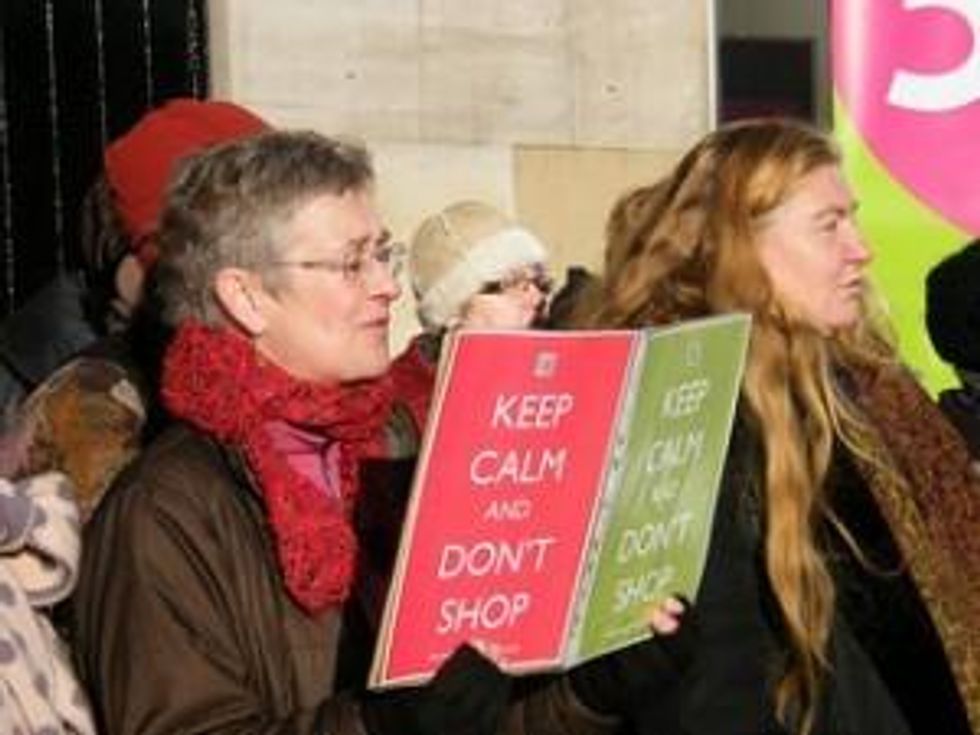
But for a small but growing sector of the population, Black Friday represents a different vision of holiday symbolism: a time to buy nothing.
It's a time for visiting friends, renewing ties and regaining one's perspective. It's a time symbolized by pot-luck dinners, reflective discussions about sustainable living and the beneficial prospects of investing in a sharing economy.
It's for resisting - and in some cases rebelling - against the temptations of unnecessary consumerism, something that some Americans feel threaten the very concept of the holiday season and their way of life.
This advocacy, often referred to as the Buy Nothing Black Friday movement (BND), stretches to every corner of the country, and can be found in every economic strata of society, from the post-hippie and yippie neighborhoods of San Francisco to the comfortable neighborly streets of Flatbush New York; from the congested streets of the metropolis, to the farms of rural small-town America.
It is also recognized in more than 50 countries around the globe, including Canada, where it is said to have been created.
Vancouver BC comic artist, Ted Dave, is credited with thinking up the "holiday" in 1992 while working on a concept for the parody magazine Adbusters. The manifesto was simple: "A 24-hour moratorium on consumer spending, designed to remind the consumer and the retailer of the true power of buying public."
As Dave later mused in an interview for the Vancouver magazine The Georgia Straight, The Buy Nothing Day "ignores the political structure completely and goes directly at the money." (Robin Laurence, Vol. 33, #1666, Nov. 25, 1999.) Big-box stores and franchise-based businesses would have no choice but to recognize the power of consumers to decide whether they wish to support an economy that BND proponents felt was artificial.
A retrospective of the BND campaign wouldn't be complete without mentioning its irony. The power of the Canadian-based Buy Nothing Day lies in the fact that it coincides with the day after the U.S. Thanksgiving holiday, and the first day of the Christmas shopping season in the United States (not Canada, which celebrates Thanksgiving a month earlier). It is an economic landmark to which Canadians don't necessarily give homage. Thus, by placing BND on Black Friday, Dave and his co-creators was not only able to capture the imagination of American residents who want to disenfranchise themselves from the consumer lifestyle, but in effect, underscore the very power that Black Friday has over global economies.
Interestingly, Adbusters announced recently that it would be changing the name and sentiment of the BND "holiday" to Occupy X-mas, a concept more in keeping with its other famous creation, the Occupy movement. One has to wonder however, if the idea of creating the BND holiday of abstinence was too controversial for the tastes of its international supporters, many of whom eschew any reference to Black Friday. This year however, some Canadian stores decided to compete against U.S. sales and open extra-early on Friday in order to entice Canadians into heading over the border.
For those who really want to make a statement against excessive consumerism in North America, the Occupy X-mas movement promises even more potential disruption to the Christmas shopping season. Whether it will dampen the delight that thousands have experienced over the years from the 24-hour Buy Nothing Day campaign however, is yet to be seen.
For many Americans, Black Friday is a special but important part of the holiday season. A time in which the warm, appreciative glow of a family Thanksgiving is replaced by insatiable deals at midnight store openings; when hot turkey sandwiches, hot coffee and cold pie are savored all the more for the comfort they provide during long shopping lines, brutal crowds and desperate searches for those key items on the Christmas list. It's a time that comes but once a year for both the consumer and the store owner, who each know that a profitable Black Friday may determine the financial outcome of the rest of the holiday season.
But for a small but growing sector of the population, Black Friday represents a different vision of holiday symbolism: a time to buy nothing.
It's a time for visiting friends, renewing ties and regaining one's perspective. It's a time symbolized by pot-luck dinners, reflective discussions about sustainable living and the beneficial prospects of investing in a sharing economy.
It's for resisting - and in some cases rebelling - against the temptations of unnecessary consumerism, something that some Americans feel threaten the very concept of the holiday season and their way of life.
This advocacy, often referred to as the Buy Nothing Black Friday movement (BND), stretches to every corner of the country, and can be found in every economic strata of society, from the post-hippie and yippie neighborhoods of San Francisco to the comfortable neighborly streets of Flatbush New York; from the congested streets of the metropolis, to the farms of rural small-town America.
It is also recognized in more than 50 countries around the globe, including Canada, where it is said to have been created.
Vancouver BC comic artist, Ted Dave, is credited with thinking up the "holiday" in 1992 while working on a concept for the parody magazine Adbusters. The manifesto was simple: "A 24-hour moratorium on consumer spending, designed to remind the consumer and the retailer of the true power of buying public."
As Dave later mused in an interview for the Vancouver magazine The Georgia Straight, The Buy Nothing Day "ignores the political structure completely and goes directly at the money." (Robin Laurence, Vol. 33, #1666, Nov. 25, 1999.) Big-box stores and franchise-based businesses would have no choice but to recognize the power of consumers to decide whether they wish to support an economy that BND proponents felt was artificial.
A retrospective of the BND campaign wouldn't be complete without mentioning its irony. The power of the Canadian-based Buy Nothing Day lies in the fact that it coincides with the day after the U.S. Thanksgiving holiday, and the first day of the Christmas shopping season in the United States (not Canada, which celebrates Thanksgiving a month earlier). It is an economic landmark to which Canadians don't necessarily give homage. Thus, by placing BND on Black Friday, Dave and his co-creators was not only able to capture the imagination of American residents who want to disenfranchise themselves from the consumer lifestyle, but in effect, underscore the very power that Black Friday has over global economies.
Interestingly, Adbusters announced recently that it would be changing the name and sentiment of the BND "holiday" to Occupy X-mas, a concept more in keeping with its other famous creation, the Occupy movement. One has to wonder however, if the idea of creating the BND holiday of abstinence was too controversial for the tastes of its international supporters, many of whom eschew any reference to Black Friday. This year however, some Canadian stores decided to compete against U.S. sales and open extra-early on Friday in order to entice Canadians into heading over the border.
For those who really want to make a statement against excessive consumerism in North America, the Occupy X-mas movement promises even more potential disruption to the Christmas shopping season. Whether it will dampen the delight that thousands have experienced over the years from the 24-hour Buy Nothing Day campaign however, is yet to be seen.
For many Americans, Black Friday is a special but important part of the holiday season. A time in which the warm, appreciative glow of a family Thanksgiving is replaced by insatiable deals at midnight store openings; when hot turkey sandwiches, hot coffee and cold pie are savored all the more for the comfort they provide during long shopping lines, brutal crowds and desperate searches for those key items on the Christmas list. It's a time that comes but once a year for both the consumer and the store owner, who each know that a profitable Black Friday may determine the financial outcome of the rest of the holiday season.
But for a small but growing sector of the population, Black Friday represents a different vision of holiday symbolism: a time to buy nothing.
It's a time for visiting friends, renewing ties and regaining one's perspective. It's a time symbolized by pot-luck dinners, reflective discussions about sustainable living and the beneficial prospects of investing in a sharing economy.
It's for resisting - and in some cases rebelling - against the temptations of unnecessary consumerism, something that some Americans feel threaten the very concept of the holiday season and their way of life.
This advocacy, often referred to as the Buy Nothing Black Friday movement (BND), stretches to every corner of the country, and can be found in every economic strata of society, from the post-hippie and yippie neighborhoods of San Francisco to the comfortable neighborly streets of Flatbush New York; from the congested streets of the metropolis, to the farms of rural small-town America.
It is also recognized in more than 50 countries around the globe, including Canada, where it is said to have been created.
Vancouver BC comic artist, Ted Dave, is credited with thinking up the "holiday" in 1992 while working on a concept for the parody magazine Adbusters. The manifesto was simple: "A 24-hour moratorium on consumer spending, designed to remind the consumer and the retailer of the true power of buying public."
As Dave later mused in an interview for the Vancouver magazine The Georgia Straight, The Buy Nothing Day "ignores the political structure completely and goes directly at the money." (Robin Laurence, Vol. 33, #1666, Nov. 25, 1999.) Big-box stores and franchise-based businesses would have no choice but to recognize the power of consumers to decide whether they wish to support an economy that BND proponents felt was artificial.
A retrospective of the BND campaign wouldn't be complete without mentioning its irony. The power of the Canadian-based Buy Nothing Day lies in the fact that it coincides with the day after the U.S. Thanksgiving holiday, and the first day of the Christmas shopping season in the United States (not Canada, which celebrates Thanksgiving a month earlier). It is an economic landmark to which Canadians don't necessarily give homage. Thus, by placing BND on Black Friday, Dave and his co-creators was not only able to capture the imagination of American residents who want to disenfranchise themselves from the consumer lifestyle, but in effect, underscore the very power that Black Friday has over global economies.
Interestingly, Adbusters announced recently that it would be changing the name and sentiment of the BND "holiday" to Occupy X-mas, a concept more in keeping with its other famous creation, the Occupy movement. One has to wonder however, if the idea of creating the BND holiday of abstinence was too controversial for the tastes of its international supporters, many of whom eschew any reference to Black Friday. This year however, some Canadian stores decided to compete against U.S. sales and open extra-early on Friday in order to entice Canadians into heading over the border.
For those who really want to make a statement against excessive consumerism in North America, the Occupy X-mas movement promises even more potential disruption to the Christmas shopping season. Whether it will dampen the delight that thousands have experienced over the years from the 24-hour Buy Nothing Day campaign however, is yet to be seen.