SUBSCRIBE TO OUR FREE NEWSLETTER
Daily news & progressive opinion—funded by the people, not the corporations—delivered straight to your inbox.
5
#000000
#FFFFFF
To donate by check, phone, or other method, see our More Ways to Give page.
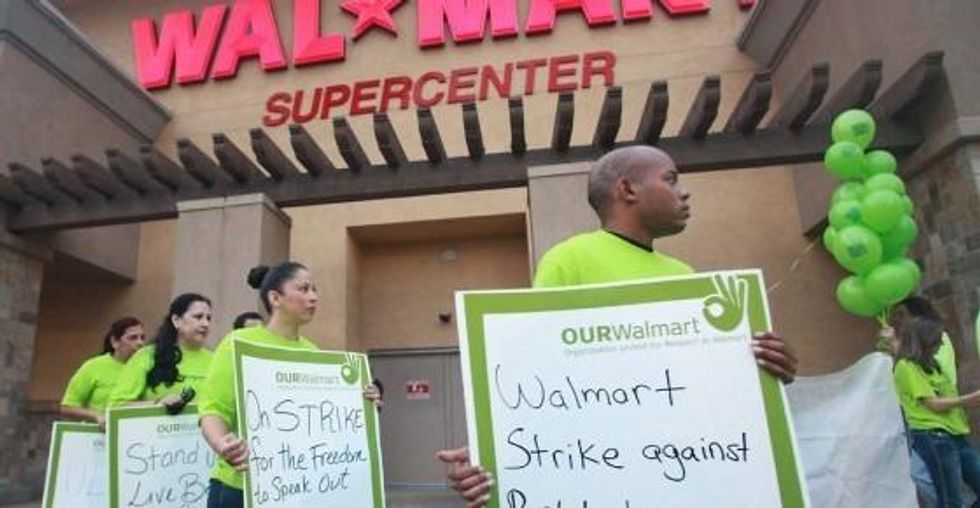
This week, Wal-Mart workers launched the first strike against the giant retailer in its 50-year history, with protests and picket lines at 28 stores across 12 states. Many of these nonunion workers are facing retaliation from their employer, despite the protections that exist on paper through the National Labor Relations Board. The strikers are operating under the banner of OUR Walmart: Organization United for Respect at Wal-Mart, started with support from the United Food and Commercial Workers Union. OUR Walmart members protested outside Wal-Mart's "Meeting for the Investment Community 2012" in Bentonville, Ark. Demanding a stop to the company's retaliations, the group promised a vigorous national presence at Wal-Mart stores on Black Friday, the day after Thanksgiving and the largest retail shopping day of the year. The workers have an impressive array of allies ready to join them, including the National Organization for Women.
Wal-Mart has historically shrouded its business practices by engaging subcontractors to perform tasks like warehousing and delivery. In Elwood, Ill., warehouse workers employed by Wal-Mart subcontractor RoadLink went out on strike immediately after a similar strike in California. According to Warehouse Workers for Justice (WWJ), "warehouse workers labor under extreme temperatures, lifting thousands of boxes that can weigh up to 250lbs each. Workplace injuries are common; workers rarely earn a living wage or have any benefits."
According to WWJ, after 21 days on strike in Elwood, the workers "won their principal demand for an end to illegal retaliation against workers protesting poor conditions. They will return to work ... with full pay for the time they were on strike."
I spoke with one of the Elwood strikers, Mike Compton, who described just one of the awful conditions they endured at their low-wage job:
"We have a big problem with dust. You know, all our containers that we unload come from China, and they're just filled with black dust. It's horrible, breathing the stuff in all day, you know, and we'd have to ask seven, eight times to get a dust mask. We'd just be pointed in different directions, to a different manager, to a different department. And half the time we'd walk away empty-handed at the end of it anyway. We've actually had trailers that were labeled 'defumigated in Mexico.' We don't know why. People have had trouble breathing in the trailers. You know, dust--something as simple and as cheap as a dust mask should just be readily available to anyone, in my opinion, especially a company as wealthy as Wal-Mart."
Compton was in Bentonville, Ark., Wal-Mart's corporate headquarters, to protest at the Wal-Mart investor meeting
Meanwhile, immigrant farmworkers have for generations labored under brutal conditions, picking tomatoes in the rural town of Immokalee, Fla. In 1993, they formed the Coalition of Immokalee Workers (CIW) to organize in solidarity with consumers to demand that major restaurant chains source their tomatoes from farms that pay a fair wage to their workers.
I spoke with farmworker and CIW organizer Gerardo Reyes-Chavez. He was in Denver, where the fast-food outlet Chipotle is based. CIW has been working on Chipotle for 10 years. He told me: "We have been able to create a Fair Food Program, addressing abuses in the tomato industry. We created a whole new system ... to identify where abuses are going on and uproot them from the system. This is an opportunity for Chipotle to do the right thing. They claim that they sell food with integrity, and they are really focused on the sustainability ... what we are saying is, this is an opportunity for them to make it a reality."
The day after I spoke with Reyes-Chaves, Chipotle signed the Fair Food Agreement. As the presidential candidates trade barbs over jobs in their heavily-controlled debates, workers at the grass roots are organizing for change, from Florida to California.
Denis Moynihan contributed research to this column.
This week, Wal-Mart workers launched the first strike against the giant retailer in its 50-year history, with protests and picket lines at 28 stores across 12 states. Many of these nonunion workers are facing retaliation from their employer, despite the protections that exist on paper through the National Labor Relations Board. The strikers are operating under the banner of OUR Walmart: Organization United for Respect at Wal-Mart, started with support from the United Food and Commercial Workers Union. OUR Walmart members protested outside Wal-Mart's "Meeting for the Investment Community 2012" in Bentonville, Ark. Demanding a stop to the company's retaliations, the group promised a vigorous national presence at Wal-Mart stores on Black Friday, the day after Thanksgiving and the largest retail shopping day of the year. The workers have an impressive array of allies ready to join them, including the National Organization for Women.
Wal-Mart has historically shrouded its business practices by engaging subcontractors to perform tasks like warehousing and delivery. In Elwood, Ill., warehouse workers employed by Wal-Mart subcontractor RoadLink went out on strike immediately after a similar strike in California. According to Warehouse Workers for Justice (WWJ), "warehouse workers labor under extreme temperatures, lifting thousands of boxes that can weigh up to 250lbs each. Workplace injuries are common; workers rarely earn a living wage or have any benefits."
According to WWJ, after 21 days on strike in Elwood, the workers "won their principal demand for an end to illegal retaliation against workers protesting poor conditions. They will return to work ... with full pay for the time they were on strike."
I spoke with one of the Elwood strikers, Mike Compton, who described just one of the awful conditions they endured at their low-wage job:
"We have a big problem with dust. You know, all our containers that we unload come from China, and they're just filled with black dust. It's horrible, breathing the stuff in all day, you know, and we'd have to ask seven, eight times to get a dust mask. We'd just be pointed in different directions, to a different manager, to a different department. And half the time we'd walk away empty-handed at the end of it anyway. We've actually had trailers that were labeled 'defumigated in Mexico.' We don't know why. People have had trouble breathing in the trailers. You know, dust--something as simple and as cheap as a dust mask should just be readily available to anyone, in my opinion, especially a company as wealthy as Wal-Mart."
Compton was in Bentonville, Ark., Wal-Mart's corporate headquarters, to protest at the Wal-Mart investor meeting
Meanwhile, immigrant farmworkers have for generations labored under brutal conditions, picking tomatoes in the rural town of Immokalee, Fla. In 1993, they formed the Coalition of Immokalee Workers (CIW) to organize in solidarity with consumers to demand that major restaurant chains source their tomatoes from farms that pay a fair wage to their workers.
I spoke with farmworker and CIW organizer Gerardo Reyes-Chavez. He was in Denver, where the fast-food outlet Chipotle is based. CIW has been working on Chipotle for 10 years. He told me: "We have been able to create a Fair Food Program, addressing abuses in the tomato industry. We created a whole new system ... to identify where abuses are going on and uproot them from the system. This is an opportunity for Chipotle to do the right thing. They claim that they sell food with integrity, and they are really focused on the sustainability ... what we are saying is, this is an opportunity for them to make it a reality."
The day after I spoke with Reyes-Chaves, Chipotle signed the Fair Food Agreement. As the presidential candidates trade barbs over jobs in their heavily-controlled debates, workers at the grass roots are organizing for change, from Florida to California.
Denis Moynihan contributed research to this column.
This week, Wal-Mart workers launched the first strike against the giant retailer in its 50-year history, with protests and picket lines at 28 stores across 12 states. Many of these nonunion workers are facing retaliation from their employer, despite the protections that exist on paper through the National Labor Relations Board. The strikers are operating under the banner of OUR Walmart: Organization United for Respect at Wal-Mart, started with support from the United Food and Commercial Workers Union. OUR Walmart members protested outside Wal-Mart's "Meeting for the Investment Community 2012" in Bentonville, Ark. Demanding a stop to the company's retaliations, the group promised a vigorous national presence at Wal-Mart stores on Black Friday, the day after Thanksgiving and the largest retail shopping day of the year. The workers have an impressive array of allies ready to join them, including the National Organization for Women.
Wal-Mart has historically shrouded its business practices by engaging subcontractors to perform tasks like warehousing and delivery. In Elwood, Ill., warehouse workers employed by Wal-Mart subcontractor RoadLink went out on strike immediately after a similar strike in California. According to Warehouse Workers for Justice (WWJ), "warehouse workers labor under extreme temperatures, lifting thousands of boxes that can weigh up to 250lbs each. Workplace injuries are common; workers rarely earn a living wage or have any benefits."
According to WWJ, after 21 days on strike in Elwood, the workers "won their principal demand for an end to illegal retaliation against workers protesting poor conditions. They will return to work ... with full pay for the time they were on strike."
I spoke with one of the Elwood strikers, Mike Compton, who described just one of the awful conditions they endured at their low-wage job:
"We have a big problem with dust. You know, all our containers that we unload come from China, and they're just filled with black dust. It's horrible, breathing the stuff in all day, you know, and we'd have to ask seven, eight times to get a dust mask. We'd just be pointed in different directions, to a different manager, to a different department. And half the time we'd walk away empty-handed at the end of it anyway. We've actually had trailers that were labeled 'defumigated in Mexico.' We don't know why. People have had trouble breathing in the trailers. You know, dust--something as simple and as cheap as a dust mask should just be readily available to anyone, in my opinion, especially a company as wealthy as Wal-Mart."
Compton was in Bentonville, Ark., Wal-Mart's corporate headquarters, to protest at the Wal-Mart investor meeting
Meanwhile, immigrant farmworkers have for generations labored under brutal conditions, picking tomatoes in the rural town of Immokalee, Fla. In 1993, they formed the Coalition of Immokalee Workers (CIW) to organize in solidarity with consumers to demand that major restaurant chains source their tomatoes from farms that pay a fair wage to their workers.
I spoke with farmworker and CIW organizer Gerardo Reyes-Chavez. He was in Denver, where the fast-food outlet Chipotle is based. CIW has been working on Chipotle for 10 years. He told me: "We have been able to create a Fair Food Program, addressing abuses in the tomato industry. We created a whole new system ... to identify where abuses are going on and uproot them from the system. This is an opportunity for Chipotle to do the right thing. They claim that they sell food with integrity, and they are really focused on the sustainability ... what we are saying is, this is an opportunity for them to make it a reality."
The day after I spoke with Reyes-Chaves, Chipotle signed the Fair Food Agreement. As the presidential candidates trade barbs over jobs in their heavily-controlled debates, workers at the grass roots are organizing for change, from Florida to California.
Denis Moynihan contributed research to this column.