SUBSCRIBE TO OUR FREE NEWSLETTER
Daily news & progressive opinion—funded by the people, not the corporations—delivered straight to your inbox.
5
#000000
#FFFFFF
To donate by check, phone, or other method, see our More Ways to Give page.
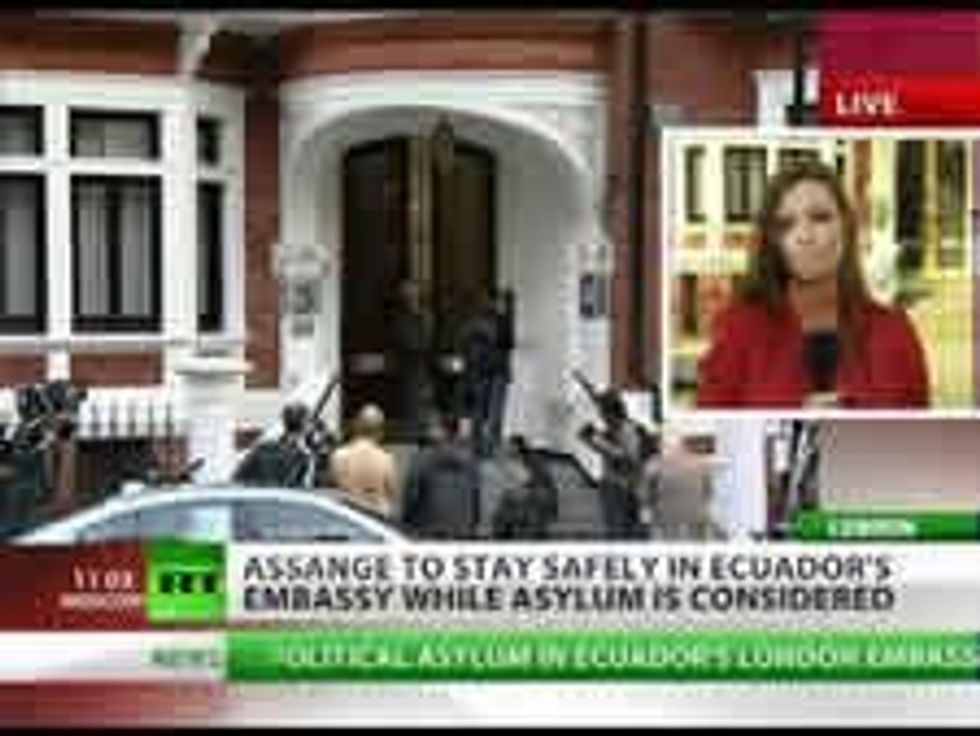
Wikileaks founder Julian Assange has taken refuge in Ecuador's embassy in London, where according to Ecuadorian authorities he is "under the protection of the Ecuadorian state," as he awaits the government's decision on his application for political asylum. If you have been relying on the mass media for information about why he is there or what he is being protected from, you may have no idea what is going on.
Instead, he is only wanted for questioning by a Swedish prosecutor. Now, why can't he simply be questioned in the UK where he is? Try to find the answer to that question in all the "news" reporting on the case. Former Stockholm Chief District prosecutor Sven-Erik Alhem testified that the decision of the Swedish government to extradite Assange is "unreasonable and unprofessional, as well as unfair and disproportionate," because he can be easily questioned in the UK. These simple facts make it clear that the Swedish attempt to extradite Assange has nothing to do with any criminal investigation.
But it gets worse. Once in Sweden, Assange would be put in prison and have limited access to the media. Pre-trial procedures would be conducted in secret. And perhaps most importantly, he could be more easily extradited to the United States, where there are investigations to see if he can be tried under the Espionage Act. This carries a potential death penalty, and powerful U.S. officials such as Diane Feinstein, Democrat and chair of the U.S. Senate Intelligence Committee, have called for his prosecution under that law.
People of conscience in Sweden should oppose their government's policy of collaborating in the persecution of a journalist who is not charged with any crime. This persecution is a threat to freedom of expression and information everywhere.
Wikileaks has helped to disseminate important information about serious crimes committed by the U.S. government, such as the video footage of a 2007 incident in which the U.S. military appears to have deliberately killed civilians from a helicopter. It is for that reason that the U.S. government seeks to punish Assange and others associated with the group.
The role of the international press in these events has been as shameful as that of the Swedish government. The press should be rallying in defense of someone who is facing threats of prison and even death for the "crime" of practicing journalism. Instead they appear more sympathetic to the people who want to imprison and possibly kill Assange.
How fortunate that Ecuador, unlike Sweden, has an independent government that doesn't take directions from the United States.
This is another example of how Latin America's "second independence," led by the left governments that have been elected and re-elected over the past 15 years, has benefited not only the region but the world.
Wikileaks founder Julian Assange has taken refuge in Ecuador's embassy in London, where according to Ecuadorian authorities he is "under the protection of the Ecuadorian state," as he awaits the government's decision on his application for political asylum. If you have been relying on the mass media for information about why he is there or what he is being protected from, you may have no idea what is going on.
Instead, he is only wanted for questioning by a Swedish prosecutor. Now, why can't he simply be questioned in the UK where he is? Try to find the answer to that question in all the "news" reporting on the case. Former Stockholm Chief District prosecutor Sven-Erik Alhem testified that the decision of the Swedish government to extradite Assange is "unreasonable and unprofessional, as well as unfair and disproportionate," because he can be easily questioned in the UK. These simple facts make it clear that the Swedish attempt to extradite Assange has nothing to do with any criminal investigation.
But it gets worse. Once in Sweden, Assange would be put in prison and have limited access to the media. Pre-trial procedures would be conducted in secret. And perhaps most importantly, he could be more easily extradited to the United States, where there are investigations to see if he can be tried under the Espionage Act. This carries a potential death penalty, and powerful U.S. officials such as Diane Feinstein, Democrat and chair of the U.S. Senate Intelligence Committee, have called for his prosecution under that law.
People of conscience in Sweden should oppose their government's policy of collaborating in the persecution of a journalist who is not charged with any crime. This persecution is a threat to freedom of expression and information everywhere.
Wikileaks has helped to disseminate important information about serious crimes committed by the U.S. government, such as the video footage of a 2007 incident in which the U.S. military appears to have deliberately killed civilians from a helicopter. It is for that reason that the U.S. government seeks to punish Assange and others associated with the group.
The role of the international press in these events has been as shameful as that of the Swedish government. The press should be rallying in defense of someone who is facing threats of prison and even death for the "crime" of practicing journalism. Instead they appear more sympathetic to the people who want to imprison and possibly kill Assange.
How fortunate that Ecuador, unlike Sweden, has an independent government that doesn't take directions from the United States.
This is another example of how Latin America's "second independence," led by the left governments that have been elected and re-elected over the past 15 years, has benefited not only the region but the world.
Wikileaks founder Julian Assange has taken refuge in Ecuador's embassy in London, where according to Ecuadorian authorities he is "under the protection of the Ecuadorian state," as he awaits the government's decision on his application for political asylum. If you have been relying on the mass media for information about why he is there or what he is being protected from, you may have no idea what is going on.
Instead, he is only wanted for questioning by a Swedish prosecutor. Now, why can't he simply be questioned in the UK where he is? Try to find the answer to that question in all the "news" reporting on the case. Former Stockholm Chief District prosecutor Sven-Erik Alhem testified that the decision of the Swedish government to extradite Assange is "unreasonable and unprofessional, as well as unfair and disproportionate," because he can be easily questioned in the UK. These simple facts make it clear that the Swedish attempt to extradite Assange has nothing to do with any criminal investigation.
But it gets worse. Once in Sweden, Assange would be put in prison and have limited access to the media. Pre-trial procedures would be conducted in secret. And perhaps most importantly, he could be more easily extradited to the United States, where there are investigations to see if he can be tried under the Espionage Act. This carries a potential death penalty, and powerful U.S. officials such as Diane Feinstein, Democrat and chair of the U.S. Senate Intelligence Committee, have called for his prosecution under that law.
People of conscience in Sweden should oppose their government's policy of collaborating in the persecution of a journalist who is not charged with any crime. This persecution is a threat to freedom of expression and information everywhere.
Wikileaks has helped to disseminate important information about serious crimes committed by the U.S. government, such as the video footage of a 2007 incident in which the U.S. military appears to have deliberately killed civilians from a helicopter. It is for that reason that the U.S. government seeks to punish Assange and others associated with the group.
The role of the international press in these events has been as shameful as that of the Swedish government. The press should be rallying in defense of someone who is facing threats of prison and even death for the "crime" of practicing journalism. Instead they appear more sympathetic to the people who want to imprison and possibly kill Assange.
How fortunate that Ecuador, unlike Sweden, has an independent government that doesn't take directions from the United States.
This is another example of how Latin America's "second independence," led by the left governments that have been elected and re-elected over the past 15 years, has benefited not only the region but the world.